Carving a Handmade Rubber Stamp

This will be the first post of a couple about making stamps and using handmade stamps and objects to print on fabric.  For some reason, once you add the words “on fabric” to any art technique, I am suddenly interested . . . but of course you can also use hand carved stamps on paper, and even clay!  My aunt Barb taught me to make stamps, she uses hers to make beautiful collage-type art, in her handmade books (where I found this design which she let me use in an earlier post), and in her pottery work.  We talked about a feature of her art to go along with this how-to, but it’s a busy season for both of us, so we’ll save that to look forward to later.


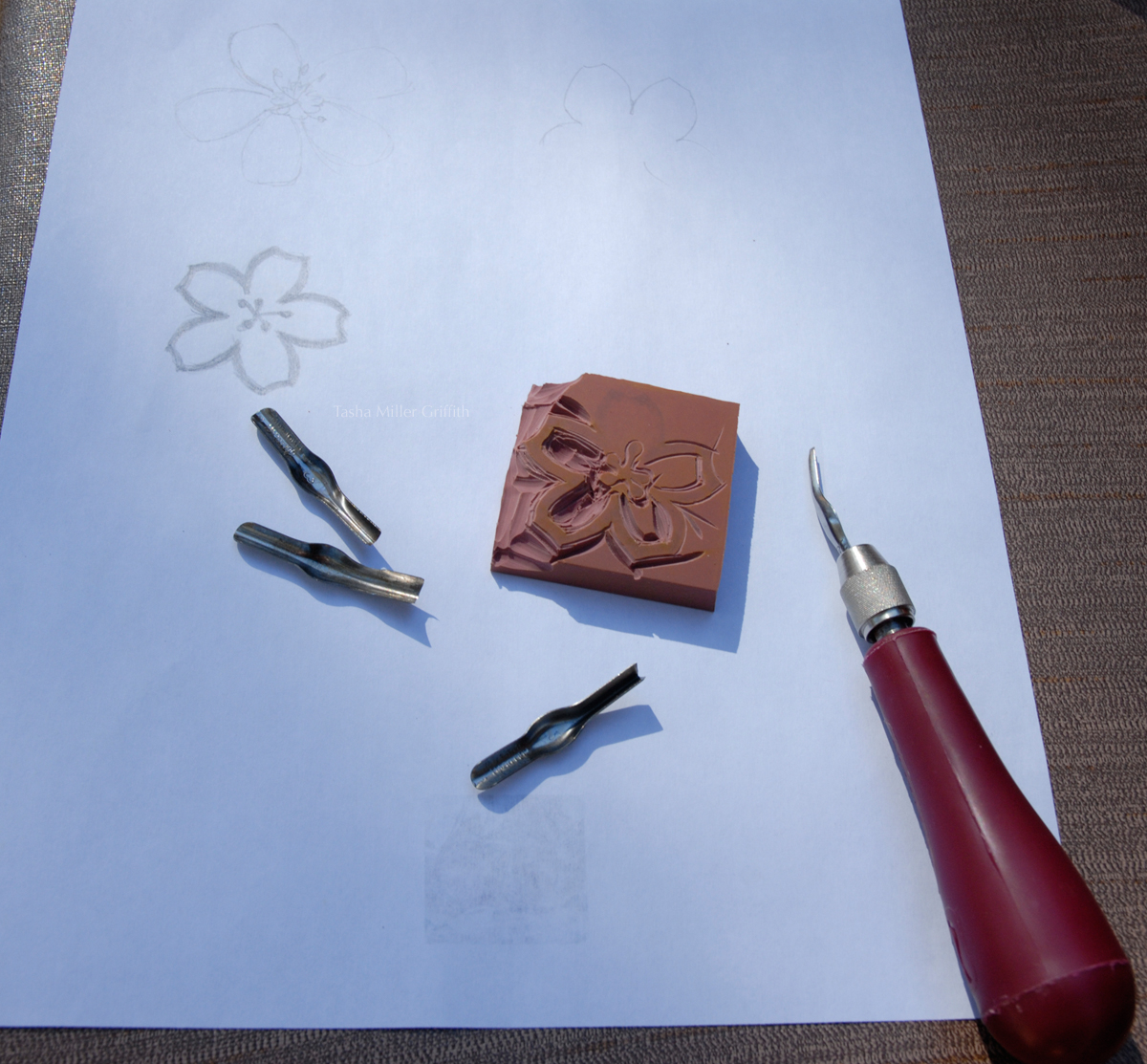
For today, how to carve a stamp!  You will need a tool called a linoleum cutter (seen in the second picture), which you can get at most art stores, and some kind of block to carve.  Lately I’ve used two kinds, pink stuff called “Speedy-Carve” from Speedball, which I got at the chain art and crap store here, and brown “Eco Karve Printing Plate” from Inovart (made of recycled material!), which I ordered from Blick along with the paint.  The pink kind is a little softer, slightly easier to carve, and much easier to see to see your pencil designs on because of the lighter color.  It’s a little thin for bigger stamps, which can get floppy if you don’t attach them to anything.  I liked carving and printing with the brown stuff, and it’s thicker, and easier to see what you have carved out than the pink, but it can be hard to see your transfer design on the darker surface.  When I started making stamps we used a whitish carving block, which as far as I can tell from the scraps was also made by Speedball.  It’s not my favorite, little bits of it can crumble away while you’re carving, where you’d rather they didn’t (you can kind of see this in the inside corners of the star stamp).  In any case, you can probably find a material near you to try it out.

Now that you have your materials, you need a design.  I have been into five-petaled flower designs lately, and I liked the artwork on the posters for the cherry blossom festival we saw in DC earlier this year, so I decided on a cherry blossom stamp.  You can draw on the rubber carving stuff, but I find it easier to draw on paper and transfer the design.  It’s easier to erase your mistakes or start over, and the design when you stamp it will be the same as you drew it, instead of a mirror image (because it’s flipped once when you transfer it and again when you stamp).

It helps to use a soft pencil and make thick lines.  You can get a fair amount of detail in your stamps, but don’t go crazy with fine lines for the first one you make!  Once you have a design you like, flip the paper over onto the carving block, hold it still, and rub it with something hard and flattish, like a spoon or a bone folder, to transfer the design onto the rubber.  You’ll get more out of your carving blocks if you place the design on a corner instead of right in the middle.


Time to carve it out!  I think it’s easier to cut out the section of rubber around your design with a razor knife before you carve it.

The idea is to cut out everything that you don’t want to print, from around the design that you do.

Loosen the head of the linoleum cutter and put the smallest carving tip (sharp side goes out – watch out, it’s sharp!) in the curved slot that opens on one side of the ball as you loosen.  The previous sentence probably makes zero sense unless you are looking at the tool, but that’s Ok.  Start carving; each one of the tips for this tool acts like a sharp scoop, use them point or scoop down to carve out pieces of rubber that you don’t want.  I like to start with the smallest tip and go carefully around the edges of the design, it helps keep me from accidentally slicing through it with the bigger cutters.

Cut away from inside corners to both sides.  It’s helpful to turn the block, as well as the tool, while carving around curves.

Once you get the design outlined, switch to the larger V shape tip, and use it to cut around your outlines, making a deeper channel.  Then, use the scoop to carve out large sections that you don’t need.  Cut away from your design at a steep slope on the edges of your stamp, to keep them from printing.  Then go back with the smallest V tip and clean up any leftovers.  You can see this process progressing clockwise around my flower stamp above.

Try out your stamp with an ink pad and paper, you’ll get to see how it’s coming out, and any areas you don’t like will be helpfully colored with ink, so you can see where to carve them off.  Some little bits of messiness are part of the charm of a handmade stamp, but you can decide how much of that you want.
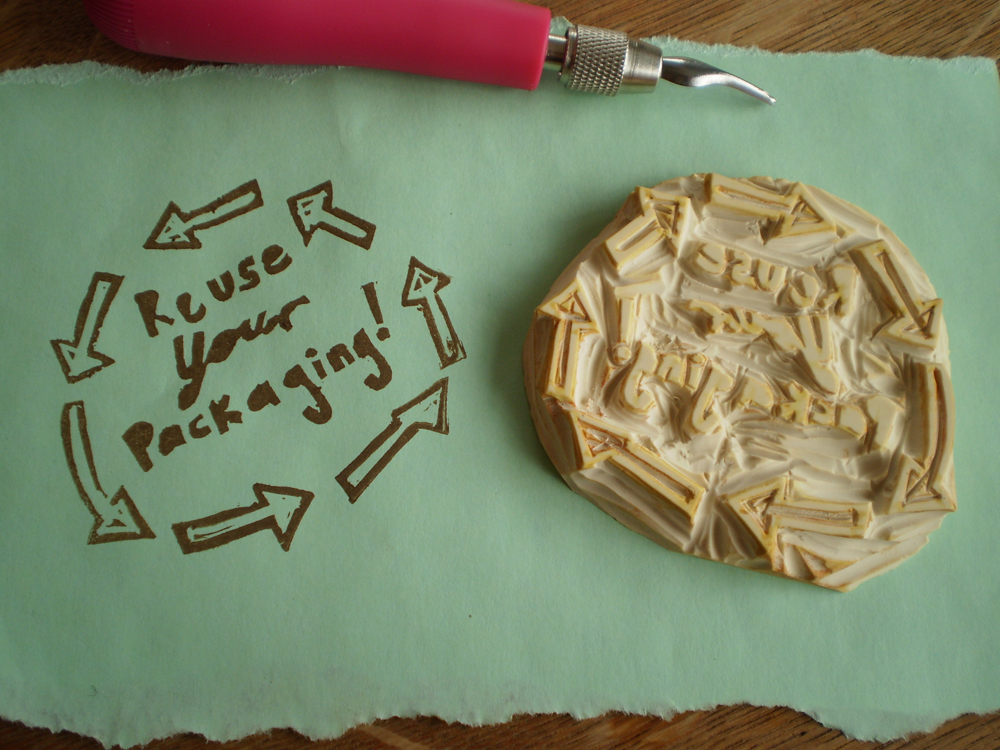
 

You can carve just about anything into a stamp!  I made the one above while hanging out with a friend, to stamp on the re-used boxes and envelopes that I send orders in (it also appeared on KP’s blog as part of her recycle package challenge).


If you’d like to jump- start your handmade stamp collection, talktothesun on Etsy sells some great-looking ones (not my shop, I just like it)!

Have a question?  A stamp carving tip? A material you like?  Leave it in the comments, I’d love to hear what you think!


Next time: use your stamps (and other stuff) to print on fabric.


Storing Herbs in the Fridge


Ok, one more thing related to our super haul from the last farmers’ market last week.  It’s also related to a big bag of assorted herbs that some visiting relatives left at our house this summer.  They were from the garden, and I made it my “herb challenge” to use every one, and in some cases to figure out what they were.  After having fresh oregano in pasta sauce, rosemary potatoes, lemongrass syrup for soda, and tarragon butter – the finale – I decided this was way too much fun to stop just because we got to the bottom of the bag, and I’ve been buying more fresh herbs ever since.  They just add such a punch of round, fresh flavor.

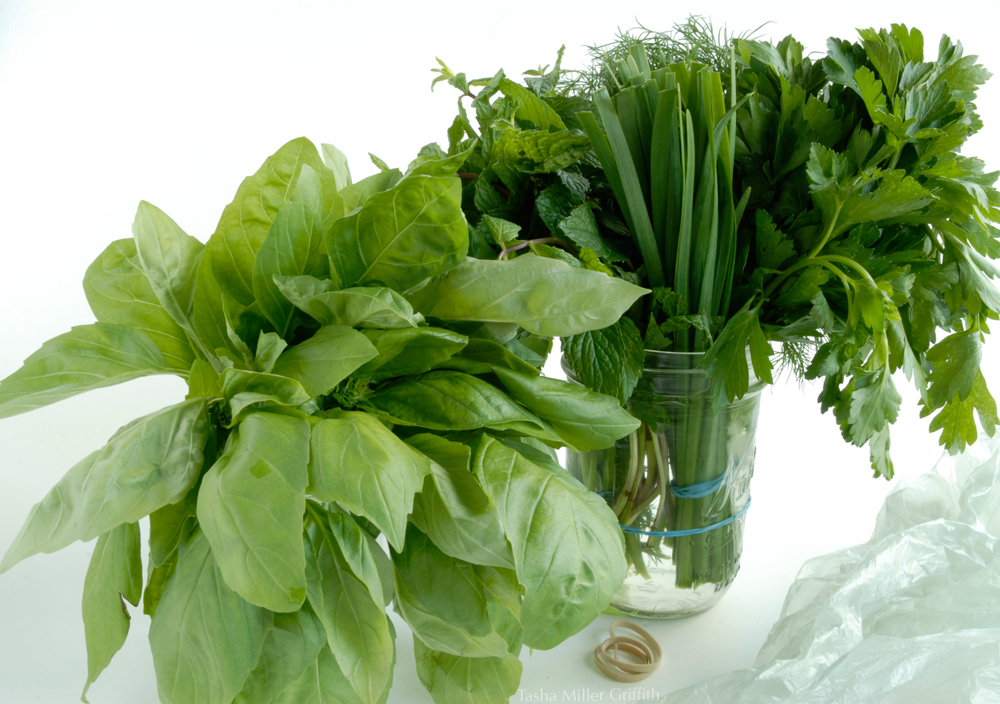
This tip for storing them is something we figured out last fall while visiting friends in Bend, OR.  You know how basil wilts in the fridge pretty much immediately?  Well, the farmer at one stall told us to try putting the stems in a jar with water in the refrigerator, which we did – and it wilted immediately, maybe even faster than in a bag.  I was telling this story to another farmer the next week and he said, “But, did you put a plastic bag over the top?”

Aha!  This works amazingly well, like some kind of magical super-cold greenhouse.  Put the bag loosely over the herbs, and then use a rubber band to keep it tight to the base of the jar.  For basil, I also trim the stems just a bit like I would cut flowers.  The basil in this picture is already a few days old, it will stay fresh for about a solid week.  The other herbs have so far all been eaten before they show signs of wilting.

Hope this inspires you to add some fresh herbs to your fridge!

Update: If your basil stems aren’t long enough for a jar of water, I’ve had good success keeping them sealed tight in a plastic bag in the fridge, with just a little moisture inside.  If it seems dry in the bag, I sprinkle in a little water and distribute it by gently mixing the leaves around, then seal the bag again.  This works in a cooler too, as long as the leaves don’t touch the ice.

A Good Way to Open a Pomegranate


Sunday was the last farmers’ market of the year here.  Bryan and I went together, and pretty much went nuts (pun intended?) on all the fruit and veggies we could buy.  “Hon,” I said, “That’s a lot of tomatoes.”

“Well,” he said, “I don’t think we’ll have a problem eating extra tomatoes!”  You know the produce is beautiful when it’s not just me taking pictures of it, the professional photographer in my house is getting into the act as well, and buying extra tomatoes for the purpose.

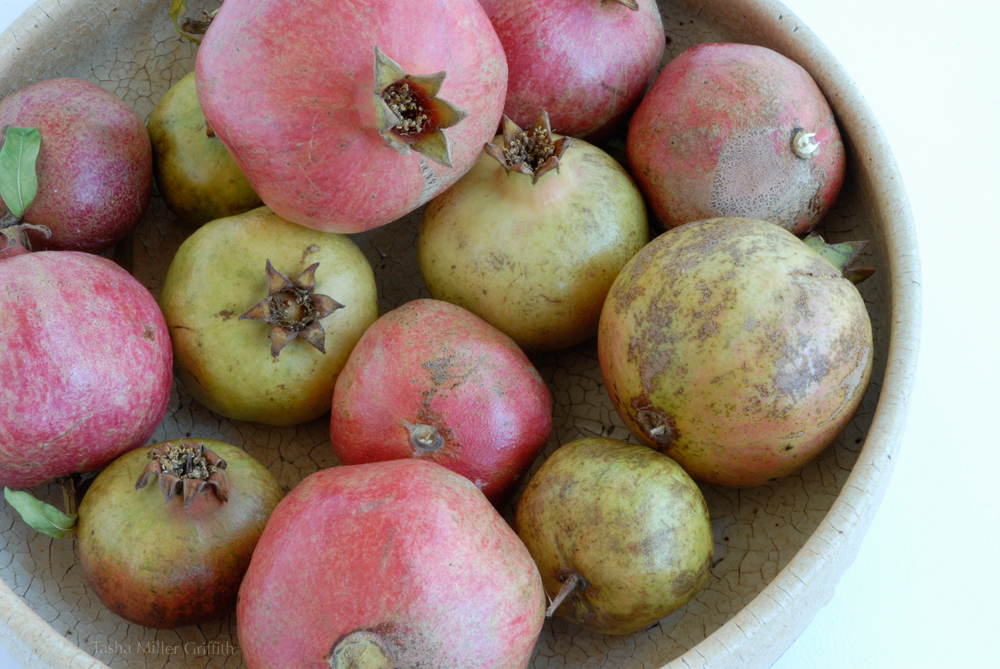
Anyway, our fridge and pantry are pretty much stuffed, and we have a whole tray of pomegranates.  I love pomegranates.  I like the whole idea of them, like hidden treasure.  And, of course the taste!  Luckily, they grow in the valley not too far from here.

Especially with this method, the lovely seeds are not too hard to get at.  The idea of soaking them in water came from The Joy of Cooking, source of much good kitchen knowledge.


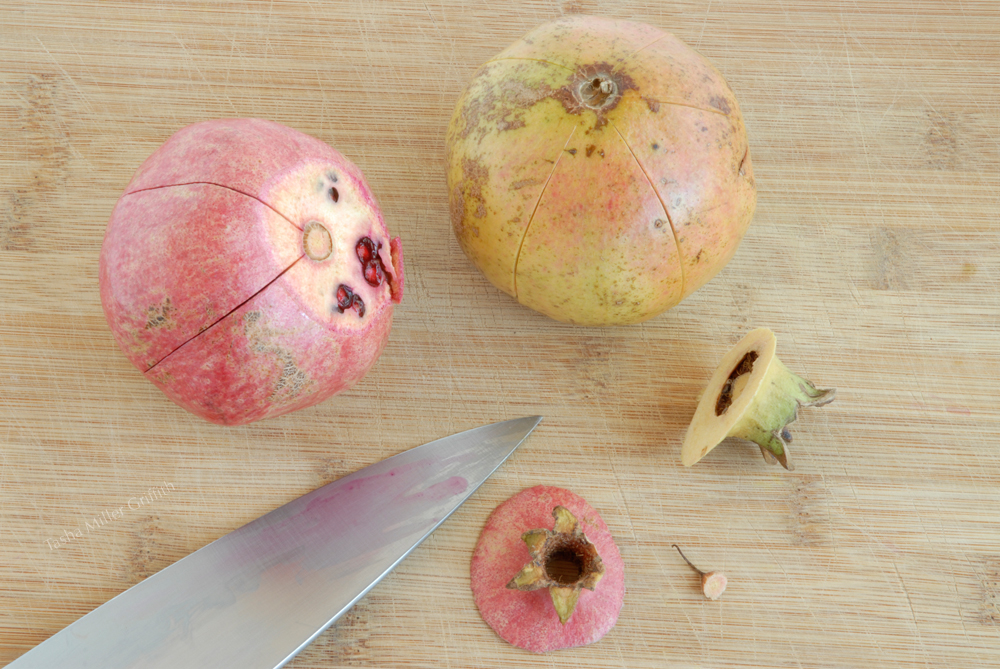
Step 1: slice off just the tops.  If you hit a few seeds don’t worry.  Score around the sides to the bottom in sections.  You’ll cut fewer seeds if you use the naturally more indented places as a guide for where to score.  Go all the way through the peel.


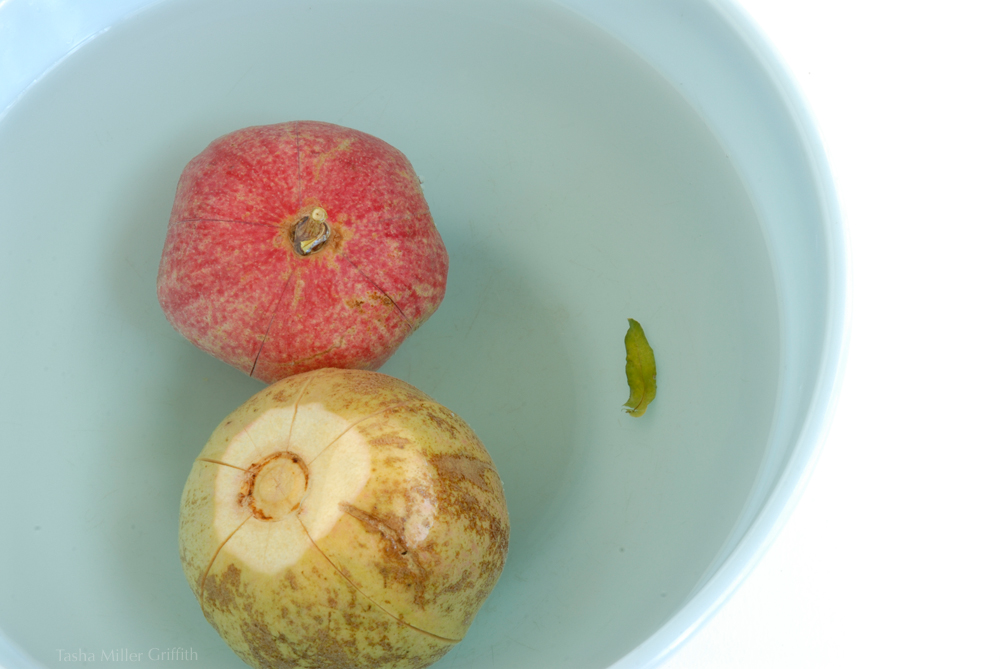
Step 2: drop the scored pomegranates into a bowl of water.  Leave them alone for about 15 minutes, or longer if they have been sitting around for a while and the skins are dried out.


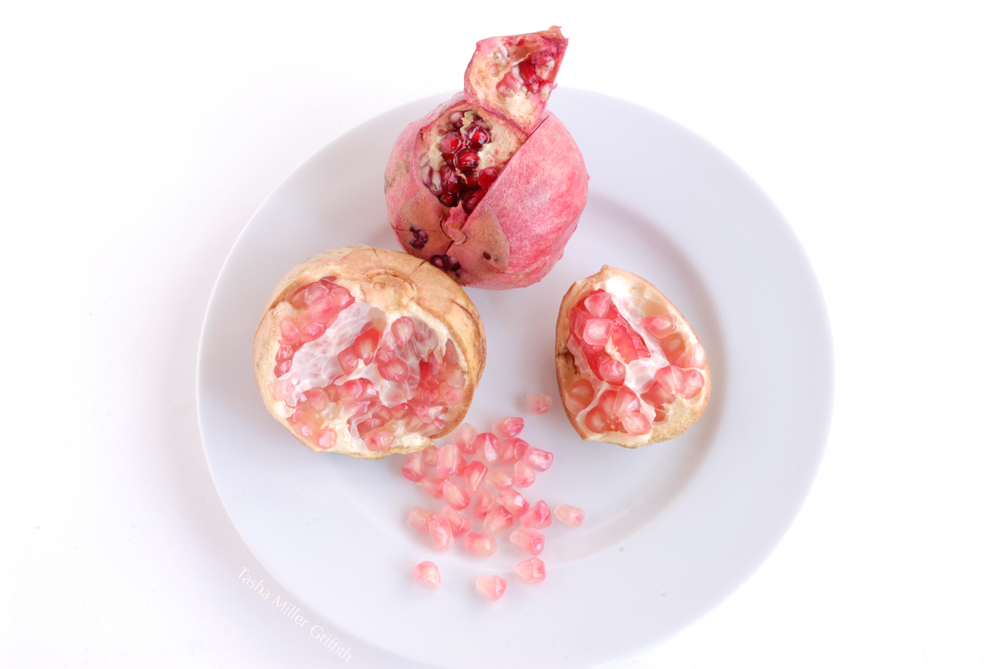
Step 3: pull one out of the water, and gently break it open.  When you come back, the skins should have softened, and the whole thing will feel more elastic when you attempt to pull it open.  It may help to use a knife or your fingernail to break the connection at the top center.  Then, just tug on a section until it breaks loose.  Pomegranates respond better to a steady pull than to a hard yank.


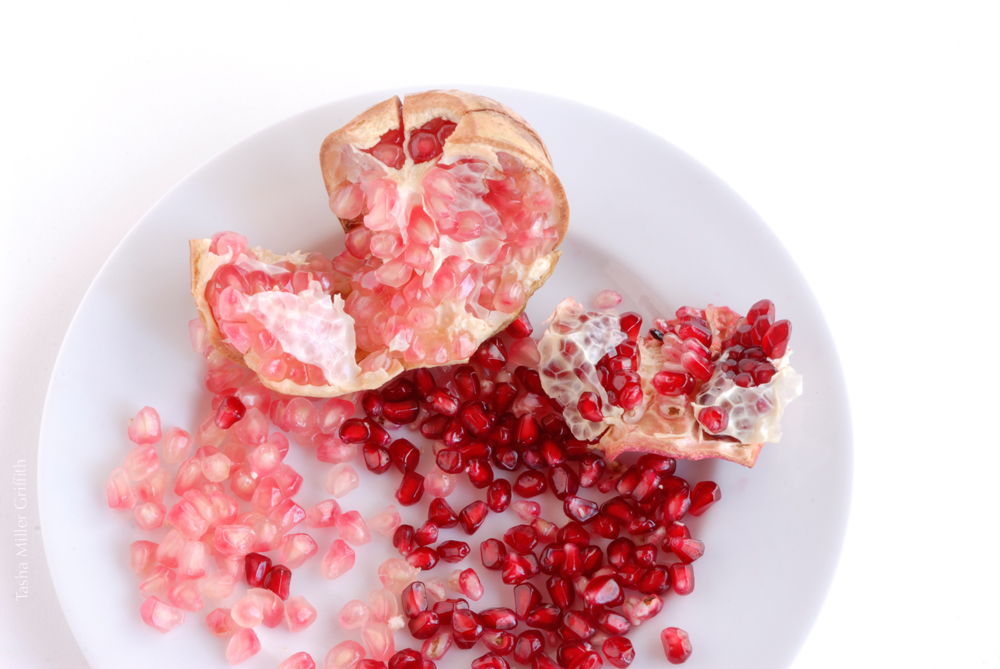
Once the fruit cracks open, whole flanks of seeds are exposed.  Rock and push them gently with your thumb, sections of seeds will loosen and break off at once.  Any that are shriveled or cloudy are not as good, just leave them on the peel.


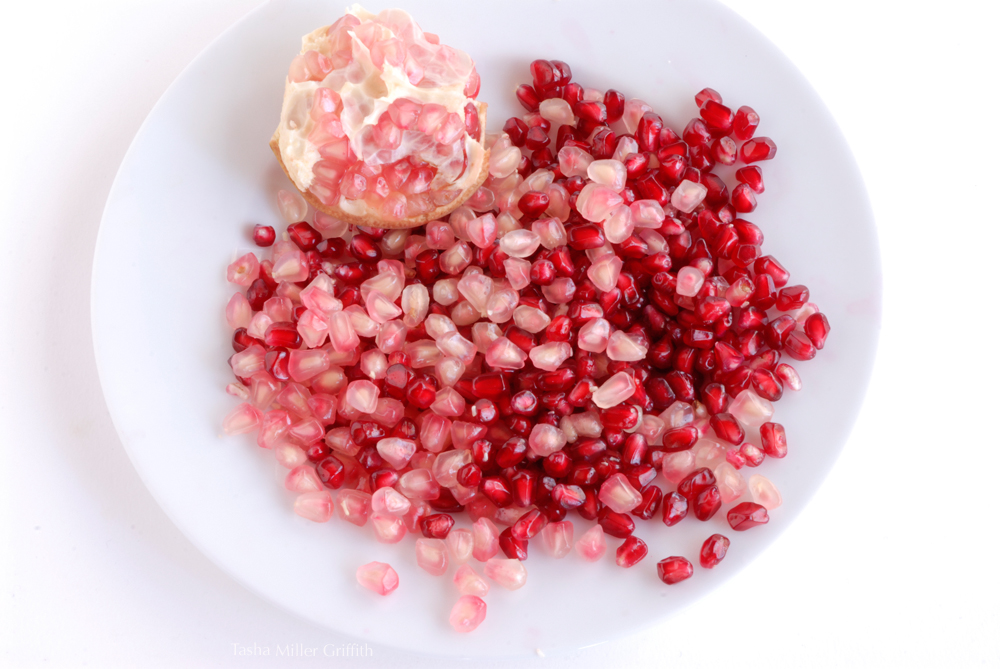
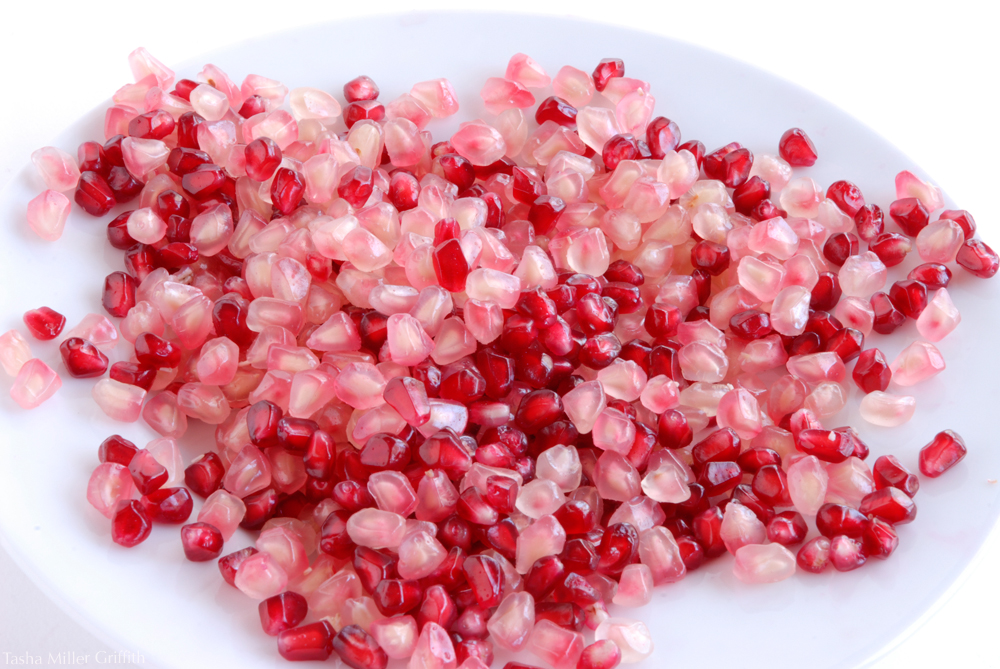
The red seeds (from the pinkish fruit) are the classic pomegranate tart with a little sweetness.  The pink seeds (from the yellow fruit) are much milder and sweeter if you can find them.  For eating out of hand, I think a mix of about half and half is ideal.

They also make a lovely treat with desserts, or on my morning fruit and yogurt.  If you need another excuse to get one, try this salad, really unusual flavors, but we and our friends quickly grew to love it.  Equally good with butter lettuce, and either honey mustard as suggested, or good quality balsamic and olive oil.  And, we subbed a small kabocha squash the first time we made it, with good results.

Really, have you ever seen anything so lovely as a plate of pomegranate seeds?  I could have easily spent the whole day photographing fruit . . .


It’s the Colors . . .


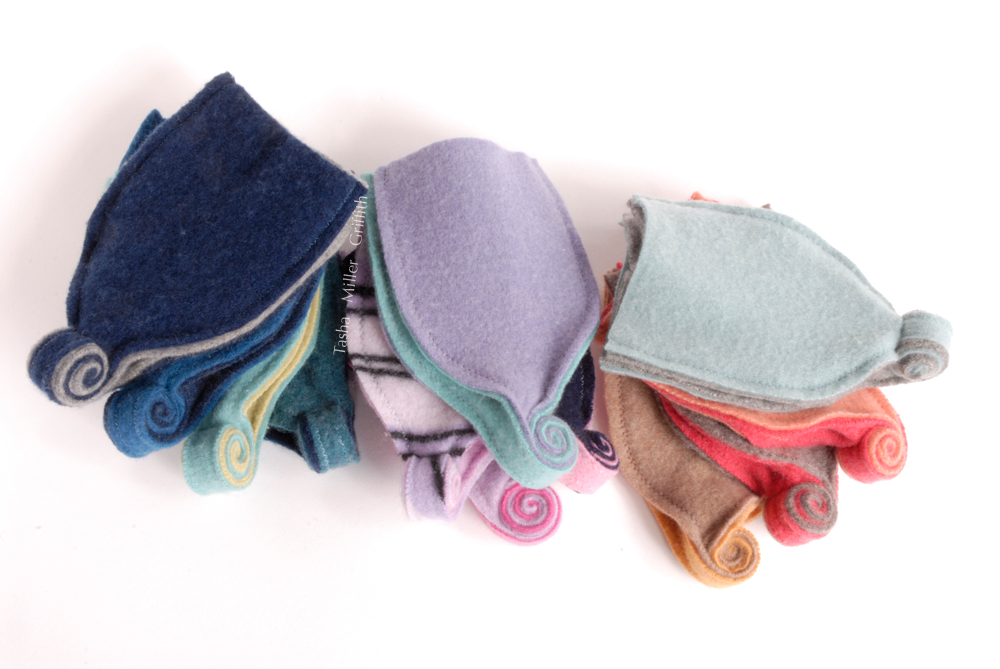
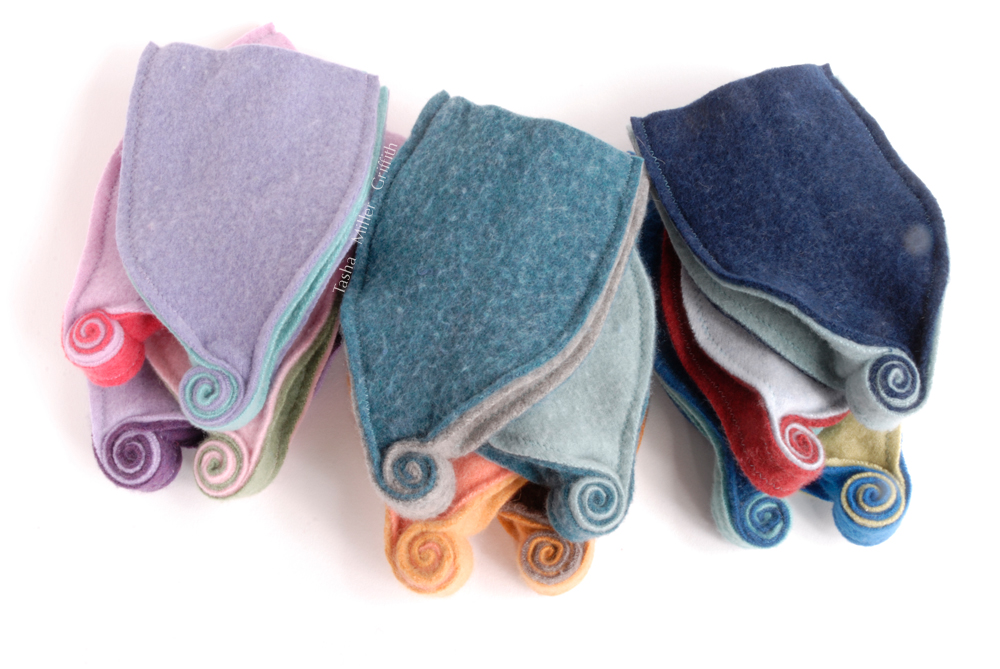
Right now it’s the time of year for big orders from the shops that sell my little fuzzy hats.  After 400 or so of these suckers all told so far, you’d think I would be sick of them.  I still like this design (if I only I could come up with a few more that were as cute and efficient!) but mostly, what keeps me coming back is:


I love picking colors that don’t just go together, they make each other sing.  These remind me of a dusky southwest sunset.  This is what I do when I’m making the hats, I stare at the colors.  Luckily, using recycled materials means there are new colors every time, new ones to find and play with.


As a kid, I would spend hours looking through my mom’s embroidery floss, not really wanting to make anything, just enjoying the colors, they each seemed so vivid and lovely, they lived grouped together in their families in neatly numbered plastic bags.  I remember wishing there was fabric, or something I wanted to use, in all those colors, but not knowing what I would do with it if there was.  I’m still figuring that out . . .


Half My Wardrobe in Detroit, and What I Did About It

Not as much as I would have liked.  But, contrary to the impression you may have gotten from this space, I did squeeze in a little sewing for myself the last time we were home.  When we leave the truck somewhere in art show land (otherwise known as the Midwest) and fly back home to get some r&r (or maybe embark on some crazy giant new project) I leave a bunch of my summer wardrobe out there.  This last time, I kind of did it to myself on purpose, packing even fewer of my summer tops than I reasonably could have fit in my luggage, hoping that it would motivate me to sew some new ones.

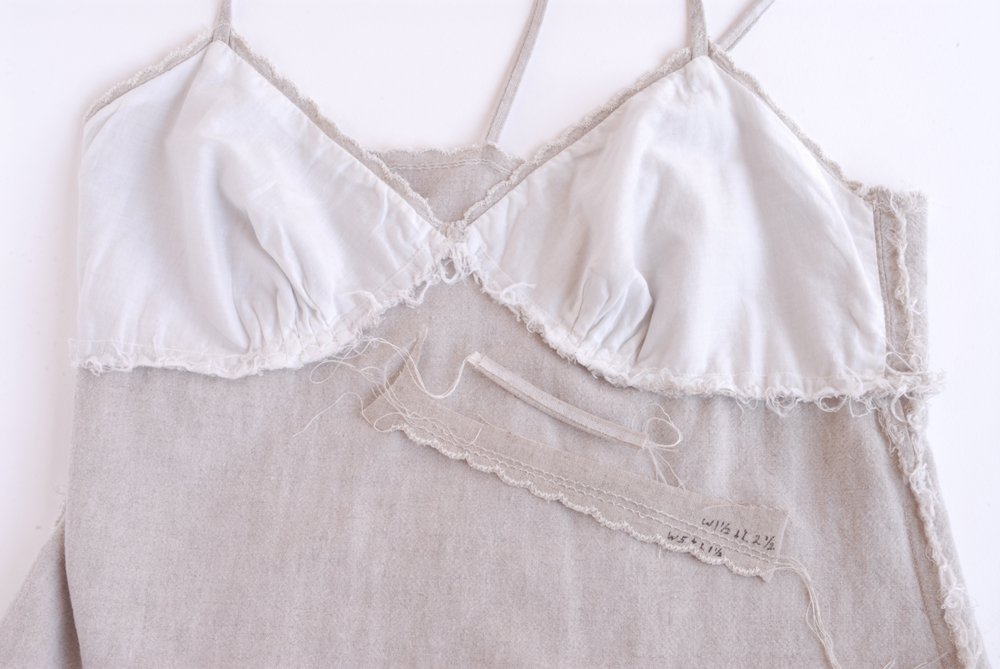
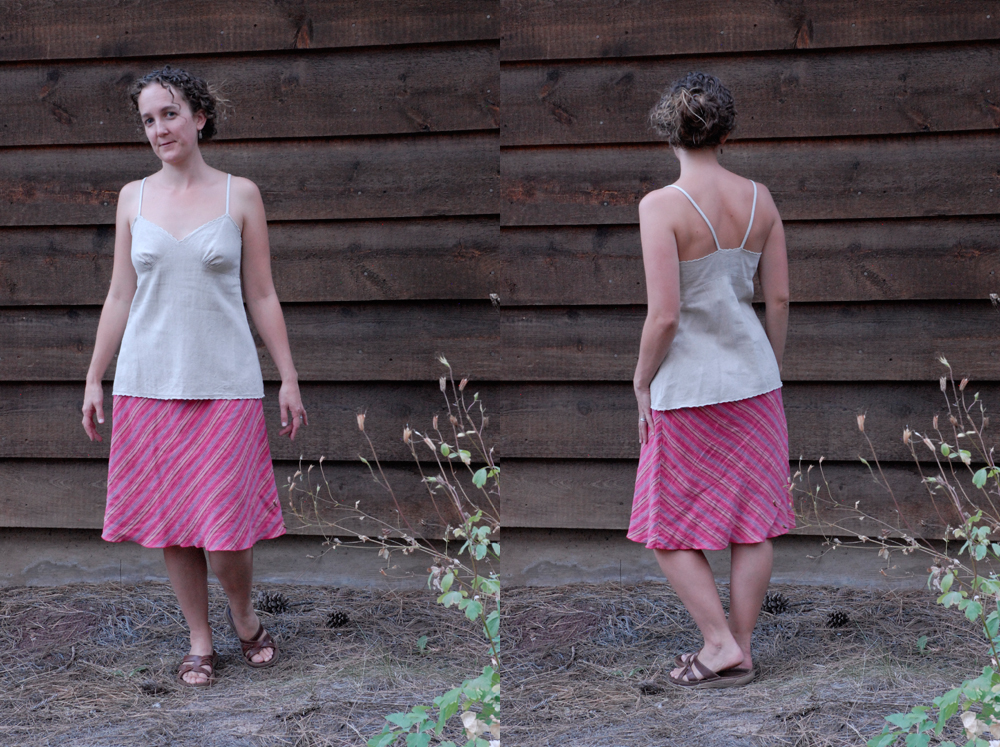
First, I finished a top I had been working on during the visit home before this one.  I wear a lot of tank tops in the summer, and I have been thinking about how to make some woven ones as well as the usual knits.  This one is a copy of a silk top, the cups of which I found flattering and comfortable.  During Me Made May, I fell in love with linen all over again, specifically this one mm green linen skirt, which is getting to the super soft and drapey stage of life.  I had this natural linen leftover from a long-ago project and thought I would try it out.


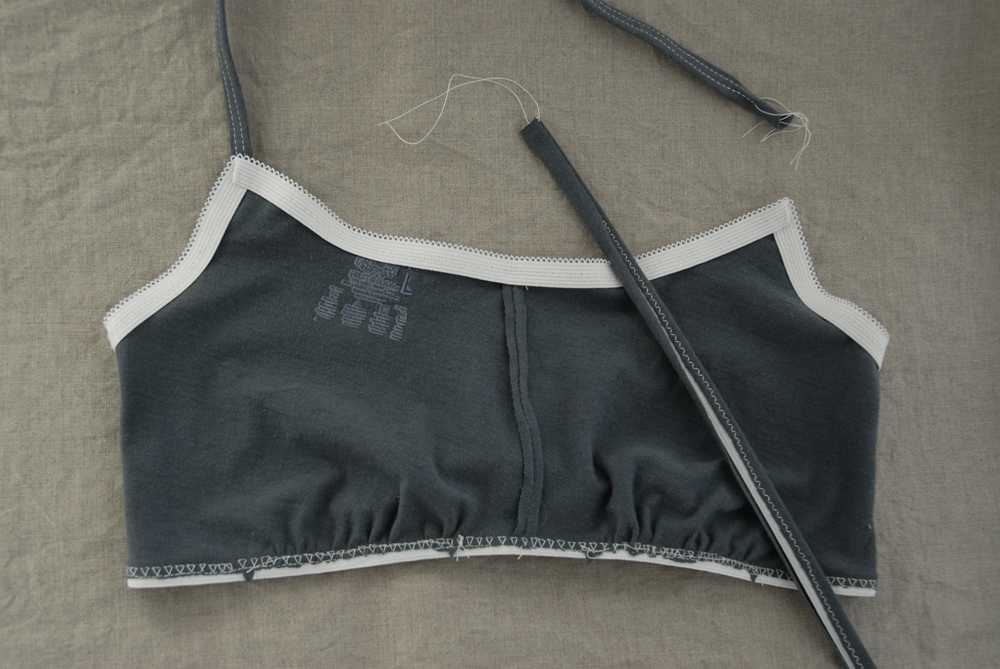
I lined only the cups, with thin soft cotton, catching them in the midriff seam and folding under and hand sewing the other sides, I like how it came out.  The original top has a scalloped satin stitch on the edges, and I decided to try something similar.  I also had some thick linen thread which I loved with the fabric, but no amount of coaxing and bigger needles would convince my machine this was a reasonable thing to work with, so I ended up using a narrow zigzag to hold in on the surface.  Both of the edge treatments are softer and more subtle after a few washings.  I made the straps using a thin piece of fabric from the selvage edge, wrapping it around a thin ribbon.


I wanted to make sure it came out long enough, and I may have overdone it, but the tunic length is working alright so far.  Funny how I don’t notice things in the original (like the back riding up) until I copy it.  Sigh.  I’ll also check out the front wrinkles before I make another one.

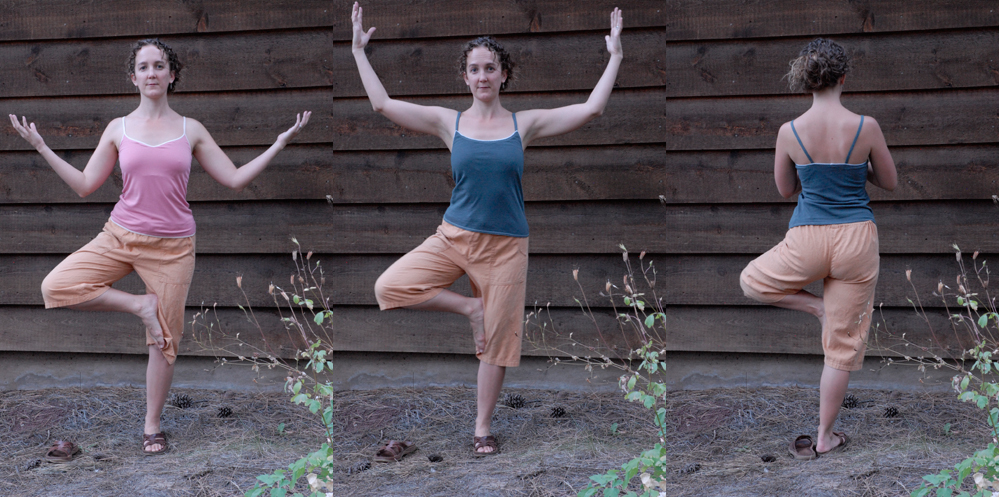
Next, I pulled out some pink knit leftover from another top to make a tank for yoga, of which I desperately needed more.  I had some narrow fold over elastic in my stash which should have been perfect, but for some reason every step of this project fought me tooth and nail and used up WAY more of my precious sewing time than was reasonable for something so simple and small!  I ripped a lot of seams.  I tried adding a self-fabric section for the hem which absolutely refused to look decent with any type of stitching.  Plus, when I tried the top on it seemed too tight and clingy, and I already have one round of tops made from this pattern (a heavily modified Kwik Sew 3524) which are NOT too tight and clingy!  Finally I realized that if I ripped the stitching from the little bit of elastic I had used as a test, I would have just enough to put around the bottom as well.  Which I did, and without even trying it on again, put it in my closet and wore it to yoga the next day (keep reading for a picture).  The top stitching on the elastic is beyond wonky.  But I needed it, I made it, and I was wearing it, and some days that just has to be enough.

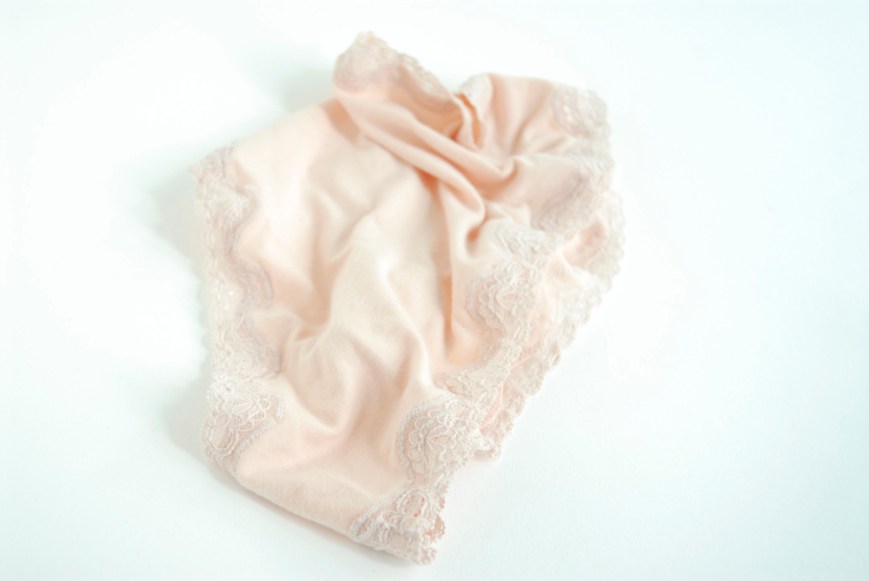
After that, I made a pair of dainties, partly because I didn’t have much time left and they were cut out already, and partly to prove that my beloved Bernina and I do actually have a good relationship with knits.  Which in fact we do.


On our “real” return home for the fall a couple of weeks ago, I decided to make one more tank top before moving on to fall/winter sewing. I had a tee shirt with a hole in it that I had been meaning to convert into a wearable top for ages.  Unfortunately, it was cut so far off the grain of the knit that I couldn’t just use the the original hem, as Zoe suggests, and I had to cut the back and front shelf liner in two pieces each to get them to fit.  But I did use white top stitching, which I liked on the original shirt.


I liked this picot edge elastic, but it was not exactly soft, so I sandwiched it between the layers, sewing it to the liner first with a zigzag, and then the top layer with a twin needle.  For the straps I used a similar idea to the ribbon wrapping, but using plain elastic, zigzag, and the twin needle again.  This time everything went smoother, and start to finish, including experiments, took less than three hours.  That’s more like it!


See me being all zen about the pink top.  See how much clingier AND drapier it is than the blue one?  Crazy fabric difference.  I checked and the previous versions have stretched out with wear as well.  I might make the next one just slightly wider to start with.

Next up for my sewing, pants!  What are you making for the coming season? How do you figure out what fabric will do before you sew it?  I’m, um, still figuring that part out apparently. . .


Chile Freezing Time


This topic is a bit specific to my home place, the Southwestern USA,  at least I think it is – let me know if you live elsewhere and you can get fresh roasted chiles!  Around here, roasters set up outside at the farmers’ market or in a parking lot this time of year, and fill the air with the most incredible smell, a smoky autumn aroma that draws me like a magnet and reminds me of all the best things about crisp fall days and warm New Mexico comfort food.

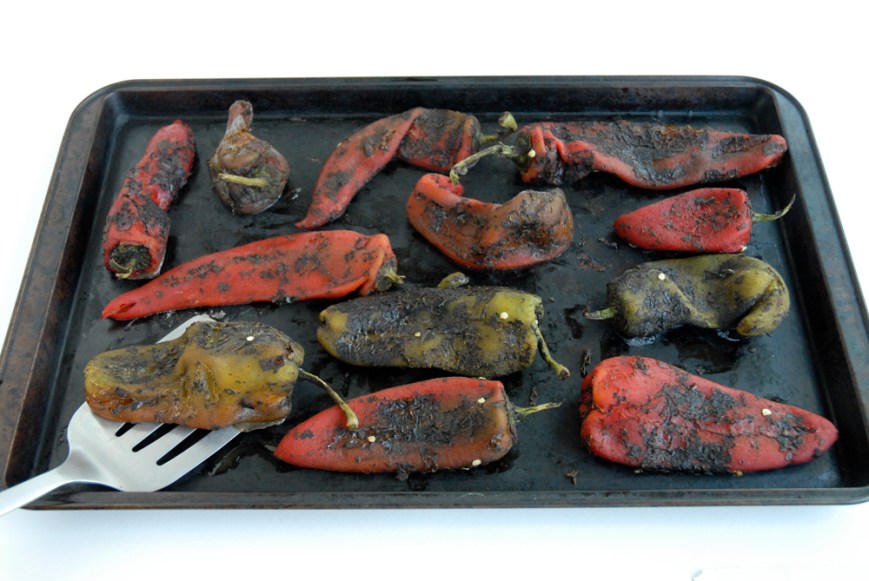
This is what’s called “green” chile, fresh rather than dried, and usually green colored too, although as you can see I like to wait until they start turning red and ripe to buy mine.  My absolute, all-time favorite are these “sugar” chiles from Whipstone Farm.  Sweet and hot at the same time, they have just the most amazing flavor, especially the red ones.

Whatever kind you can find, I like to freeze them whole, spaced out on a cookie sheet or broiler pan.  When they’re solid, I get them out and pop them off with a spatula (it helps to wait just a minute out of the freezer), and put them in plastic bags.  Back into the freezer they go, to last me all year.  I got this idea from freezing blueberries on a sheet, so that you can get out just as many as you need.  I love pulling out a chile or three, and this way once they thaw, they are still intact enough for stuffing with cheese or other goodies.  And, I don’t have to worry about pulling out all the tops and seeds before freezing, I just process them as I thaw and use them.

This is the first and probably easiest, possibly most rewarding, food stocking up/saving/preserving I have done so far!  I highly recommend it.