Should We Call It Farmwashing?

So, here we are on the road for our last group of summer art shows. I went straight from gathering my weeks’ groceries at the farmers’ market, eating tiny strawberries from our yard (approximately 4 per week!) and canning buckets of jam from blackberries we picked in the creek, 20 minutes away, to this:

20120830-105930.jpg

It was late night in Toledo and there weren’t a lot of options.
This restaurant was overflowing with fake photoshopped signs of “their farm” while serving the same processed food as ever. Grrr. Why can’t they either actually change something, or embrace the kitschy fake food the way it is?

Oh well. As I type this, I’m sitting in the truck outside a fleabag hotel in Lancaster PA. And right across the street is a big corn field. As I watched, a man in a traditional outfit appeared, hacking off the corn at the fringes of the field with a machete. I could see the stalks nearby moving, and then a big chestnut horse popped out at the edge of the field, followed by another man and pulling some kind of harvester.

20120830-114331.jpg

You can’t really see it, but in the middle of the field two horses are pulling a cart loaded with corn. I’m using my phone and the WordPress app today, so apologies if anything looks really strange.

One of my least favorite things about this country of ours is how as a whole, we have embraced and promoted mass produced everything. But one of my favorite things is how there is room here for a whole spectrum of choices, from Bob Evans right through my blogging and canning to the PA Dutch farmers.

Chopping Vegetables, or “Get a Big Knife”


Ok, blog people, let’s talk about something important: chopping vegetables.  Nope, I’m not kidding, in fact I think that being able to do this efficiently can make a real difference in how much work it is to cut up veggies, and therefore how many we cut up and eat.  I have not been to cooking school, so I learned most of my “knife skills” just by experience, and reading cookbooks.  But there are a few simple principles I use now that really make quite a bit of difference.

First of all, get a big sharp knife.  This does not have to break the bank.  When we were renting in Madison, we went to the thrift store, got the most solid-looking/feeling knife (from a rather large and alarming bin of them) went home and sharpened it, and it worked great.  If you use a tiny knife, you will have to cut each piece of each vegetable separately, and that will take forever, and you will be grumpy and think that vegetables are too much work.

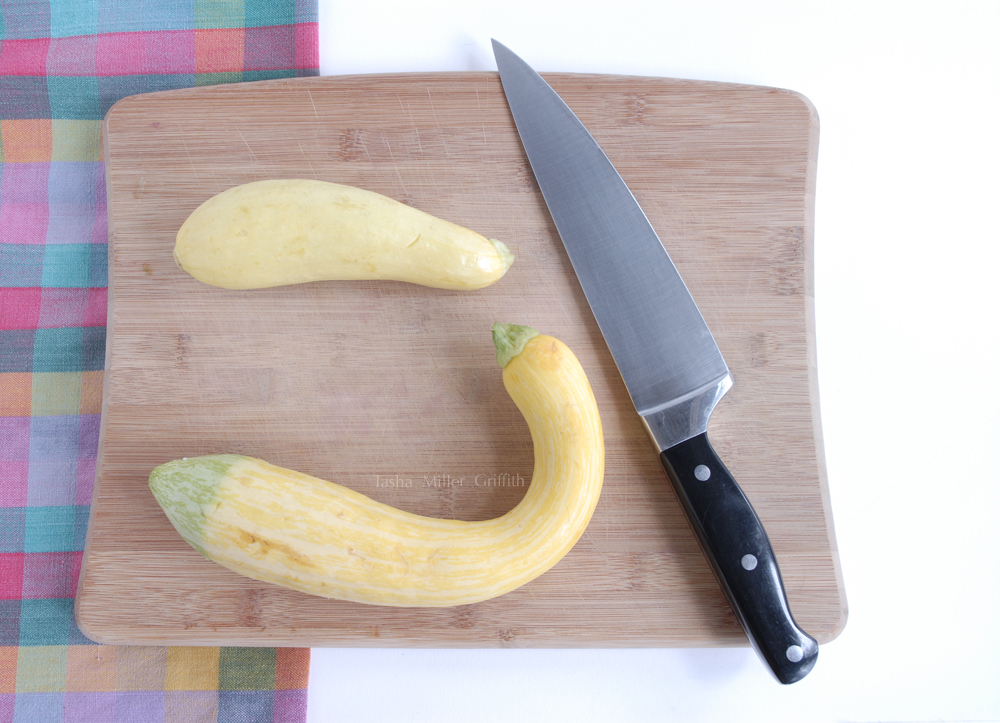
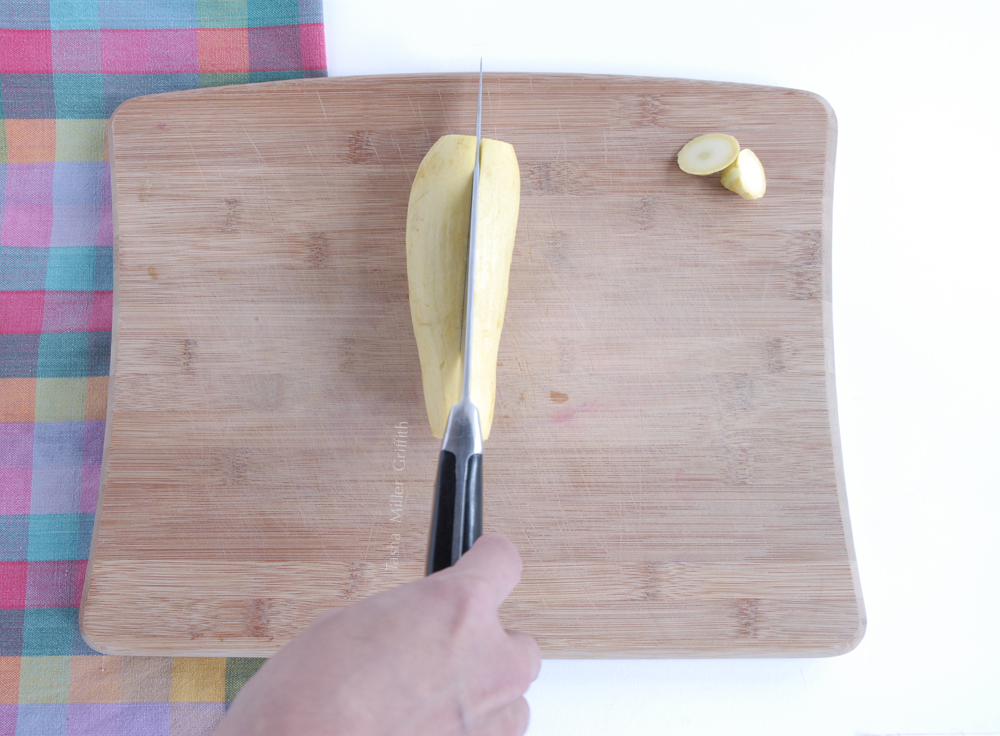
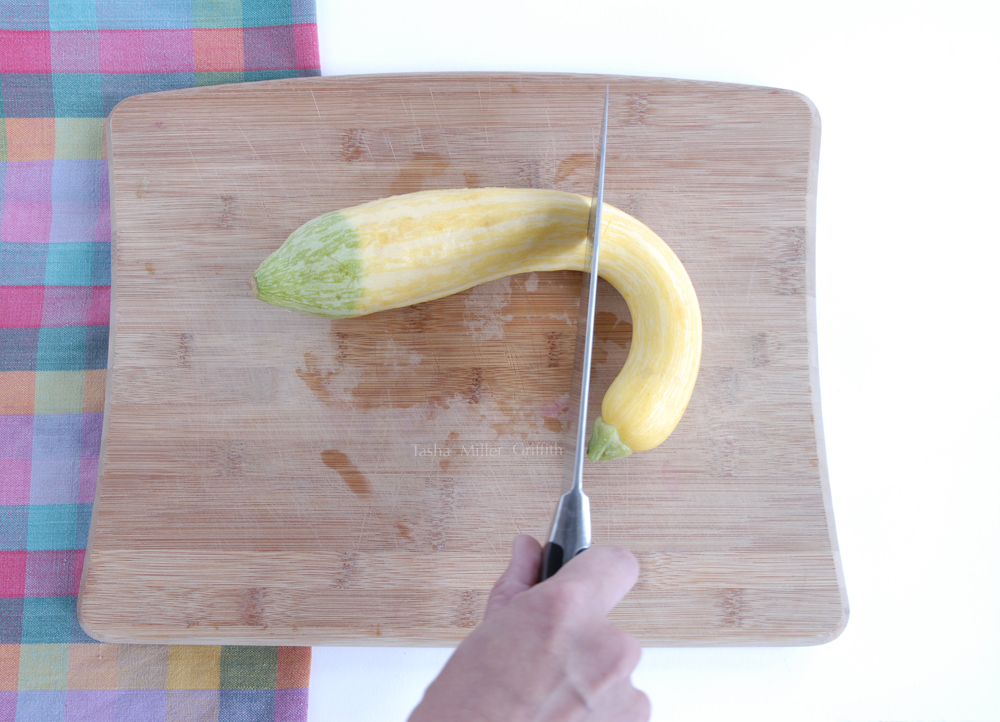
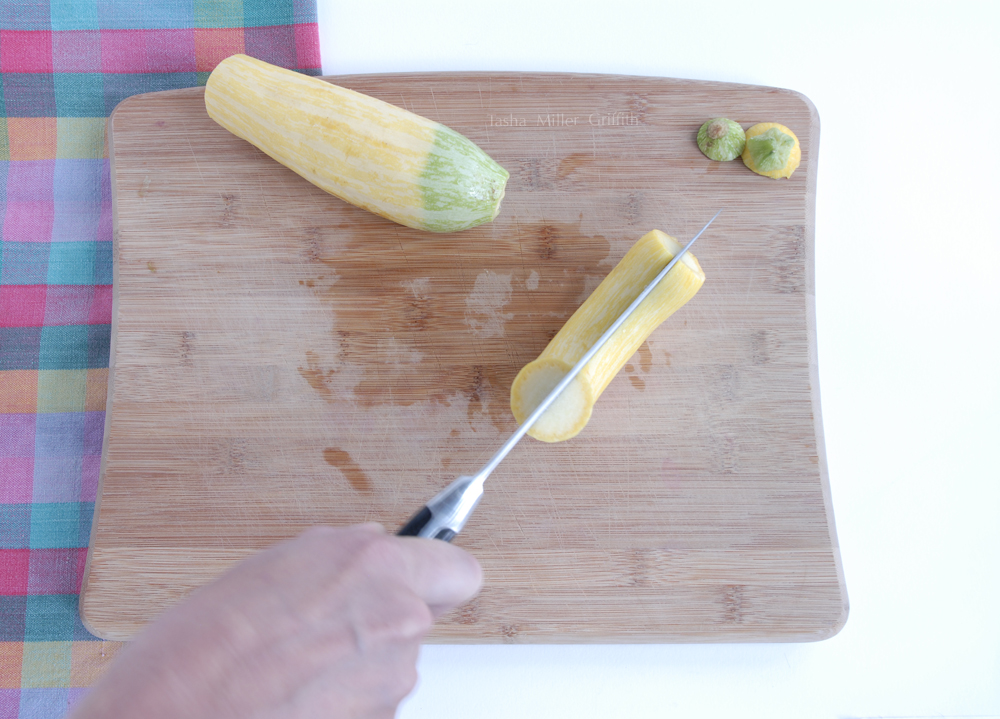
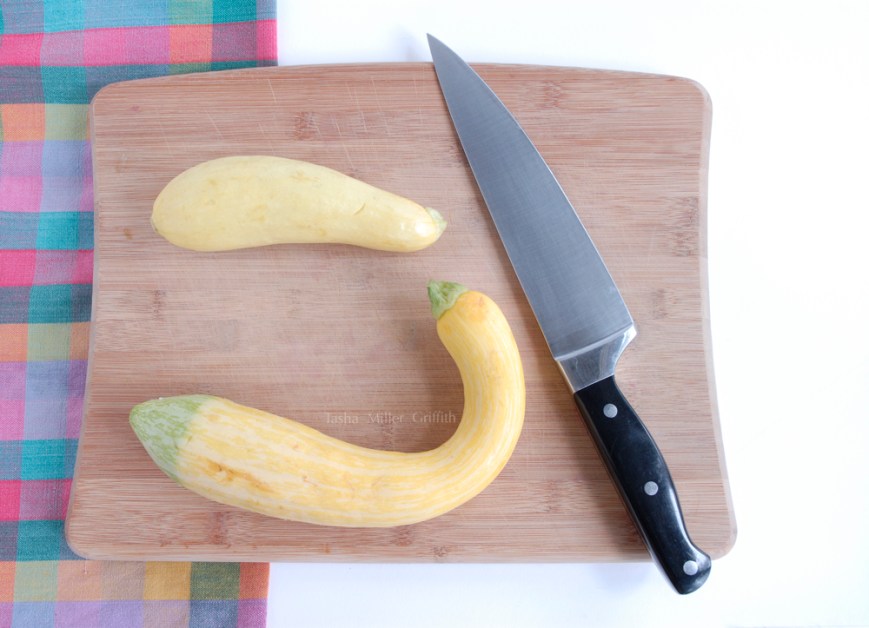
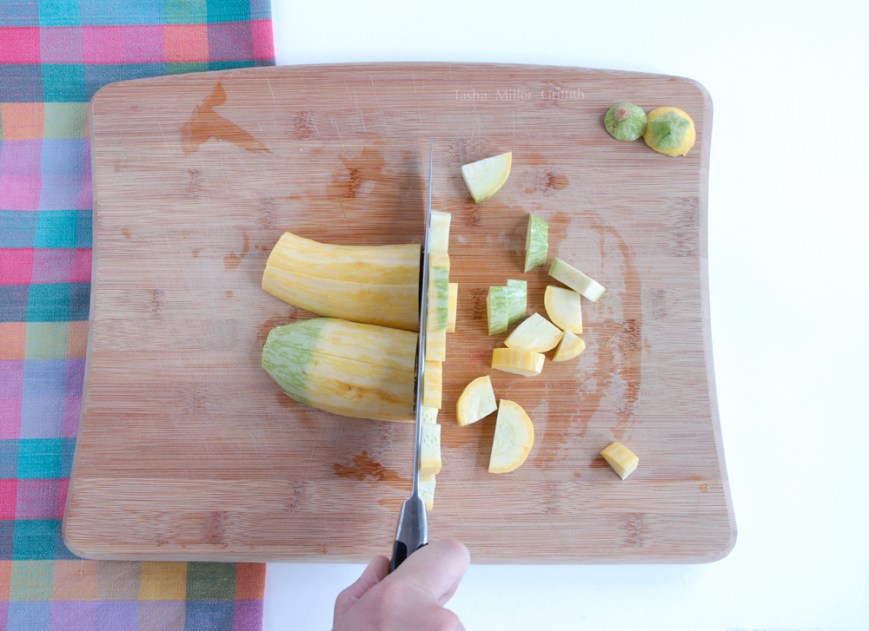
Ok, second thing, and this really the key as far as I’m concerned, chop the vegetable into sections, which you can chop together into pieces the size that you want to end up with.  I’ll demonstrate on this squash: cut the ends off (any part you don’t want), and then cut it in half.
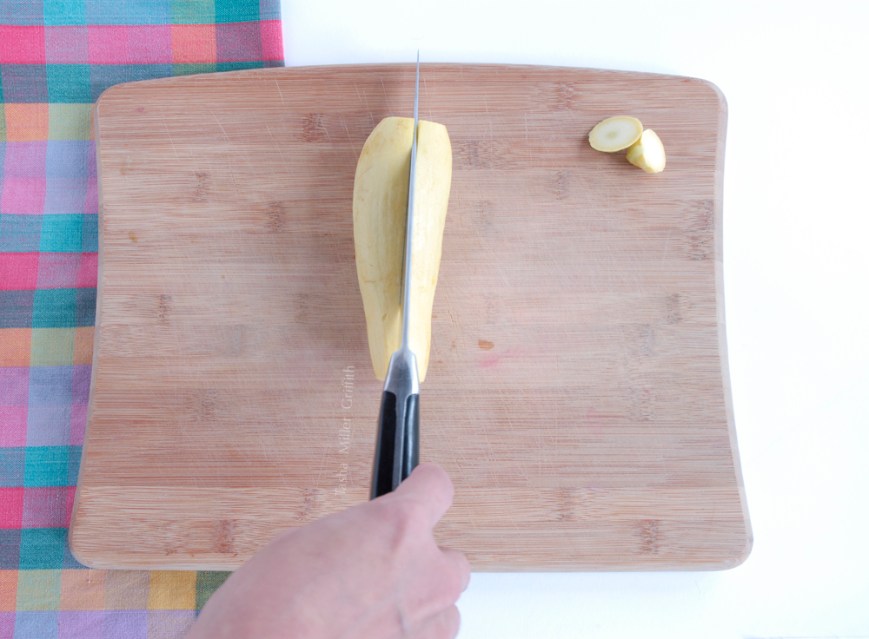


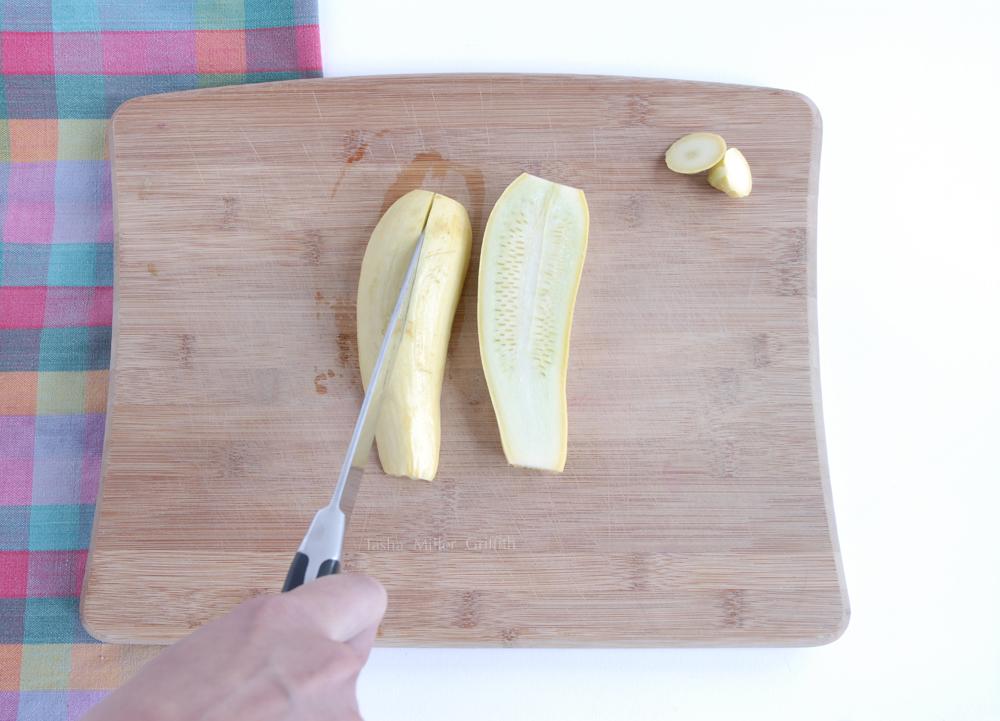
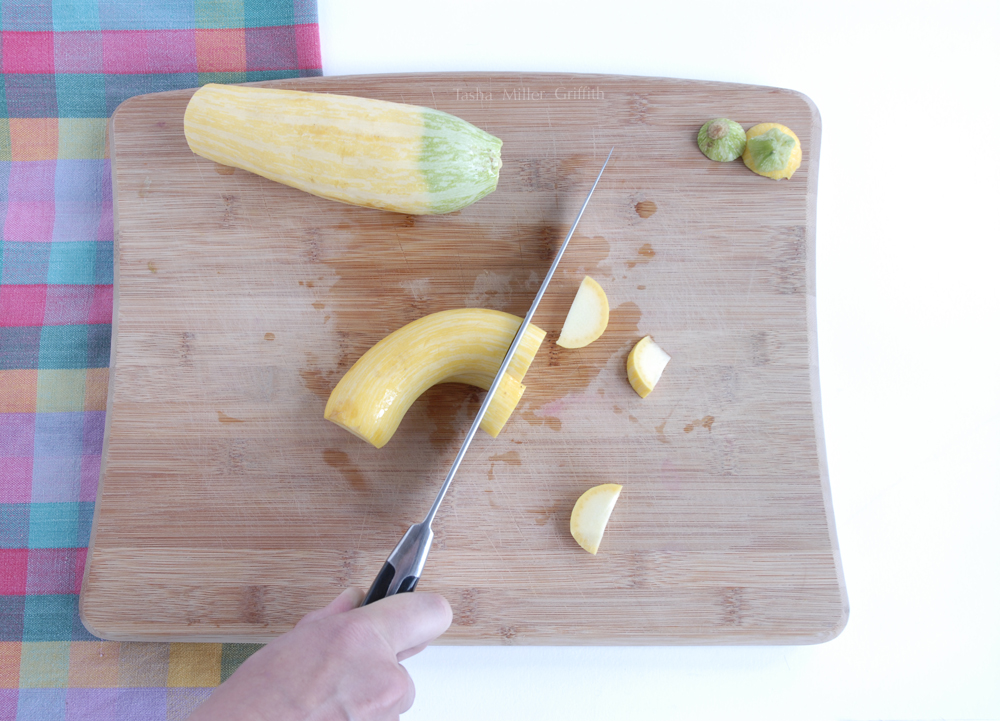
Then, cut the halves in half again, so that you have four sections of squash.  You can pull the knife in a curve as you cut if your veggie is curved.  If you want very small pieces at the end, cut into eight sections now, dividing each one one more time.
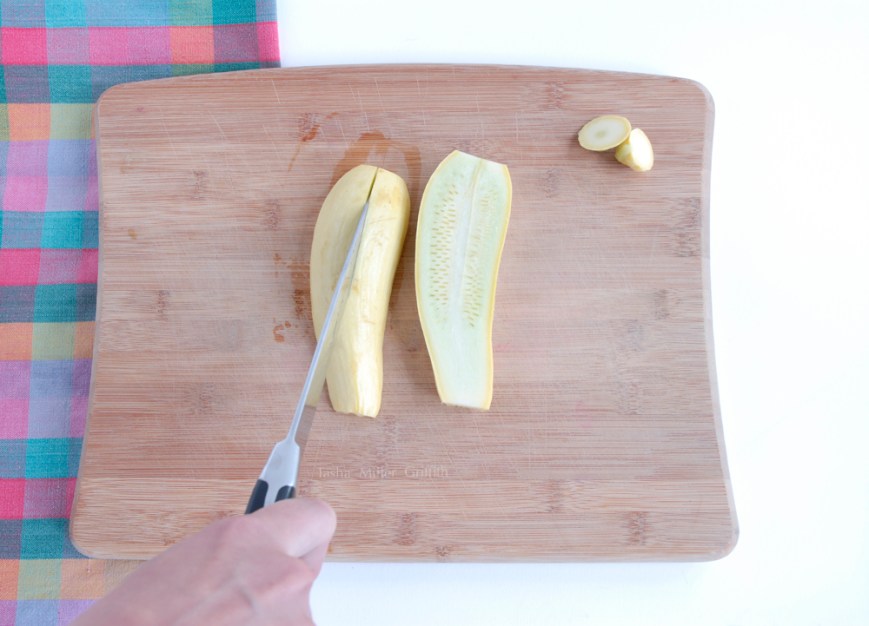


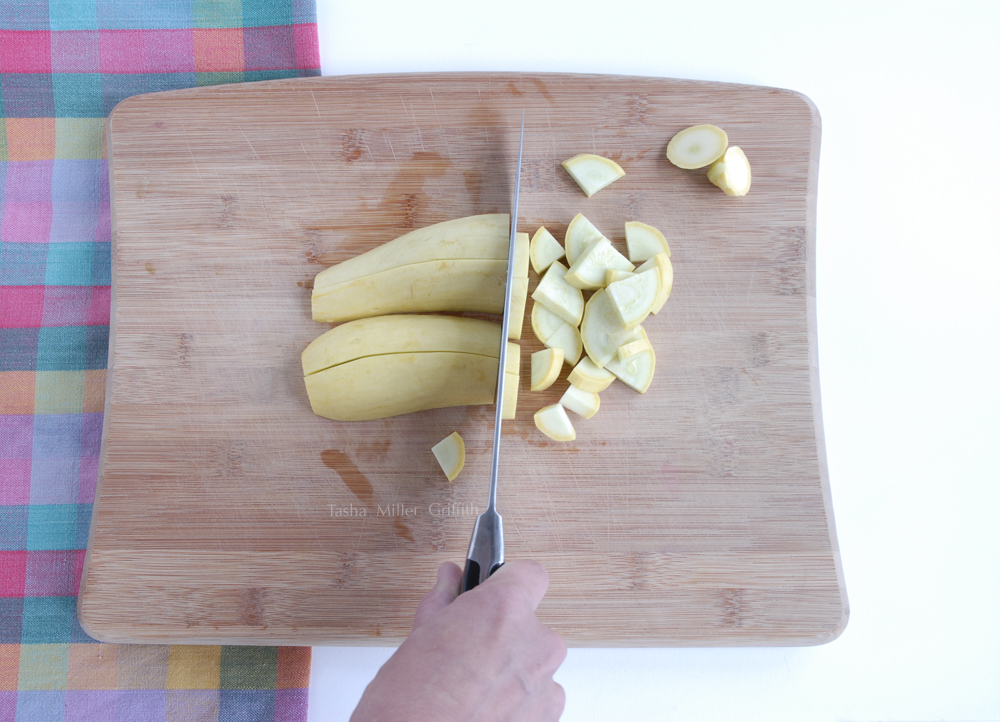
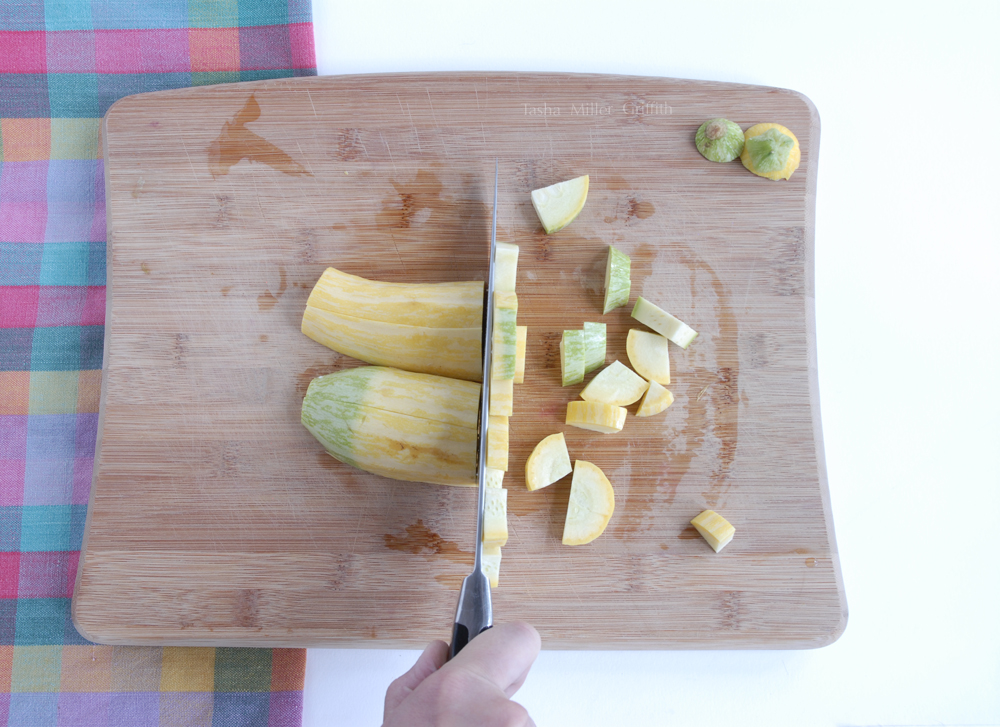
Now, line up the sections and chop all at once!  You can chop thin or thick pieces, whatever you’d like for your dish.  Notice that the tip of your big knife can stay touching the cutting board as you lift the thicker part near the handle and chop chop chop.
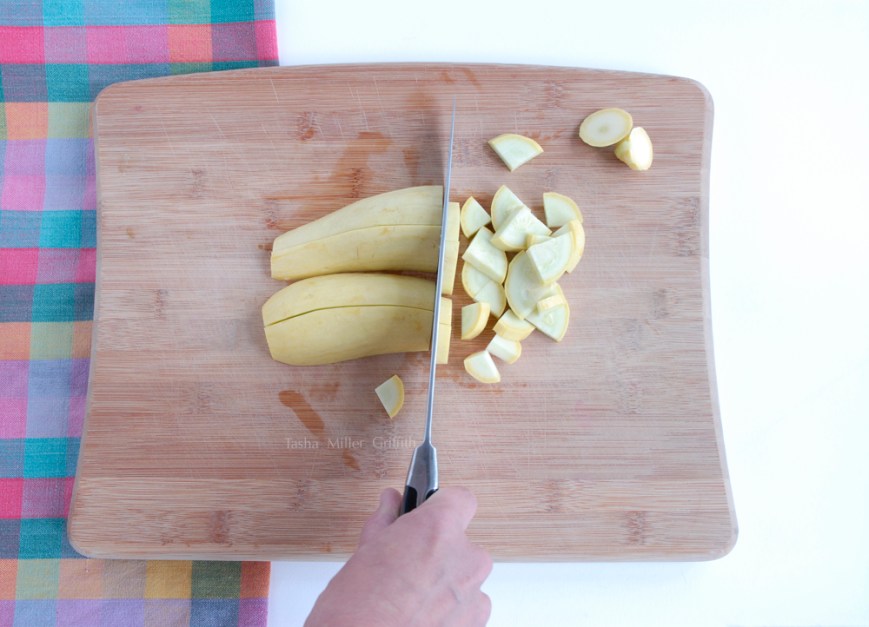


At this point I should perhaps point out that I am usually holding whatever I’m chopping (not the camera) with my non-dominant hand.  And that if you are left-handed, you’ll do exactly the same things, but your chopped squash pieces would appear on the left side of the frame above.  When you’re holding something that you’re chopping, lots of cookbooks advise you to keep your fingertips tucked under, I think on the theory that if your knuckles are sticking out the furthest, they are higher above the thing being chopped, and more likely to bump into the side of the knife than being accidentally shaved by the blade.  Most of the time, I forget to do this.  Use whatever works for you without chopping your fingers.

Also at this point, you may be thinking, “Ok, fine, but not all vegetables come in such a straight and manageable shape.”  Ah ha!  True, but use the same principles to break them up.  For example, I cut this crookneck squash into a (more or less) straight part, and a very curvy part.
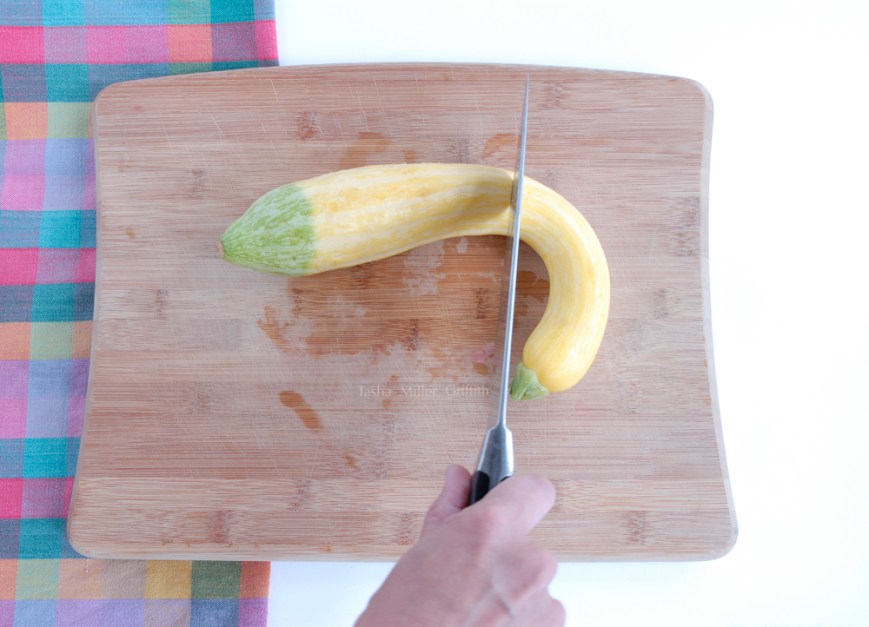


Cut off the ends and divide into sections as before.  If one part is noticeably thicker, I’ll cut it into quarters, and leave the thinner section in halves, to get pieces of about the same size.  That way they will all cook in about the same amount of time.
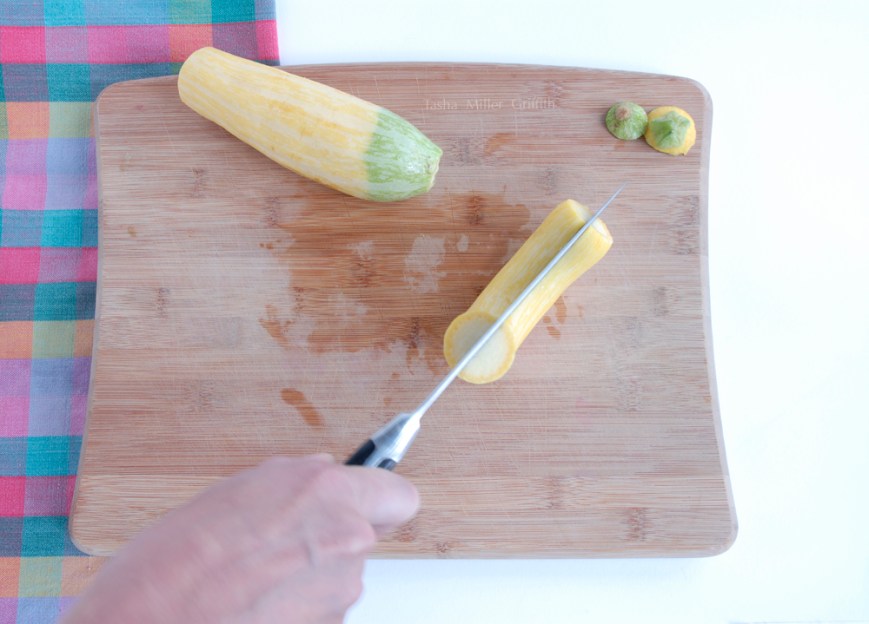


There wasn’t an easy way to line up the curvy sections flat, so I stacked them on top of each other.  It’s all about chopping more pieces with one cut.
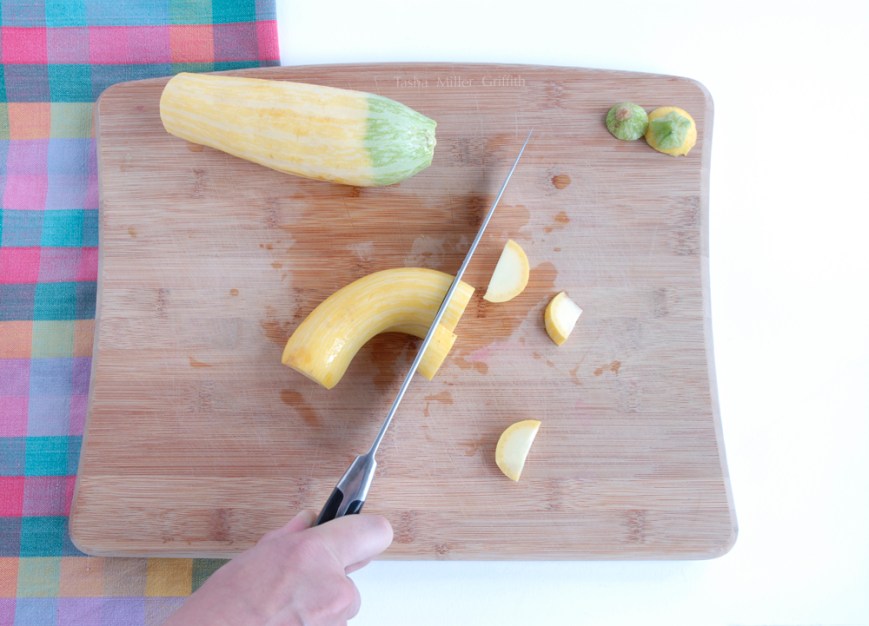


Another thing that’s not illustrated, but helps a lot, is having a big bowl (or two if they are not all going to the same dish) to collect your chopped veggies in.  Having a cutting board cluttered with things you’ve already chopped will force you to make smaller, less efficient movements.


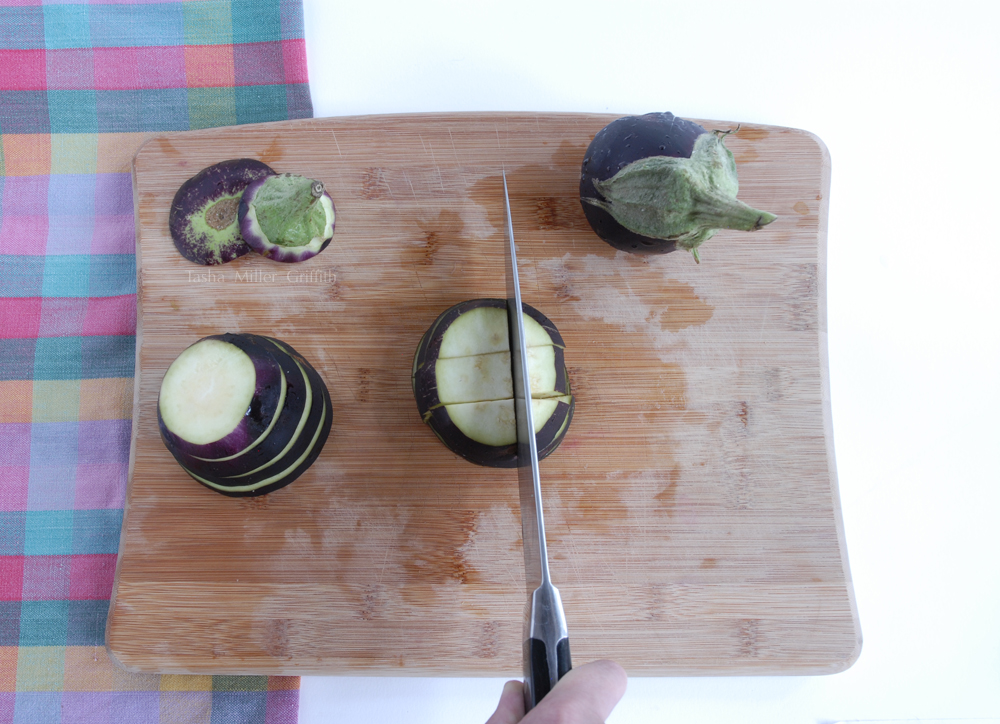
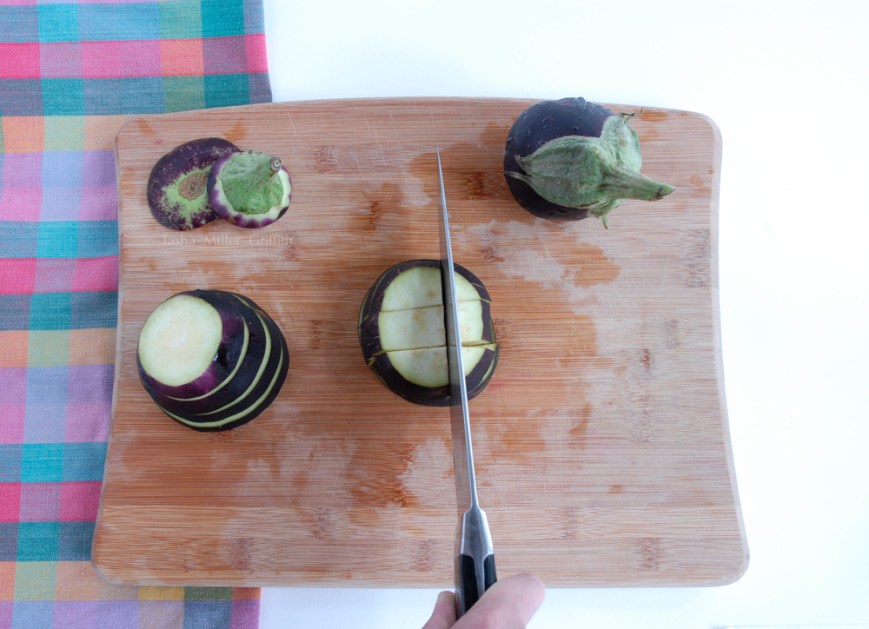
Apply the same principles to a round eggplant: slice first, crosswise this time, then stack and cut into pieces the same size as the squash.


A few vegetables have their own variations on these ideas, like onions.  Any other ones you’d like to see covered?

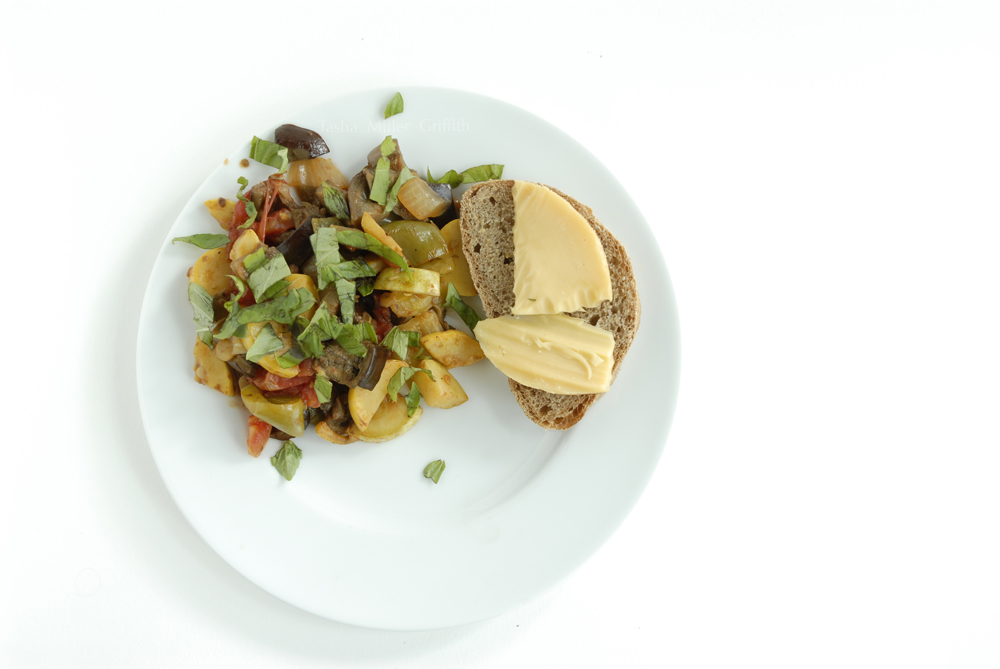
What to do with all these lovely freshly chopped veggies?  All of the ones illustrated here went into ratatouille.


Try it, trust me, it’s faster, it’s so worth it.

When I say “faster,” I don’t mean “hurry” or “rush” (which in my case always leads to mistakes and/or injuries, usually and), I mean more efficient, less time spent doing the same task, even though you are doing it well.  Whenever I think about efficiency as applied to hobbies (like cooking is for me), I think of this quote, it’s from a weaving and sewing book that my grandmother gave me off her shelf when I liked it.  I love the way the authors write about craft:


In all human pursuits there seem to be fast, efficient ways of doing things and slower ways of doing things.  Some weavers hesitate to look for and adopt efficient methods in their craft because they think of themselves as amateurs.  In their heart-of-hearts they feel that it is not appropriate for them to become more proficient.  . . . Loving the craft of weaving and wanting to pursue it more efficiently are certainly not mutually exclusive.  There is every reason, in fact, for all weavers to try to become efficient.  The first benefit of increased proficiency is the production of a better fabric.  There are very few satisfactions that compare with that of a job well done!”

– Handwoven, Tailormade by Sharon D Alderman & Kathy Wertenberger


There’s a lesson here for all of us who make ourselves anything as a hobby.  I’d love to spread this attitude, and the resulting more and better sewing/cooking/weaving/whatever you make.  What do you think?  How to you view efficiency in your hobbies?

 

Ratatouille


This time of year, at least where I live, the market is simply overflowing with fresh veggies.  While the fruits seem to come in a relatively orderly sequence, one replacing another, the vegetables apparently just multiply, more kinds, more flavors, more colors, every week until the frost.

So, a perfect time to make something delicious out of them!  Something full & rich with the flavors of all the late summer bounty.

Ratatouille

Makes enough to feed 4 as a main course

Chop into large chunks (see the next post):

2 medium summer squash; zucchini, crookneck, etc.

2 smallish bell peppers; red, orange, yellow or purple

1 medium yellow onion

4 small or two larger eggplants

1 mildly spicy chile (optional but really good) If your chile happens to be already roasted, add it with the tomatoes.  Otherwise, keep it with the peppers, squash and onion.

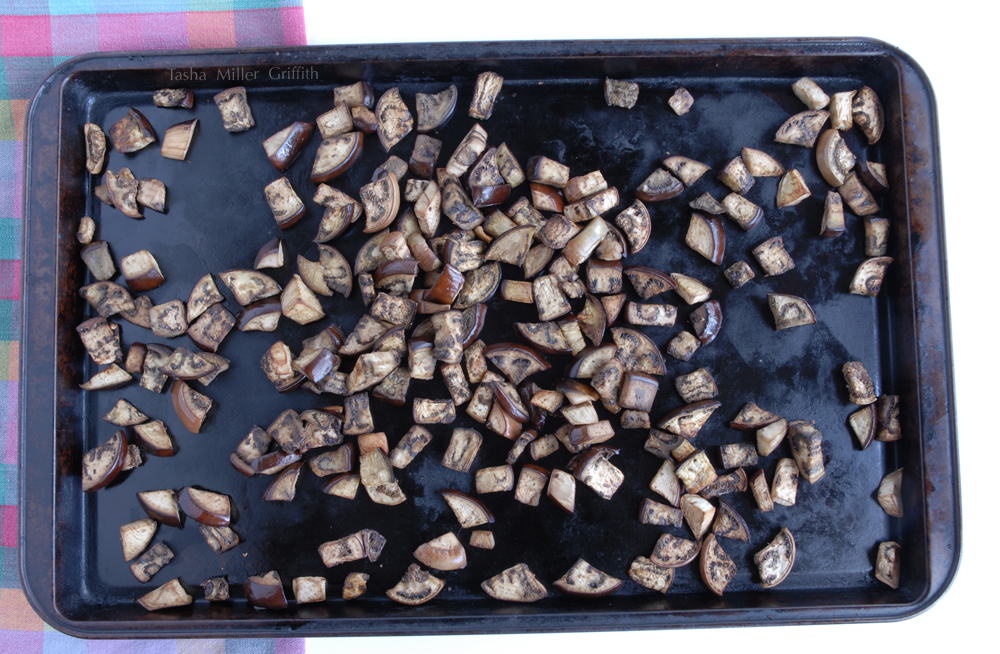
This many veggies will not fit in my largest skillet in anywhere close to a single layer, meaning I know they won’t all brown on the edges.  So, I put the chopped eggplant on a baking sheet and toss with a little olive oil, and roast it in the oven at 375° F until soft and slightly browned, about 30 minutes.

Meanwhile, chop the other veggies and put them in a large heavy skillet on high, with more olive oil, enough to keep them from sticking.  Stir occasionally, letting the surfaces of the vegetables get a nice medium brown.

While the veggies are cooking in the skillet, also chop:

4 -5 large tomatoes chopped roughly, or a little more than a pint of small ones cut in half

3-4 cloves of minced garlic

When the veggies in the skillet are just about browned, add the eggplant to them.  Make a clear space in the center of the skillet, add a drizzle of olive oil, and put the garlic in it.  When the garlic just starts to color, mix it in with the rest of the veggies, and add the tomatoes.  Turn the heat down and cook until the tomatoes start to collapse.

That’s it!  Serve with a generous portion of fresh basil (fresh oregano is also nice, although I like basil best), and a few grinds of black pepper on top.  You can salt to taste as well.


This recipe is delicious with risotto, or any cooked grain with a little cheese mixed in, or just with bread and cheese for lunch.


Giant Cyanotype on Silk!


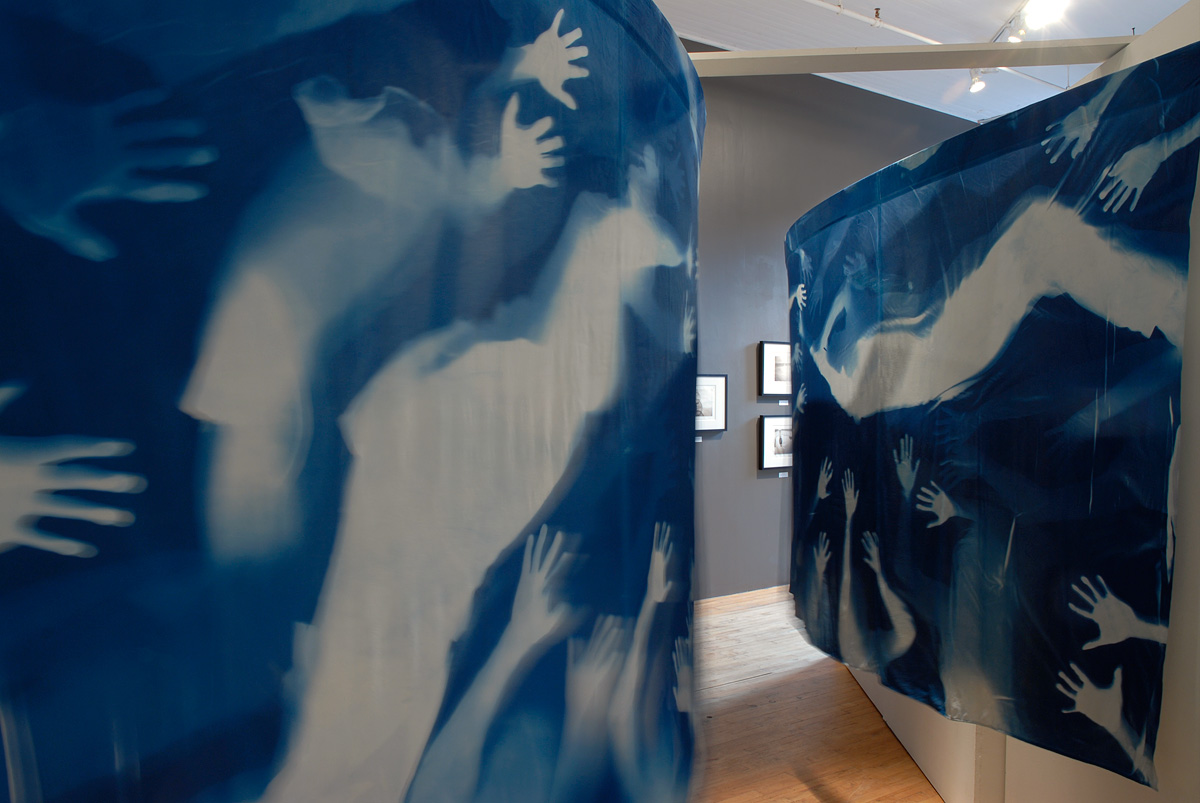
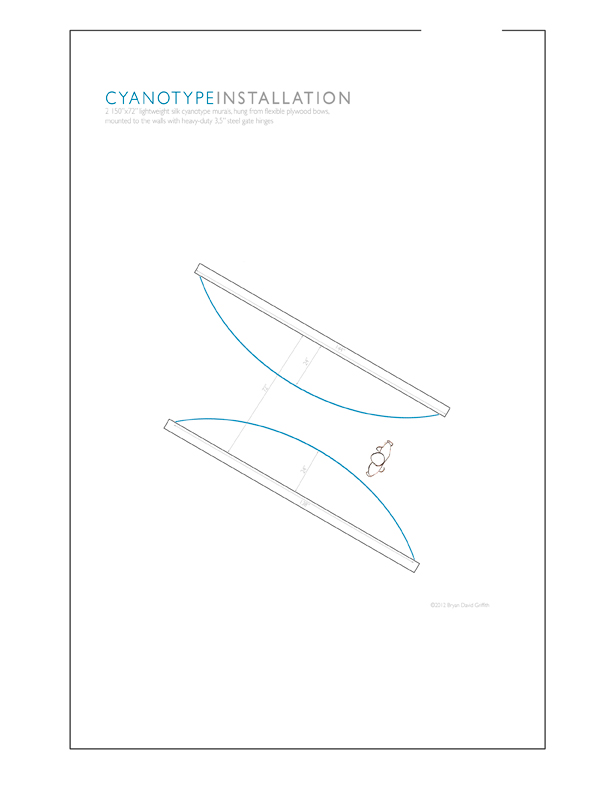
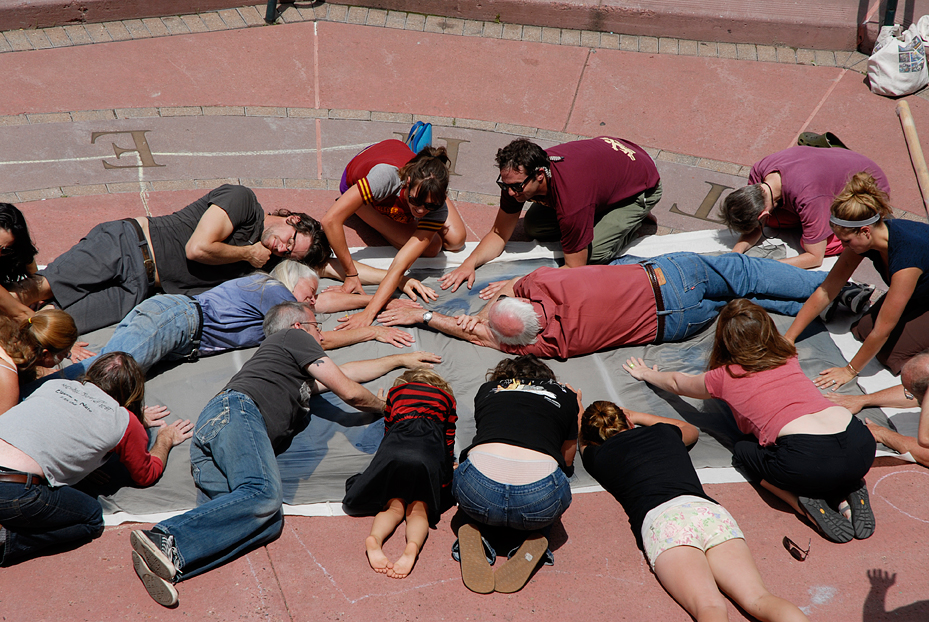
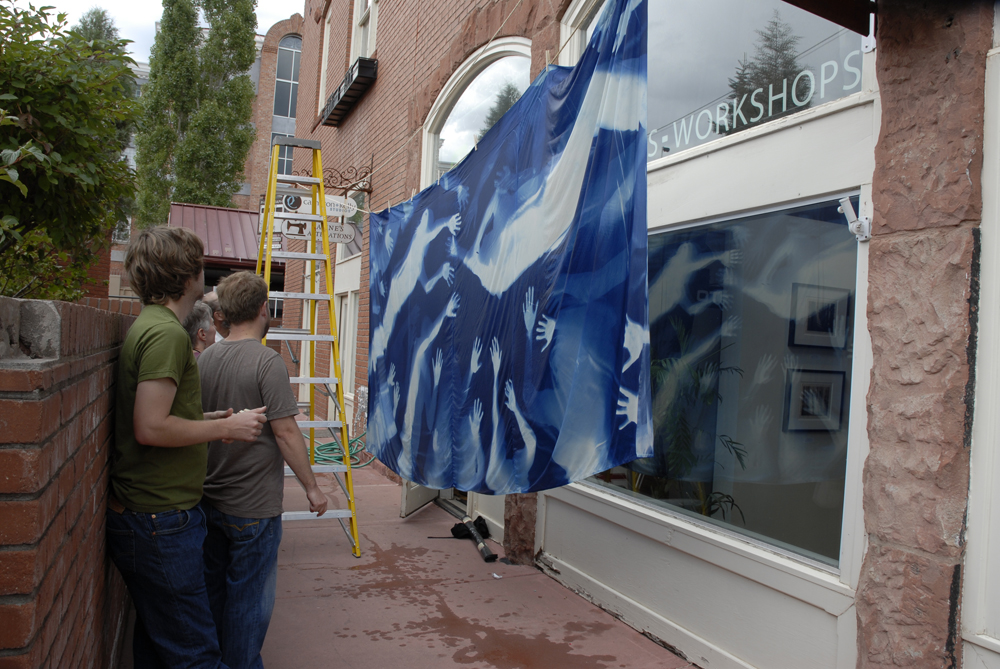
Some of you may be wondering what I have been up to lately, besides cooking and (occasionally) posting about it here.  Well, in part – this!  Bryan has a solo show on at the Flagstaff Photography Center for the next month, and for part of it he had this crazy brilliant idea to make a huge public participation project.  On silk, panels 12′ by 6′.  Which would hang on curved wooden supports (making that part was his responsibility).  The idea is that you walk through it, not just look at it, and the fabric touches you and moves with the wind, thus making a different, more interactive experience of what a photograph can be.


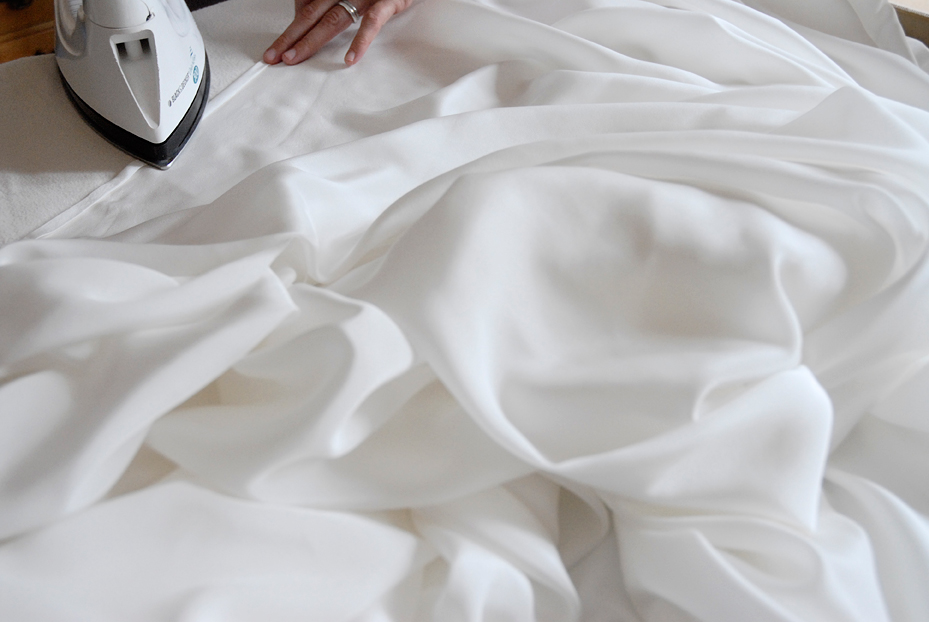
The first part for me was making the silk panels.  Suffice it to say I have never been this nervous about sewing a rectangle.  Ever.  I attached a measuring tape to my work table so that I would tear all the pieces exactly the same length, and got out my walking foot so as not to distort the long seams.


In the process, I kind of fell in love with this huge expanse of crepe de chine.  Having never sewn anything nearly this big out of silk before (a ballgown is the only thing I could think of that would compare) I had never studied how it falls like liquid, but somehow also holds a body, almost a stiffness in certain circumstances.  Amazing.  I’m not-so-secretly hoping that the leftover fabric ends up in my stash.


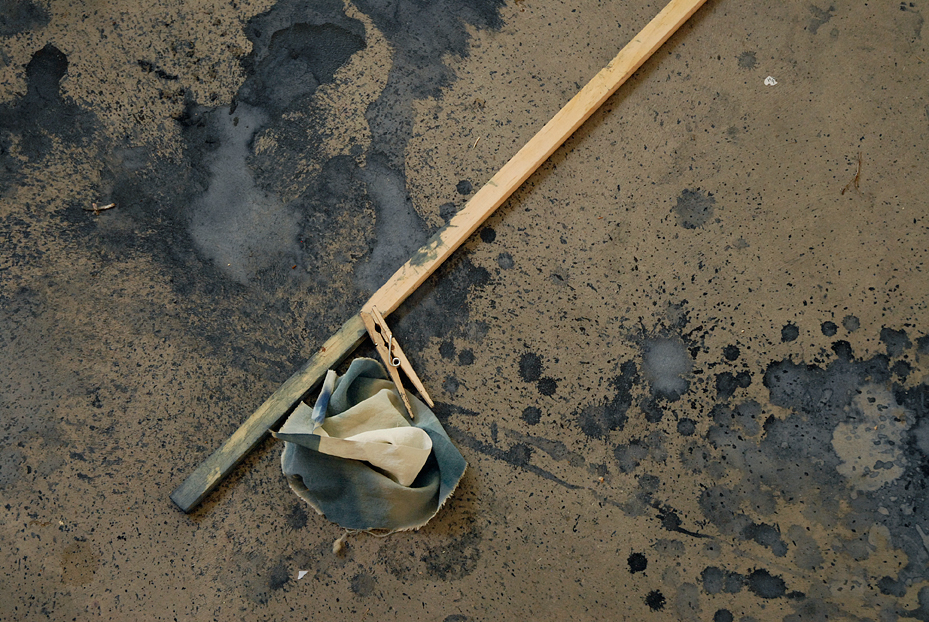
But back to the photo project – the next step was to soak the silk panels in the chemistry for cyanotype – like those blue prints you may have made in the sun with leaves and flowers, and hang them up to dry.  This we did at night, inside the garage.  It took longer to dry than Bryan expected, so we ended up setting the alarm for 4 am to take them down.  They got rolled up and the rolls went into a long skinny bag of blackout fabric (also made by me, and luckily went together easily like the plan in my head).  By now you are starting to see how this project had a certain secret-agent-mission appeal.  At one point I had a grocery list which included 8 gallons of distilled water, blackout fabric, muslin, carpet rolls/large dowels, thread, and shellac.


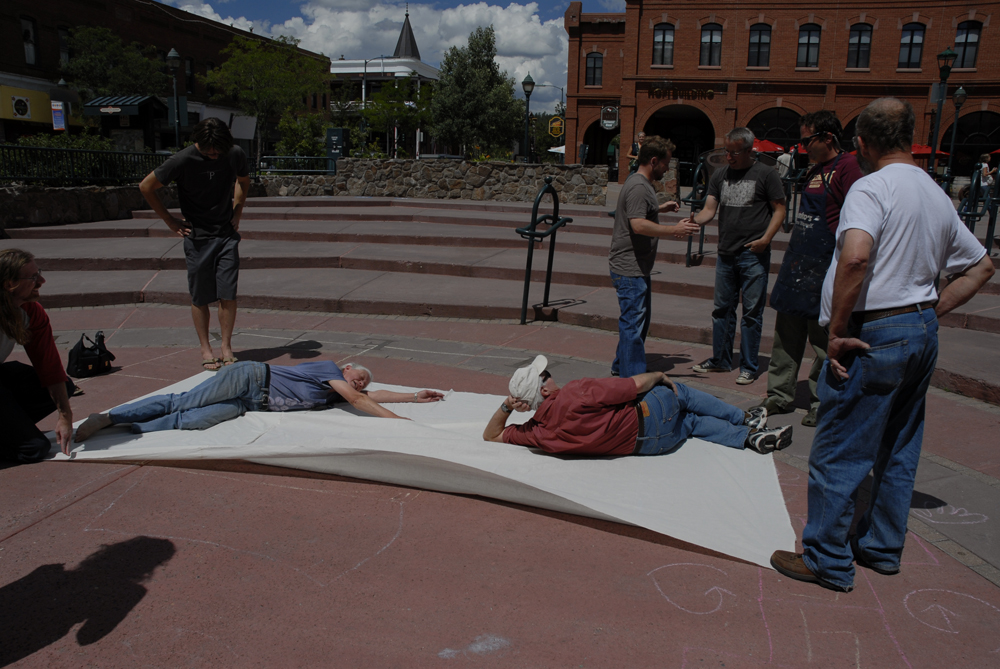
On the morning of the exposure, we set up (mostly) clean trash cans to hold water for rinsing, a hose, the muslin sheet so everyone could practice where to put their hands and bodies, and a hugely tall clothesline to hold the finished pieces while they dried.  Thankfully, a bunch of our friends and members of the photo community showed up and agreed to lie still in the sun for 15 minutes while they and the silk sheets took in enough light to make a photo.  And thankfully the monsoon clouds held off just long enough to get it done (it rained later)!  Bryan repositioned people partway through to get a lighter blue in some places.


Meanwhile I ran around taking snapshots, and then with the help of a few volunteers, dunked the first panel in successive changes of water to rinse out the unexposed chemistry, while Bryan and the rest of the volunteers exposed the second one.


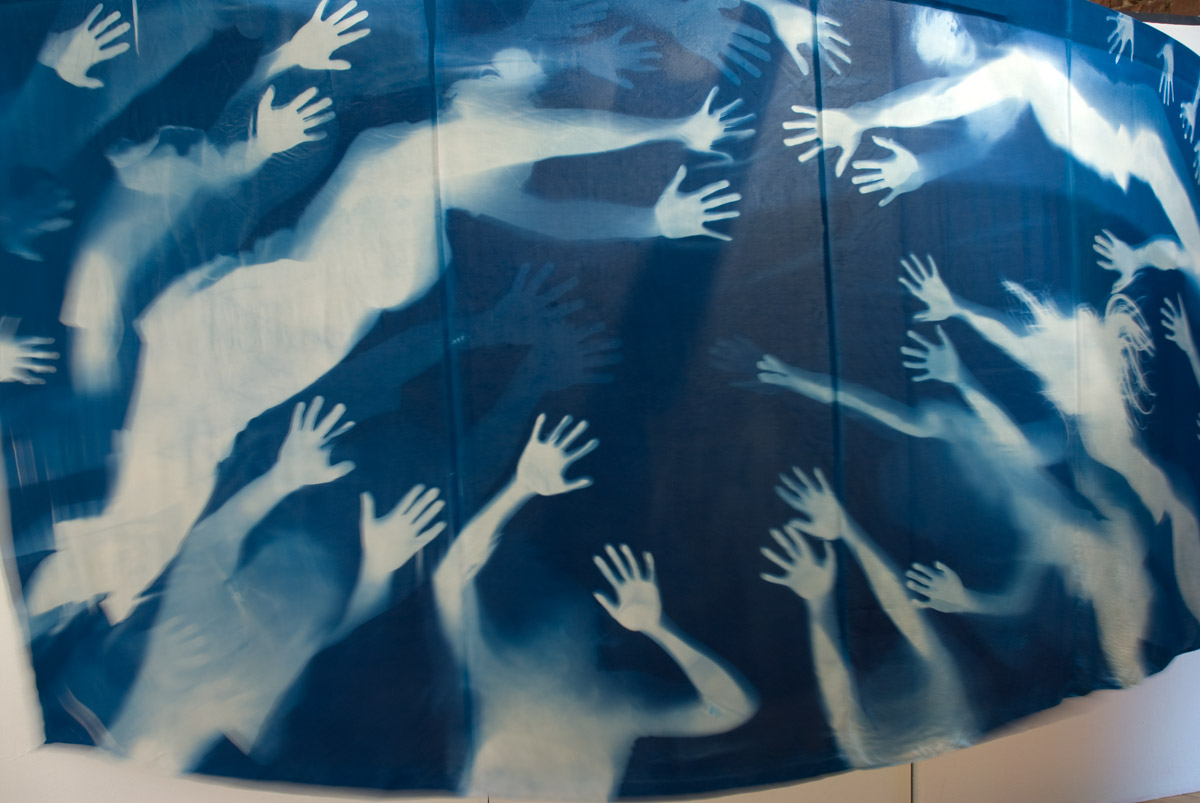
Even though I was very involved with this project, I didn’t anticipate quite how much I would like the finished result.  I think Bryan did a great job bringing his vision for it into reality.  And, after obsessively checking my math at the beginning, I could finally breathe a sigh of relief as the panels slid onto the wood and I could see that everything came out the right size!  It’s hard to see just how cool it is here, but imagine walking through it.  I am impressed with the little details that come through, aspects of people’s hair and clothing that make it more personal.


If you are passing though Flagstaff, you can check it out yourself at the Photo Center (right on Heritage Square) through the end of August!


Asian Coleslaw Recipe Sketch


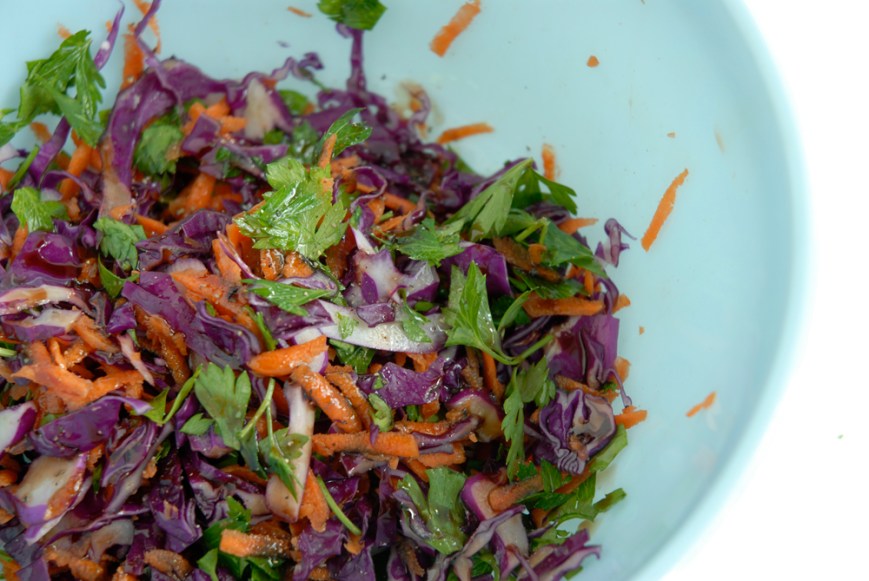
This is a family recipe in a few ways.  I first got obsessed with this salad a couple of years ago when one of my aunts was making it a lot.  Hers was inspired by two different recipes (neither for Asian coleslaw), which I bothered her until she sent me, I thought it was so good I couldn’t stop thinking about it.  I have been making my version of her salad (below) for long enough that it’s established its own pattern in my head of what “Asian Coleslaw” is like.

So, during our craft retreat, another aunt decided to make “Asian Coleslaw” with some veggies left in her fridge.  Great!  I offered to help, and had to laugh as soon as she started putting things in.  Parsley?  Olive oil instead of peanut or sesame?  If you’re putting that, why not add this cauliflower?  No?  As it became more and more clear that our visions differed (and of course her version was also delicious) I realized that here was one of my own lessons coming back to me, of course you can make it with whatever you have and whatever you like!  Please feel free to experiment.


Asian Coleslaw

This much will feed four as a side.

Combine in a bowl:

1/2 small cabbage (your favorite kind) shredded

3 medium carrots, grated

1/4 cup chopped cashews (peanuts and or/sesame seeds would also be good)

3 green onions/scallions, chopped fine (optional)

1/2 cup chopped cilantro (and/or parsley or other herbs)

Dressing (I make this in my little food processor):

1 Tablespoon shallot, or 2 cloves of garlic

1 Tablespoon fresh ginger

2 Tablespoons toasted sesame oil (you can also use peanut)

Juice of one small lime (or splash of rice vinegar, although I like lime better)

2 – 3 Tablespoons soy sauce or tamari

2 teaspoons sugar or maple syrup

Squirt of hot sauce (or add serrano or another hot chile)

Process the dressing until everything is combined and chopped fine (you could also mince the solid ingredients by hand and combine everything in the bowl).  Pour the dressing over the salad, toss, and you are done!  This also keeps quite well in the fridge for several days.


I realized as I was thinking about posting this recipe that’s a really a year-round salad.  I tend to think of it almost more for winter, since the ingredients are still readily available, and it provides a little something fresh when almost everything seems warm and stewed.  But, it also makes me think of my cousin (sweating out the Brooklyn summer without AC) and everyone stuck in the Midwest heatwave – a tasty way to get your veggies without ever turning on the oven.  I’m still making it here, even though our monsoon-season weather has been exquisite, so close to perfect that I keep sitting on the (brick) front steps with my laptop to feel the breezes.   I’m telling you, the world’s best weather is in the mountain southwest, once it starts to rain.

One last note, my DIY envelope tutorial was featured on KP’s blog today!  We became friends in person (when we lived in the same country) now I love keeping up with her fun projects and lovely photos (plus she has a recycle project challenge)!


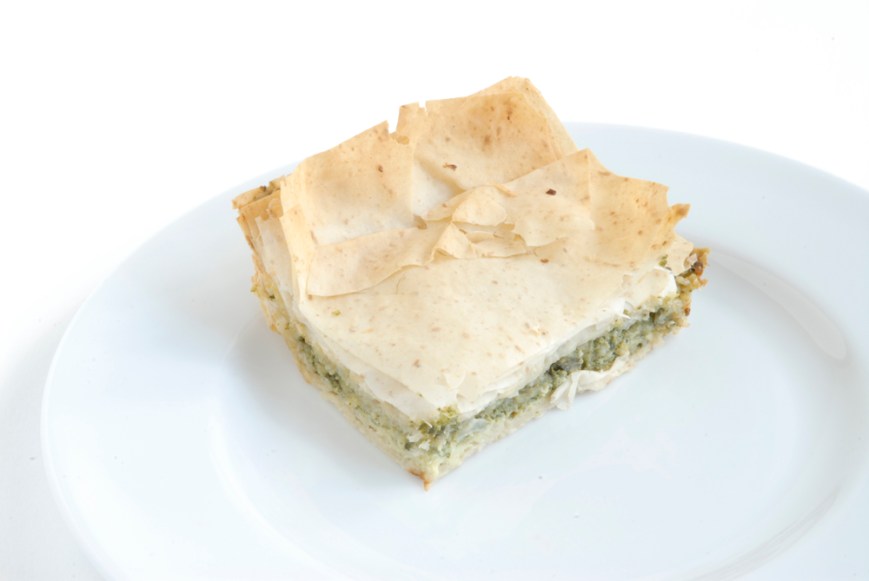
Chard Phyllo Pie, and Experimenting in the Kitchen


Years ago I took an Indian cooking class with my mom at our local community college.  Although none of the recipes from the class became my favorites, the instructor said something which I found wonderfully liberating – use what you have.  If a recipe calls for one vegetable or spice you are out of, just try it with something similar or something you think will taste good.  Sometimes, especially when you are cooking something from a culinary tradition other than your own, it can be easy to think you have to have exactly everything the recipe calls for, in exact quantities.  However, that’s, um, never actually true!

I have been thinking about this lately and wondering how to talk about it here, especially since reading this truly stellar piece about everyday cooking on The Yellow House.  One of the true keys to this kind of culinary freedom and weekday luxury is being able to make something with what you have on hand.

For example, the other day I had chard (thanks to my aunt Barbara, who brought some from her garden all the way to Flagstaff in her cooler!), and phyllo dough, but no kind of cheese I would normally use to make spanakopita.  But I did have a large chunk of Beemster Graskaas (creamy Dutch cheese), and a bit of leftover sharp cheddar.  Hmm, I thought, this may not come out so great, but I think it’s worth a shot (embracing the possibility of failure is essential here).

Well, after a couple of bites, I looked at Bryan and asked, “What do you think?”

“I think I like it better than regular spanakopita.” he said.  So did I!  Keep in mind that our normal spanakopita recipe has been a staple in our house for years now.  This one definitely has more of an American comfort-food feeling, deliciously so.


Chard Phyllo Pie


Makes one 9 x 12 pan, or similar size

Preheat oven to 375° F

1 bunch spinach, kale, chard, or un-identified green from CSA (as long as it’s the kind you cook)

Wash and stem this, my favorite method is to grab the stem with one hand and pull the leafy stuff off with the other hand.  Put the stemmed greens in a pot with a steamer basket and some water in the bottom.  Bring the water to a boil and then turn it down to medium – low heat, let the water simmer until the greens are bright green and relaxed.

Meanwhile, finely chop ½ of one yellow onion and 2 medium garlic cloves

Saute the onion in a litle olive oil over medium heat in a small skillet or pan until it just starts to have a golden color.  Add the garlic and stir and cook for about another minute.

Scrape onion and garlic out of the pan into a bowl.

When the greens are ready, turn off the heat and let them cool for a couple of minutes.  Use tongs to transfer them to a food processor and pulse until pureed (or how you like them).  Add them to the onion bowl.

Also add to the bowl:

–       About 8 oz creamy Dutch cheese (the whole point of this post is to try whatever cheese you like/have!)

–       A little sharp cheddar cheese, or another kind that will add a little more punch to the cheese flavor

–       4 eggs

–        A few grinds of black pepper

–       A pinch of salt

Mix this all together.

Melt (I like to just drop it in the onion pan) 2 Tablespoons butter

Get out your thawed frozen phyllo dough

You may need to cut the phyllo sheets in half. If so, tightly wrap what’s left and put it back in the fridge.  Working quickly, brush a little butter in the pan, lay down a sheet, lightly brush it with butter, lay down the next sheet, etc. until you have used 8 – 10 sheets or half your stack.  Spread on the filling, then repeat with the rest of the phyllo sheets.  If you have some butter left, spread more on the top sheet or two.  Cut the spanakopita into pieces through the top layer of dough, then put in the oven and bake until the top is golden and the filling looks solid where you cut it, about 40 minutes.  With this version the filling will be a little more moist & creamy, definitely let it cook until the top is a rich golden brown.  Let cool for a few minutes, cut through the bottom, and enjoy!


Not every culinary experiment will produce results you want to note down and make again.  But, with just a little practice cooking with what you have & what you can find, every day can be fresh, wholesome, creative – in other words, a small miracle of food at your fingertips.