Fitting Pants (Trousers) – At Last!


Let me just say this has been a long journey.  I’ve never had ready-to-wear pants that fit me, if they fit Ok through the thighs and seat, they’ll be ridiculously baggy around the waist, etc.

I also haven’t had a huge amount of luck making my own pants, until now that is!  I’ve definitely made pants, lots of trial ones and some real ones, but there are just so many variables that sometimes it’s been hard to tell exactly what to change for my next pair.  This pair, however, is really close, and I learned a lot along the way, mostly thanks to my internet friends.  I just feel so self-sufficient wearing these pants, it’s fantastic!  On their very first day I wore them to hang a show of Bryan’s work at a restaurant here, climbing up and down ladders and carrying things around.  Then the next day I wore them with a nicer sweater and looked totally presentable (ok, after wiping off some grime from the day before . . . )


I’ve definitely learned some sewing lessons along the road to pants that fit.  Among them:

  • It’s possible to draft a pattern from scratch from your measurements and still not like the fit.
  • If you copy a pair of pants made in a stretch fabric, do not try to convert them to a non-stretch fabric, the “fit” you like will probably disappear.
  • Using top stitching, and thick top stitching thread, really makes your pants look more professional.

For this pair, I worked from a copy of some corduroys I thrifted last fall.  I liked the fit of them pretty well through the hard-to-fit booty area, and I knew I could taper the waist to fit into a contoured waistband.  I had made one previous test version out of thin nylon for hiking, which were wearable but a bit tight.  So, my first idea, which I should have thought of a million years ago, for these was to use 1″ seam allowances all around to give me a little room to work with.  I’m totally doing this on every pair of pants I make from now on, and it turns out it’s also recommended in this genius book (more about that in a minute).
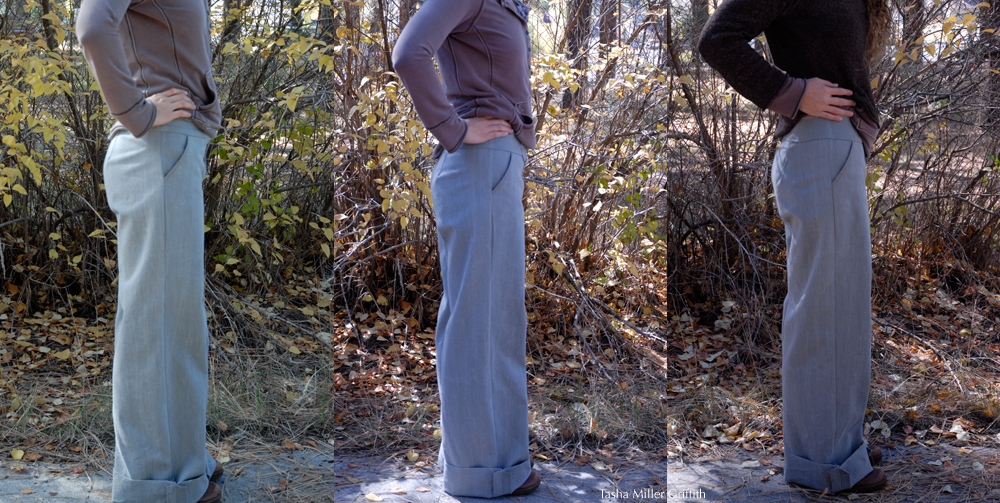


The second thing I learned on this pair is that it’s amazingly helpful to take pictures while you’re fitting.  I NEVER would have thought to do this before I had this blog, but I can’t recommend it highly enough.  You don’t have to show the pictures to anyone, but you can go back and see exactly what you’re working on, long after you’ve taken them off.

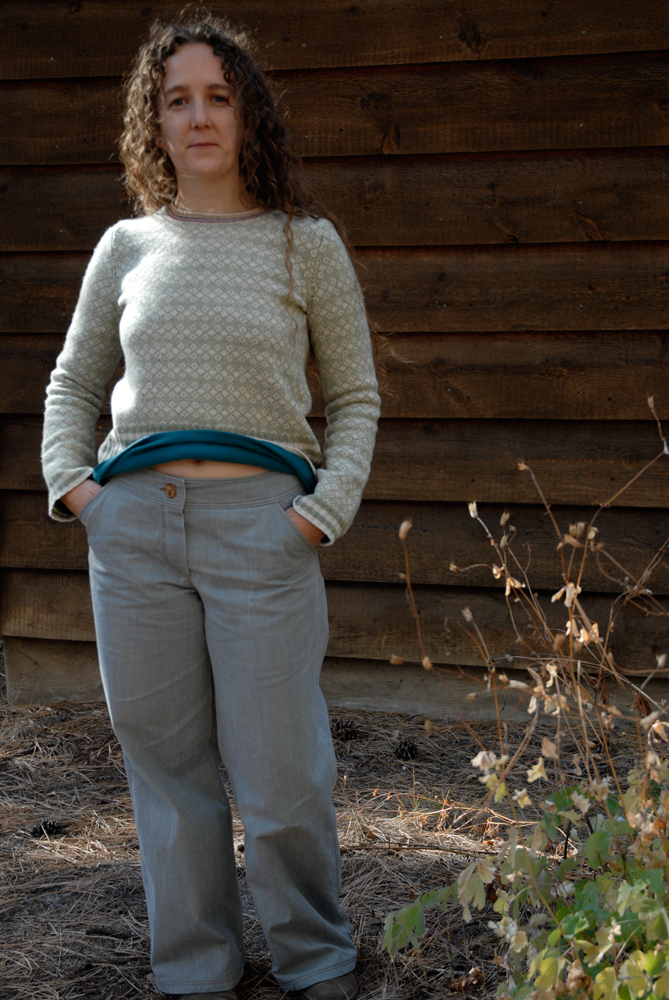
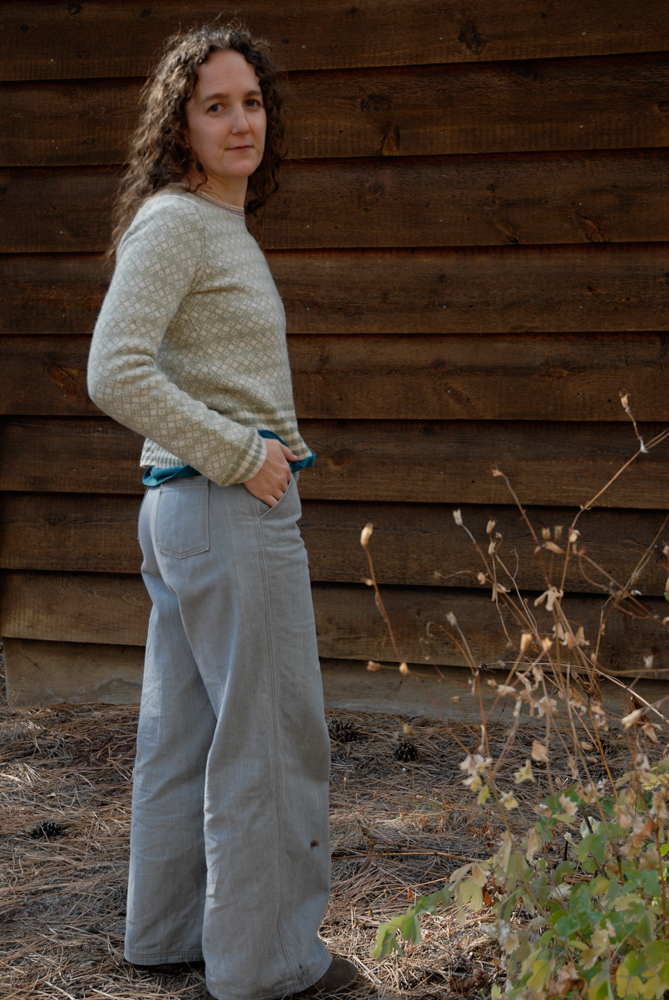
The third thing I learned was that there’s great info about fitting pants on the web!  Even though I scoured every single mention I could find in Threads magazine, again, the most useful stuff I found was on other blogs.  Thanks especially to Tasia’s post of fitting resources (her pattern would be a good place to start on pants if you’re pear shaped like me), where I linked to Sunni’s enormously helpful trouser sew-along (my pants looked remarkably like hers in the back picture here).

She also recommended the book Pants for Real People.  I had passed this book by at the library before, since none of the models are shaped like me.  But, don’t let that deter you, the illustrated fitting problems and solutions in this book are total GENIUS!  I have probably never been more happy that a book was at the library just when I needed it, and I ordered my own copy as soon as I read it.  And I quote, for full derriere,

Generally, you need to add only to the back inseam, but rarely you need to also add to the top.  Deeper, or additional, back darts may also be needed.

The back inseam?! It would have taken me at least another decade to figure that out on my own.  Check out my pants on the left above, then I let out the back inseam for the middle picture.  On the right, I used another tip from Pants for Real People, taking out my dart and making it deeper, and taking out part of the waistband so that I could pull up the back to get rid of those wrinkles at the hip.

Maybe I could let out the inseam a little more in the back, but I ran out of fabric to try it, even with my extra seam allowance.  Next time!
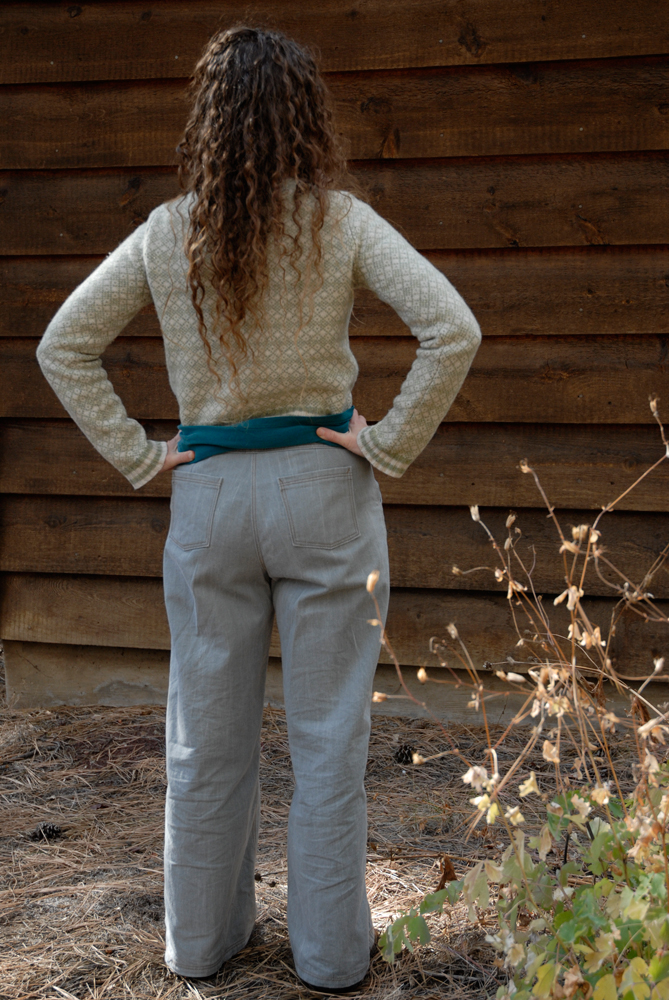


These pants are supremely comfortable in any position except sitting straight in a chair, when it feels just slightly like I’m being cut in half.  I have a couple of tweaks in mind for the next pair, but let me be clear: I am 100% OK with these pants not being 100% perfect.  In fact I’m thrilled that both:

  1. I MADE the best fitting pants I’ve ever had, and
  2. The next pair will be even better!

I have been frustrated along the way by making lots of test pants in muslin which I don’t wear around much, so it’s hard to figure out how they really fit, and I knew I was close enough this time with my copy that I’d end up with something wearable, so I went for “real” fabric.  I also like this approach because it lets me see how a more substantial fabric will behave, and because as I wear the finished pants in real life, I get a much better idea of how they work and what I’d like to improve.
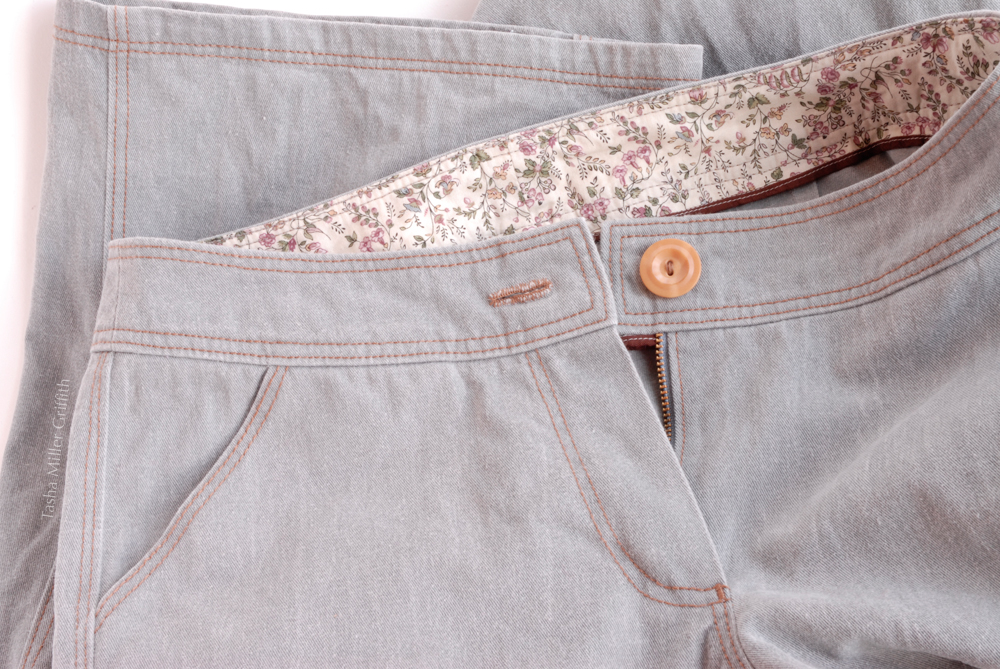


Just a couple of construction notes: I used a rayon ribbon to bind the bottom of the waistband, which I quite like, although next time I’ll try to get it closer to the bottom waistband seam so that it doesn’t flip up.  I debated whether this was too much top stitching, but on the pants when worn it doesn’t stand out much at all.  This is my third try at a vintage button, the first two did not survive a trip through the washer, by which I learned that if a button looks crumbly, it probably is, and if it snaps in half like a fortune cookie in your fingers, well, it wasn’t going to stand up to much.

Ready to tackle DIY pants?  I’d say there’s a lot of great resources out there, go for it!  I’ll mention one more pattern which could be a good starting place, Juniper from Collette, which just came out, with a similar shape to these.
Whatever you’re making, I hope it’s giving you that “I could conquer the world with this” feeling!

 

Saving Pumpkin Seeds


I’m kind of jealous of my friend Tom, who grew about 2 dozen pie pumpkins in his yard this year, here in Flagstaff!  He has been sharing them, which has been great, but I still found myself wishing that I had dozens of pumpkins too – wait a minute!  I have a yard, I have some grey water, and we were home enough this summer that it might have worked, plus it wouldn’t be too much work for our house-sitters.  So, I saved some seeds.


After reading directions here and here, I picked out and rinsed the seeds in cool water, then spread them out on this cookie rack.  At first they were plump and glossy, but after a week or so they have flattened out somewhat and the skins are crinkley & papery.  I think I’ll leave them out a little longer.  Further bulletins as events warrant!

Heat Setting Fabric Ink, and “Green” Printing

Heat setting is the last step for a lot of fabric inks, including the ones I used for stamping (Speedball Fabric Screen Printing Ink).  The heat bonds the ink permanently to the fabric, so you can wash it and your design won’t come off.

So, how to do it.  The most foolproof method is what the manufacturer recommends: ironing.

After the fabric ink dries on the fabric, set a household iron at the highest dry heat (no steam) that will not scorch the fabric and with a cloth or paper between the iron and printed material, iron on each side for 3 – 5 minutes. This will make the ink withstand repeated washings.

from speedballart.com


The first time that I did screen printing and stamping, I decided to look for alternatives, since I wasn’t too excited about ironing each part of the skirt I had stamped as directed above.  I emailed the company to ask about other methods, and just how hot the ink needs to get.  I got a helpful answer back, including the answer, 350-375° F, and the suggestion that I could try heating my items in the oven.


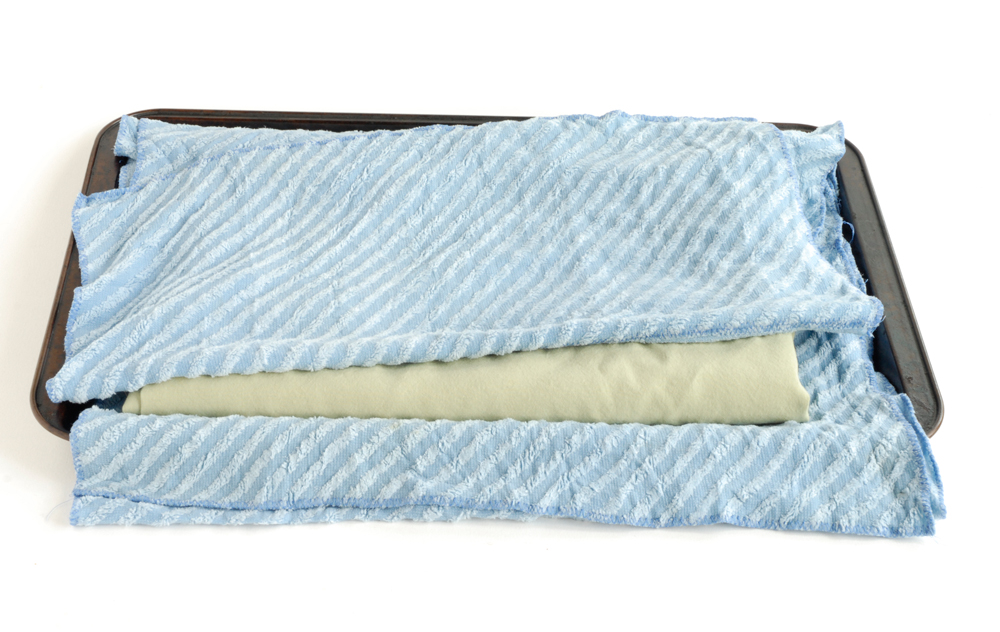
My oven set method: Preheat your oven to 400 with an extra metal pan inside to pour water into.  Boil some water.  Fold your printed piece and wrap in scrap cloth or place inside an old T-shirt, so that any scorching or oven gunk goes on that and not your creation.  You can also put old fabric or paper between items if you are worried about transfer of ink.  Don’t make your fabric bundle so dense that it will take too long for heat to reach all of it.  Place your bundle on a cookie sheet.  When the oven gets up to temperature, turn it off.  Open the door and pour a cup or two of boiling water into the extra pan.  Quickly pop in your cookie sheet and shut the door again. Leave everything inside with the door shut for 10 minutes.  If you have an oven thermometer and a window in your oven, you should be able to check that the temperature stays above 350° for at least a few minutes.  Common sense note, this method will not work for synthetics (although I did a partly polyester apron and it seems fine) or anything that will melt at those temps. If you have a piece with meltable parts, like nylon bag handles, you will need to iron the design/printed part only.


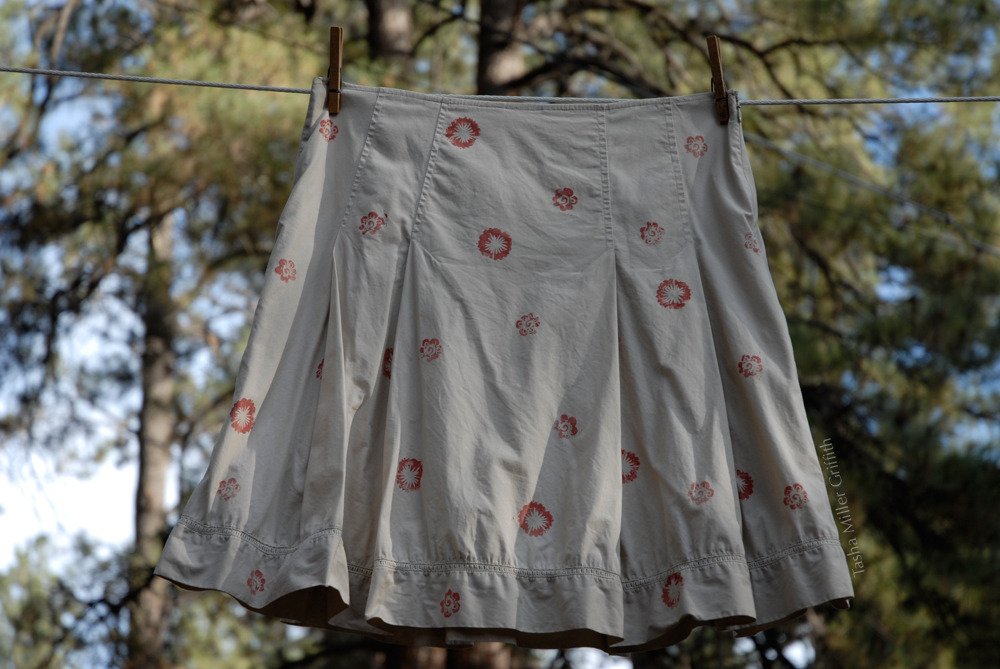
I have had good success with this oven method, I did the skirt below this way, without a steam pan, and it has survived years of washing and wearing without any noticeable fading in the design whatsoever.  In fact, I remember that I washed it before reading the manufacturer recommendation that you wait a week before washing the first time, and as I said it still looks great!  Some other folks that I shared the oven method with (and even myself once, when I didn’t turn off the oven – not a good experiment) have had some problems with fabric scorching around the edges.  I came up with adding the steam pan, since fabric can usually take practically any heat without scorching as long as the heat is wet.  I heat set a big batch of dish towels this way with my friend Megan a couple years ago, I checked in with her and she said that those designs have held up to lots of use and washing as well.


A couple of things that didn’t work: as extra insurance against scorching I tried wetting the old towel that I wrapped my last piece in before putting it in the oven.  Everything smelled like warm steamy fabric, but I don’t think it got hot enough inside.  I have also heard that some people use a commercial dryer, so I snuck into the laundromat with a couple of samples from my latest stamping day with friends.  I put all these test pieces though the wash 6 times, as I was doing laundry between then and now, and hung them on the line to dry.  They all show significant fading and some of the motifs are totally gone.  So for now my best suggestions are the ironing and oven methods above, I will of course post an update if I come up with a new and better way!


One more thing I’d like to talk about, and this seems as good a place as any, eco-friendly printing!  Part of what I love about DIY is the ability to turn something you wouldn’t use into something you will, and save resources and cash.  I hate it when I realize that I’m wasting supplies, or sending lots of extra stuff to the landfill when I’m crafting.

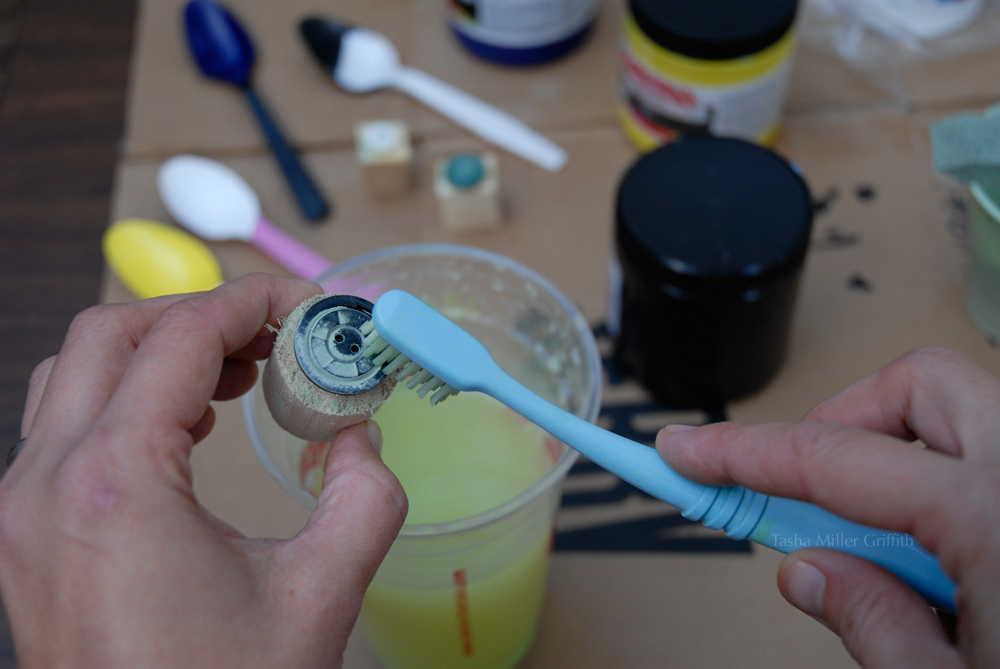
My tips for “green” fabric stamping are: for clean up, you only need a cup’s worth of water and an old toothbrush, and a rag.  When your hands or tools get messy, rinse them in the water, then wipe them on the rag.  Heat set the rag when you’re done to use again (it looks cool).  Reuse paint mixing cups by pouring out excess paint (into the trash, or onto something else?) and letting them dry before putting them away.  I use one plastic spoon to scoop paint for each primary color, and one to mix each new color.  I let all the spoons dry at the end and save them for next time.  The foam brushes I rinse in the clean-up cup, then a final time in the sink, and again let dry.  If you use something that’s still useful with paint on it, like a mailing box, under your paint jars to protect the table, the total waste is down to a little unused paint!

Well, that’s about it for this project, please feel free to add comments if you try printing, how does it work for you?  I’d love to hear more ideas for heat setting as well!  Stay tuned for more DIY . . .


Stamping on Fabric – With Hand Carved Stamps and Household Objects


Ok, so now you have a hand carved stamp.  Or, maybe you don’t yet.  How about stamping with something you already have around your house?  And, what gets me excited about either of these options: being able to use them on fabric and clothing.


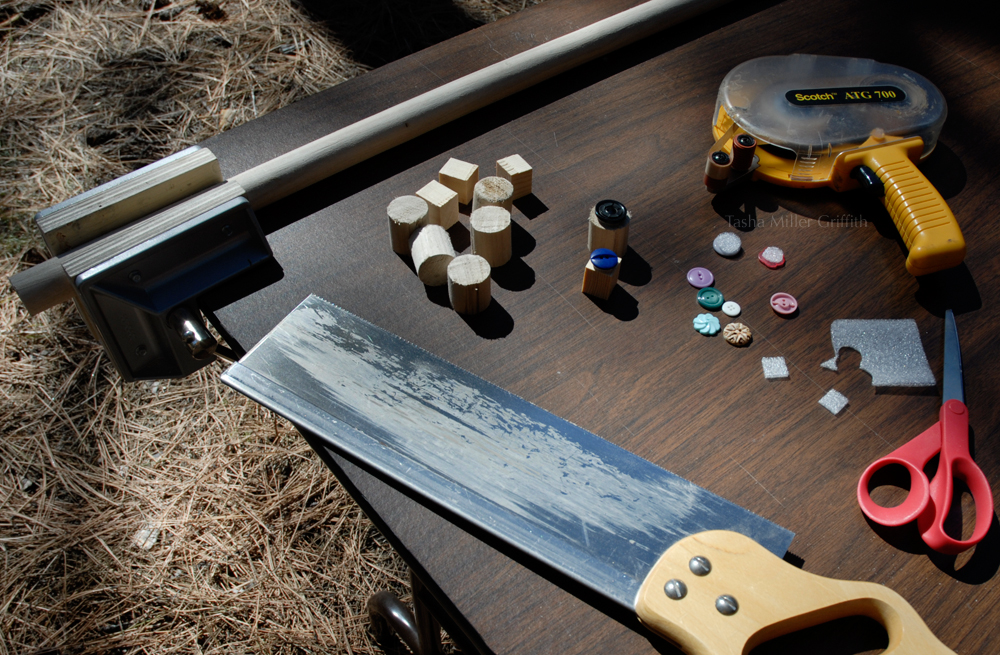
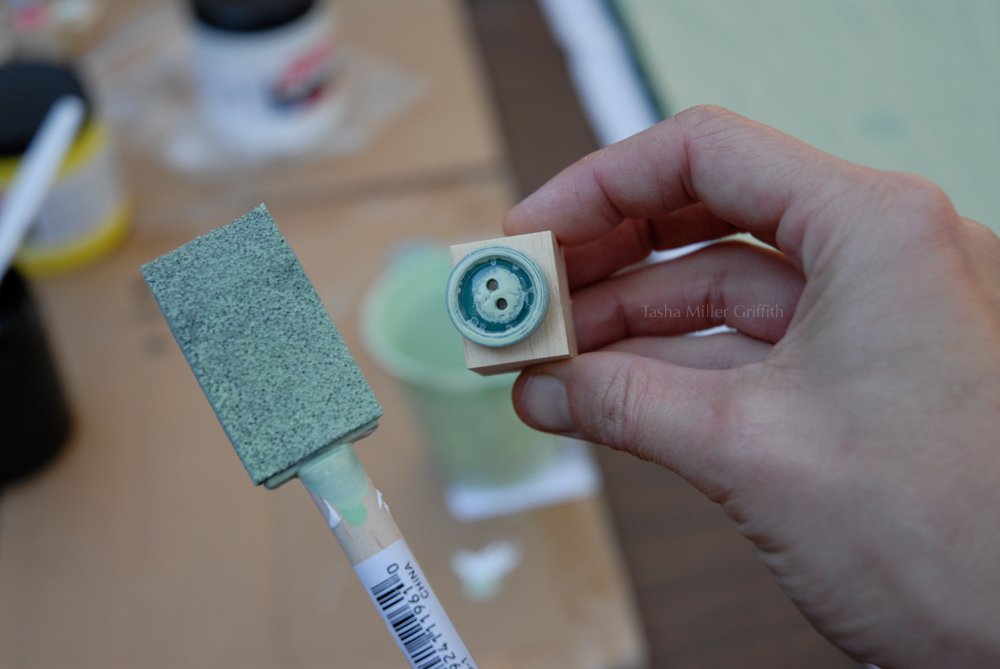
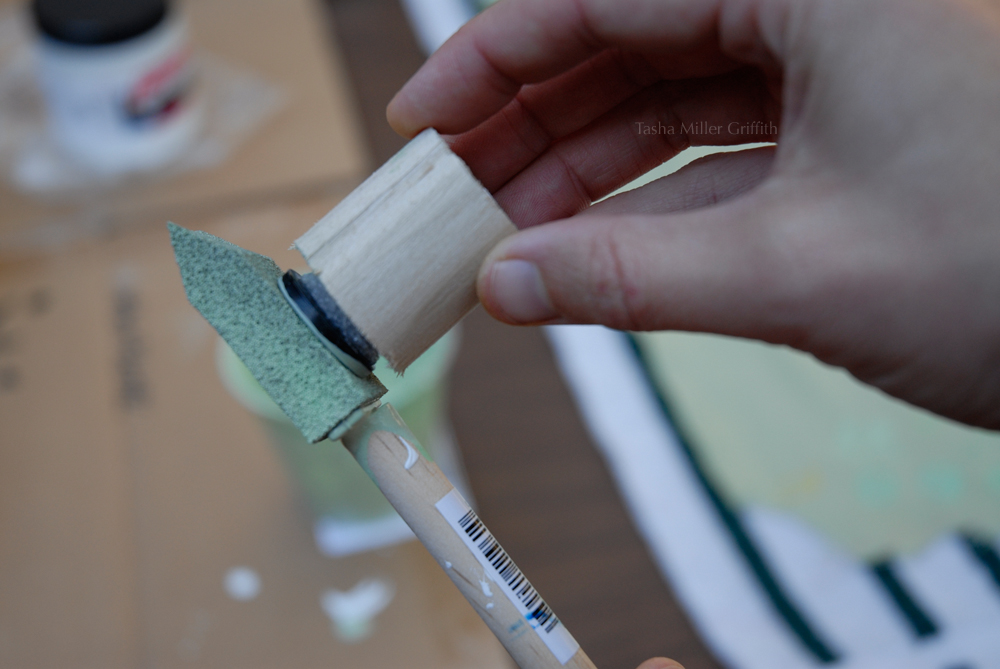
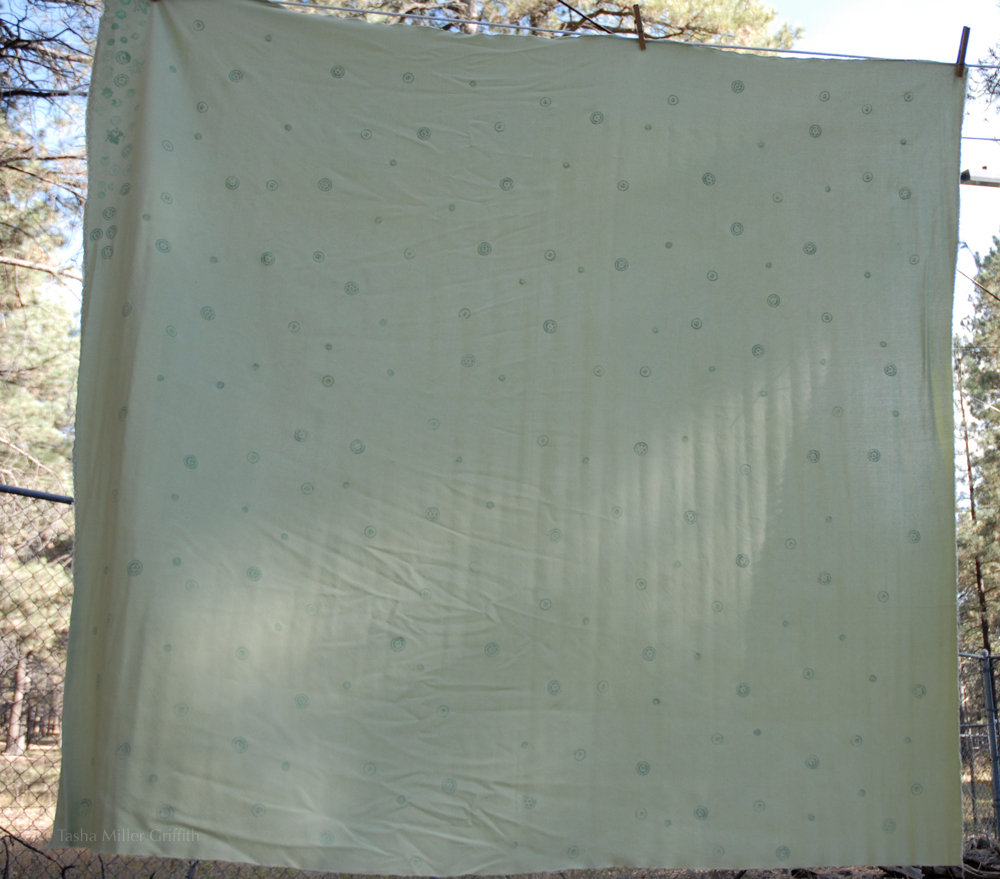
Before we discuss fabric ink and stamping, let me talk briefly about how I set up these buttons as stamps.  I got this idea from a really creative slideshow (on Martha Stewart of all places) which illustrates using all kinds of things you might find around your house to make some interesting designs.  My favorite was the buttons.  Some things already have an easy point to grab them by without getting your fingers covered in ink (like long pieces of wood, which you can see printed in the top photo), but buttons, not so much.  I cut some pieces from a leftover dowel and a small wood block, just using a clamp and a handsaw, they don’t have to be perfect in any way.  I did some quick online research and a couple of sources suggested using some kind of foam to back your stamps, to give them a little more give for even printing.  This seemed like a good idea since buttons are pretty much hard to begin with.  I used tiny pieces of dish packing type foam (we get it as packing material with some supplies) glued to the back of each button and its piece of wood with ATG, which once again I borrowed from the photo studio.  You can use any type of glue as long as it will hold the object and be water-resistant enough to be rinsed after you stamp.  And, you could use just about anything squishy for the foam, just cut the pieces smaller than your object, otherwise the edges of the foam may print.


Ok, time to stamp!  For ink, I used Speedball Water-Based Textile Screen Printing Ink.  I have gotten it from Blick, local art stores, and chain stores.  On the jar, it just says FABRIC Screen Printing Ink, but if you look on the side it also says water based and non-toxic.  I really like that you can thin this ink as much as you want with water, and you don’t have to worry about it if you get it on your hands, which is pretty much inevitable.  Plus it is permanent on fabric with heat setting.  It comes in lots of colors.  I like to mix my own using the three primary colors; the “process” cyan, magenta, and yellow will give truer mixing results than the regular red blue and yellow.  You’ll also need white and black.  A tip I learned from Lena Corwin’s book Printing by Hand (I highly recommend this book if you are interested in more about printing!) is that mixing in a little of both white and black will give you a more subtle color (less screaming bright) and I love subtle colors.

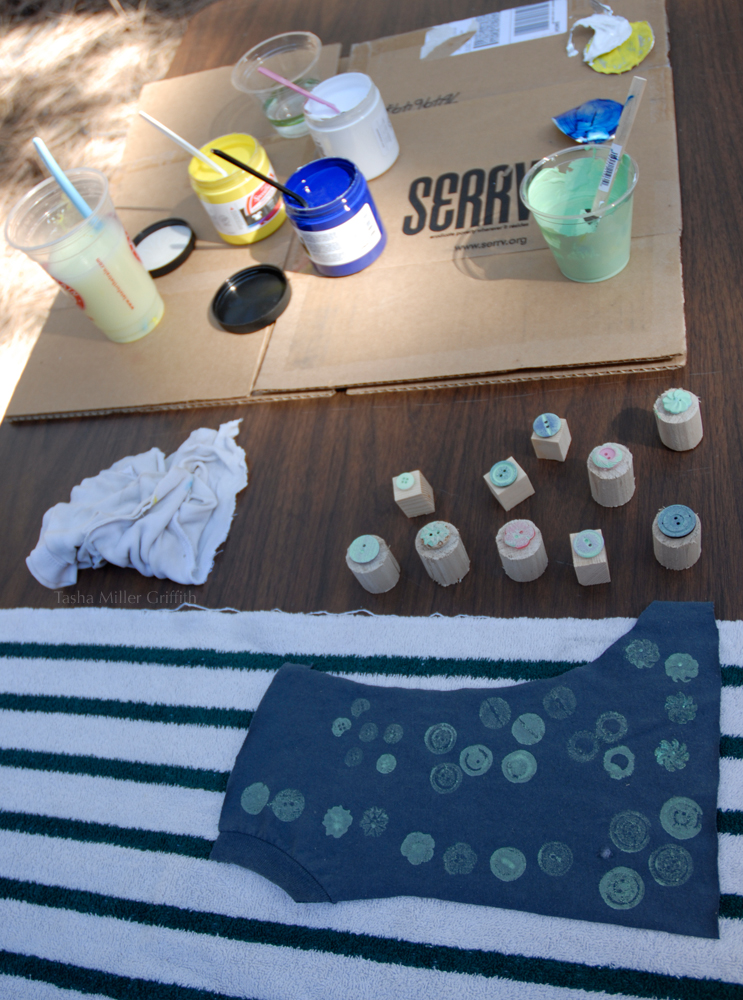
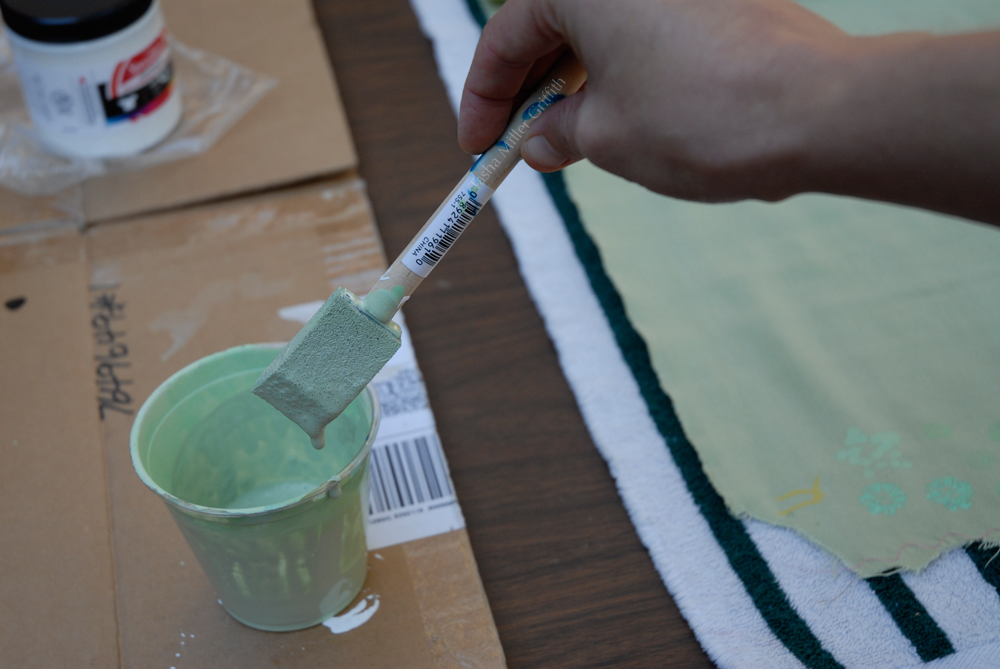
To set up for printing, you’ll need ink, a little water for mixing, and more for washing things off (a big cup full with an old toothbrush for scrubbing is perfect) and a wet rag to wipe your hands and tools on after you rinse.  It’s easier to print on thin fabrics if you put down an old towel underneath to give the surface a little more give, which can allow more details of the stamp to print.  Putting all this on a big table you can wipe off is ideal, and it’s nice to have something under the messy ink part to catch drips.  I used a box since I figured it would still be good for shipping with ink on it.  I used one spoon to get out each color, one to mix my color with, and a small foam brush to hold the ink for stamping.  I let the spoons dry when I’m done, and wash the foam brushes to save for the next time.


When mixing ink colors, start with as little ink as you can, you’ll add more as you decide what to add to get the color you’re looking for (a color wheel can help here), plus you’ll be adding water, and stamping doesn’t take very much ink in any case.  Keep in mind that the ink will dry slightly darker in color than it looks wet.

Having scrap fabric to test on is essential!  The closer the fabric is in type, weight and color to your intended project, the better you’ll be able to see how the stamps are coming out.  For this project, I just used a small section on the edge of my fabric for testing, changing the color or the dilution of the ink a little bit at a time and waiting a couple of minutes to see how the results looked as they dried.

I like the ink to be absorbed into the fabric so that it doesn’t leave a hard or crunchy surface, but looks more like a dye.  To get this effect, I add water until the ink slowly drips from the foam brush when I lift it up.  The consistency you want may vary with your fabric, again, testing is key!


Here is my best fabric stamping tip: squeeze the ink out of the foam brush until it’s not dripping, and only releases ink when you press on it, like a stamp pad.  Then, gently press your stamp or object against the sponge to get a coat of paint.  You can see which parts are going to print by where the ink is on the stamp or object.


Keep the foam brush in one hand, and bring your stamp back to it for a fresh coat each time you print it.  The sponge will hold enough ink for a bunch of stamps before it needs more from the cup.

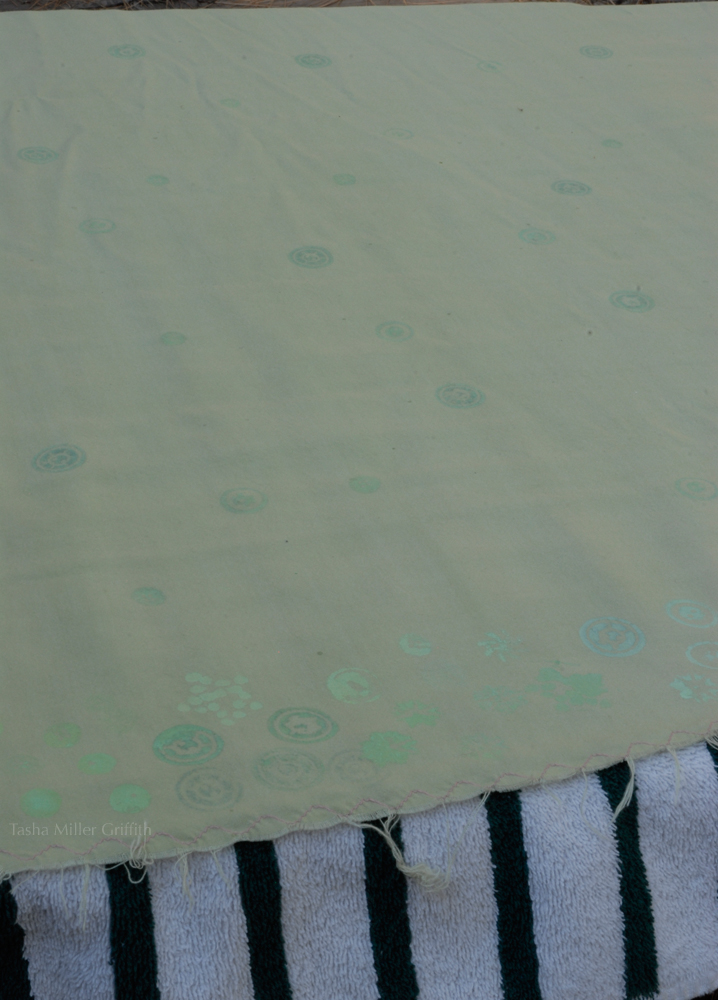
I found that a light coating of ink, and a soft rolling motion against the fabric with each stamping helped the full possible detail of the buttons to print.


That’s about it!  I place my stamps pretty much randomly, alternating whichever ones I am working with until I get a design density that I like.  It helps to step back and take a look, especially if you are printing something big that you can’t work on all at once.

For troubleshooting, take a look at the very top photo (click to enlarge it).  If you have too much ink on the stamp or the ink is too watery, it will spread out all around your stamp and the detail of the design will be lost.  Clean the stamp off, squeeze more ink out of your sponge, press it gently on just the surface of the stamp and try again.  If it’s still too flowy, add more ink to your color to reduce the water content.  If you don’t have enough ink on the stamp, you’ll get a pale ghost of an image.  If the ink is thick, like it comes out of the jar, it will dry harder and raised on the surface of your fabric, which you may want, depending on your design. If your fabric is wrinkled, iron it before you start.  Soft wrinkles won’t get in the way too much, but if you stamp over a crease, you can see it when the crease opens up.

One last troubleshooting thing: some objects print better than others.  Some of the buttons I tried had details too fine to print, but this will depend a lot on what fabric and how much ink you use, so test it out!


Here’s my finished button printed fabric.  I think it may become a skirt.


Stamping is also awesome for reviving finished clothes or linens that are a little too plain.  I used some of my aunt Barb’s hand made stamps to decorate this previously just beige thrift store skirt.


While your stamped fabric is drying, it’s worthwhile to clean off your tools, since this ink can eventually clog your stamps if left to dry.  Using the old toothbrush and a little water from your clean-up cup works great.

Next time, I’ll post about heat setting the ink, lots of options for this important step that makes the finished product washable!  Plus, a little bit about “green” crafting and less waste from what we make.

In the meantime, have you tried something similar?  I’d love to know what you did and how it came out!


Carving a Handmade Rubber Stamp

This will be the first post of a couple about making stamps and using handmade stamps and objects to print on fabric.  For some reason, once you add the words “on fabric” to any art technique, I am suddenly interested . . . but of course you can also use hand carved stamps on paper, and even clay!  My aunt Barb taught me to make stamps, she uses hers to make beautiful collage-type art, in her handmade books (where I found this design which she let me use in an earlier post), and in her pottery work.  We talked about a feature of her art to go along with this how-to, but it’s a busy season for both of us, so we’ll save that to look forward to later.


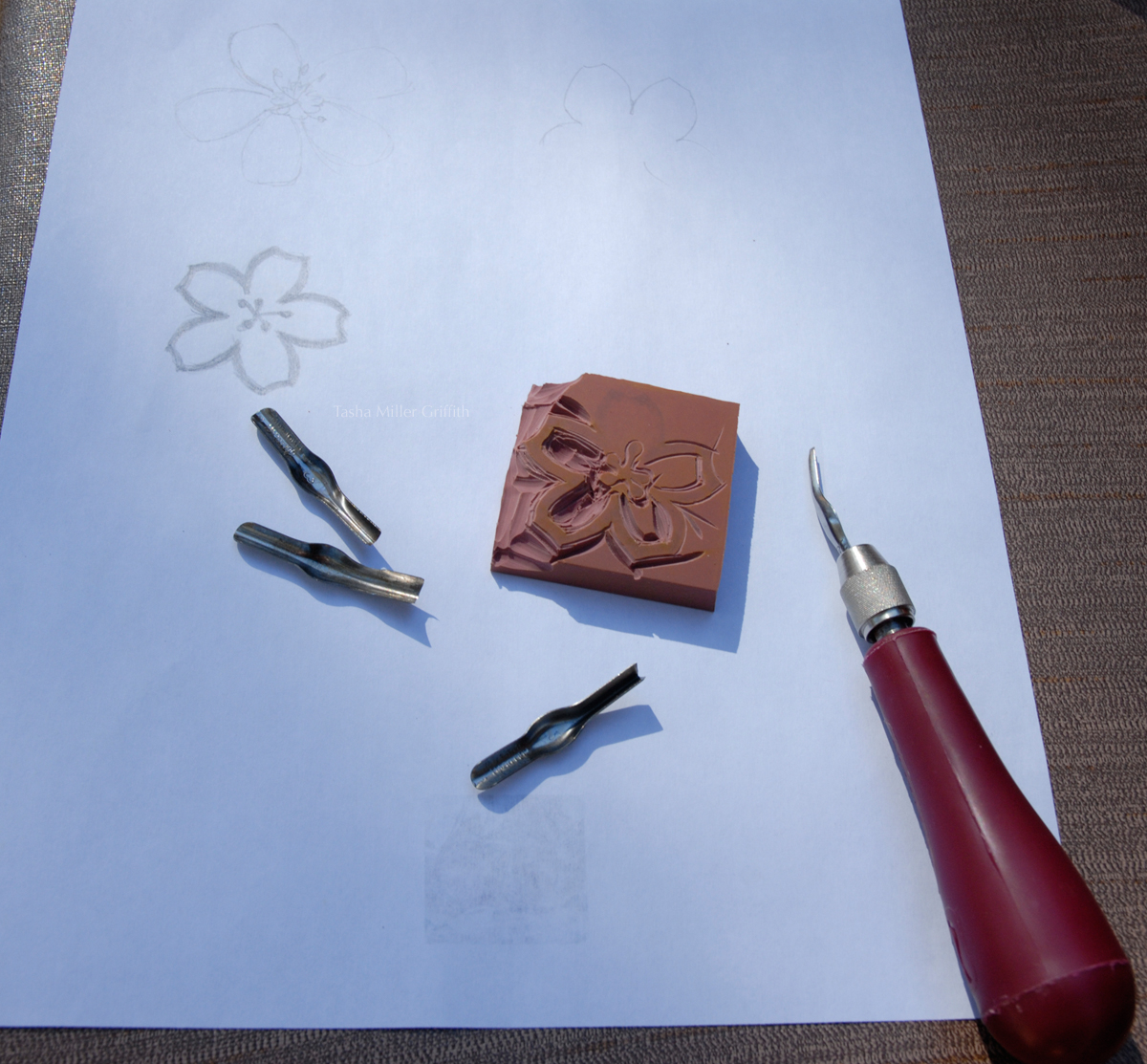
For today, how to carve a stamp!  You will need a tool called a linoleum cutter (seen in the second picture), which you can get at most art stores, and some kind of block to carve.  Lately I’ve used two kinds, pink stuff called “Speedy-Carve” from Speedball, which I got at the chain art and crap store here, and brown “Eco Karve Printing Plate” from Inovart (made of recycled material!), which I ordered from Blick along with the paint.  The pink kind is a little softer, slightly easier to carve, and much easier to see to see your pencil designs on because of the lighter color.  It’s a little thin for bigger stamps, which can get floppy if you don’t attach them to anything.  I liked carving and printing with the brown stuff, and it’s thicker, and easier to see what you have carved out than the pink, but it can be hard to see your transfer design on the darker surface.  When I started making stamps we used a whitish carving block, which as far as I can tell from the scraps was also made by Speedball.  It’s not my favorite, little bits of it can crumble away while you’re carving, where you’d rather they didn’t (you can kind of see this in the inside corners of the star stamp).  In any case, you can probably find a material near you to try it out.

Now that you have your materials, you need a design.  I have been into five-petaled flower designs lately, and I liked the artwork on the posters for the cherry blossom festival we saw in DC earlier this year, so I decided on a cherry blossom stamp.  You can draw on the rubber carving stuff, but I find it easier to draw on paper and transfer the design.  It’s easier to erase your mistakes or start over, and the design when you stamp it will be the same as you drew it, instead of a mirror image (because it’s flipped once when you transfer it and again when you stamp).

It helps to use a soft pencil and make thick lines.  You can get a fair amount of detail in your stamps, but don’t go crazy with fine lines for the first one you make!  Once you have a design you like, flip the paper over onto the carving block, hold it still, and rub it with something hard and flattish, like a spoon or a bone folder, to transfer the design onto the rubber.  You’ll get more out of your carving blocks if you place the design on a corner instead of right in the middle.


Time to carve it out!  I think it’s easier to cut out the section of rubber around your design with a razor knife before you carve it.

The idea is to cut out everything that you don’t want to print, from around the design that you do.

Loosen the head of the linoleum cutter and put the smallest carving tip (sharp side goes out – watch out, it’s sharp!) in the curved slot that opens on one side of the ball as you loosen.  The previous sentence probably makes zero sense unless you are looking at the tool, but that’s Ok.  Start carving; each one of the tips for this tool acts like a sharp scoop, use them point or scoop down to carve out pieces of rubber that you don’t want.  I like to start with the smallest tip and go carefully around the edges of the design, it helps keep me from accidentally slicing through it with the bigger cutters.

Cut away from inside corners to both sides.  It’s helpful to turn the block, as well as the tool, while carving around curves.

Once you get the design outlined, switch to the larger V shape tip, and use it to cut around your outlines, making a deeper channel.  Then, use the scoop to carve out large sections that you don’t need.  Cut away from your design at a steep slope on the edges of your stamp, to keep them from printing.  Then go back with the smallest V tip and clean up any leftovers.  You can see this process progressing clockwise around my flower stamp above.

Try out your stamp with an ink pad and paper, you’ll get to see how it’s coming out, and any areas you don’t like will be helpfully colored with ink, so you can see where to carve them off.  Some little bits of messiness are part of the charm of a handmade stamp, but you can decide how much of that you want.


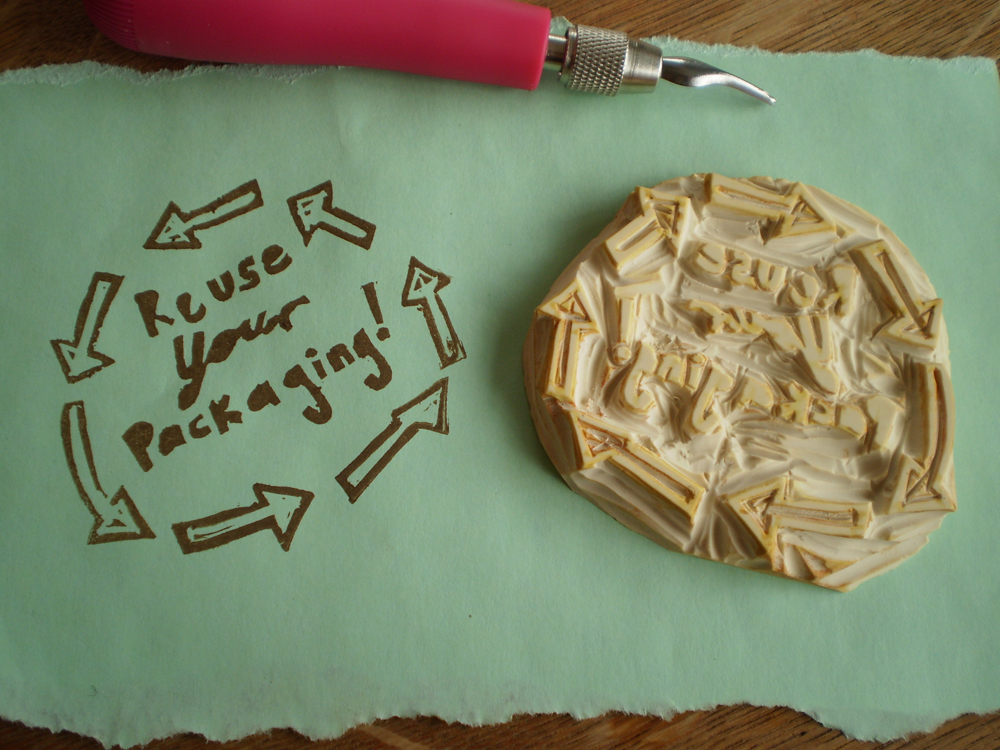
You can carve just about anything into a stamp!  I made the one above while hanging out with a friend, to stamp on the re-used boxes and envelopes that I send orders in (it also appeared on KP’s blog as part of her recycle package challenge).


If you’d like to jump- start your handmade stamp collection, talktothesun on Etsy sells some great-looking ones (not my shop, I just like it)!

Have a question?  A stamp carving tip? A material you like?  Leave it in the comments, I’d love to hear what you think!


Next time: use your stamps (and other stuff) to print on fabric.


About Gauge in Knitting

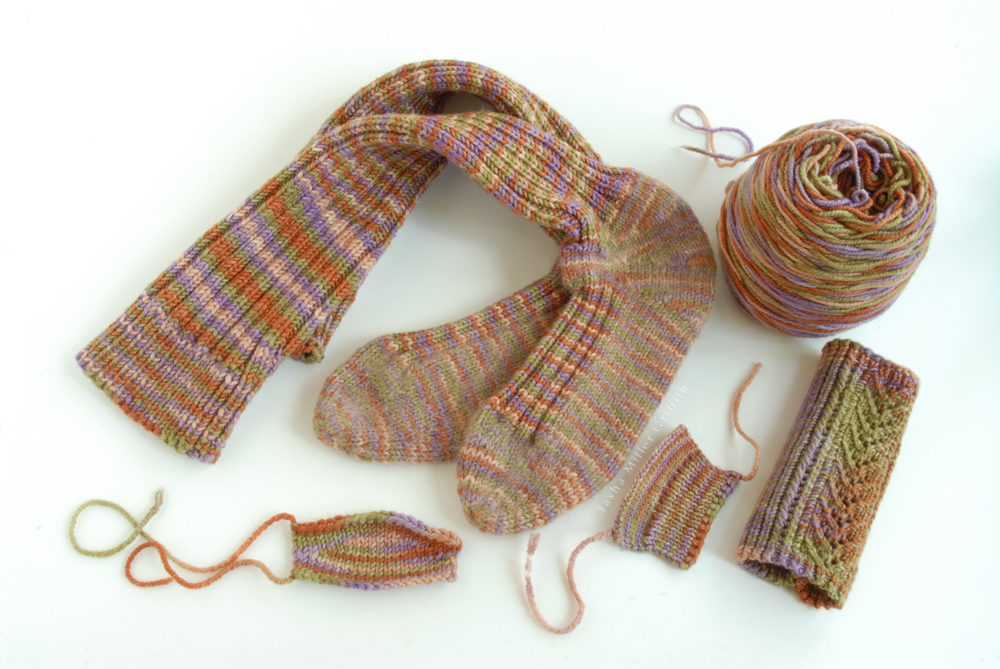
One of the things my knitting students have a lot of questions about is gauge, so I thought it would be a good topic for a post.  I am helped out on the visuals here by my aunt Kathy, who gave me a lot of this yarn (thanks Kathy!).  A LOT – I made all this stuff, gave 2 skeins to my friend Becca, and still have the ball you see left.  It’s been interesting for me, since I would normally not make several things from the exact same yarn.

Ok, so quickly, in knitting, gauge is: how many stitches per inch you are knitting.  It varies with the yarn and needles you are using, and with your individual tension, how you hold the yarn, so it will not be the same as the person sitting next to you, even if you are using the exact same materials.

A little math:

Imagine you are making a sweater.  If the pattern calls for 5 stitches to the inch, but you are knitting at 4.5 sts/in (knitters love abbreviations, have you noticed?) and you multiply that by the 200 stitches you need for your sweater.  What can seem like a small difference is suddenly 4″, the difference between it fits or it doesn’t.  It follows that the bigger and/or more fitted the project you are making is, the more important it is to know what your gauge is going to be before you start.  I nearly always make a sample square to test gauge before I start, a big one (maybe a foot square) for an important project, and a smaller one for something that’s easier to take out and start over.

How to measure your gauge:

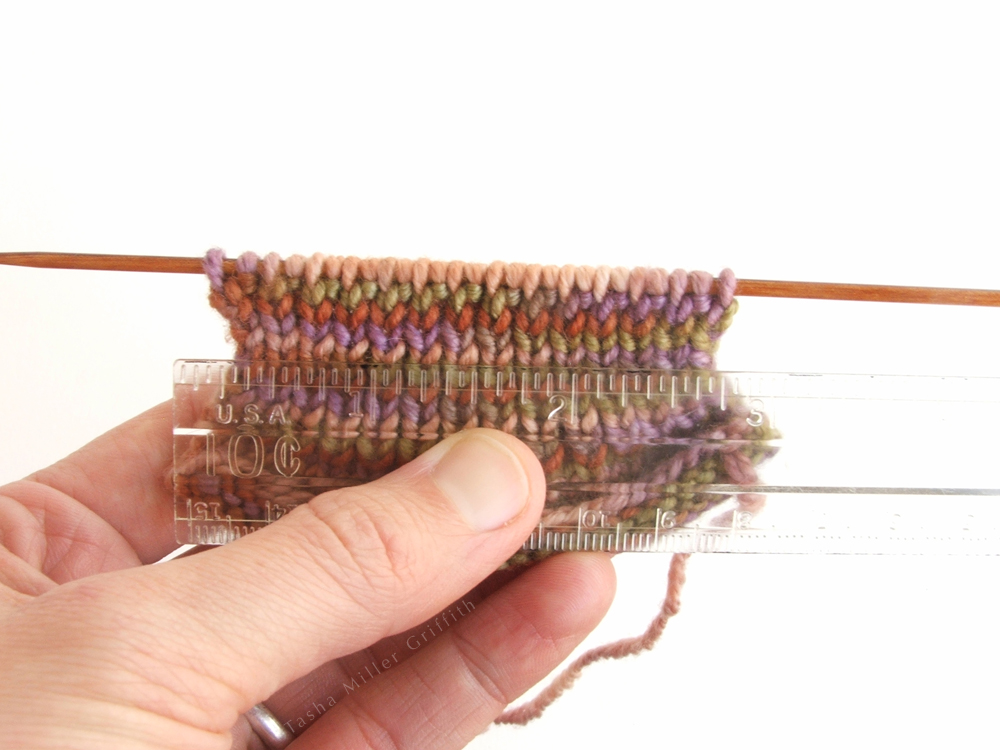
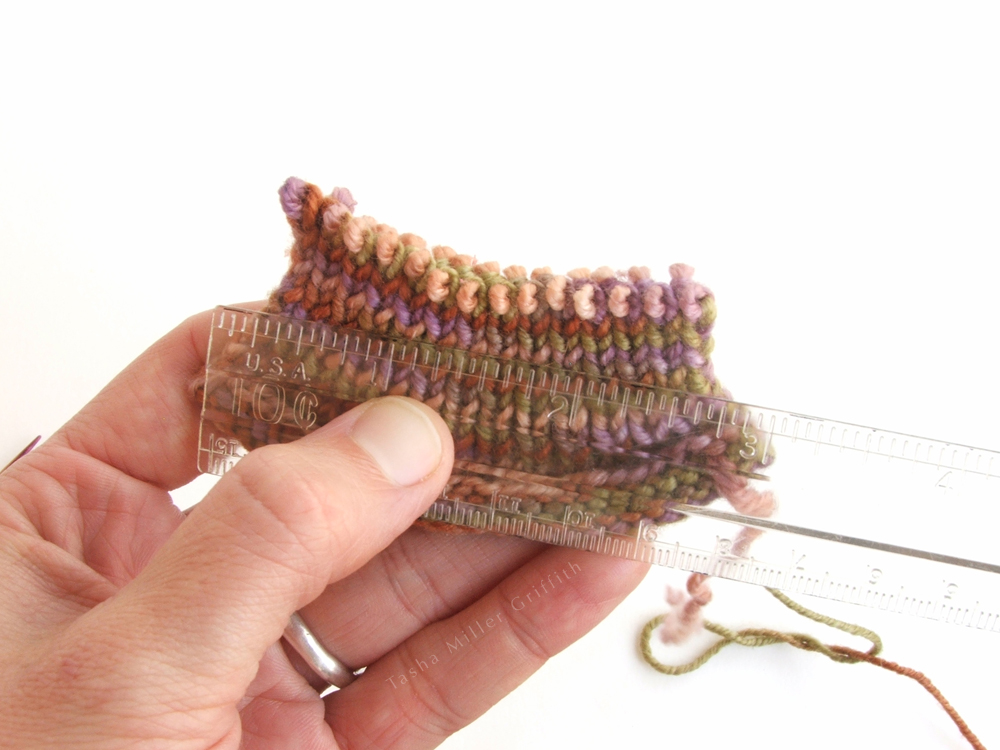
Each “V” or tiny mountain is one stitch.  Line your ruler up with the starting line between two stitches.  Count the stitches (it helps to have a spare needle or something else smaller than your finger to count with).  If you count over more stitches you’ll get a more accurate measurement, especially if you have halves or quarter stitches in each inch, so count over 2″ or 4″ or however many you can in your sample, and then divide to get your number of stitches per inch.  When measuring, take your sample off the needles, or slide it onto the center cable if you are using a circular needle, or bind it off if you want to keep it.  You can see here how the needle is holding the stitches apart, taking the sample off changes the measurement by 1/2 stitch per inch!

If your gauge is not the same as the gauge in your pattern, you have a couple of options.  One is to try to loosen or tighten your gauge, usually by using a bigger or smaller needle.  If you knit loosely, there’s a good chance this won’t work very well, but you can tighten your stitches by keeping them packed closely together on the needle as you knit each one.  Use a finger on your right hand to keep them from spreading out, and thus using more yarn for each stitch.  This fabulous tip is from Stephanie Pearl-McPhee, by way of Cat Bordhi in her amazing workshop earlier this year (Sweet Tomato Heel workshop, from whence these socks)!

Your other option is to do a little more math.  If you like how your sample looks and think it’s a good thickness and drape for your project, you can figure out the finished size of your project by diving the number of stitches suggested in your pattern by the suggested gauge.  That will give you the size in inches, which you can multiply by your personal gauge to get a new total number of stitches.  Be aware that if you choose this option, you may have to make more adjustments as you go, you might need more or fewer decreases, etc.  Knitting lends itself to experimentation (and taking out small sections, then trying them again) so go for it!

Which leads me to my last point – gauge is all in how you see it.  Yarns knit tighter will yield a thicker and stiffer fabric, which might be great for a cowl that stands up on your shoulders and keeps you warm.  The same yarn knit much looser might make a lacy, drapey scarf.  Or it might not, depending on other characteristics like the fiber and the way it was spun.  Try a little bit and see!

If you are interested, here is the breakdown of the things I made and their gauge.  All were knit by me, the yarn is Fiesta Boomerang (100% superwash Merino, I looked it up and they still make it, although not in this colorway).  The small curved sample and the feet of the socks (which I knit along with a mohair & silk yarn, another awesome tip from Cat’s workshop) are both 5.5 – 6 sts/inch, which for my taste is about ideal for this yarn.  The legs of the socks (pre-that tip about squishing the stitches together) are about 5 sts/inch, or would be if they weren’t ribbing.  The tight square sample was made in preparation for the lace mitt (the tube-looking thing), the tightest I could get this yarn was 8.5 sts/in.  It did make a very firm and stretchy ribbing!  By the way, the gauge suggested on the label was 4.5 sts/in – I don’t know where they get those, but they are often way off what I think is reasonable.  A better guide is the weight of the yarn, especially if you are looking to substitute for another yarn suggested in a pattern.

If you think of anything I haven’t covered, feel free to ask!

DIY Envelopes


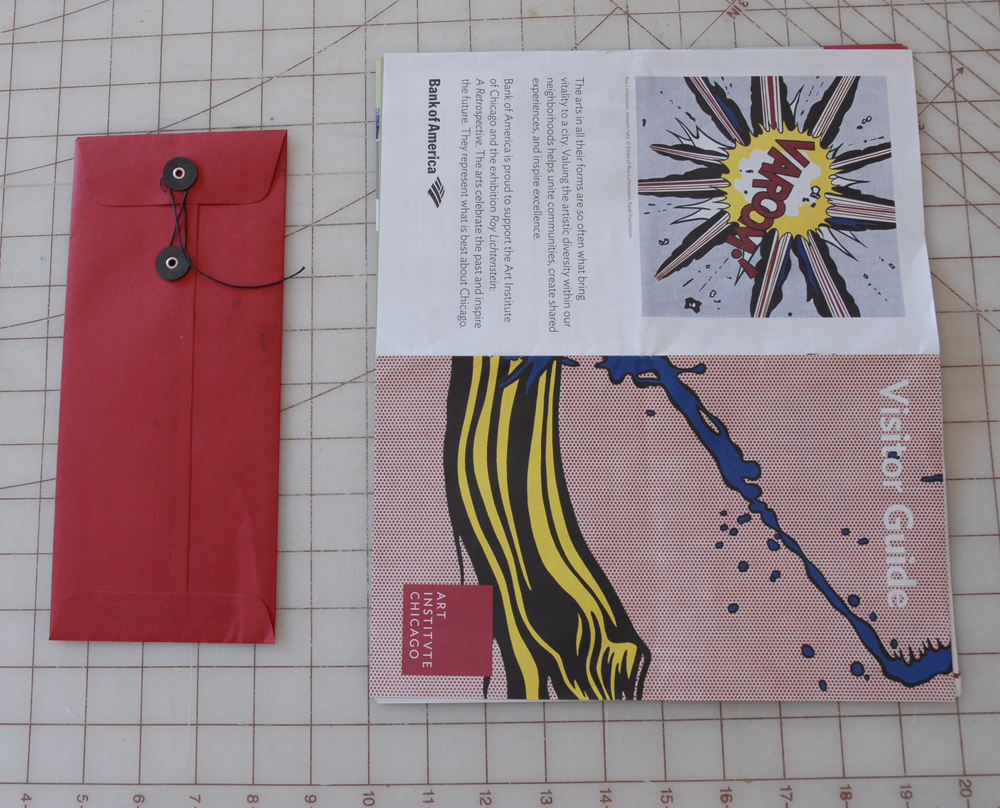
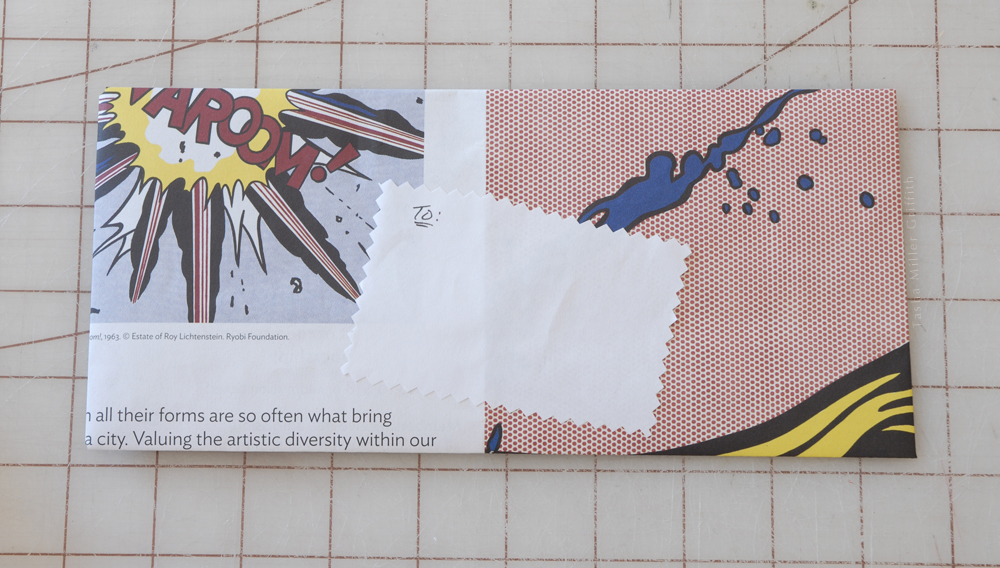
Really, why didn’t I think of this ages ago?  But actually, my lovely aunt Barbara introduced me to this idea at our craft retreat, which she in turn got from one of her teachers.  I have made a few handmade cards, and looked for envelopes to fit them, but it never occurred to me to just make one!  And, you can use all kind of cool recycled paper.  The kind that is too pretty/interesting to just put in the bin.  I going to use this map and guide from The Art Institute of Chicago, mostly because it has the word “varoom!” on it in big letters.


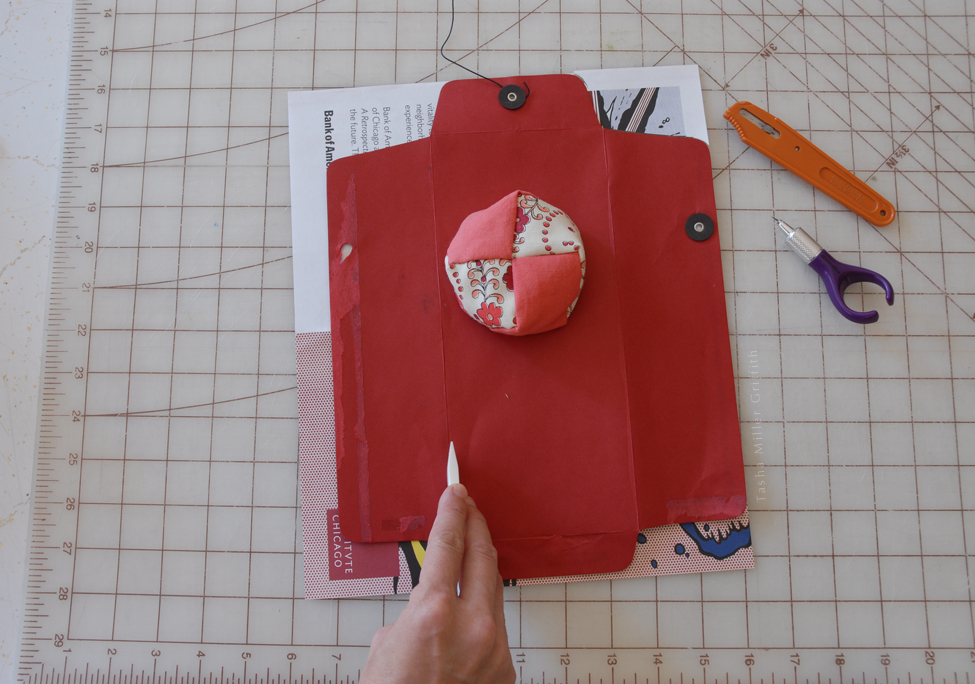
I’ve had this red envelope for quite a while, I love the shape and the old-style closure.  You can use any envelope you like as a pattern, just peel it apart carefully so that you have clean edges to trace.  You can also buy plastic templates in various sizes, or print out paper ones from lots of online sources, search for “envelope template.”  I like using an envelope you already have to start, since it’s right here ready to go.

In any case, check out the placement of your envelope on the new paper to make sure any motifs you really like will be where you want them.  Either use a paper cutting blade (hence my very old cutting mat is my backdrop today) or trace around your envelope and cut it out with scissors.  Use a bone folder, or similar hard but not too sharp object, to score along the folding lines.


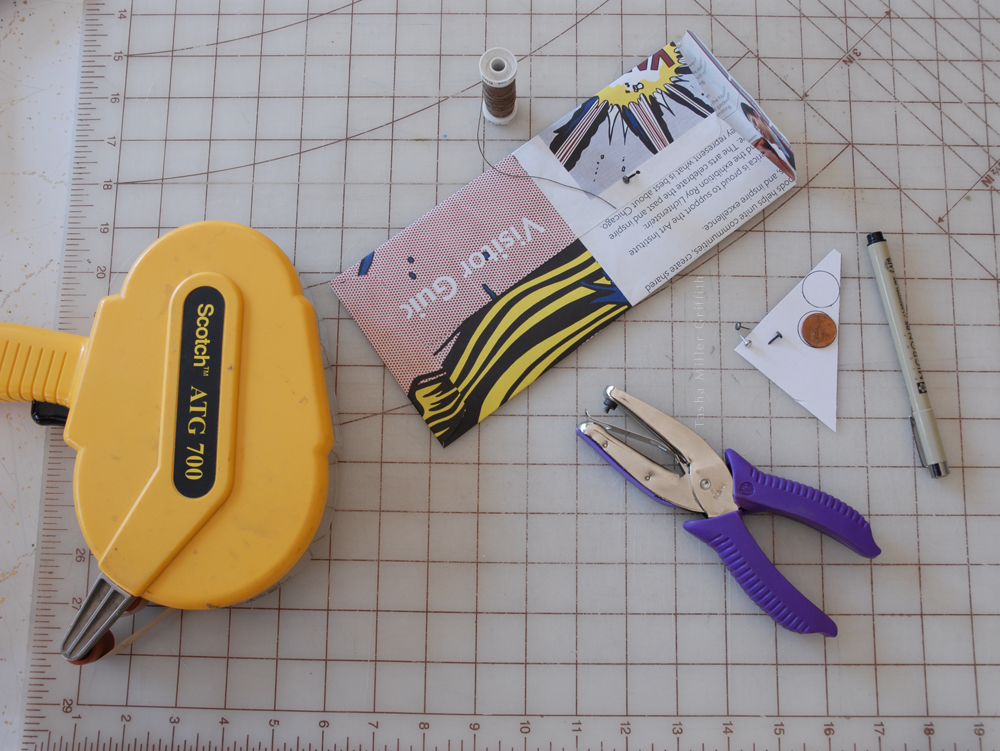
Fold in the sides and stick your envelope together using glue stick, paper glue or ATG (borrowed from the matting and framing part of our studio).

For a simple envelope, you are done!  Just glue the top when you are ready to mail. Ridiculously easy.


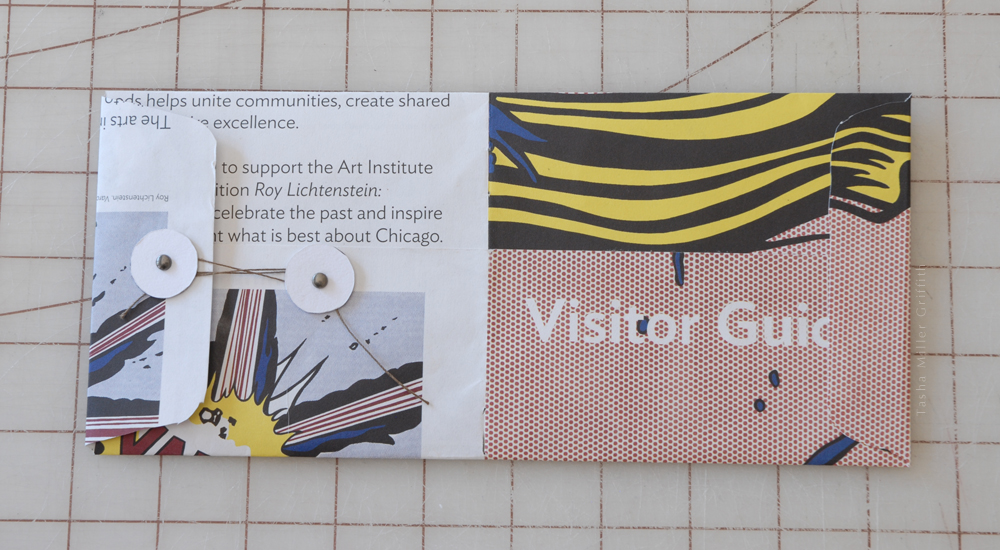
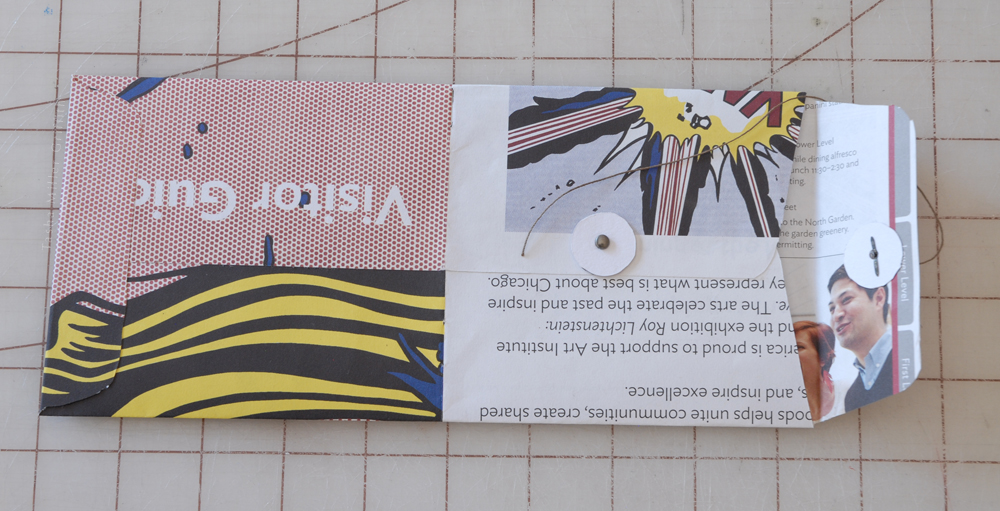
I wanted to recreate the loop and tie closure from my pattern envelope, so marked the position of the circles from the original when I cut it out.  I traced a penny on heavier paper, and used two thicknesses glued together for each circle.  I used metal brads and a bit of top stitching thread, tying the thread in a knot around the brad, and slipping the knot under the paper circle before sticking it through the envelope.  Gluing an extra circle on the back for reinforcement seemed like a good idea as well.


I also think it would look great to glue or sew on a big snap to close the envelope, or a use buttons and loops, or make a reusable envelope out of something hefty and sew it together, or make your own folders . . . sometimes I think the measure of a good idea is when it gives you ten other ideas at once!

At our retreat I made a big map-velope which has two layers to make it sturdy, plus some small ones, to hold business cards, etc.  And of course you can decorate them!


I hope this gives you a bunch of new ideas, too!

(If you want to keep up with all my new ideas you can now Follow my blog with Bloglovin  Actually, you could before, but now I am officially claiming it.)

Creative Retreat Projects

So, I thought I would share a few of the projects we made this year at my fabulous family and friends retreat.  Each year all the women in our little circle get together and create and share and cook and eat, and magic happens.  Not like spells and potions (unless you count margaritas!), but a real feeling of this time being more than the sum of its parts, allowing us creative expressions that it can be so hard to find in everyday life.


This year thanks to the generous donation of time and effort by a friend of my aunt’s, we got to try encaustic, an ancient technique of painting with wax that I have admired in the work of some of our art show friends for some time.  I was so excited to try it out, and impressed by how everyone jumped in and made art.  Really, playing with warm wax is pretty irresistible.


We also got to make lip balm (beeswax again!) and flavor it ourselves with oils.  Plus knitting, screen printing, a field trip and making envelopes!


Even if you don’t have your annual craft retreat put together (yet!), one thing I find keeps me sane all year round is just a little creative time every day.  I started setting aside an hour a day for sewing in college, and I was really shocked how much more I got done.  Now I work on creative projects a lot of the time, but I found that I still need a little bit of the day that’s just for me, that I can spend however I want, regardless of whether the product will ever make money or even appear on this blog.  Even 20 or 30 minutes when I’m busy, to just put my brain on a different track, leaves me refreshed and thinking outside the box again.

What do you think?  How do you structure your creative break time?


(PS There’s still time (until tomorrow morning) to win a Fiddleheads hat.)

A New Month, A New Challenge – Spark Your Summer

The thing I love about setting a particular goal or participating in a challenge is that it can push me to take something I am vaguely thinking about doing and make it something I am actually doing and concretely thinking about.

I loved participating in Me Made May’12 this last month.  I was surprised by how much pride and self-sufficiency I felt wearing at least one me-made garment every day, even though I didn’t make anything new for the challenge!  It also got me thinking about what I really wear and how I want my style to evolve.  Although I’m not sure I would want to spend as much time thinking about my wardrobe all the time as I did in May, it really pushed me to better define my style (see this post), to figure out what I really need to make (pants!), and to meet some other sewers/thinkers/bloggers, all of which has been wonderful.  In another unexpected spillover, after MMM ended I found myself coming up with new combinations of my not-self-made clothes to better fit my style – bonus!


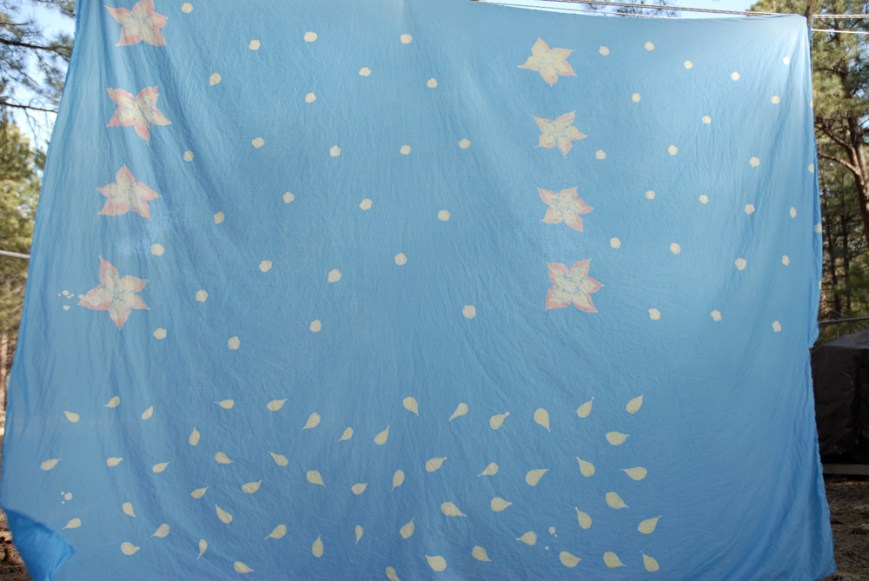
So when my new friend Alessa, along with Ali and Sarah, announced a new challenge for June, I was pretty much in at the word go.  Plus, this one is a little less involved, you just sew one special garment in June, something you’d like to wear all summer.  It’s good timing for me, since I have fabric I batik dyed last summer that’s supposed to become a dress in time for a special event which starts June 20!  I’ll be making my self-drafted sundress, with a few modifications from the first one.  And, I’ll be home late tonight!!  One thing I have really missed during MMM is my studio – sewing starts tomorrow!


Again, it seems to me that there’s no reason you have to sew to set yourself a helpful challenge for this month.  What about a cooking one?  An art one?  What are your broader goals and how can you set a specific goal to help you get there?  What would you like to do more of?  Why not set aside a specific amount of time for that every week?  Whatever you decide to do, I’d be willing to bet you’ll get some unexpected lovely side effects.

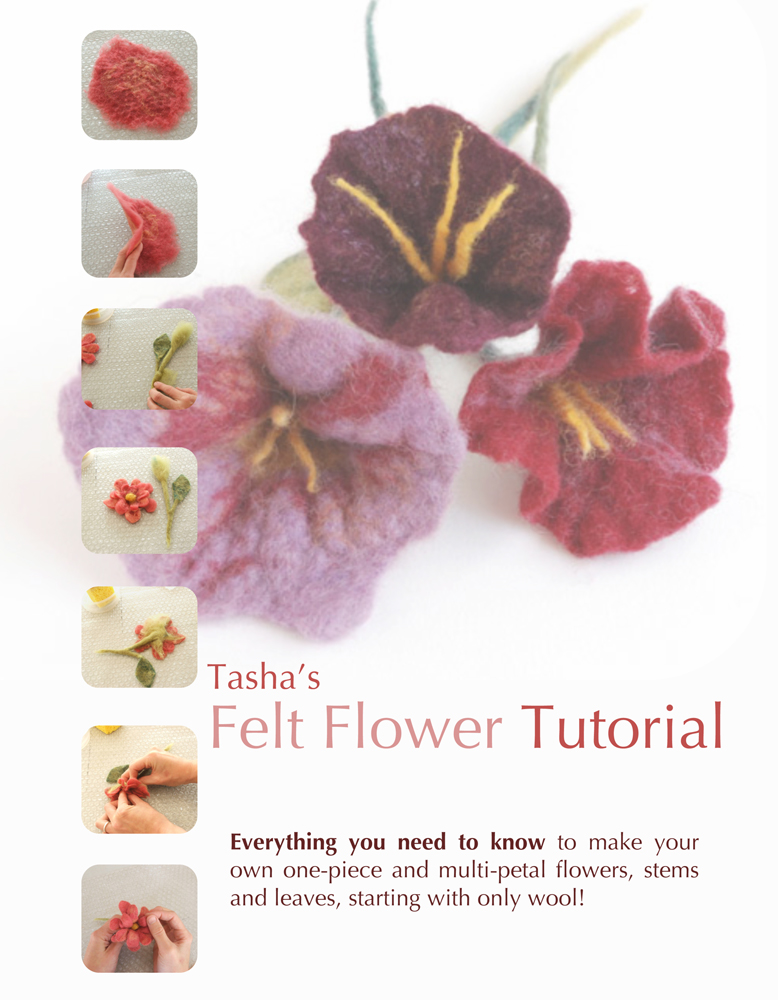
Announcing My First Tutorial!

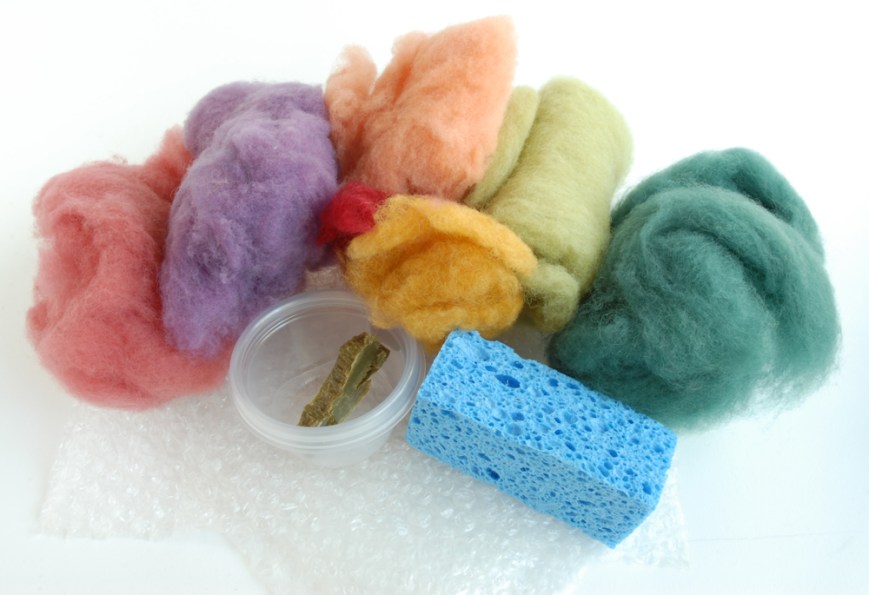
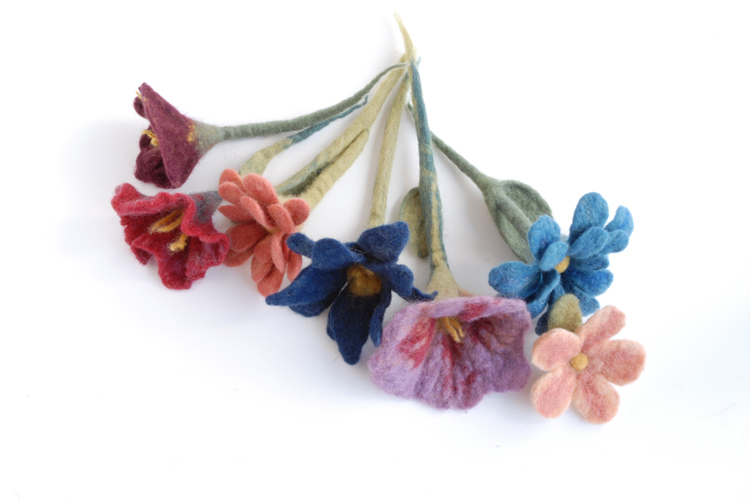
I’m super excited to announce that my first tutorial is finished and available in my Etsy shop!  And, it’s also available as a kit with wool and practically everything else you need to get started.
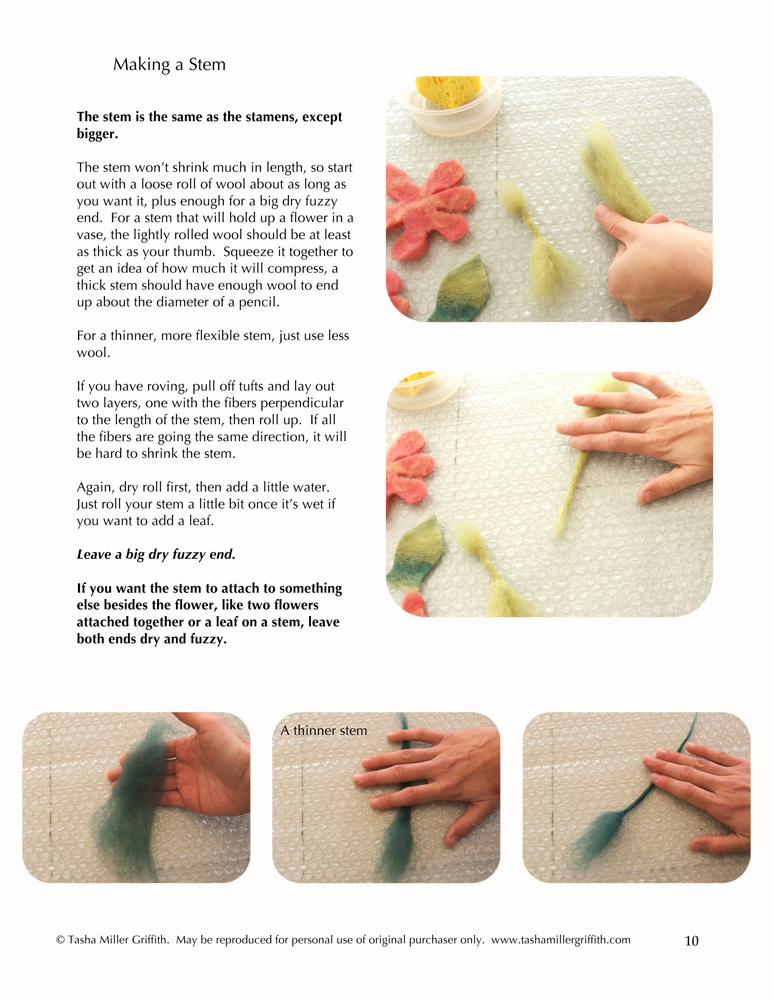
I’m really happy with how it came out.  I’ve spent quite a bit of time and energy on it, but 28 pages, lots of flowers, and over 115 color photos later (LOTS of photo editing), it’s everything you need to know to make your very own felt flowers, all from my brain, hands, and laptop!
Looks interesting, right?  Why not try it out!