All’s Well That Ends Well, but Please, Don’t Put Your Wool in the Washine Machine


viola outfit 2


At one point, I considered not writing this post at all, because I’m pretty embarrassed about how this skirt got to the point where it needed remodeling in the first place.  But in the end, there was no way to not write about it, especially since I ended up wearing this once-shameful skirt to dressy Flagstaff event (maybe the only dressy Flagstaff event? We always joke that people here wear jeans to everything) . . .

I made this skirt, as near as I can figure, about 10 years ago!  This was a time before I knew much at all about wool, other than the basics; it comes from sheep, it’s been used since ancient times, people say it’s lovely, etc.  It may be worth pointing out that this was also years before I had felted anything, on purpose or otherwise.  You probably see where this is going.  I put a sample of the fabric though a normal cycle in the washing machine.  Nothing happened, the fabric looked just about the same as when it went in.  “Great!”  I thought.  I made up the skirt using the Folkwear Walking Skirt pattern, one I love and have used a lot.  And, I continued to wash it in the machine.  It never went in the dryer, thankfully, or what happened next probably would have been a much shorter process.  As it was, the fabric continued to look like nothing happened, for many years, for dozens and dozens of washes.  But eventually, all that agitation inevitably started the fibers felting together.  By last winter it was impossible to ignore.
 

pinstripe skirt remodel 1


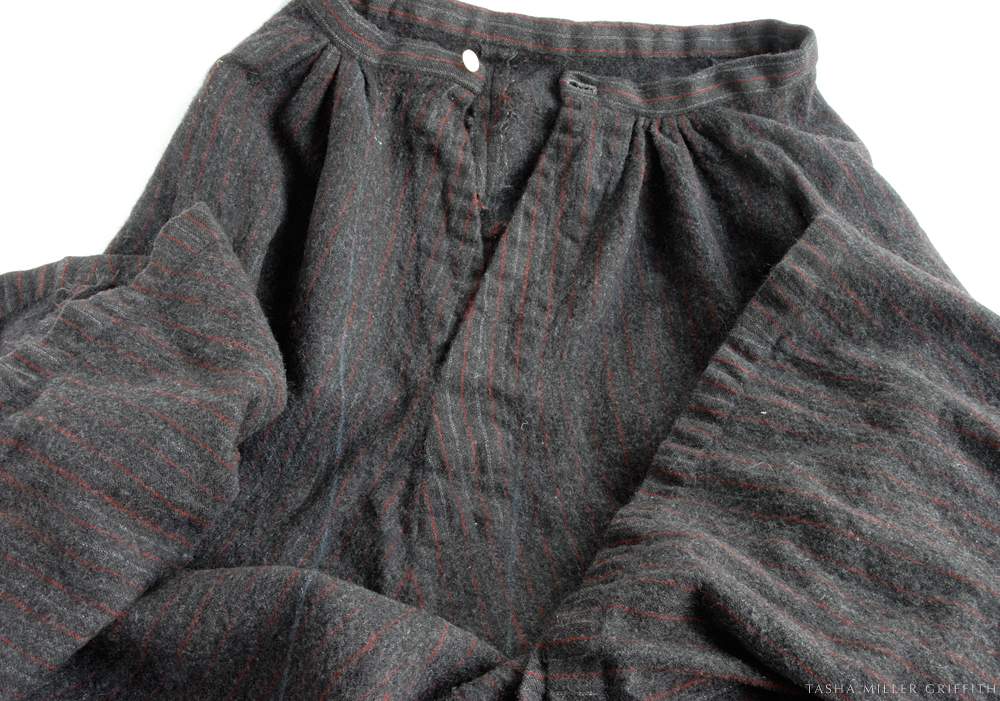
Since I now know quite a bit about felting, once I could look past my obvious horror since I had ruined some lovely fabric, I found it fascinating that the places on the skirt where small parts of the fabric were stitched to each other (the waistband, hem, and back placket) were still unfelted, while the big skirt pieces were noticeably felted, thicker and fuzzier.  Actually, it was the contrast between the two parts that made the skirt look weird, especially the unfelted hem, which looked almost gathered against the felted skirt.  My current theory is that since the hem and placket fibers couldn’t move as much, they couldn’t interlock to felt like the others did.

The skirt sat in my to-fix pile until I figured out a plan, actually a pretty simple one, which I think is essential to not spending inordinate amounts of time remodeling something.  I would cut off the not-as-felted hem, waistband, and placket, fit the remaining felted skirt to a wider and lower waistband facing, make a new placket, and re-hem it.  Above you can see my chalk lines for what to cut in the back, I continued the line of the wider side of the placket down to the hem, and cut a symmetrical amount from the other side of center back, to keep the back pieces the same size.  I got little pieces of felted fabric to use for my new placket from the extra cut off below the old placket.
 

viola outfit 3


While I working on this project, I was also trying to figure out what I would wear to the Viola awards.  They’re Flagstaff’s yearly art and science awards for teaching, exhibits, and community outreach, and they throw a big Oscar-like party to give them out.  Bryan was nominated for one this year, for the exhibit of his In a Big World Wandering work, for which we also made the giant silk cyanotype.  I’d never been before, and I wondered what would everyone wear, what should I wear, should I borrow something, is it more like a costume party, should I wear something shiny?

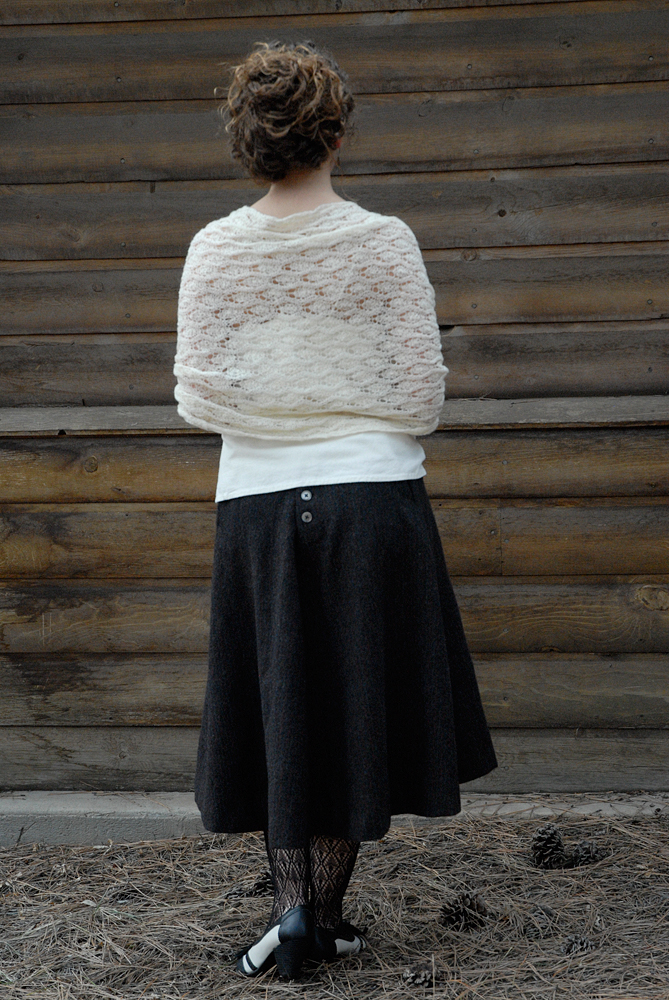
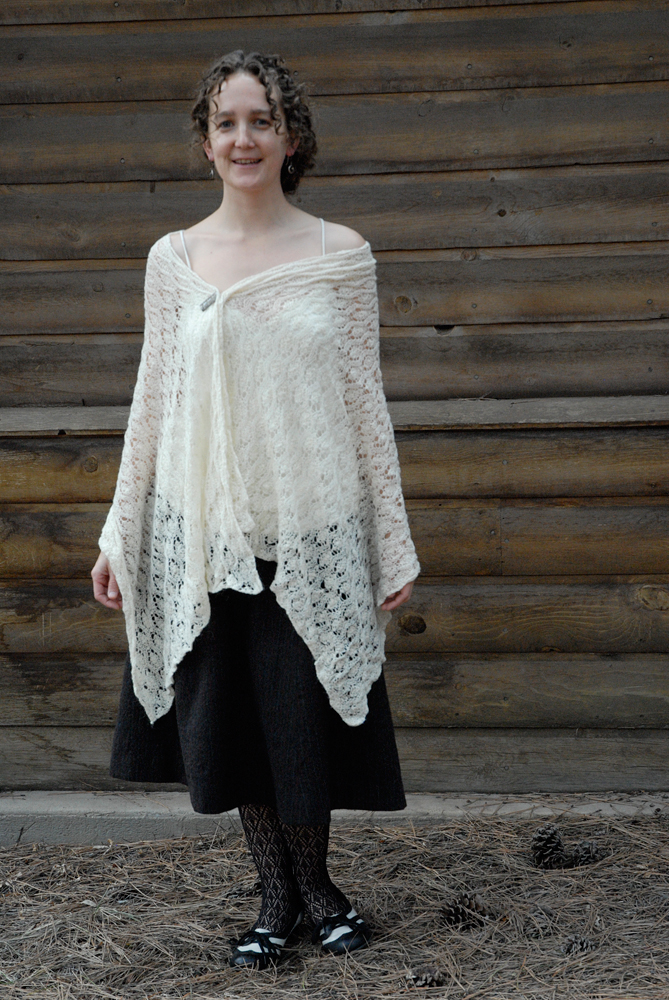
I am not a shiny person.  In the end, I decided not even to go to my friend’s and try on formals to borrow, but instead to wear something that reflects who I really am.  Not only that, but I realized I could actually wear the lovely tailored skirt I was working on – if I went ahead and finished it!  I took the photos of my outfit right before we left, and I think you can tell I was pretty thrilled with my decision.  If what we wear tells everyone we meet a lot about who we are and where we stand, shouldn’t it be even more important, at an event where people are actually paying attention to my clothes, for me to wear something that shows my values and my heart?
 

pinstripe skirt and top


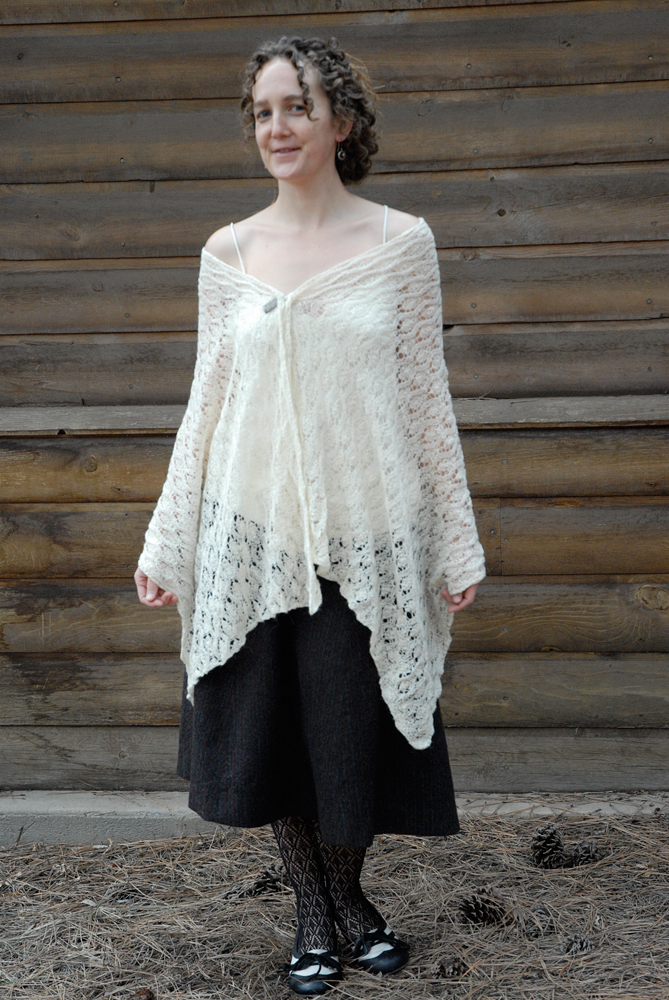
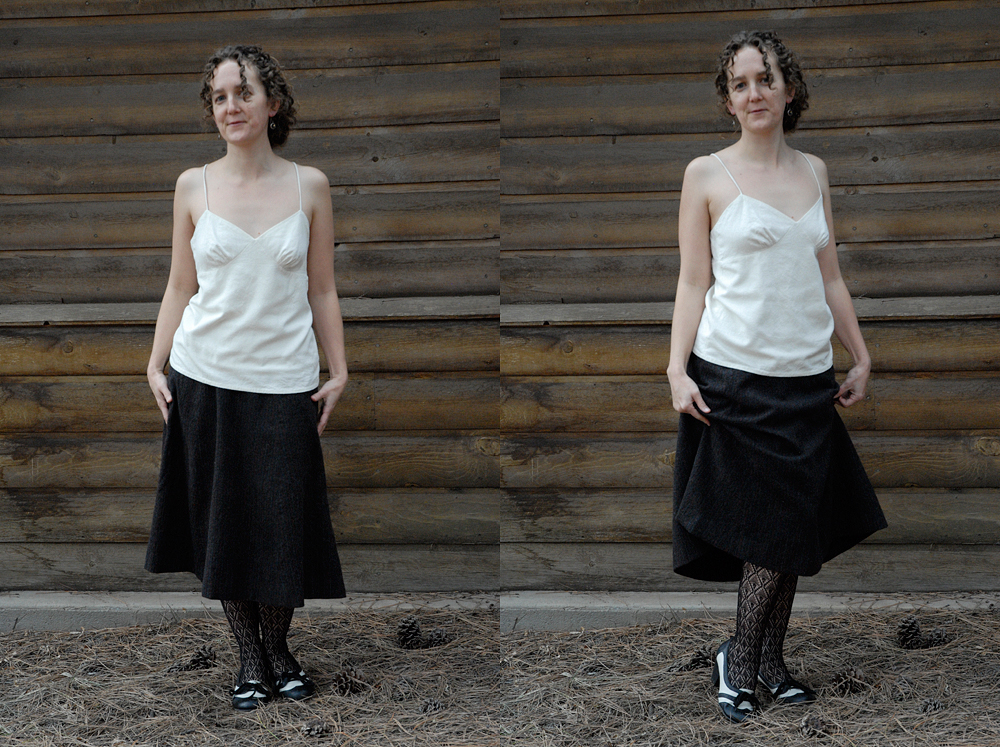
So I wore the rescued skirt, in it’s newly tailored glory!  Note the buttery folds.  And a nubbly cream silk tank top I made to wear to a wedding last year (same copied pattern as this linen one) which has proved more useful than I thought it might.  The shawl is something I started knitting for our wedding, realized would never be done in time, and eventually finished later.  (It’s a longer and wider version of the Fiber Trends Cocoon Lace Wrap, in a wool/alpaca blend lace weight yarn.)  It’s drapey and surprisingly warm, enough to keep me comfortable outside while I took the photos.  The pin holding it closed was my grandmother’s.  I didn’t make the tights or shoes, but I still love them . . . topped off with my winter coat, and I felt like I had stepped back to the ’40’s.


bryan and tasha viola photo booth


Proof that we went and I wore this outfit!  If you are curious what others wore, or what the event looked like, there are lots and lots more photos on the Facebook page for the organization.   We didn’t win (Bryan’s photo exhibit was up against the opening of the Discovery Channel Telescope!  And the winner, a recycled art exhibition that’s been going strong for 10 years here) but it was a really fun party, and I got lots of compliments, especially on the shawl.
 

pinstripe skirt remodel 2


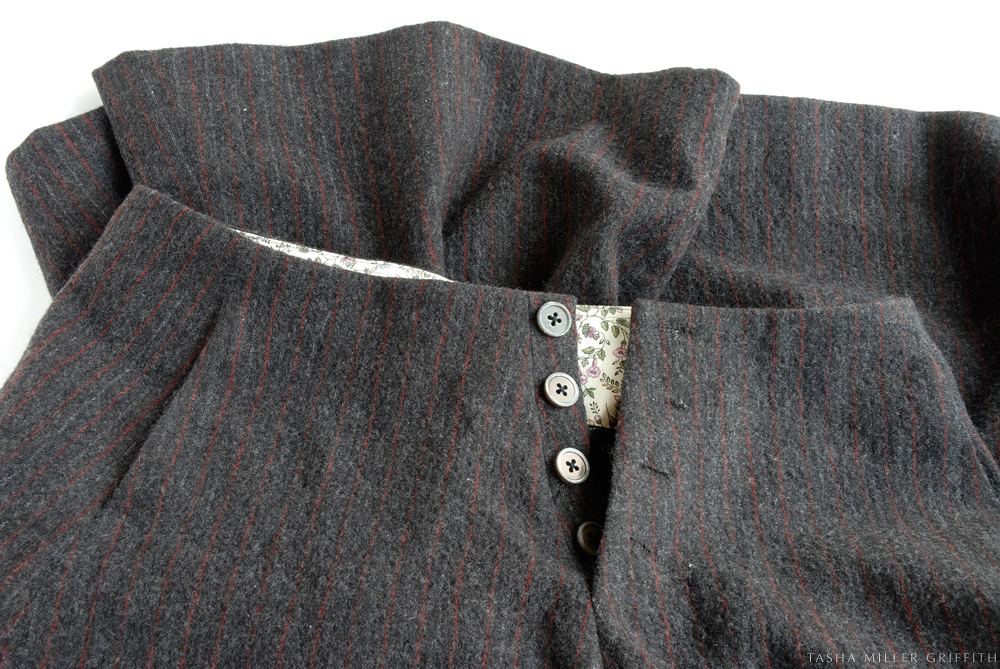
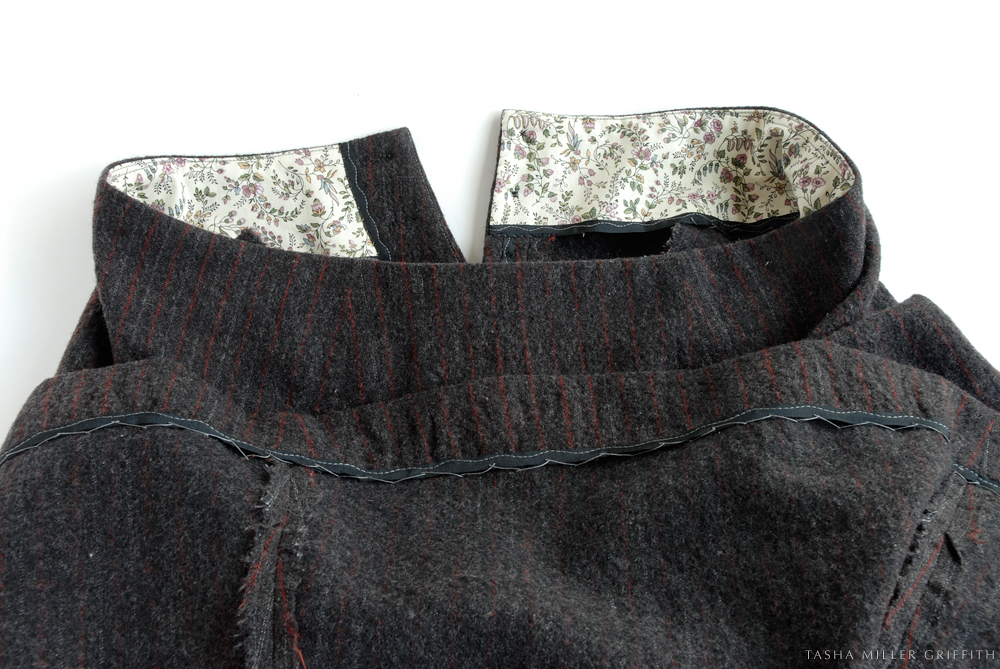
But back to the skirt, and I might as well confess one more thing, I feel slightly guilty but I can’t help it; I like this fabric more now than I did in it’s new/intended state.  It’s so soft but with so much body, and it tailors like a dream.  In fact, making the new placket and waistband gave me the itch to sew with wool again, it’s just a pleasure to work with.  This has got to be the flattest-laying, easiest-pressed-in-place placket I’ve ever made.  And the buttonholes – I made them by hand with a single strand of waxed black cotton sewing thread, and it was as if I sealed the cut edges with a magic wand.  Not only can you not see the stitches here, I couldn’t see them in my studio while sewing in broad daylight.  Note the pockets!  Another benefit of me-made formal wear.
 

pinstripe skirt remodel 3


I also thought about how much I’ve learned in the last ten years.  I was able to add several refinements to this second round of the skirt, including using rayon ribbon on a lot of the edges to reduce bulk, adding a contoured waistband that fits my figure, and using catch stitches to secure the hem and placket so they wouldn’t show from the outside.  Now that it’s on a strictly hand-wash-only plan, the new and improved version should last me another ten years at least!
 

viola outfit 1


Morals of the story: please wear your heart on your sleeve, especially to formal events.  Sometimes a silk purse is lurking inside the sow’s ear of your mistakes.  And people please, no wool in the washing machine!


Me-Made Purple Corduroys—How Life is Like Fitting Pants

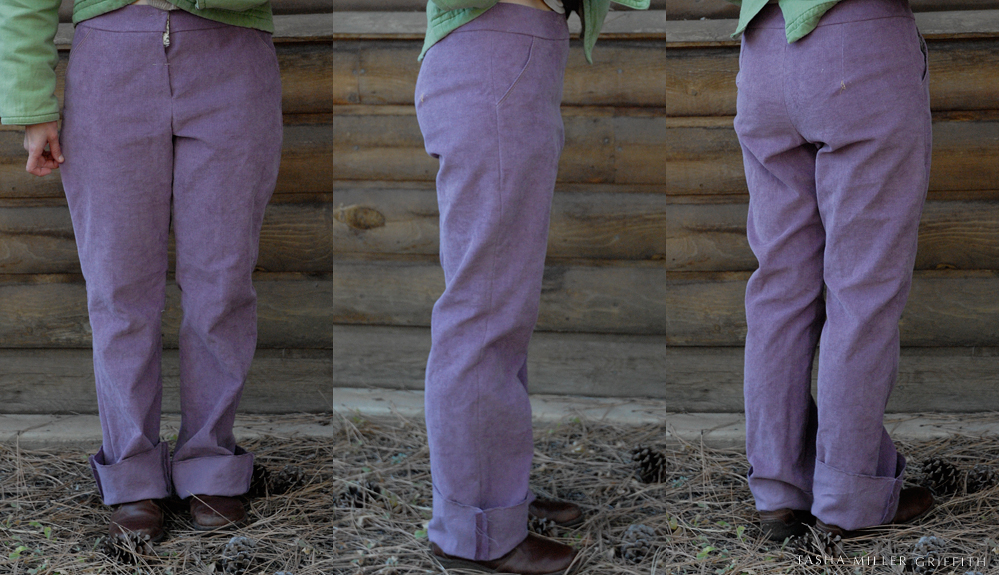
purple cords 1


Where to begin?  I think I could talk about these pants and all their glories and implications well past what you would read.  Well – I think I’ll begin with why they are purple, which will lead right into why they are fitted, which will lead right into why they are the best pants I’ve ever had.

So, a few years ago now, my aunt got this pair of purple corduroy pants, and for some strange reason I fell in love with them at first sight.  I’m not usually into purple, or brightly colored trousers, nevertheless I’ve wanted my own pair ever since.  I found 1 1/2 yards of, get this, lavender hemp and organic cotton corduroy on the NearSea Naturals clearance page!  (It had a “stain” on it, which washed right out.)  Update: although I love love love the idea of this fabric, the color of this fabric, and the resulting pants, the fabric is just not sturdy enough.  I got about a year of good-looking wear out of these before the corduroy pile started coming out, even with washing them inside out and not once putting them through the dryer, and that is just not enough for something I made.  If anyone knows of a source for sustainable, long-lasting fabric, please let me know!  The good news: all the work I did on fitting (keep reading) is already transferred to the pattern and waiting for me to find the next fabric! 

I thought this was the perfect amount of fabric.  I planned to make another pair just like my grey pants, even though I wasn’t sure that wide leg would be the best look for purple corduroys, I would figure out that fit first, and save more close-fitting pants for another day/next fall maybe.  Well – it turned out that all the wide leg pattern pieces would not fit on this much fabric.  To fit them in I had to narrow the legs quite a bit.  Well.  I just tapered the tops of the pattern pieces from the grey pants into the narrower legs, cut them out, and this is what I got.


purple cords fitting


Clearly those fabric saddle bag areas on the sides had to go straight away, that was the easy part.  Getting a better fit through the seat/inner thigh area took a lot more work.  Every day for weeks, my sewing time consisted of: ripping out and re-basting in a slightly different position some part of the crotch seam and/or inseam and/or side seam, trying the pants on, deciding what to rip out next (often the same part).  Although I worked on these only a little bit each day (partly to keep myself from getting frustrated and doing something hasty/stupid), I thought a lot about how life is like fitting pants.  The baking equivalent might be yeast bread, or even macarons.  There are a lot of variables, and each one seems to affect all the others, so that a small tweak in one area can change all kinds of things I would not expect.  But, if I just keep plugging away, trying things, seeing what happens, I will eventually reach a place where I am very happy with the results.


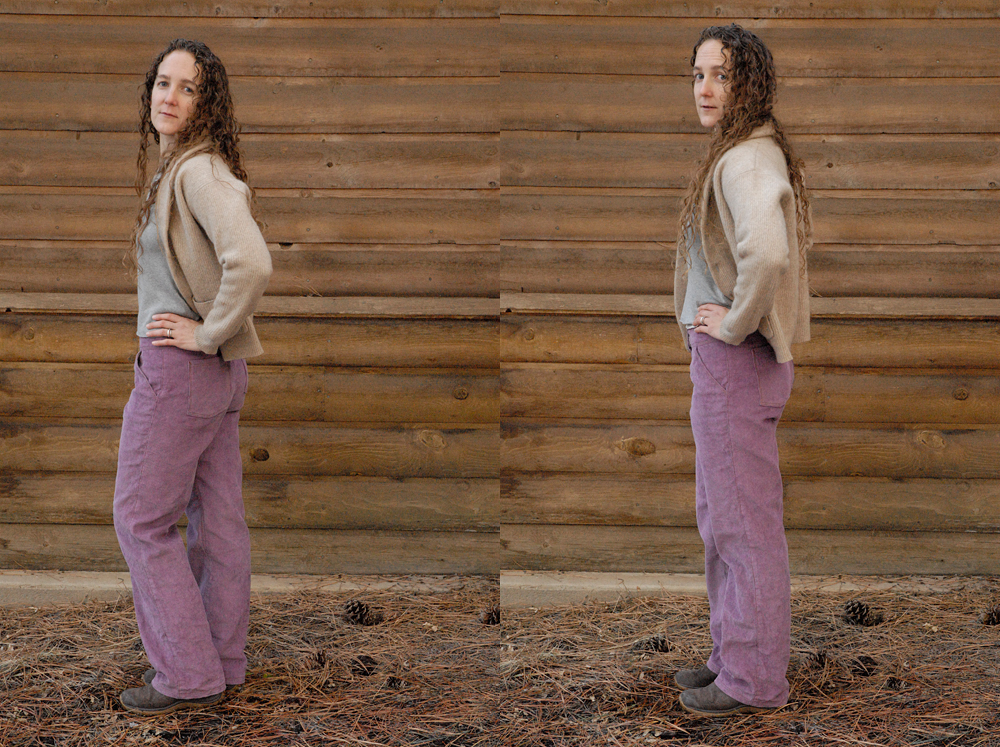
purple cords side


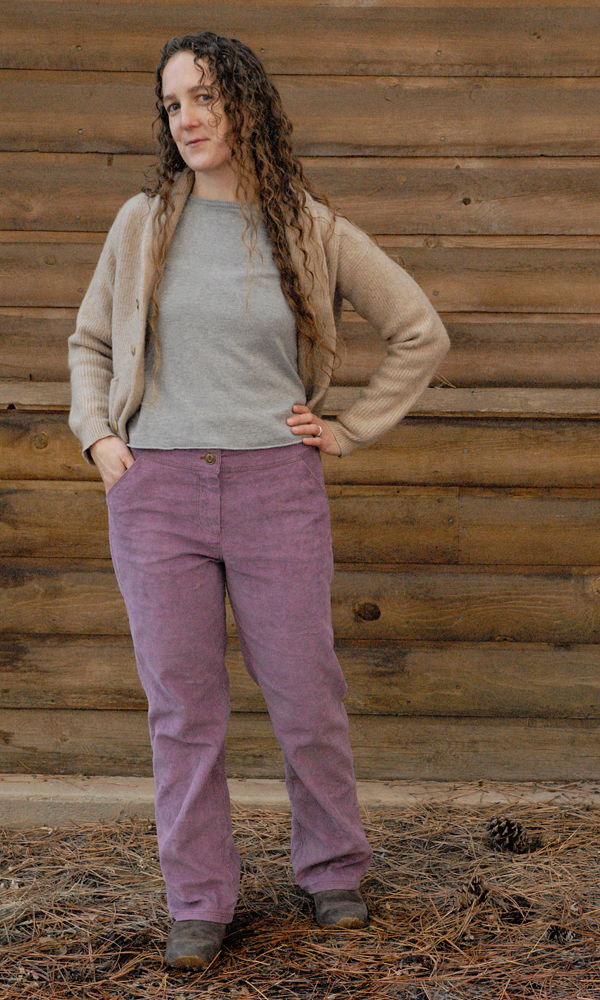
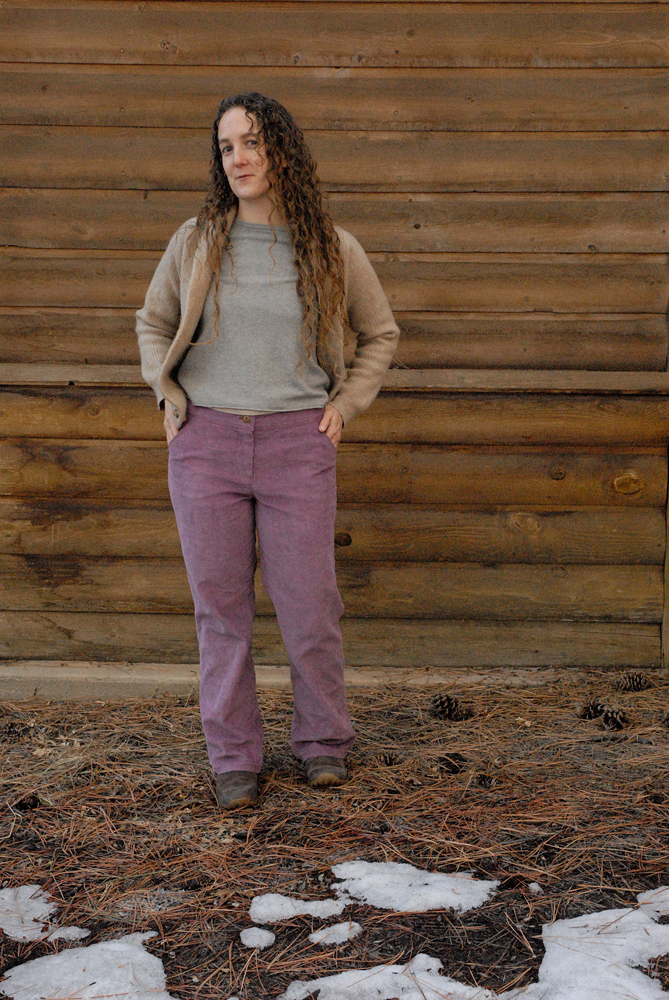
Well – I really could not be happier with this result!  Although I have tweaks to make in the next version (pants are clearly a journey, not a destination) they are the first pair I’ve ever had that really fit and flattered my figure, they’re incredibly comfortable, and I’m ridiculously satisfied with myself when I wear them.

If it wasn’t for the fact that things need washing, (Ok, and I do love skirts, and some days are for grubby clothes, etc.) I might conceivably wear these straight through until they wore out.


purple cords sewing table


Some sewing and fitting things I figured out while making them:

I took out all that extra I added to the back inseam of the grey ones, and then some.  Clearly a different fit requires a different shape.

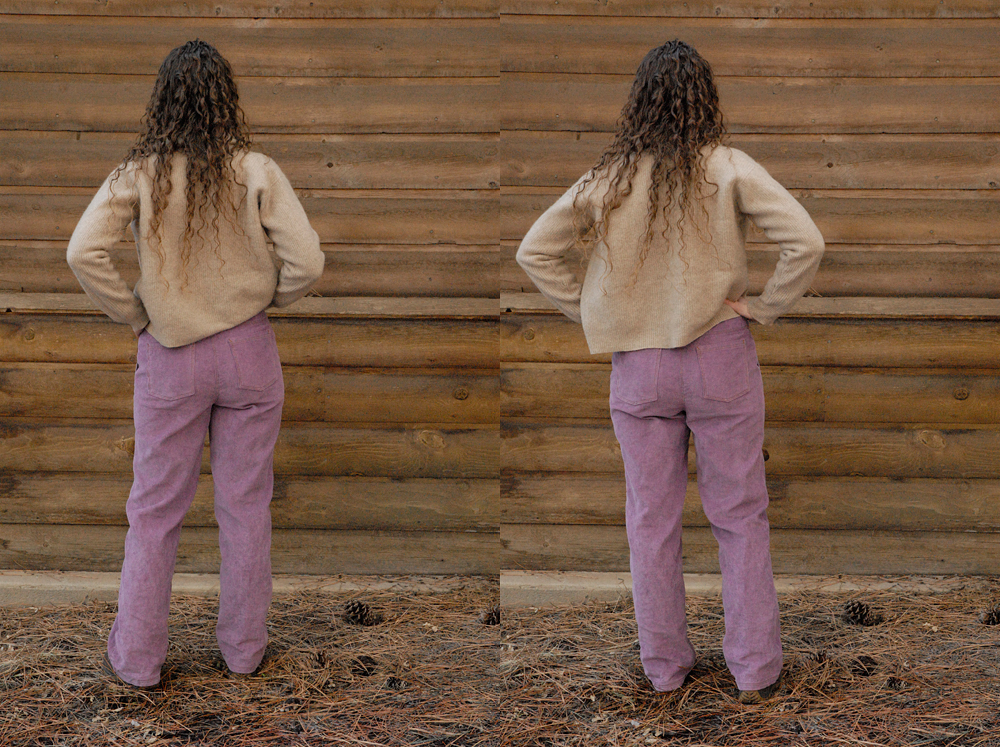
See that diagonal wrinkle across the back hip in the first fitting?  I tried all kinds of things to get rid of that; letting out the side seam, unpicking the waistband and pulling the pants up, but nothing worked, until I saw something in Patternmaking for Fashion Design by Helen Joseph-Armstrong (which is one of my all-time favorite sewing books, expensive but worth it, I asked for it for Christmas one year).  It was one of my cousin’s textbooks at FIT in San Fransisco, and it shows you how to draft a pattern for just about anything you could ever want to make, plus all kinds of construction techniques.  It’s designed more for the fashion industry that for home sewers, and there’s not a lot about fitting, so I guess it says something that there is a section on pants fitting, where I found an illustration of a similar wrinkle with this note, “insufficient dart intake for dominant buttocks.”  That’s not how I’d like to think about my derriere, but the part about the dart totally worked!  I had been leaving that dart alone since I fit it in the last pants, but clearly it’s not a good idea to start think of any part of the fit as “finished” when I am changing the rest.


purple cords back


purple cords edgestitching


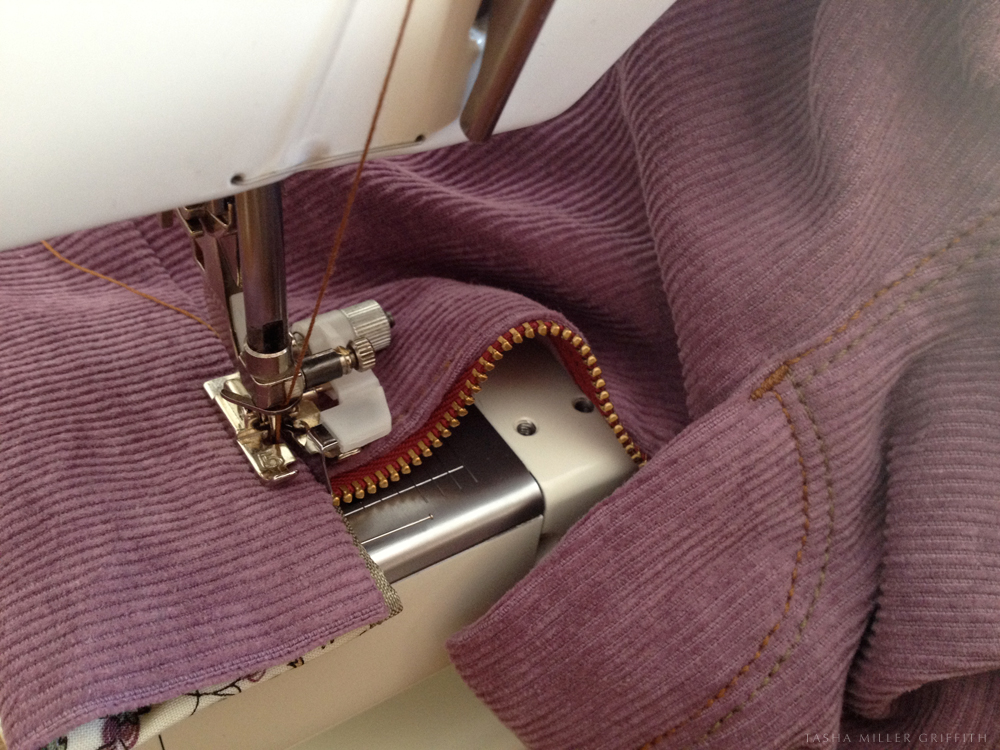
I used my edge stitching foot for the first line of top stitching (with a size 100 topstitching needle, moving the needle slightly to the left), and it worked great!  It was much easier to get an even stitching line with that little guide riding right on the edge.  I am now trying to figure out how I can use a similar guide for for the second line of topstitching, further to the inside..  Anyone know of a foot like that?  I used two colors topstitching and I really like it, one pair of Bryan’s jeans has that look and I decided to try it out.


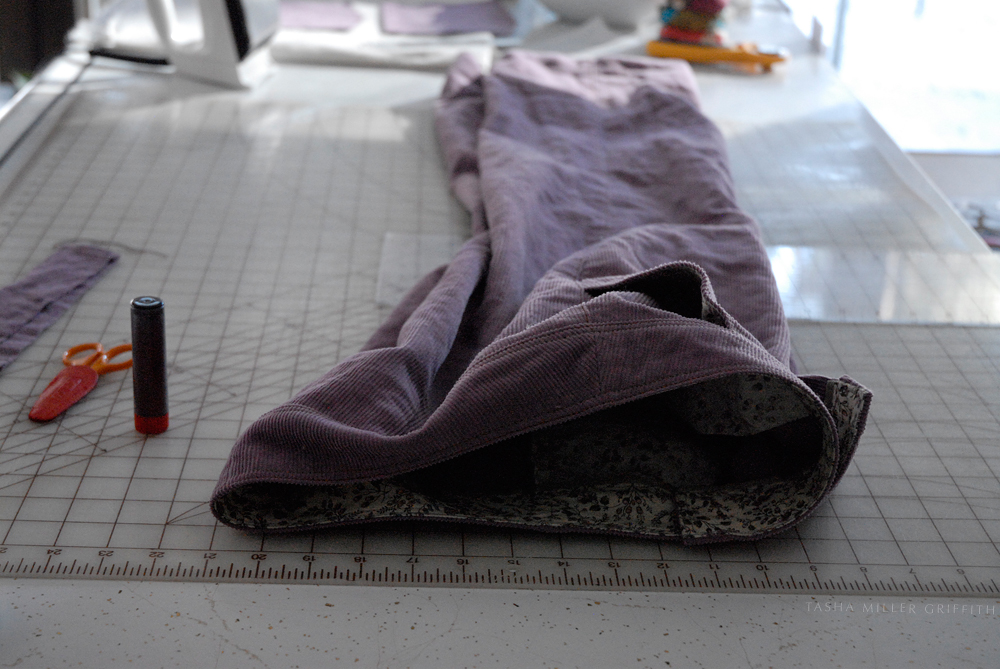
purple cords inside


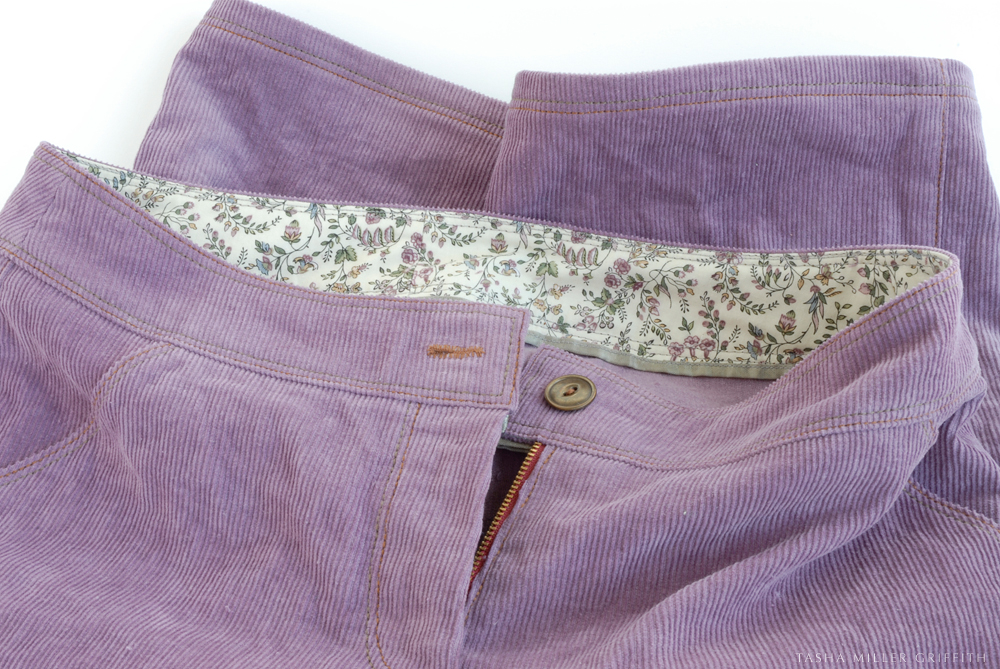
I trimmed a bit of the waistband lining before applying the rayon ribbon to the bottom edge, next time I’ll trim a bit more, but I like this finish.

If the legs look a bit long, I left them that way on purpose.  I keep noticing that the hems of cotton pants tend to creep up just a bit over time with washing, usually after I fix them just how I want them.  I’m not sure what the shrinkage of hemp is, but if these don’t get any shorter after a while I can always hem them up a bit more.

By the way, the above shot of the inside waist is probably the closest I got to the actual color, for some reason this purple seems to be hard to capture.

That’s about it, I guess, unless of course you want to talk some more about sewing, body image, and the power of DIY, etc. . . . if you see me around, I’ll be wearing these pants, and feeling happy!


tasha in purple cord pants


Fitting Pants (Trousers) – At Last!


Let me just say this has been a long journey.  I’ve never had ready-to-wear pants that fit me, if they fit Ok through the thighs and seat, they’ll be ridiculously baggy around the waist, etc.

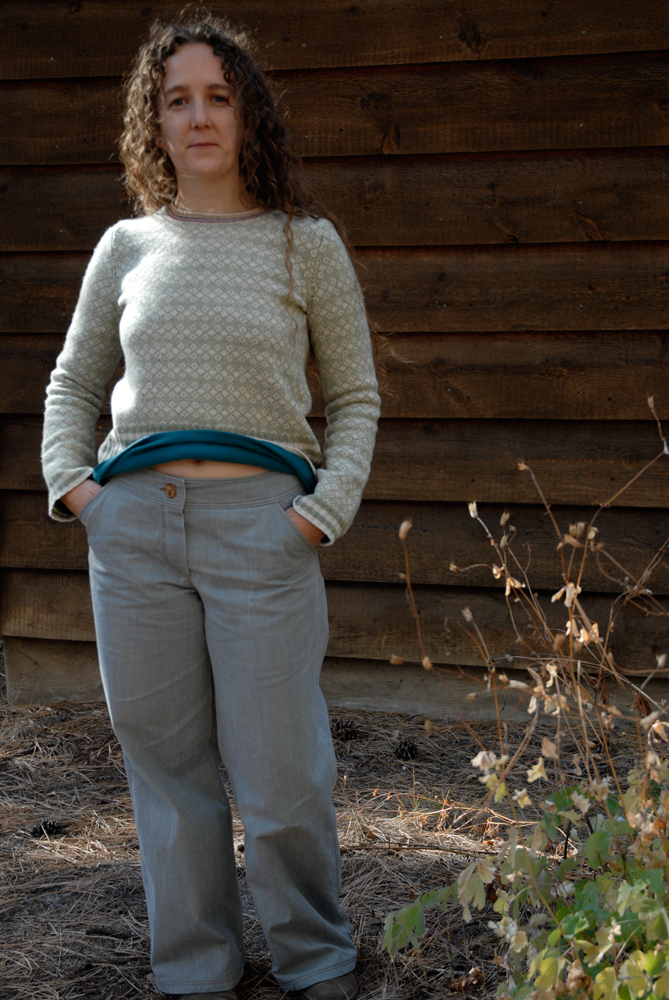
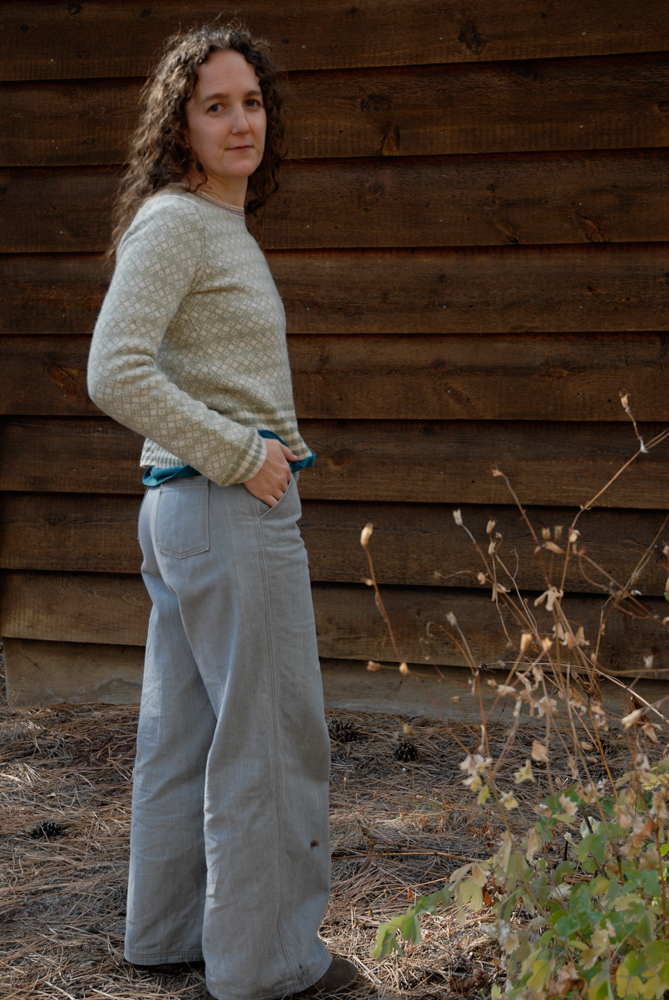
I also haven’t had a huge amount of luck making my own pants, until now that is!  I’ve definitely made pants, lots of trial ones and some real ones, but there are just so many variables that sometimes it’s been hard to tell exactly what to change for my next pair.  This pair, however, is really close, and I learned a lot along the way, mostly thanks to my internet friends.  I just feel so self-sufficient wearing these pants, it’s fantastic!  On their very first day I wore them to hang a show of Bryan’s work at a restaurant here, climbing up and down ladders and carrying things around.  Then the next day I wore them with a nicer sweater and looked totally presentable (ok, after wiping off some grime from the day before . . . )


I’ve definitely learned some sewing lessons along the road to pants that fit.  Among them:

  • It’s possible to draft a pattern from scratch from your measurements and still not like the fit.
  • If you copy a pair of pants made in a stretch fabric, do not try to convert them to a non-stretch fabric, the “fit” you like will probably disappear.
  • Using top stitching, and thick top stitching thread, really makes your pants look more professional.

For this pair, I worked from a copy of some corduroys I thrifted last fall.  I liked the fit of them pretty well through the hard-to-fit booty area, and I knew I could taper the waist to fit into a contoured waistband.  I had made one previous test version out of thin nylon for hiking, which were wearable but a bit tight.  So, my first idea, which I should have thought of a million years ago, for these was to use 1″ seam allowances all around to give me a little room to work with.  I’m totally doing this on every pair of pants I make from now on, and it turns out it’s also recommended in this genius book (more about that in a minute).


The second thing I learned on this pair is that it’s amazingly helpful to take pictures while you’re fitting.  I NEVER would have thought to do this before I had this blog, but I can’t recommend it highly enough.  You don’t have to show the pictures to anyone, but you can go back and see exactly what you’re working on, long after you’ve taken them off.

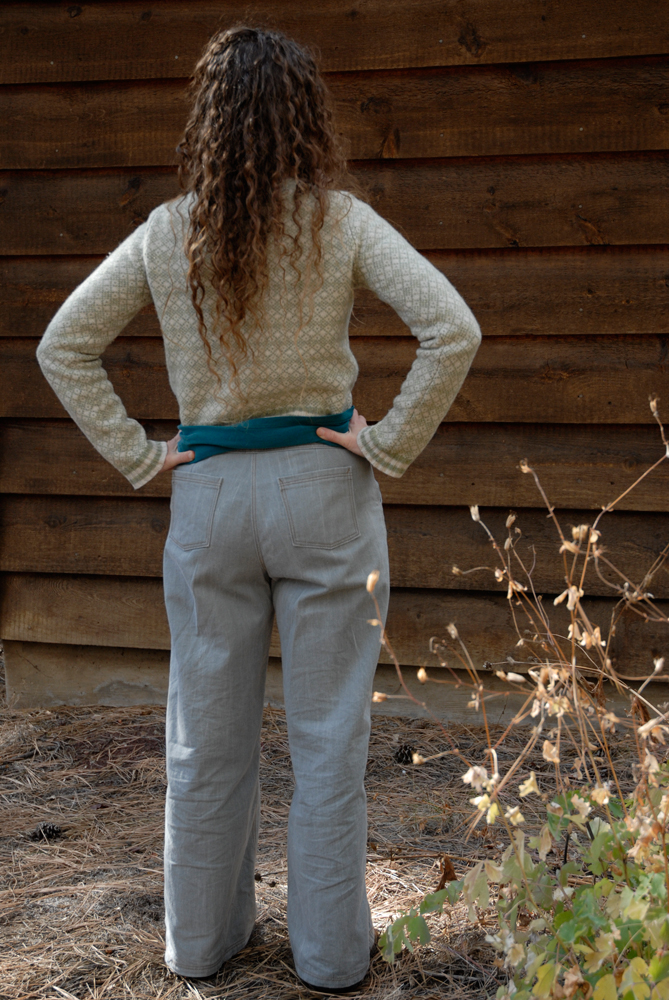
The third thing I learned was that there’s great info about fitting pants on the web!  Even though I scoured every single mention I could find in Threads magazine, again, the most useful stuff I found was on other blogs.  Thanks especially to Tasia’s post of fitting resources (her pattern would be a good place to start on pants if you’re pear shaped like me), where I linked to Sunni’s enormously helpful trouser sew-along (my pants looked remarkably like hers in the back picture here).

She also recommended the book Pants for Real People.  I had passed this book by at the library before, since none of the models are shaped like me.  But, don’t let that deter you, the illustrated fitting problems and solutions in this book are total GENIUS!  I have probably never been more happy that a book was at the library just when I needed it, and I ordered my own copy as soon as I read it.  And I quote, for full derriere,

Generally, you need to add only to the back inseam, but rarely you need to also add to the top.  Deeper, or additional, back darts may also be needed.

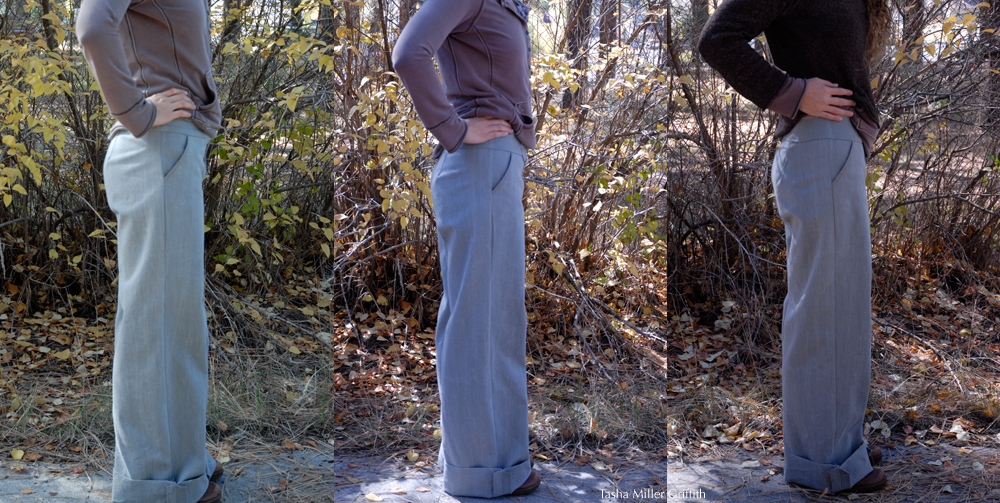
The back inseam?! It would have taken me at least another decade to figure that out on my own.  Check out my pants on the left above, then I let out the back inseam for the middle picture.  On the right, I used another tip from Pants for Real People, taking out my dart and making it deeper, and taking out part of the waistband so that I could pull up the back to get rid of those wrinkles at the hip.

Maybe I could let out the inseam a little more in the back, but I ran out of fabric to try it, even with my extra seam allowance.  Next time!


These pants are supremely comfortable in any position except sitting straight in a chair, when it feels just slightly like I’m being cut in half.  I have a couple of tweaks in mind for the next pair, but let me be clear: I am 100% OK with these pants not being 100% perfect.  In fact I’m thrilled that both:

  1. I MADE the best fitting pants I’ve ever had, and
  2. The next pair will be even better!

I have been frustrated along the way by making lots of test pants in muslin which I don’t wear around much, so it’s hard to figure out how they really fit, and I knew I was close enough this time with my copy that I’d end up with something wearable, so I went for “real” fabric.  I also like this approach because it lets me see how a more substantial fabric will behave, and because as I wear the finished pants in real life, I get a much better idea of how they work and what I’d like to improve.


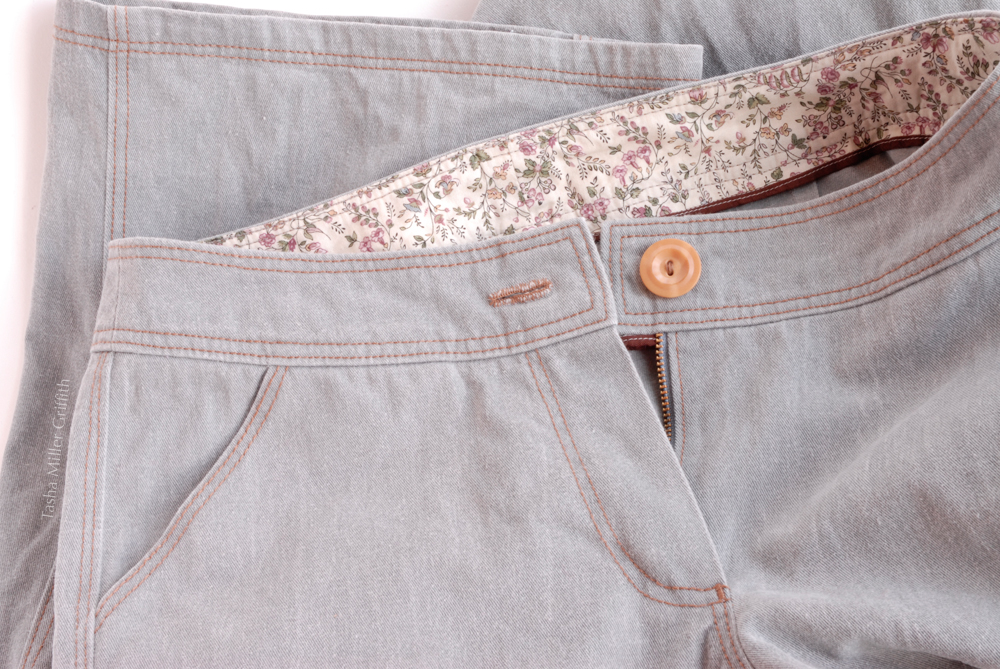
Just a couple of construction notes: I used a rayon ribbon to bind the bottom of the waistband, which I quite like, although next time I’ll try to get it closer to the bottom waistband seam so that it doesn’t flip up.  I debated whether this was too much top stitching, but on the pants when worn it doesn’t stand out much at all.  This is my third try at a vintage button, the first two did not survive a trip through the washer, by which I learned that if a button looks crumbly, it probably is, and if it snaps in half like a fortune cookie in your fingers, well, it wasn’t going to stand up to much.

Ready to tackle DIY pants?  I’d say there’s a lot of great resources out there, go for it!  I’ll mention one more pattern which could be a good starting place, Juniper from Collette, which just came out, with a similar shape to these.
Whatever you’re making, I hope it’s giving you that “I could conquer the world with this” feeling!


Half My Wardrobe in Detroit, and What I Did About It

Not as much as I would have liked.  But, contrary to the impression you may have gotten from this space, I did squeeze in a little sewing for myself the last time we were home.  When we leave the truck somewhere in art show land (otherwise known as the Midwest) and fly back home to get some r&r (or maybe embark on some crazy giant new project) I leave a bunch of my summer wardrobe out there.  This last time, I kind of did it to myself on purpose, packing even fewer of my summer tops than I reasonably could have fit in my luggage, hoping that it would motivate me to sew some new ones.

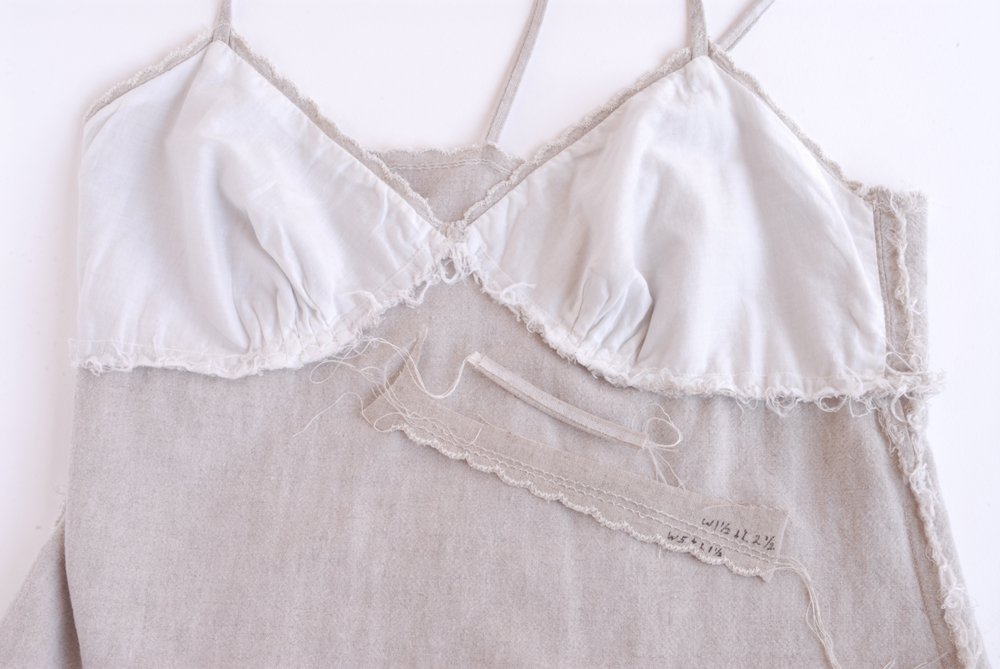
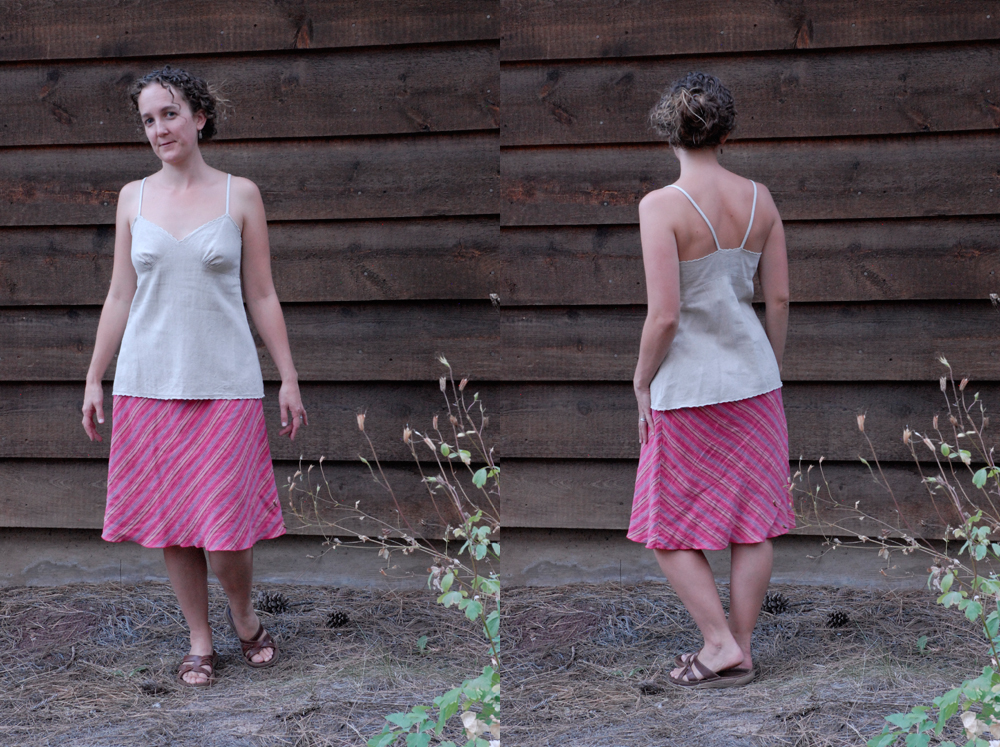
First, I finished a top I had been working on during the visit home before this one.  I wear a lot of tank tops in the summer, and I have been thinking about how to make some woven ones as well as the usual knits.  This one is a copy of a silk top, the cups of which I found flattering and comfortable.  During Me Made May, I fell in love with linen all over again, specifically this one mm green linen skirt, which is getting to the super soft and drapey stage of life.  I had this natural linen leftover from a long-ago project and thought I would try it out.


I lined only the cups, with thin soft cotton, catching them in the midriff seam and folding under and hand sewing the other sides, I like how it came out.  The original top has a scalloped satin stitch on the edges, and I decided to try something similar.  I also had some thick linen thread which I loved with the fabric, but no amount of coaxing and bigger needles would convince my machine this was a reasonable thing to work with, so I ended up using a narrow zigzag to hold in on the surface.  Both of the edge treatments are softer and more subtle after a few washings.  I made the straps using a thin piece of fabric from the selvage edge, wrapping it around a thin ribbon.


I wanted to make sure it came out long enough, and I may have overdone it, but the tunic length is working alright so far.  Funny how I don’t notice things in the original (like the back riding up) until I copy it.  Sigh.  I’ll also check out the front wrinkles before I make another one.

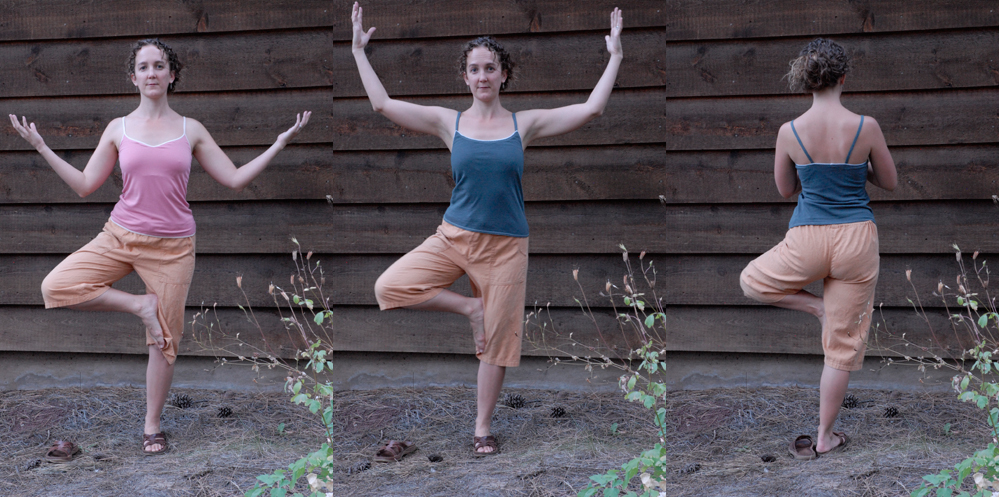
Next, I pulled out some pink knit leftover from another top to make a tank for yoga, of which I desperately needed more.  I had some narrow fold over elastic in my stash which should have been perfect, but for some reason every step of this project fought me tooth and nail and used up WAY more of my precious sewing time than was reasonable for something so simple and small!  I ripped a lot of seams.  I tried adding a self-fabric section for the hem which absolutely refused to look decent with any type of stitching.  Plus, when I tried the top on it seemed too tight and clingy, and I already have one round of tops made from this pattern (a heavily modified Kwik Sew 3524) which are NOT too tight and clingy!  Finally I realized that if I ripped the stitching from the little bit of elastic I had used as a test, I would have just enough to put around the bottom as well.  Which I did, and without even trying it on again, put it in my closet and wore it to yoga the next day (keep reading for a picture).  The top stitching on the elastic is beyond wonky.  But I needed it, I made it, and I was wearing it, and some days that just has to be enough.

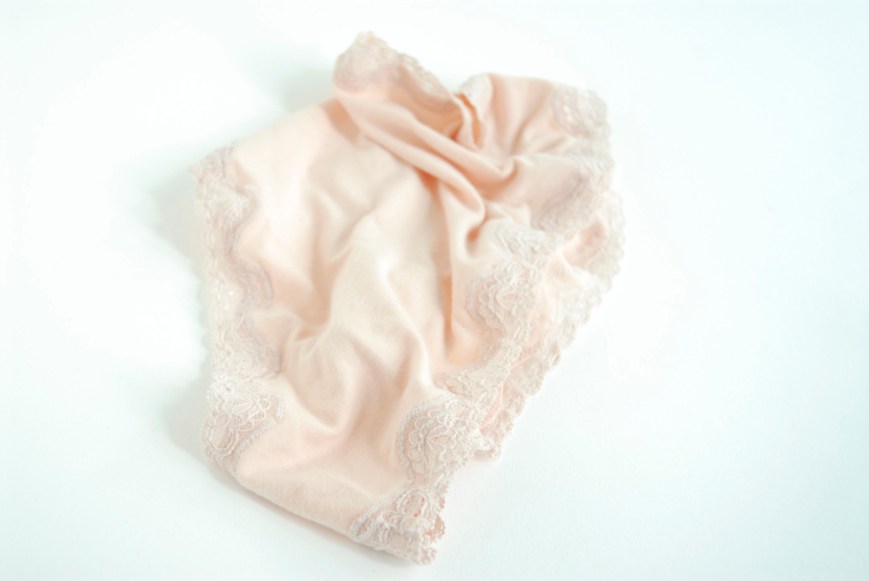
After that, I made a pair of dainties, partly because I didn’t have much time left and they were cut out already, and partly to prove that my beloved Bernina and I do actually have a good relationship with knits.  Which in fact we do.


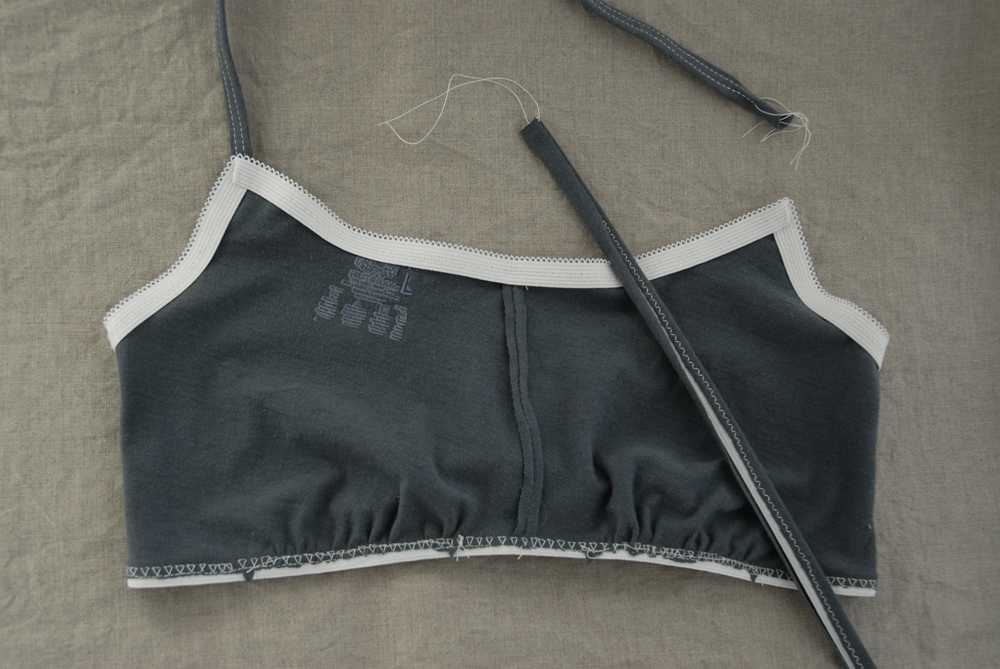
On our “real” return home for the fall a couple of weeks ago, I decided to make one more tank top before moving on to fall/winter sewing. I had a tee shirt with a hole in it that I had been meaning to convert into a wearable top for ages.  Unfortunately, it was cut so far off the grain of the knit that I couldn’t just use the the original hem, as Zoe suggests, and I had to cut the back and front shelf liner in two pieces each to get them to fit.  But I did use white top stitching, which I liked on the original shirt.


I liked this picot edge elastic, but it was not exactly soft, so I sandwiched it between the layers, sewing it to the liner first with a zigzag, and then the top layer with a twin needle.  For the straps I used a similar idea to the ribbon wrapping, but using plain elastic, zigzag, and the twin needle again.  This time everything went smoother, and start to finish, including experiments, took less than three hours.  That’s more like it!


See me being all zen about the pink top.  See how much clingier AND drapier it is than the blue one?  Crazy fabric difference.  I checked and the previous versions have stretched out with wear as well.  I might make the next one just slightly wider to start with.

Next up for my sewing, pants!  What are you making for the coming season? How do you figure out what fabric will do before you sew it?  I’m, um, still figuring that part out apparently. . .


Summer Spark Batik Dress


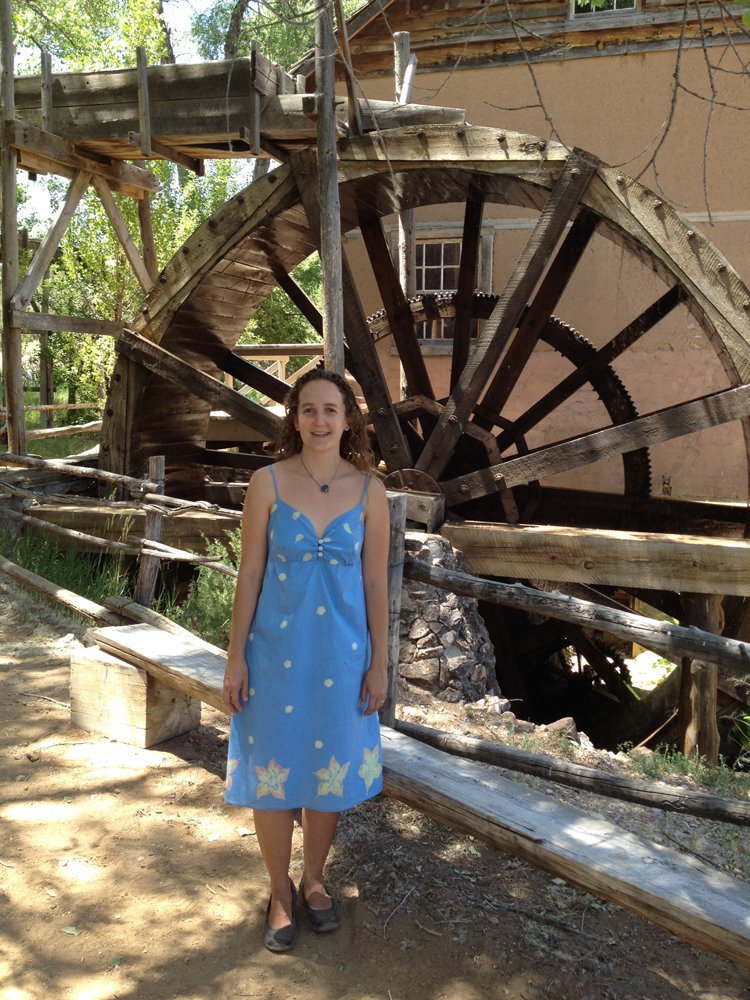
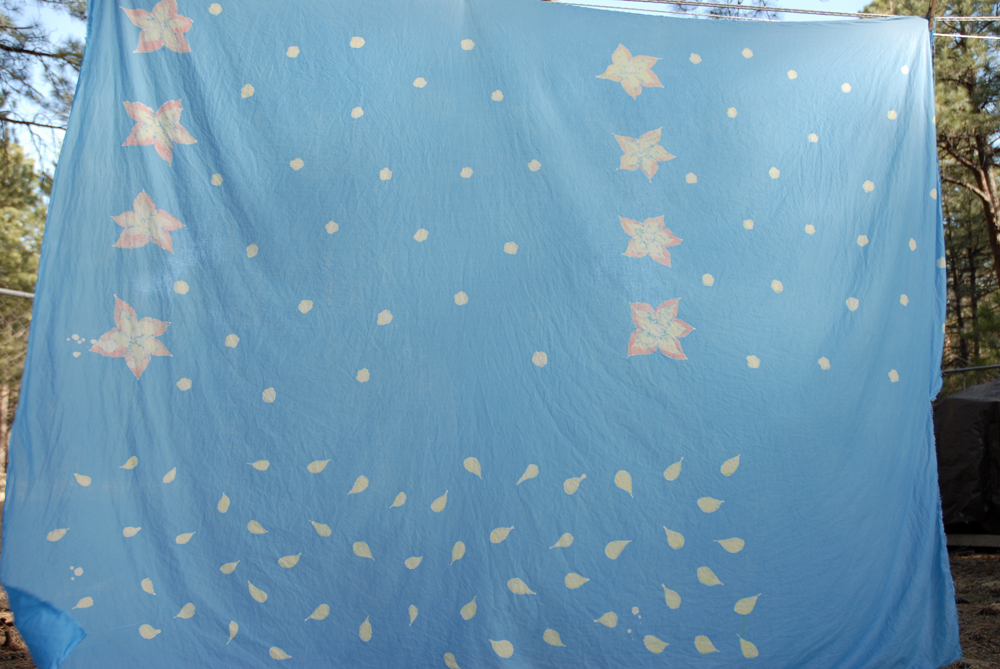
I finished this dress on time!  Just barely.  I know that sewing on a deadline is not my friend, but in this case I had backed myself into corner, since I really wanted to finish in time for my annual family and friends women’s craft retreat.  You see, last year at the same event we batiked fabric (which was ridiculously fun) and I dyed this panel with this sundress in mind.  I should at least be able to sew one dress in one year, right?  Well, sure, but a whole lot of other projects of various types jumped ahead of it in line throughout the year, until I found myself headed to retreat 2012 with the mostly-finished dress and my hand sewing kit.  I finished the hem in the car on the way over.


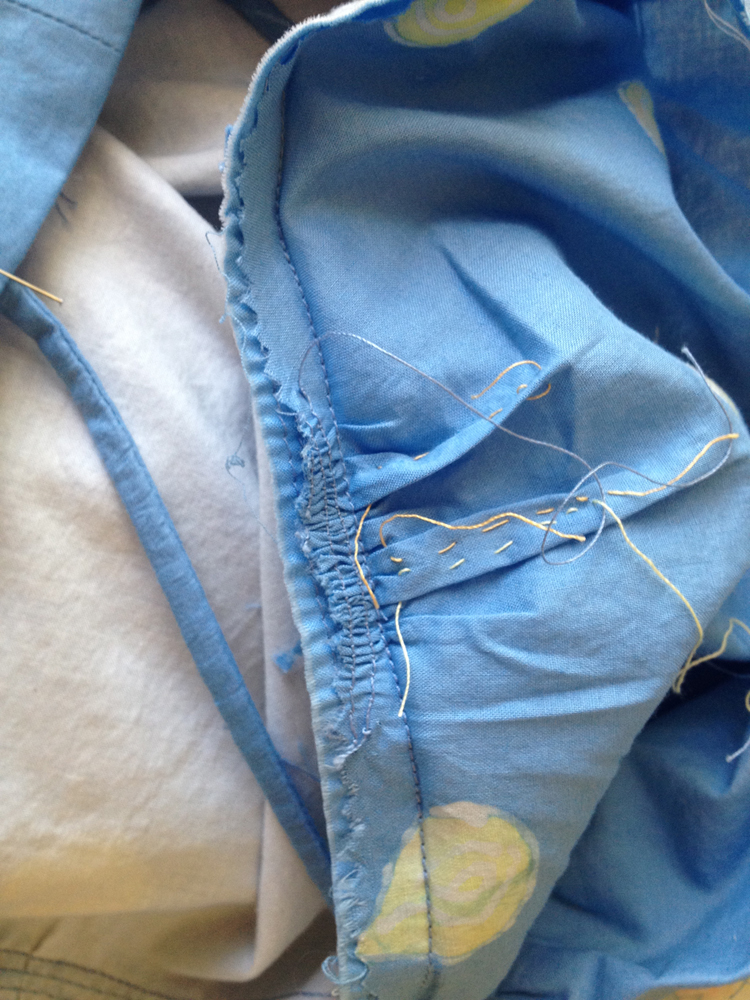
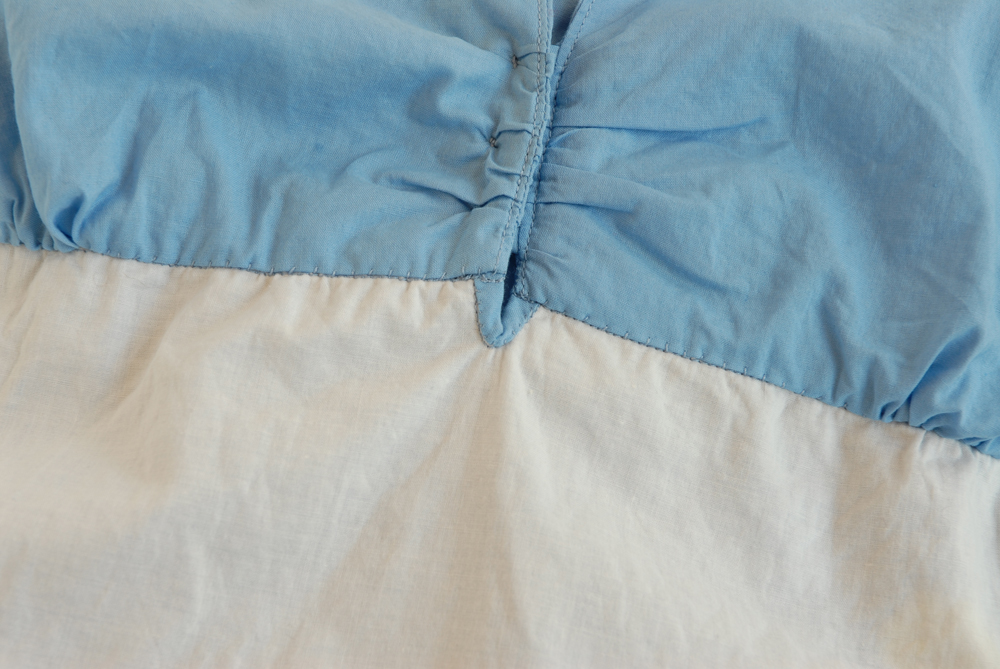
When I got there I tried it on again.  Although I had carefully tested out this pattern in a previous version, I decided that the darts from that version were a little out of hand.  Although I liked the fit, the darts just took up a lot of the bodice, and I thought that they might not look so good with the sparser print of my batik fabric.  So I decided to convert the darts to gathers.  Lesson 1 from this project: darts and gathers are not the same thing!  Although they both take up excess fabric and fit it into a smaller area, darts control the release of the excess up to a certain point, while gathers release it all right away.  Although I liked the gathers at center front, the ones under the bust were clearly not working, they created a big poof of fabric right under (definitely not at) the fullest point of my bust.  There’s no picture of this, it looked ridiculous.


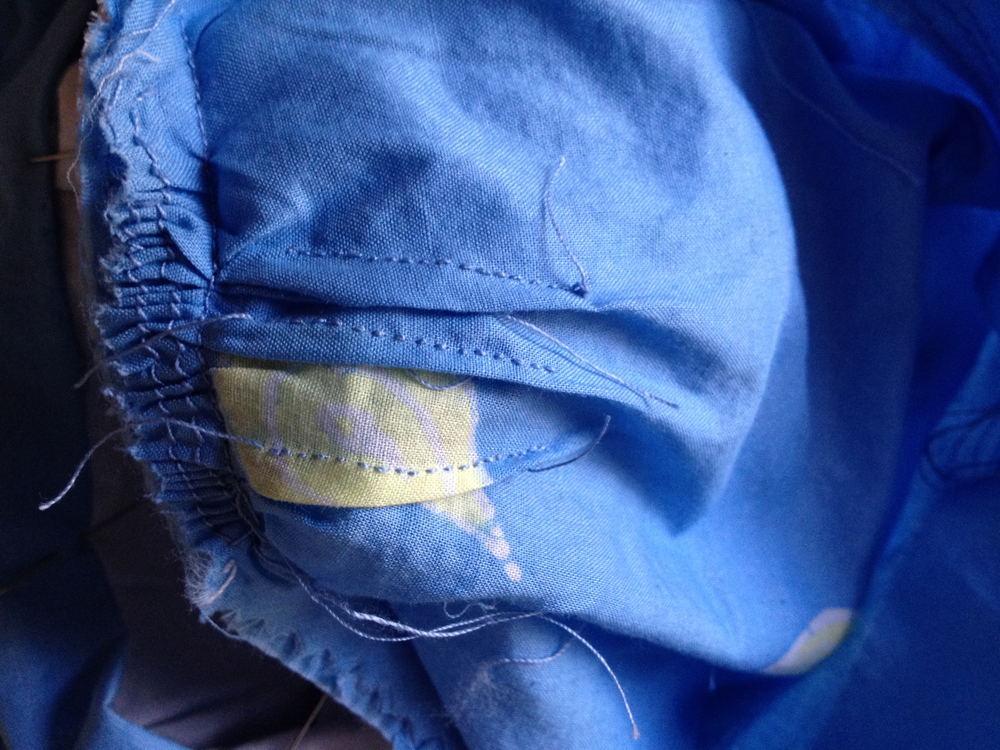
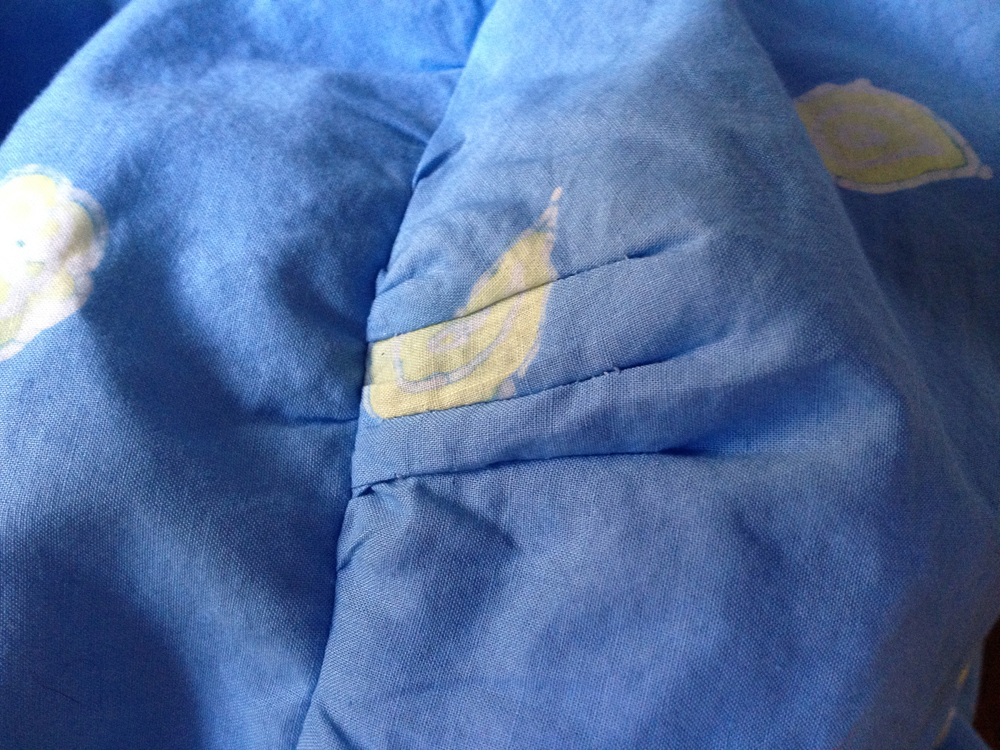
Since I had already sewn the gathers, and my sewing machine was hundreds of miles away by this time, my idea was to hand sew a few of the gathers closed, essentially creating a few small darts to release the extra fabric where I wanted it, which hopefully would not look too jarring.  I tried it out by basting the darts in place.  Have I mentioned I love basting?  It’s just a collection of fairly loose, impermanent stitches, but it’s one of the sewing world’s most perfect tools.  I truly don’t understand why anyone complains about it, it’s so wonderfully precise and useful, and you can see exactly how something is going to come out before you commit to sew it, without the distortion of pins or clips.


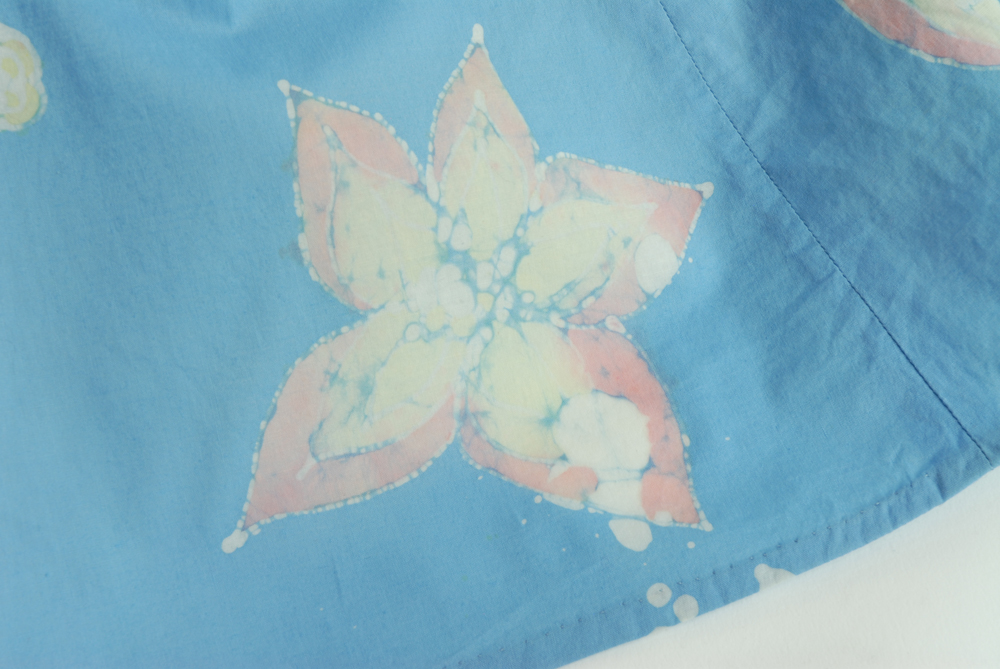
Anyway, I basted my new tiny darts in place, using the places where the gathers naturally wanted to make a deeper fold.  I tried on again, then hand sewed them in place.  I used all tiny backstitches, which was probably overkill, but for such a small seam it didn’t slow me down very much, and I wanted a similar look to the rest of the machine-sewn seams on the dress.  If I was at home with my machine, I could also have taken out the gathers, planned and measured for the darts, sewed them in place and stitched the bodice down again.  To be honest I’m not sure it would look much better, although it would look more precise and even on each side.  However, I have been comfortable with this dress having a handmade, not-so-perfect look ever since the very first flower I drew in wax (note the splotches/wax drips).


Checking out the final result, I am overall thrilled.  Probably what makes me the happiest is that I was able to plan the print on the fabric in a way that worked how I envisioned when I went to sew the dress!  It also makes me happy to look at the little bits of hand stitching on the inside, for some reason I can’t explain I love that look, when I worked at a museum I used to spend much longer than necessary checking out hand stitching on antique garments.  I will tweak the bodice a little more in further versions of this dress, it still has a funny wrinkle or two, but as I said this project was not meant to be a showpiece and I think it looks cute.  I wore it all day, on a retreat field trip to the fiber festival at El Rancho de las Golodrinas and then out to dinner with the whole group.  One of my favorite things about custom-fit clothing is how comfortable it is – I could easily have also worn this dress to sleep in, but restrained myself, after all it was pretty dusty out, and the dress doesn’t need that wear and tear.


I realize as I’m working on this post that some of these pictures have quite a different color cast, some are from my iPhone on the trip which may explain it.  If you are curious, the laundry line picture is probably the closest to the real colors.

Although I don’t have a specific project like this to be ready for next summer, I am so hoping I have learned my lesson about timing and leaving things until the last minute.  We shall see.

My First Real Self-Drafted Pattern—Sundress!


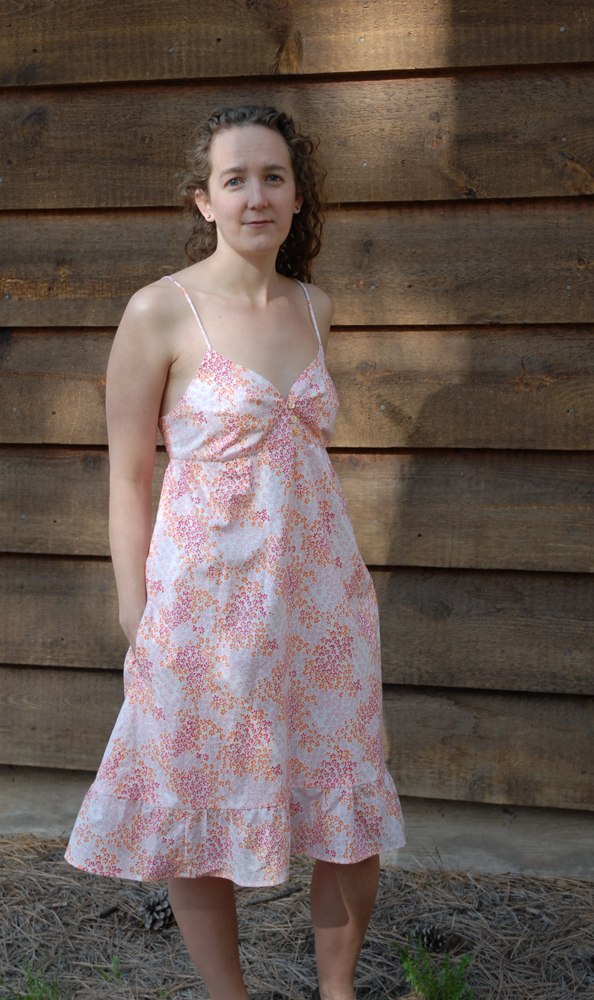
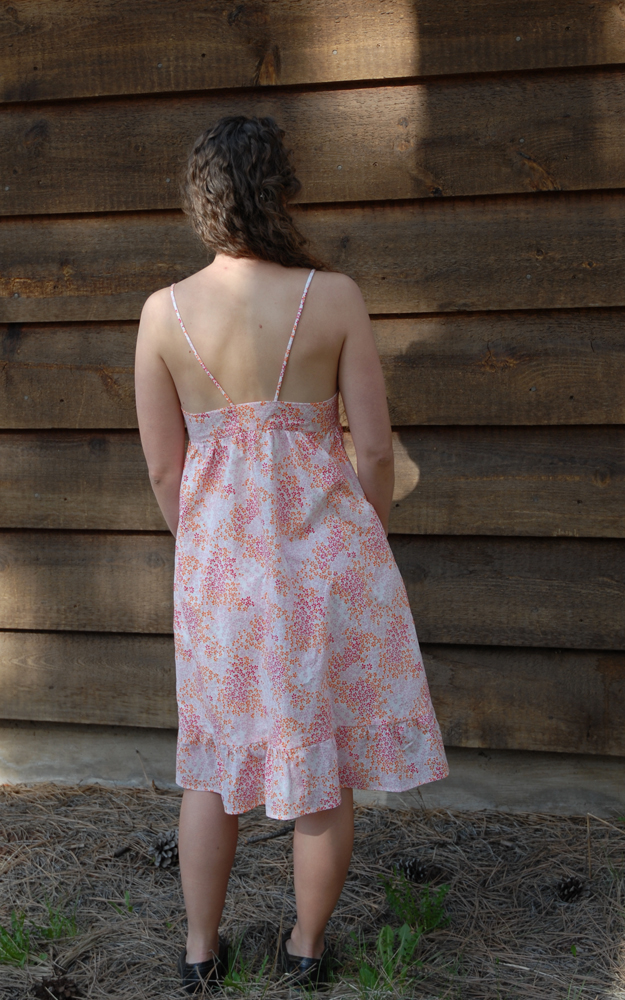
My sundress is finished!  I’m really excited because a) it’s done in time for summer, and b) this is the first pattern I have really made from scratch, not by copying a garment or altering an existing pattern.  I draped the top part with the help of my dress form, and measured and flat drafted the pieces for the skirt and ruffle.

The fabric is a very lightweight soft cotton which I am about 98% sure came from Gayfeather Fabrics in Madison, WI – a great place to stop if you are nearby.  It’s lined with a similar plain white cotton which I still have a fair amount of from the former Buttons n’ Bolts in Tucson – I miss that place.


Although I am thrilled with how it came out, there are still a couple of alterations I’d like to make.  I had made enough versions of the top out of muslin that I thought it was safe to try one in “real” fabric.  At least for me there are some things I never can tell unless I’m really wearing something around, not just trying it on for a few minutes in front of a mirror in a partially finished state. I think it would be more flattering if the join between the top and the skirt was about 1/2″ higher, which means I’ll extend the top up at the neckline as well, otherwise I think there will be too little top part.  One of the darts needs to be more curved, although the wrinkle it’s making now is kind of cute.  For the next version there won’t be a ruffle at the bottom, because I’m making it out of fabric I batiked last summer, and I made a border for the print!  For that version I think I will have the skirt a little less gathered at the top, flaring out to about the same width.

My plan was to put the dress on my form for photos, (especially since the high was 47 F the day I finished).  But I neglected the fact that while I like minimal closures and shimmying my clothes over my head, my duct tape form has immovable shoulders, there was no way I could shimmy the dress onto it!  So thanks to my dad, who stopped by this morning, for taking these snapshots.  Luckily, it was much warmer today as well, although unfortunately not warm enough to wear this all day.

Hope this gives you some ideas for summer projects!

Quick and Easy Ski Straps

We are hanging out and skiing with some wonderful friends this week in Oregon, so it seemed like a good time to add this project!

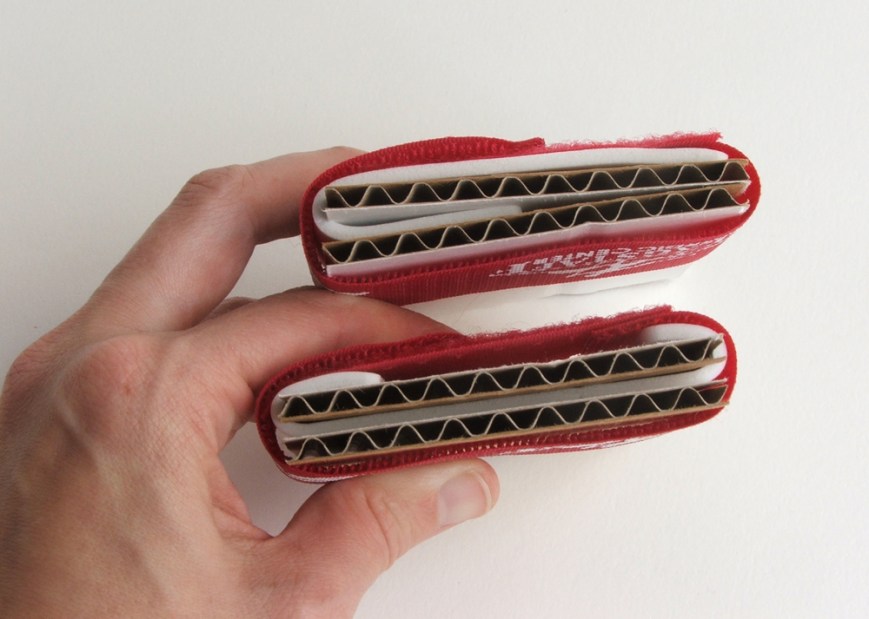
We got these ski straps for Christmas, but for some reason the foam part only extended partway between the skis, so they could still rub on the other side (imagine the cardboard here is the skis).  The top strap is how they started.


This is how I get into trouble, of course this could be better, and so I have to make it better.  The bottom strap is after I altered them.


It would be super easy to make your own for cross country or downhill skis, all you would need is something thick and squishy for between the skis, like felt, fleece, foam or batting covered with fabric.  Plus wide velcro.  Make the squishy part a little wider than the skis, plus enough to overlap and sew to the velcro, and enough velcro to reach around skis and stick to itself (fuzzy side out, hook side in).  Sew it together with a sturdy X pattern, and you’re done!

These would make a great little present for skiers you know.  Here’s hoping for some more snow in Flagstaff this winter, we love to xc ski right near our house when there’s enough.

Note: to sew an “X” for extra strength: sew in a rectangle first.  When you get back to where you started, sew diagonally across to the other corner, then along one side a second time.  Sew diagonally to the other corner, and back along the opposite side.  Overlap a few stitches where you started.