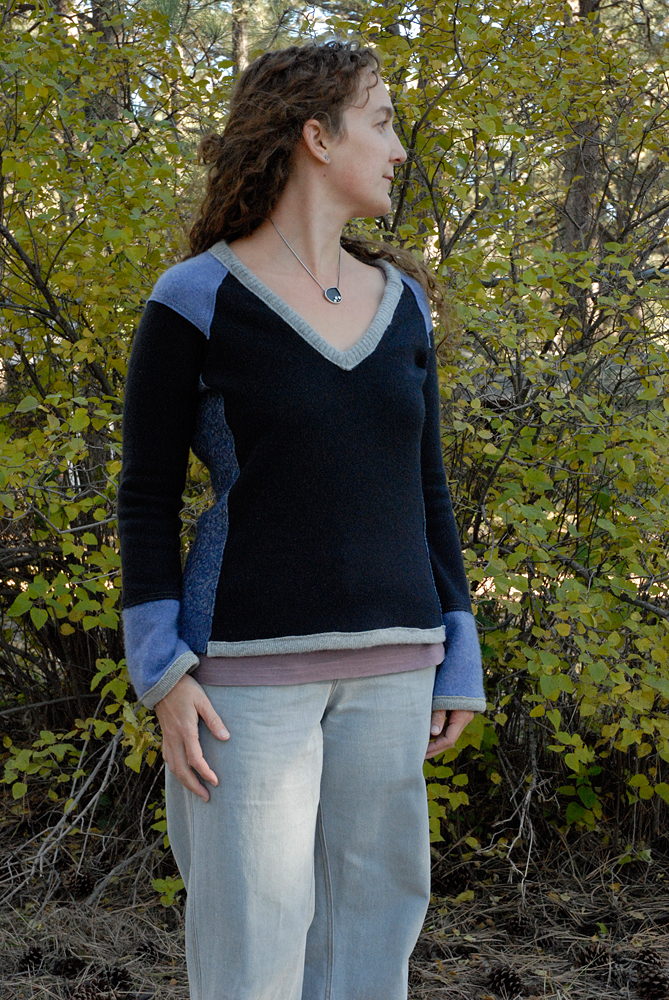
A New Me-Made Upcycled Sweater


blue upcycled sweater looking side


Hello all!  I’ve been making and mending just about as much as physically possible around here (in between making hundreds of these little fuzzy hats) ever since I got back to my studio a few weeks ago.  Not much has made it up to the blog yet, and I decided to just start with the thing I’m most excited about: my new sweater!  I really, really need some more sweater layers for this winter, and I’ve had a plan to make a couple of upcycled ones from various bits and pieces since the spring.

So, here’s the first one!  The main part of it came from a deep navy blue, super soft, slightly felted, merino sweater that some friends gave me (on the right below).  The fabric is lovely, but the shape was classic sweater that doesn’t work for me—baggy on the sides, gathered in at the bottom—in other words the least flattering possible design for a small pear-shaped girl such as myself.  I also have this knit top which I love the shape of, it has princess lines (flattering—yay!) and interesting side panels, it fits me well and since it seems to be on its way out (the problem with thrift store finds) I had already traced a pattern from it.  So . . .
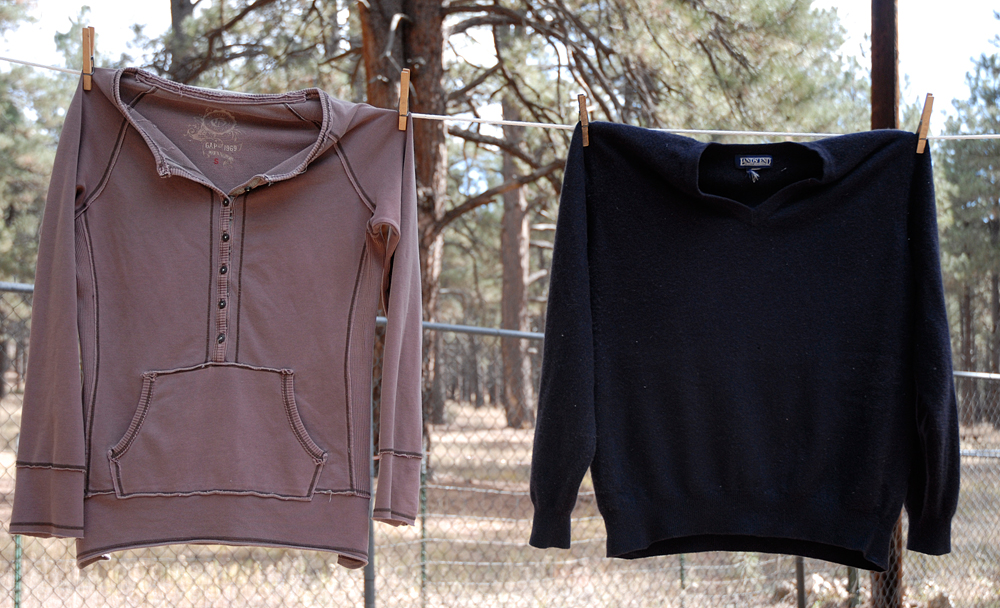
 

sweaters on line


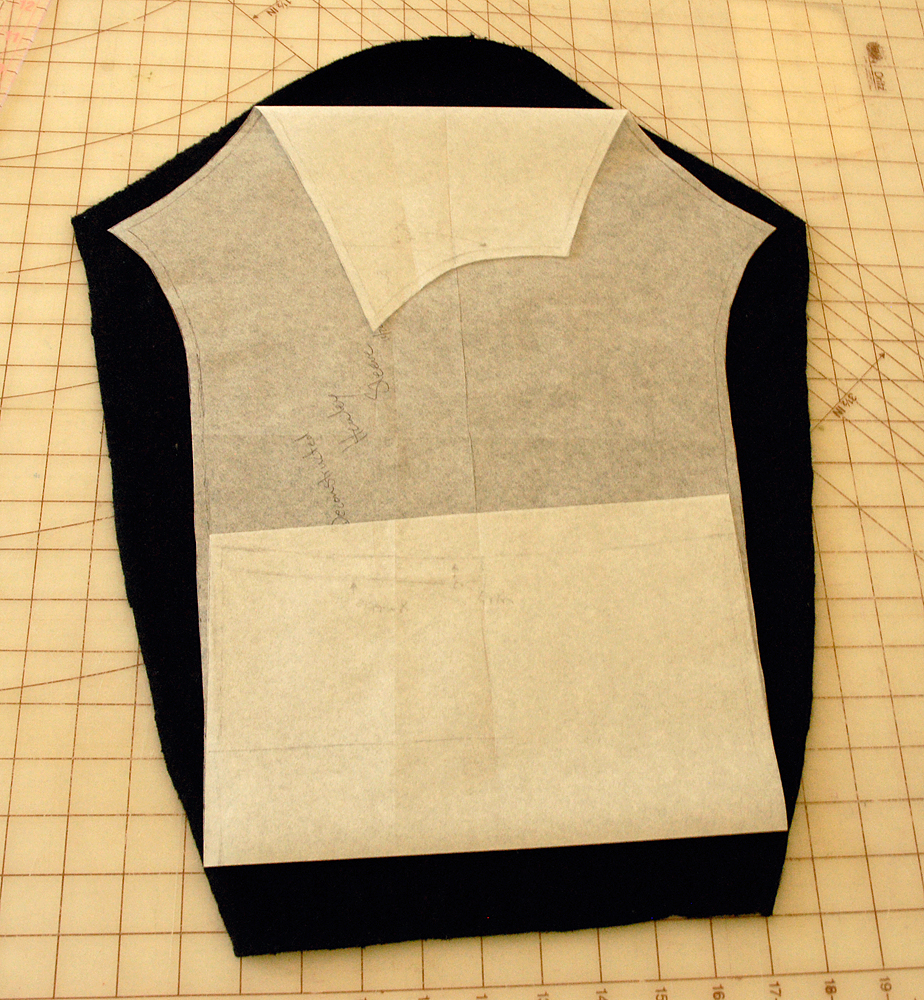
piecing sleeveThe biggest lesson I have learned so far when recycling/refashioning something old into something new, is to treat the something old as fabric.  Unless the alterations you want to make are super duper simple, take the whole thing apart and press it flat and see what you’ve got, and it will be so much less frustrating.  You do end up with some odd shaped pieces of fabric, which can lead to interesting piecing and seams.  I folded the pattern for the new sleeve to accommodate the fabric from the old sleeve, leaving me two parts to cut from another fabric. I just have to remember to allow for seams when I cut the pieces to add on.  I had allowed 1/4″ seam allowances, so I cut the top and bottom sleeve pieces 1/2″ longer than the lines where I cut the middle piece, so there would effectively be a seam allowance on both sides.  Make sense?  I have screwed up the math on that before . . . but not this time.

It probably won’t surprise you if I point out that I have a lot of scraps of cashmere lying around here, plus old sweaters friends have given me, etc.  I chose a dusky purple for the extra sleeve pieces and extra at the back, which also didn’t quite fit on its corresponding piece of ex-sweater.
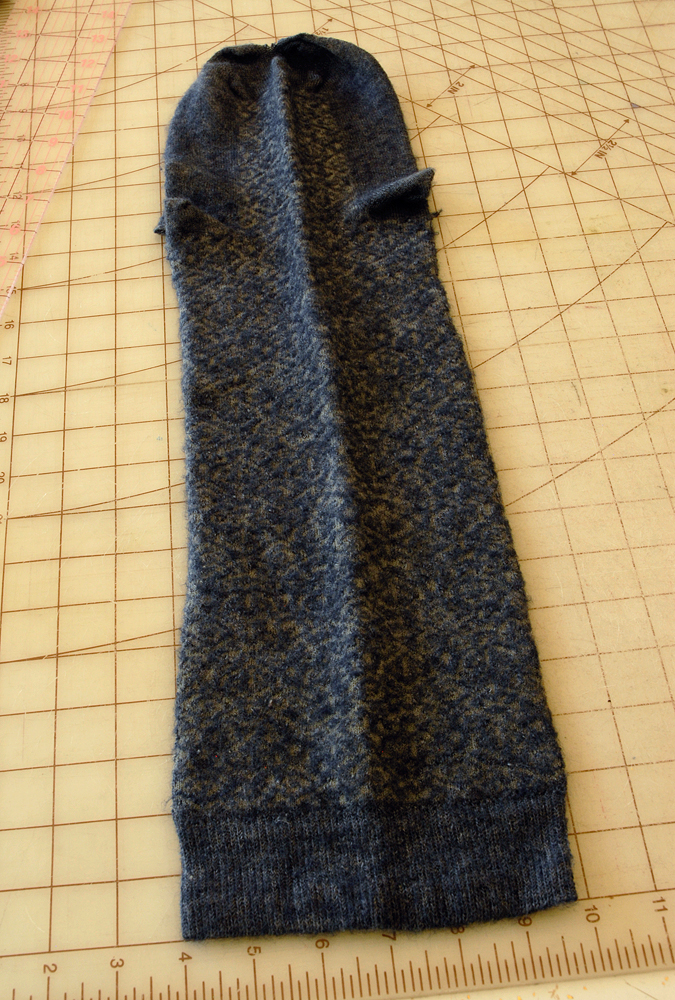
flat sockI chose the purple because it matched my material for the sides: socks!  My mom was nice enough to buy me these super soft alpaca socks at a fiber festival.  I loved the knitted pattern, I love knee socks, I carefully followed the instructions, which were to machine wash and line dry.  That’s my default washing mode anyway, so I thought I was good to go . . . but by the second wash they had shrunk to the point where fitting over my calves was no longer an option.  (Short strange tangent: this opened up sock reminds me of those animal pelts you see in museums, as if socks ran wild and were hunted for their fur.)  Once pressed flat, there was just enough material in each sock leg (including the ribbing) for one side panel of my sweater!

I experimented with sewing the seams flat, and I really like how it came out.  I overlapped the two pieces I was sewing together by 1/2″ (the same seam allowance as if I had sewed the seam 1/4″ from each edge, see what I mean?), feeling with my fingers for the edge of the layer underneath, and pinning in place.  I sewed a narrow zigzag close to the edge of the top layer, and then again about 1/4″ away, using parts of my machine foot against the edge as guides.  I used a walking foot, which I nearly always do for knits.

This method turned out to be only just slightly trickier for the curved seams connecting the sides to the front and back, so I did it there too.  I really like the slightly deconstructed look this gives it.
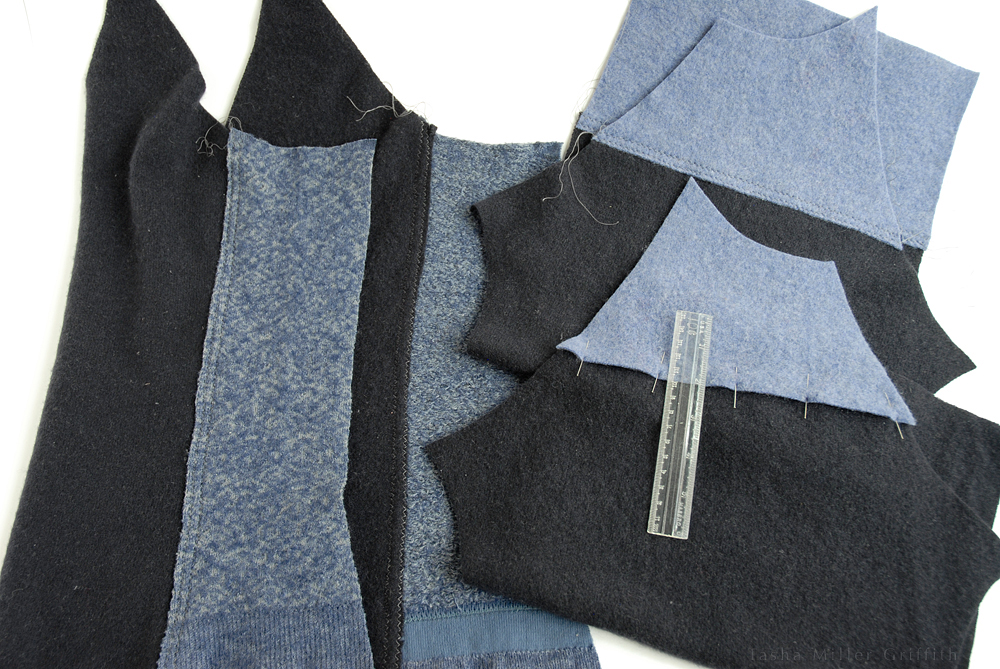
 

flat knit seams


I didn’t do the flat overlapped seams running down the sleeves, it would have been too much scrunching the sleeve up under the machine.  I did do it to attach the sleeves to the body though, and because of the raglan construction (not having to put in the whole sleeve in the round) it was pretty easy.

For the neckline, I kept the “v” of the original blue sweater, although in future I might add in some there just to make it a little cozier.  I knew that a section of scrap cashmere ribbing wouldn’t do anything much to keep the neckline from stretching all over the place, so I attached 1/4″ clear elastic first, stretching it to ease in the extra fabric and get the neck to lie flat, especially across the top of the shoulders.
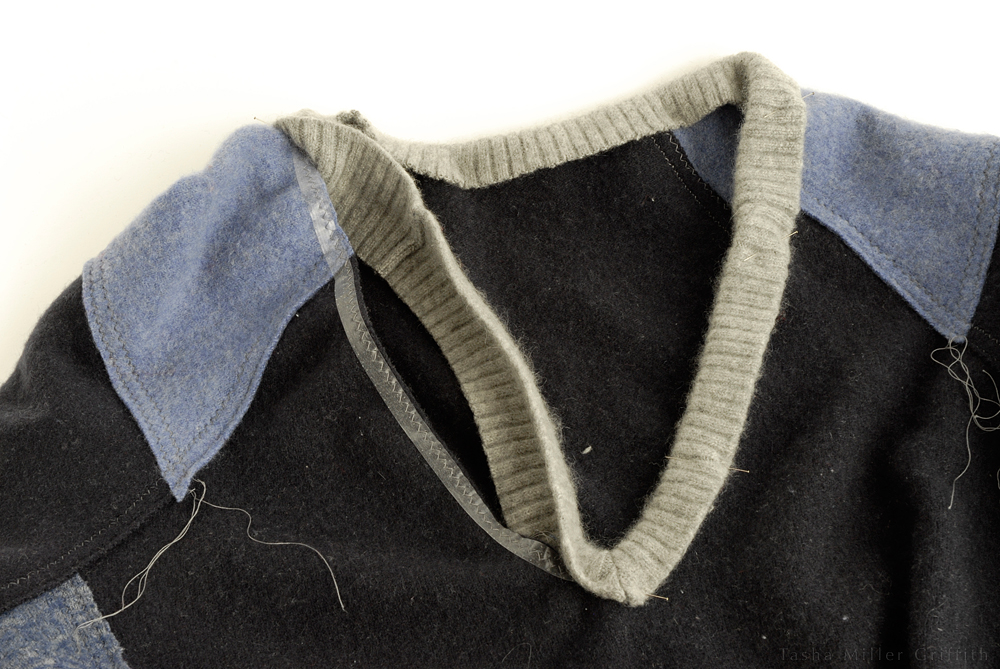
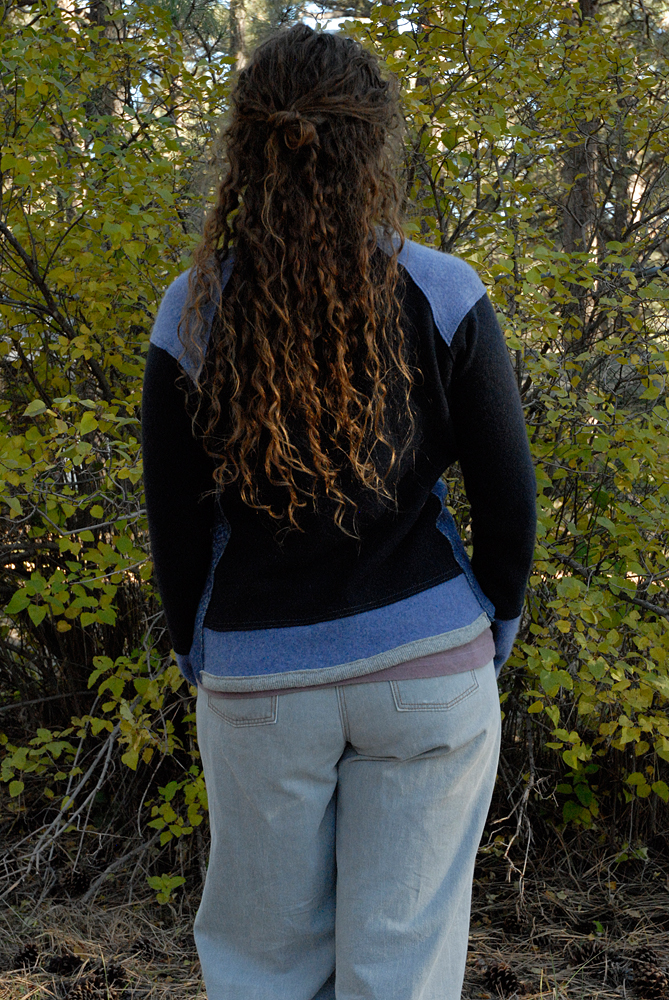
 

sweater neckline


blue upcycled sweater back(By the way, I think the colors are truest in the two pictures above.  I’ve had trouble getting my white balance and purples to get along.)

So, I zigzaged on the ribbing at the hems and bottom of the sleeves as well, and there you have it.  I actually cut pieces for another purple section around the bottom, but I decided that I really liked the sock ribbing as the hem, and I liked the length when I tried it on, it allows another layer to peek out below.  And winter is coming, so I’m going to be wearing lots of layers!

I think the saddle shoulders may be my favorite part.  I’ve got plans for another franken-sweater using something I knit years ago.  I’m really pleased with how this came out, and looking forward to a DIY cozy winter!
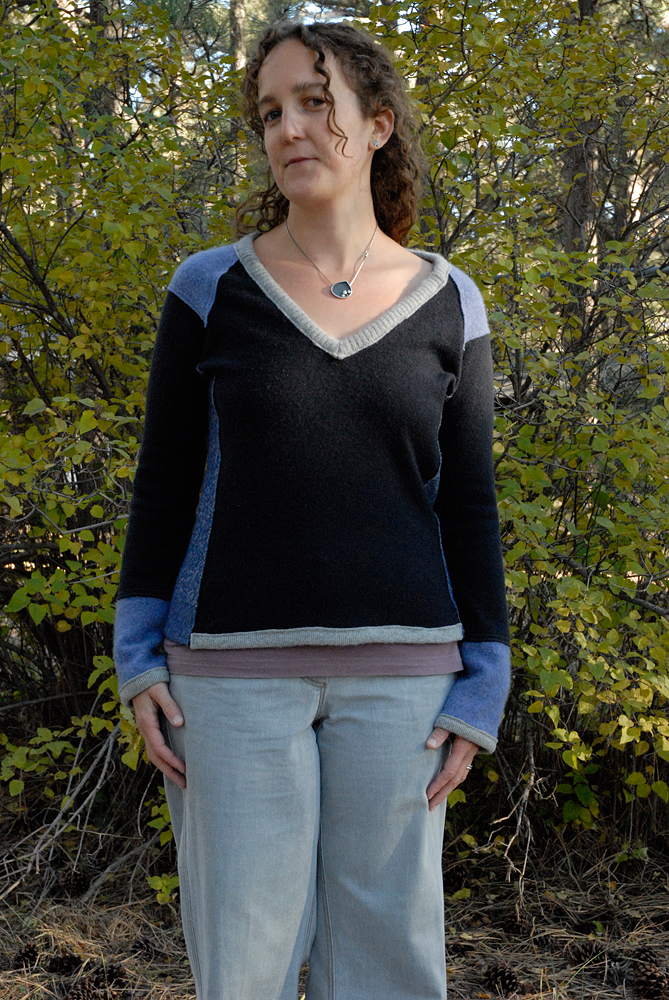
 

blue upcycled sweater front


Fried Green (Cherry) Tomatoes


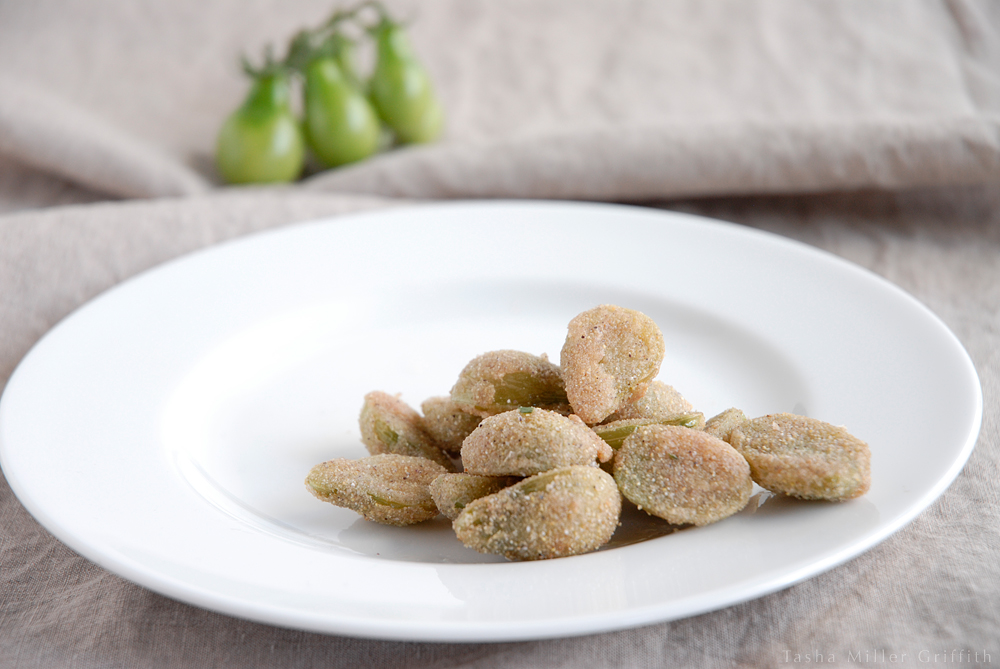
fried green cherry tomatoes


But why, you may be asking, should I fry green tomatoes?  That was my question too, until we got some from our CSA a few years ago and I tried this for the first time.  The short answer is: they’re delicious.  For a slightly longer one: in our mountain climate, an early freeze is likely pretty much inevitable in the fall, which greatly increases the chances that my friends and neighbors will give me tomatoes picked before they had time to ripen.  They will get a little riper on the counter in a paper bag or wrapped in newspaper, but they’ll never be the same as they would be on the vine. When fried, the green tomato flavor completely changes, and a crunchy cornmeal crust is a wonderful compliment to the tart soft insides.


Fried Green Tomatoes

adapted from The Joy of Cooking


Mix together in bowl for the coating:

1/2 cup dry masa

1/4 cup whole wheat flour

1/4 cup blue corn meal

Seasonings you like: a little bit of salt and pepper, seasoned salt, fresh thyme and/or Cajun spice mix . . . anything you want to give the batter a little extra flavor.

If you don’t have these exact ingredients, don’t worry.  The mixture of fine ground (masa) and coarser cornmeal seemed like a good idea as far as sticking to the tomatoes and producing a crispy crust, but a mixture of regular cornmeal and flour should work fine.  One cup total of the dry batter was enough to cover a heaping dinner plate’s worth of fried cherry tomatoes.

Pour a little buttermilk (or regular milk, I used buttermilk since it’s a little thicker and has a bit of tangy flavor) into a shallow bowl.  If you run out you can always add more to the bowl.


Dip the tomatoes in the buttermilk, then in the cornmeal mixture, shake off the excess and set on a plate to dry.  I found the most efficient method to be: chop a bunch of the little tomatoes in half.  Reserve one hand for buttermilk and one for cornmeal (so you can do several rounds without stopping to wash your hands).  With the buttermilk hand, pick up a handful of tomatoes and drop them in the milk.  Stir to coat and then drop them into the cornmeal mixture.  With the other (cornmeal) hand, scoop cornmeal on top of the wet tomatoes, stir them to coat, shake each one gently and put it on the plate.  I was a little worried about the batter not sticking to the skins of the little tomatoes, but for the most part it worked just fine.

If you have big tomatoes, slice them fairly thin (between a quarter and half inch thick is good).  Dip each slice in the buttermilk and then in the cornmeal, turning to coat.


To fry: heat 1/4 -1/2 inch of oil in the bottom of a heavy pot or skillet.  I like to use my heavy-bottomed soup pot, since any splashes of oil stay inside it instead of all over everywhere.  Use an oil that can take high heat without smoking (I used canola).  Joy suggests heating the oil until a drop of water sizzles when you flick it into the pan.  I did a little research for a recommended temperature, and Southern Living (they should know) suggests 360-375° F.  I know from experience that having the temp too low can cause strange things to happen to your batter . . . anyway, when the oil comes up to heat, drop in as many tomatoes as will fit in a single layer.  Fry until one side is golden brown and crispy, and then turn them over and cook the second side.  When done, scoop the tomatoes out with a slotted spoon or strainer, shake off the excess oil, and place on paper towels.

These are best eaten warm, delicious with a little homemade mayo or ranch as well as just plain.  If that doesn’t make you hungry for some Southern food I don’t know what will!  Black eyed peas and cornbread . . .

Free Yourself to Make Something Ordinary


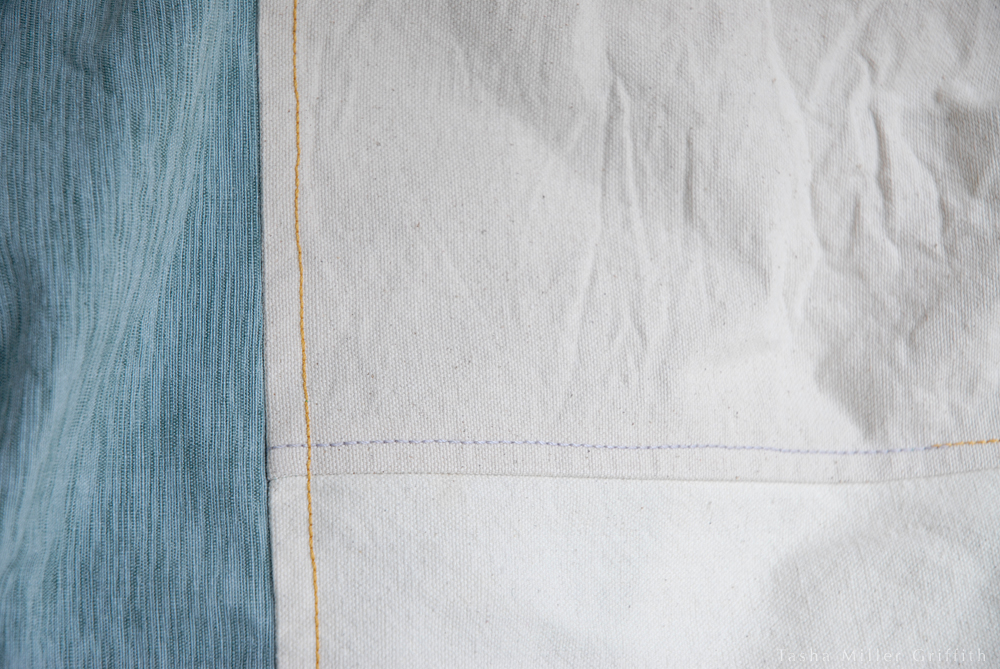
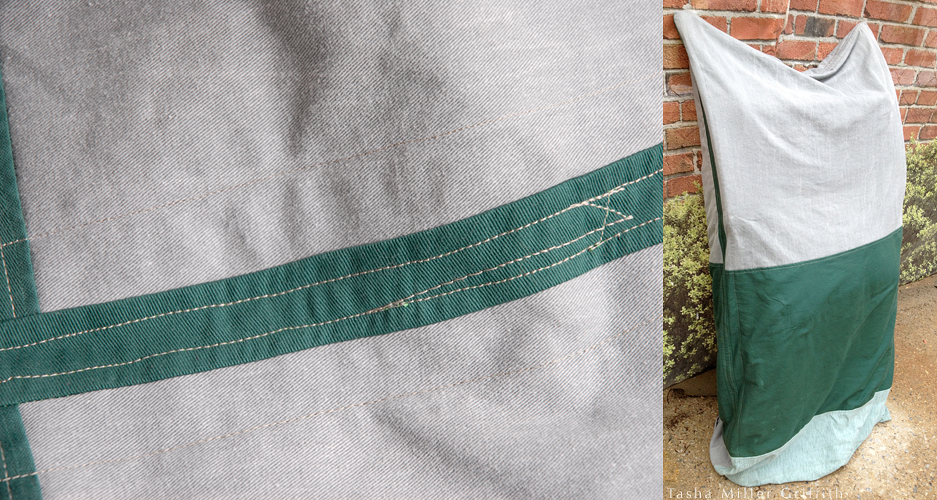
garment bag stitching


Now that I’ve told you a little more about why we travel most of the summer, I can also share some things I’ve made for our trips.


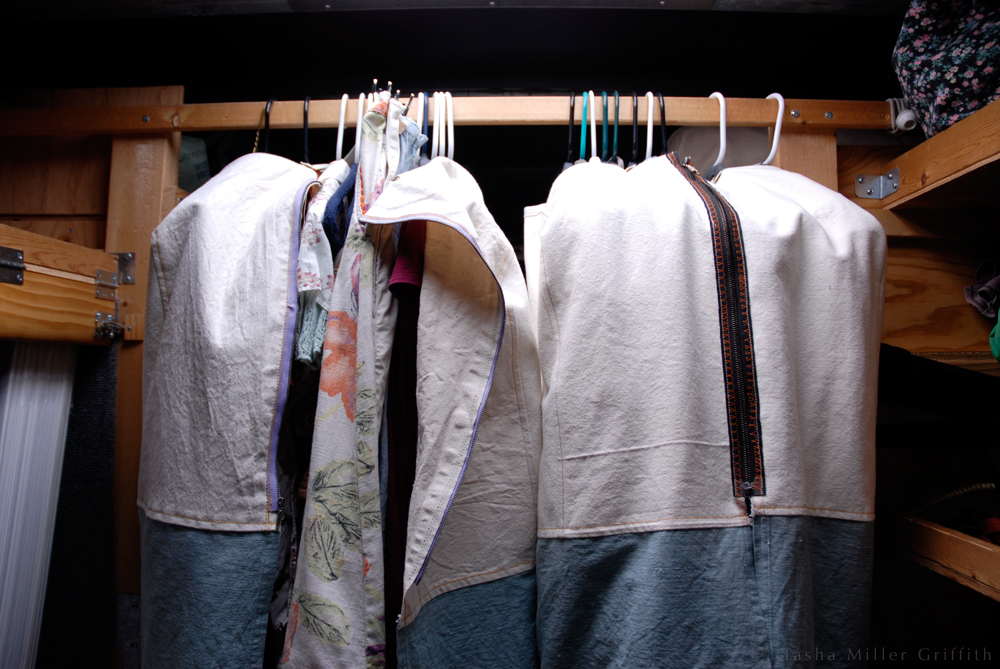
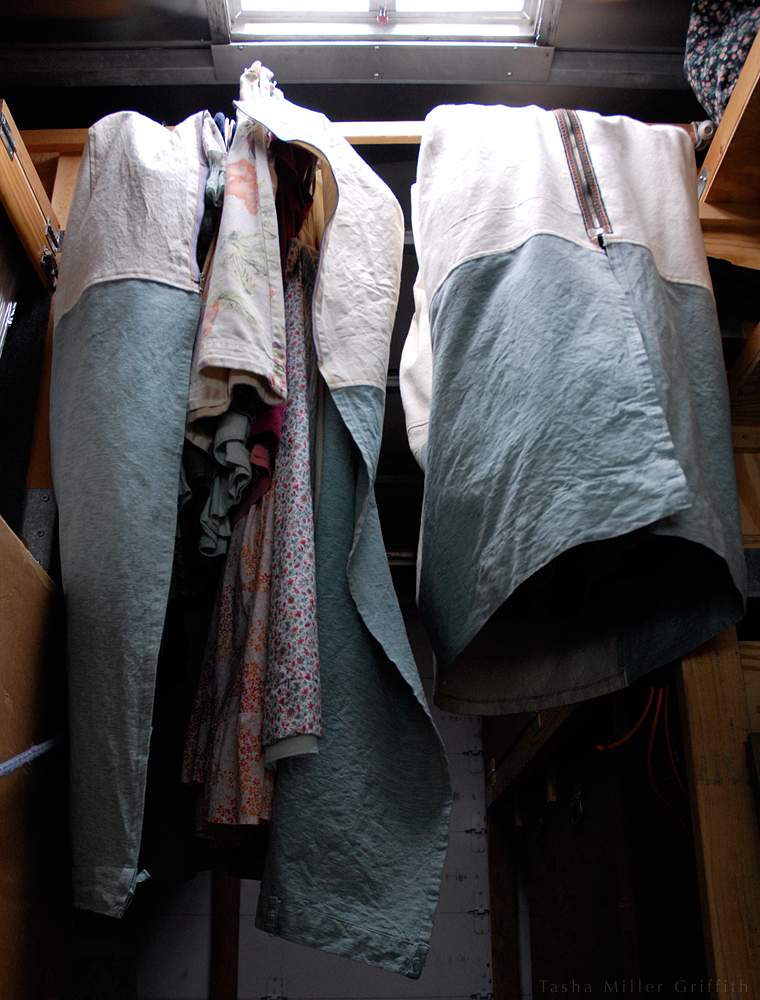
Our clothes spend a fair amount of time in a “closet” consisting of a thin strip of wood between the shelves we have built into our truck.  It’s much better than keeping them in a suitcase, but still not ideal since they are unprotected.  At the end of last summer, when we unpacked the clothes from truck to house, I noticed that one my jackets was significantly more faded on one side than the other.  Maybe hanging it with the same side to the skylight for the whole summer was not the best idea?  The same thing happened to Bryan’s jacket, so I’m pretty sure that extra UV light on one side was the problem—combined with the fact that it was warm last summer and the jackets didn’t come off the rack very often.  I had been thinking vaguely for a couple of years about making some kind of garment bags to protect our clothes from getting dirty/scratched up as we move things in and out of the truck, especially as I have started to take more me-made garments on the road.  This was the final straw, I had to do it.


garment bags hanging 2


I decided to make two, each half the width of our “closet.”  One would be slightly longer than my summer dresses, and the other just long enough to protect shirts and pants.  I traced a plastic hanger for the shape of the sides, and left a split in the front to close with a zipper.


This was the perfect scrap/thrift store shopping project.  Since it didn’t matter exactly what the garment bags looked like, as long as they worked, I could use practically anything.  I used the last of some heavy canvas from old curtains that came with our house, plus another small curtain (made out of some great textured blue-green fabric) that I bought at Goodwill.


garment bags hanging


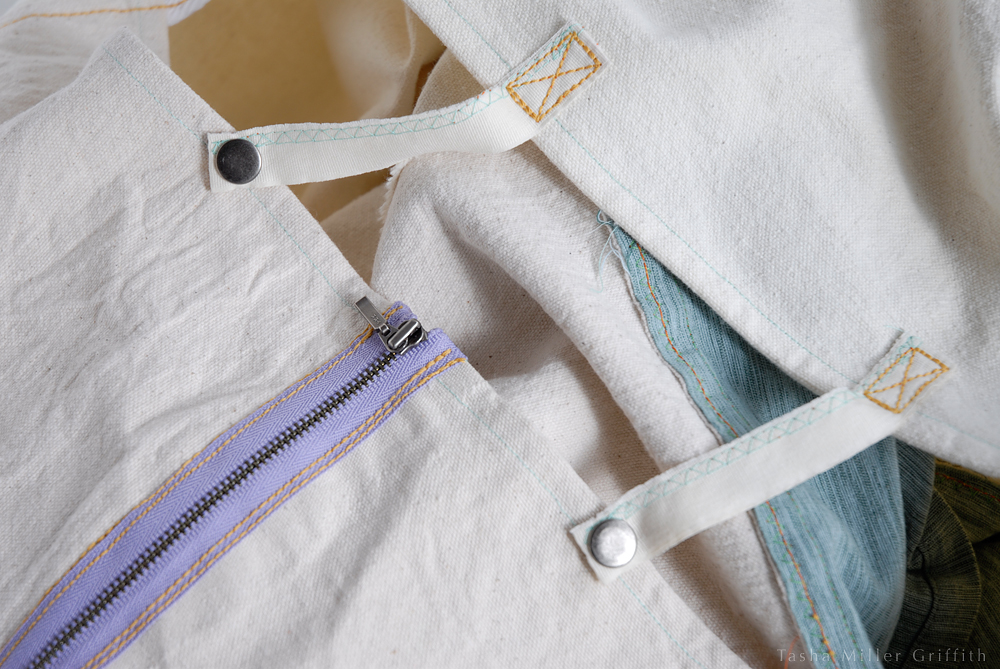
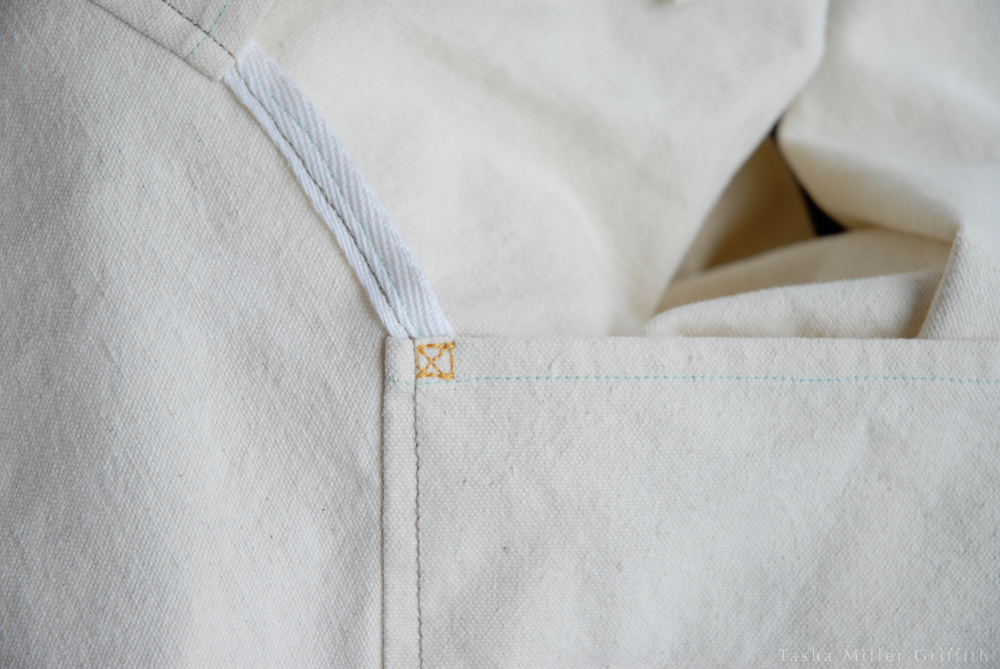
This may seem like a strange project to wax poetic about, but here’s the thing: as I cut myself loose from trying for aesthetic perfection, not caring what anyone would think of my topstitching or pieced fabric, sewing felt more like sculpting; using what I had on hand, and my hands, and just making something almost like I was pulling it out of the air.  I was free to use my creativity in any way I wanted, to use whatever I could find, odds and ends of colored thread, salvaged zippers (really nice ones actually)—and I started to see an unexpected beauty in my intentionally imperfect stitching, one that I hope comes through in these photos.  I was free to do whatever I wished, and yet cared enough to add little touches and experiments.  I was trying things, enjoying the process, and making something useful as I went.  With enough practice behind me to be comfortable with fabric and thread, I was able to just play, and it felt pretty magical.


garment bag snaps


garment bag corner stitching


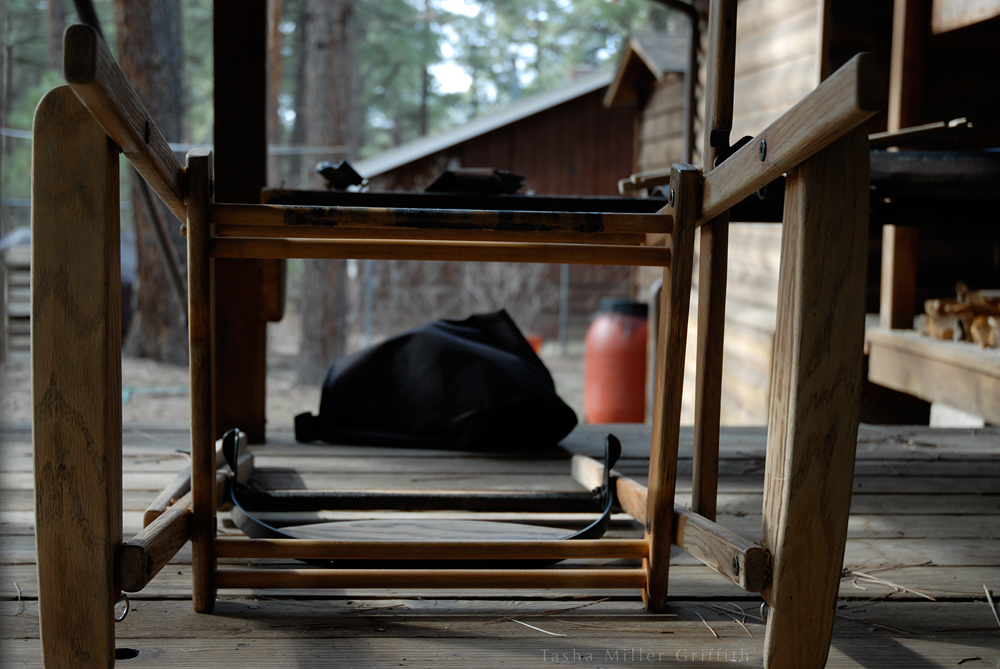
Around the same time, as we both worked on various projects for the truck and Bryan’s display before the summer season, he was refinishing the director’s chair that he uses in the booth.  He did a really nice job, dissembling and sanding the chair before applying the new finish.  After all that, I decided it needed a new bag to protect it from getting scuffed all over again as it’s loaded in and out.


disassembled chair

Chair in the process of disassembly—we’re looking through where the seat would be.


I went back to the thrift store looking for something to line my chair cover with.  I loved searching through the housewares section, looking at everything as a material instead of a finished product (always my favorite kind of shopping), and letting the serendipity of what I found help shape my project.  I decided on two vintage towels for padding the front and back, and a second-hand piece of fabric to round out the outside.  I think the green stripes with my other leftover fabrics make it look like something for sailing.


When I announced that I was going to spend our penultimate evening in Flagstaff sewing (this chair cover), I got an enthusiastic “Ok!” from my notoriously goal-oriented husband.  Remind me to try this trick again next year . . .


chair bag stitching


It’s weird, but having all these me-made covers on our travels this season has been quite a boost to my morale.  Every time I see them, or touch them, I’m reminded that I have a spring of creativity and ingenuity which I can use to make whatever I want, and whatever I need.  That’s pretty much all I need to feel good about life in general.


How about you—have you done any creative and/or freeing projects lately?


Making Drawstring Bags—Another Option for the Top


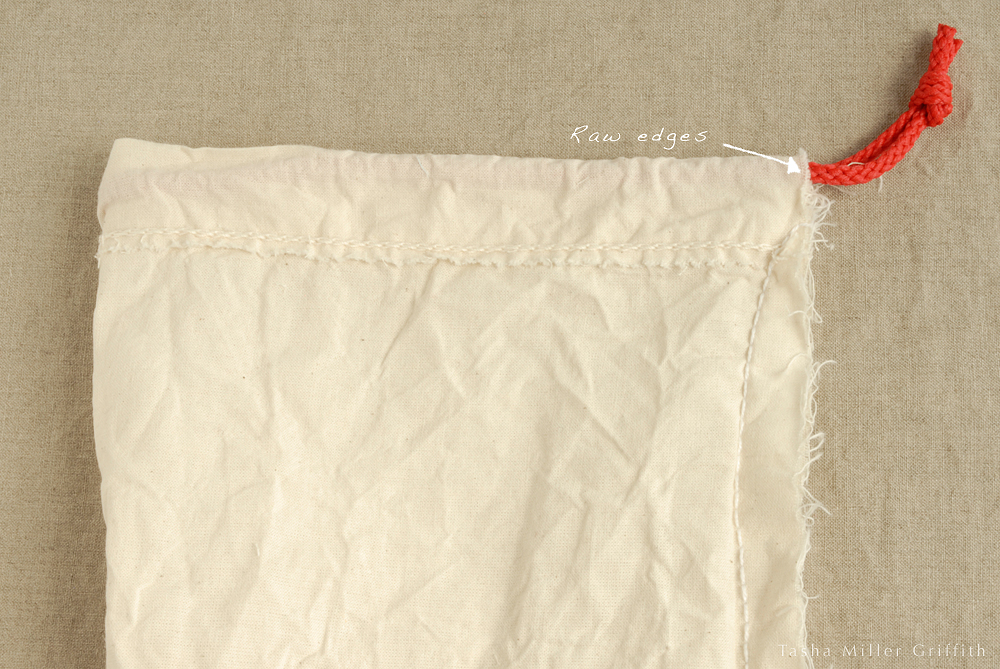
Hello!  There’s been just a little more radio silence around here lately than normal, but hey, that’s what retreats are for, right?  Today let’s jump back in with some thoughts about drawstring casings on bags.  In the second part of Hello Sewing Machine, I guide you though making a drawstring bag and leaving a “buttonhole”—a gap in the side seam for the drawstring to pull through.  That’s probably my favorite way to finish the casing, and one that helps you think about how a piece of fabric becomes a finished project, which is why I chose it for my beginner e-book.  There are lots of other options though, basically any method that encloses the raw edges and leaves a place for the drawstring will work.  One of my proofreaders asked about making a little hem on the sides of the bag instead, and I wanted to present that option here.  In my example, I’m altering a commercially made bag which doesn’t have much in the way of seam finishing, and is not going to stand the test of time.  You can also easily use this technique on DIY bags.  Click on any of the pictures to enlarge for a closer look.


drawstring bag 1


On this bag, there’s nothing to keep the raw edges from unraveling.  I’m especially concerned about the area where the drawstring emerges from the bag, because it’s likely to get a lot of wear and tear, which will cause the fabric to unravel faster.

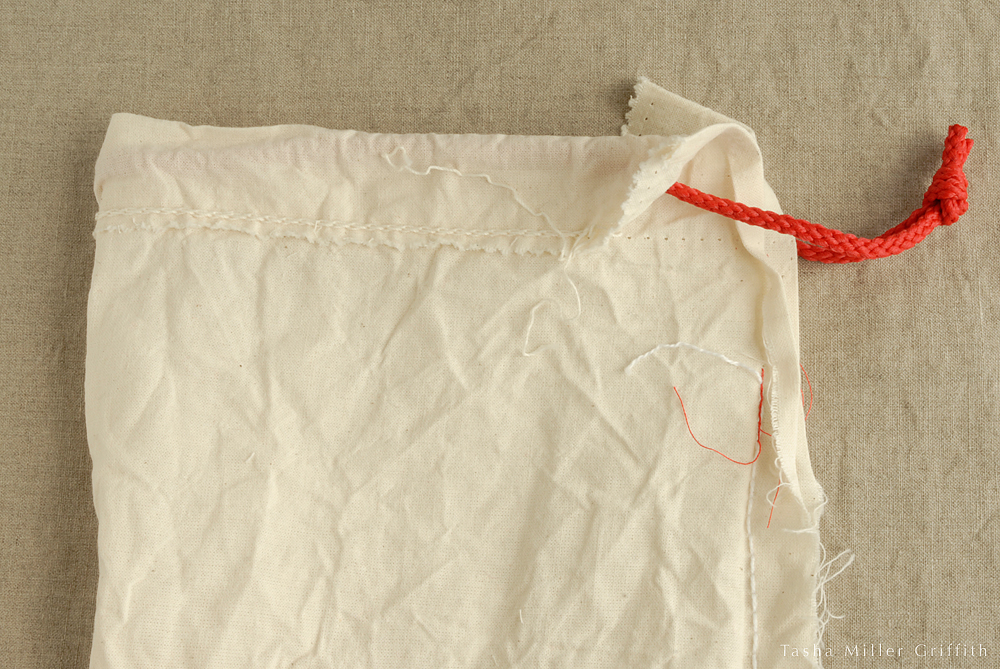
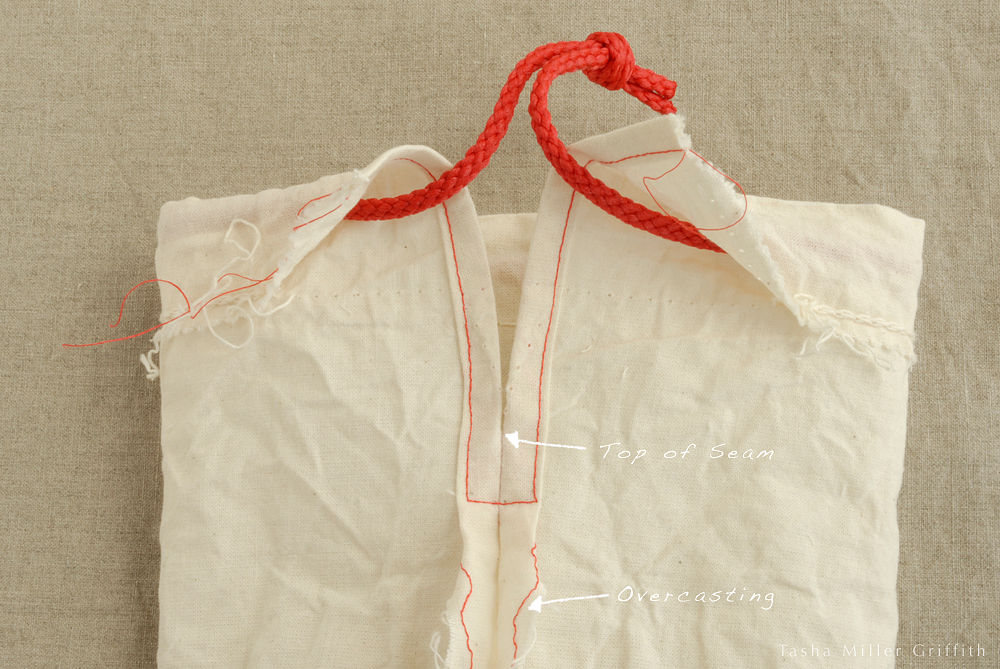
My first step was to take apart the seam stitching, down to where I wanted the seam to stop for the new finish.  I stitched up to that point and back down (with red thread) to hold all the stitching in place.  Then I took apart enough of the seam holding the casing down to let me make a narrow hem on the edges.


drawstring bag 3


If you are making your own bag, just stop sewing the side seam a little ways from the top, and back tack over the seam end.  To figure out where to stop, think about the parts of the casing you need to leave room for at the top of the bag.


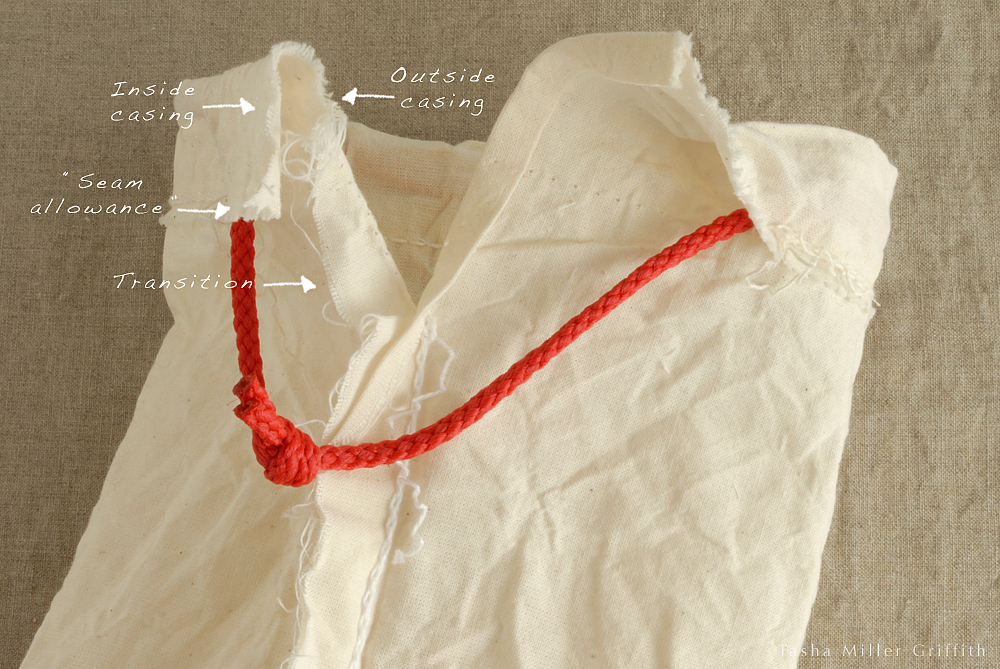
drawstring bag 2


At the very top is a little extra fabric, usually turned under (or stitched over) so that it won’t unravel.  It serves the same purpose as a seam allowance.  Then you have the inside and outside of the casing (keep in mind we are looking at the bag from the inside), and you will also need a little more room (about 1-2″ or 3-5 cm) for the transition between the hemmed edges and the seam.   Once you figure out where the end of your seam will be, go ahead and overcast the seam edges, continuing a little bit past the point where your seam stops.  Then on each edge above the seam, fold over and press down 1/4″ (or .5 cm) with your iron, towards the inside of the casing.  Fold over the edge again in same direction, using your first fold as a guide, and press in place again.  Then stitch down your hemmed edges, sewing close to the edge with a straight stitch.   Sew across the seam as well, below the top where you stopped stitching, so that all the stress from opening the bag is not on just one point.


drawstring bag 4


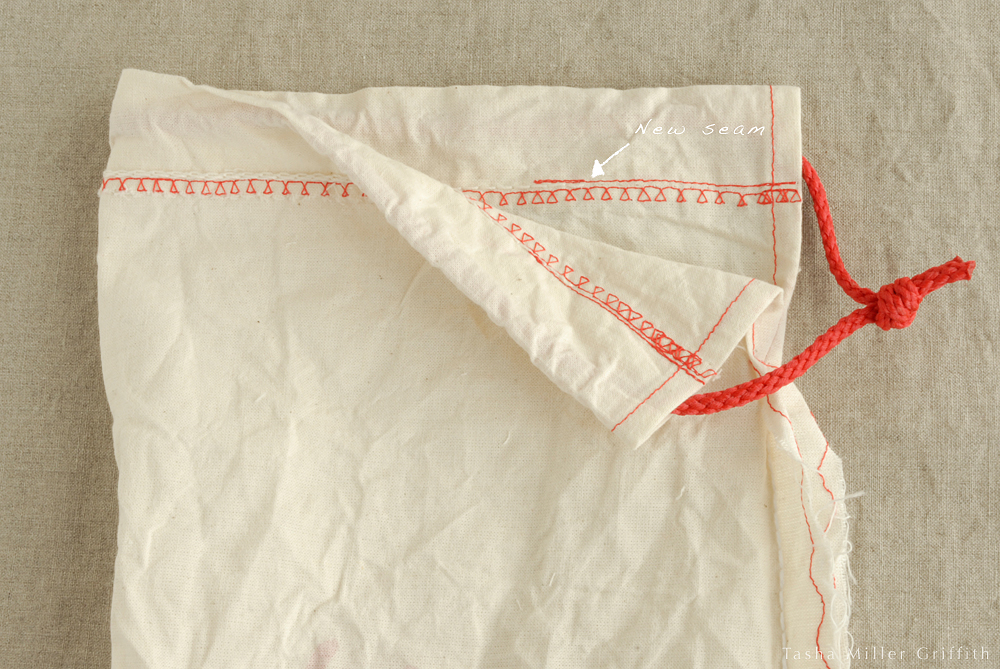
Next, sew your drawstring casing in place.  Normally I would press a small fold at the top edge towards the inside, and then fold and press down the width of the casing.  Since the casing here is already sewn in place around the rest of the bag,  I opted to replace the original stitching, overlapping it with the red thread.  Make a small back tack at each edge, since those ends won’t be held down by any other stitching later.  Then I used a mock-serger stitch to go over the small raw edge below the casing, since I don’t want it to unravel and lead to my casing pulling loose.


drawstring bag 6


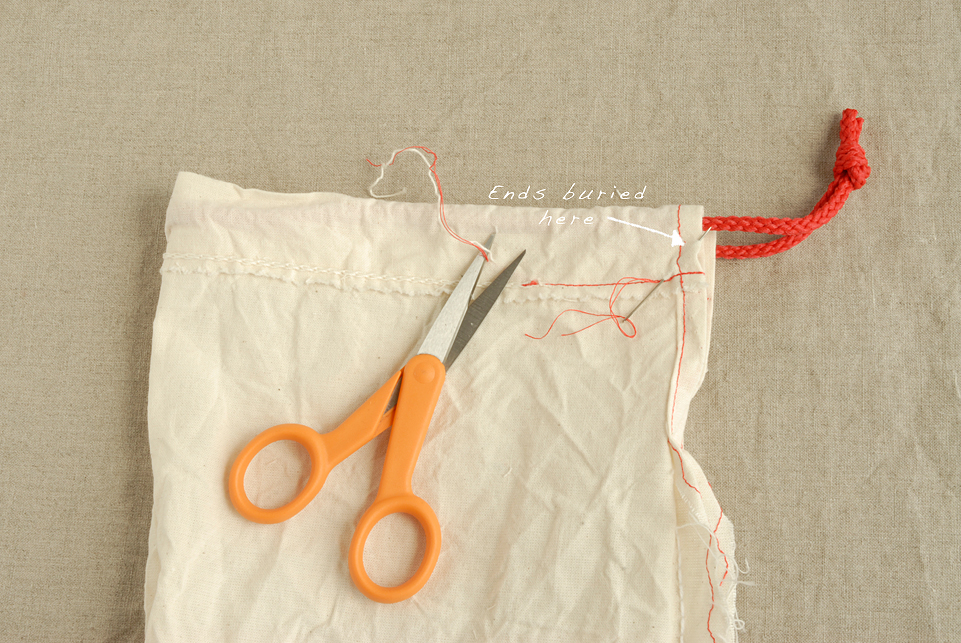
A quick note about ends: I like to bury them inside the casing or hem, or wherever there’s a double layer of fabric, so that enough thread remains to keep the stitching from pulling out, but it’s hidden.  I thread the ends on a hand-sewing needle, pull them between the fabric layers for one long stitch, and snip them off where they come out.


drawstring bag 5


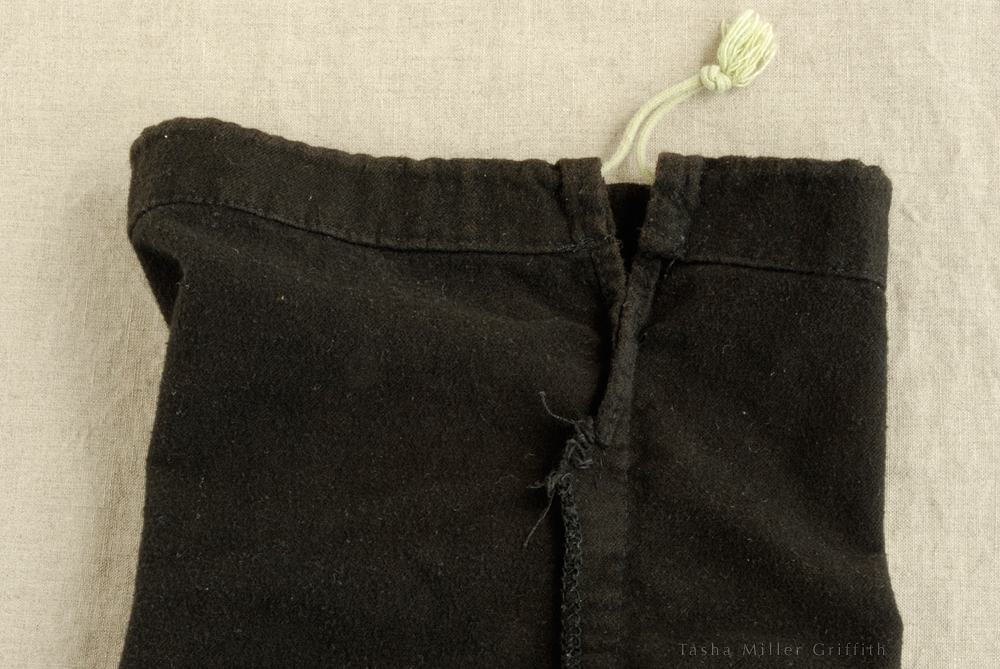
Here’s an another example of a commercially-made drawstring bag using the same concept.  I think they hemmed the sides of the drawstring first, and then caught them in the side seam, and finished the seam allowances with a serger.  As I said, you have a lot of options!


drawstring bag 13


There’s lots more thorough and friendly beginner-oriented directions for sewing seams, overcasting, using your iron to make a casing, and everything else you need to know to plan and sew a drawstring bag in my e-book, Hello Sewing Machine!

If you have other beginning questions, feel free to let me know, I’m always curious about what’s on your mind.   You can also read my answers to others’ questions in this post on Sew,Mama,Sew!


Hemming Jeans Part II, with Catch Stitch Tutorial


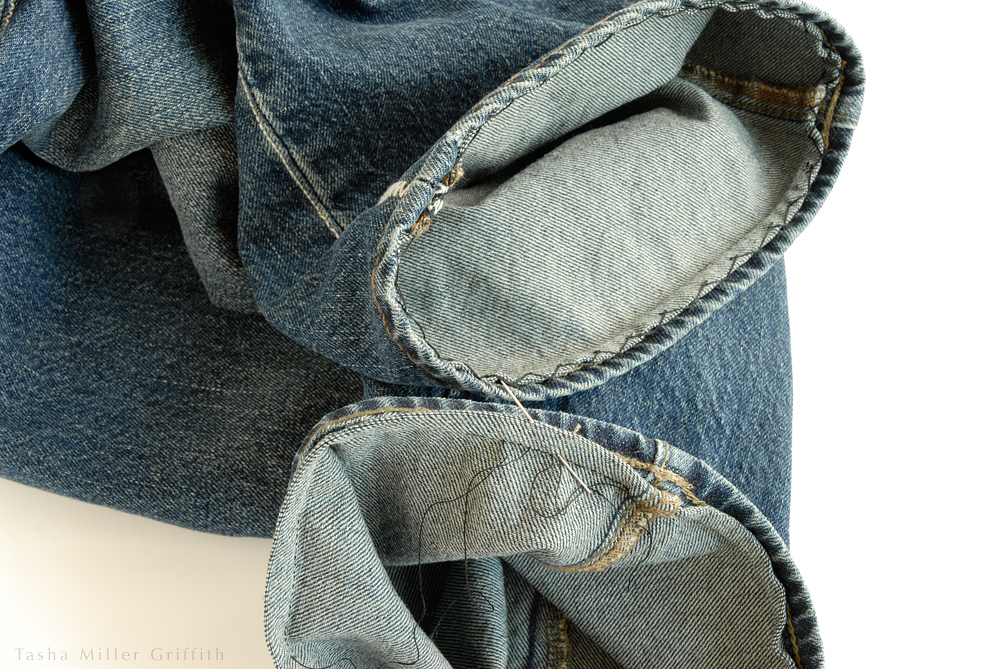
In my last post, we went over how to shorten your jeans, or other pants, keeping the original hem intact.  We left off with the jeans the length you want them, and a little fold of fabric on the inside.  That fold may have cut and overcast edges, or not, depending on how much you needed to shorten the legs.

First, let’s neaten up the thread ends left from sewing the hem by hiding them, and then trimming.  Get out your hand-sewing needle and thimble.  (Any time that the fabric I’m sewing is thick or tough, I use a thimble to protect the finger I’m pushing the needle with.)  Thread your leftover tails onto the needle, and take a stitch between the layers of the fold.  If the ends are short, you may need to put the needle into the fabric, and then thread the tails onto it.  Pull the needle through, and clip the tails where they emerge.  This keeps your stitches from pulling out later, and also keeps the thread tails from showing.


Jeans hem ends


This next thing I’m going to tell you to do is not exactly industry standard.  It’s better!  If you’ve ever had your jeans hemmed at the store where you bought them, they probably sewed them in a similar way to what I showed you in the last post.  At the store, for some reason, they usually turn the fold of extra fabric up and stitch it in place.  I think that looks weird, and like the jeans have obviously been hemmed after the fact, since the bulky fold of fabric is not where you would expect it to be for the hem.  It looks much more natural if you fold the extra fabric down, where the original hem is.  Try folding it both ways and see what I mean.
So, if we turn the fabric fold down, how to keep it there?  You could stitch beside the original hem stitches by machine, either with thread that blends into the jeans fabric, or a contrasting thread you like.  However, that’s a lot of layers of denim to sew through, and it’s likely to be difficult for your machine, and cause some skipped stitches and broken thread.  There are some times when using a hand stitch really is quicker and easier, and I think this is one of them.

Then hand-sewing stitch I like for this is called a catch stitch.  It’s designed to do just what we want here, to keep two layers of fabric in place against each other.


Jeans hem catchstitch 1


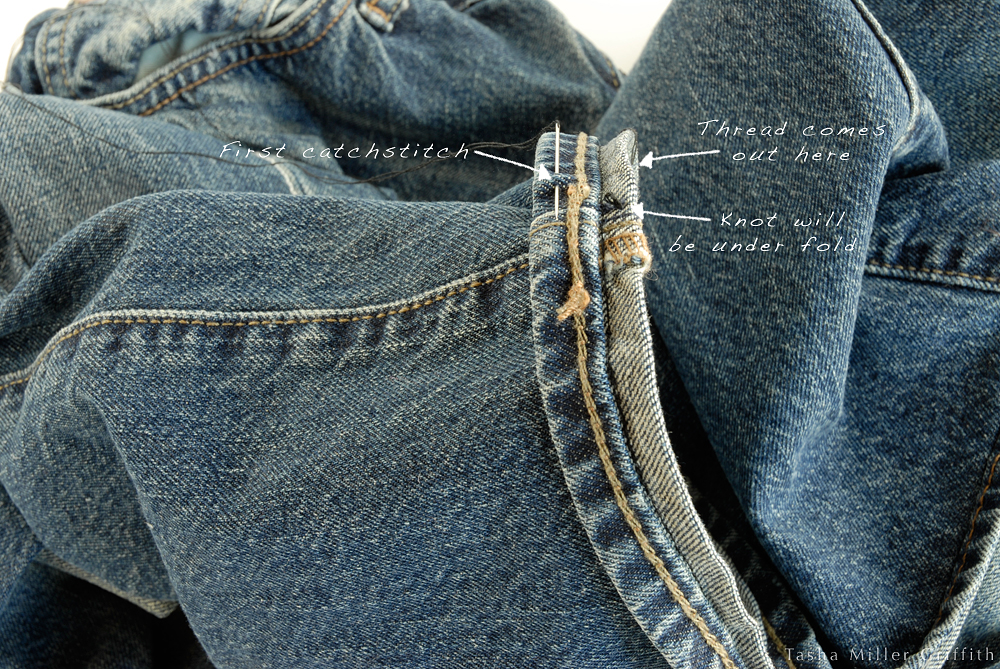
I used a doubled thread, to make the stitches a little more resistant to abrasion.  Get a piece of thread no longer than twice the length of your arm.  Thread it onto a sturdy hand sewing needle (choose one with a little more metal around the eye if you can, it will be less likely to break in the thick fabric) and knot the two thread ends together.

You want the knot to be on the inside of the fold, so stick the needle in there, and bring it out a little way away, on the outside edge of the fold.

Catch stitch crosses back on itself as you sew it.  To do that, you’ll make each new stitch further along in the direction you are sewing (away from you or to your right in the pictures) but bring the needle in and out going the opposite way (towards you or to your left in the pictures).  Hopefully this will make sense as you read through the next few steps.

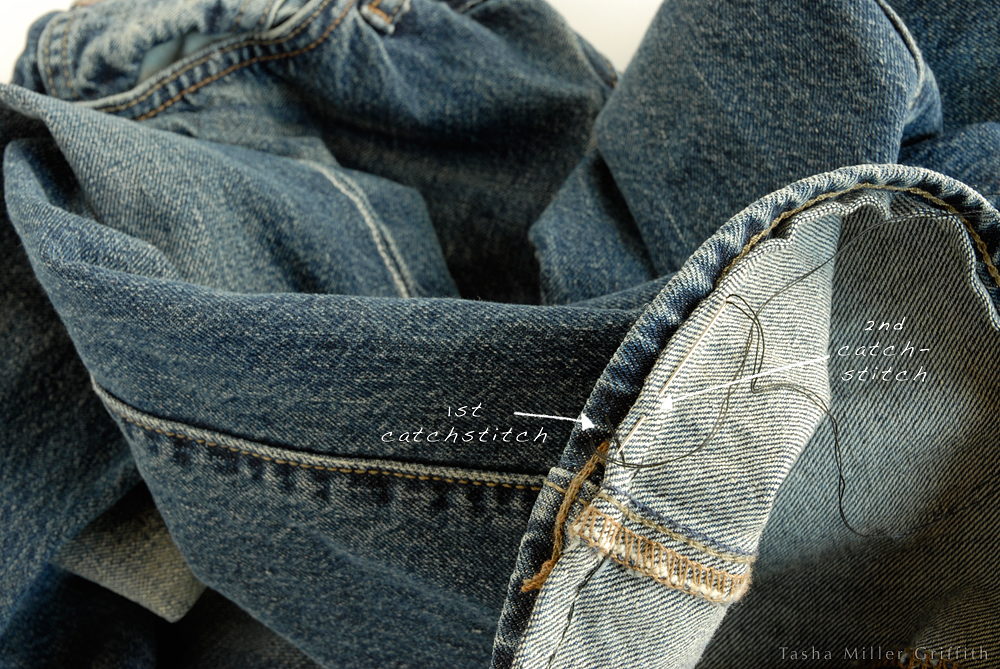
Make the first small stitch in the original hem.  Go through only the first layer of denim, to make it easier, and so that the stitches won’t show on the outside.


Jeans hem catchstitch 2


Make the second stitch in the fold, again taking a small stitch through just one layer.


Jeans hem catchstitch 3


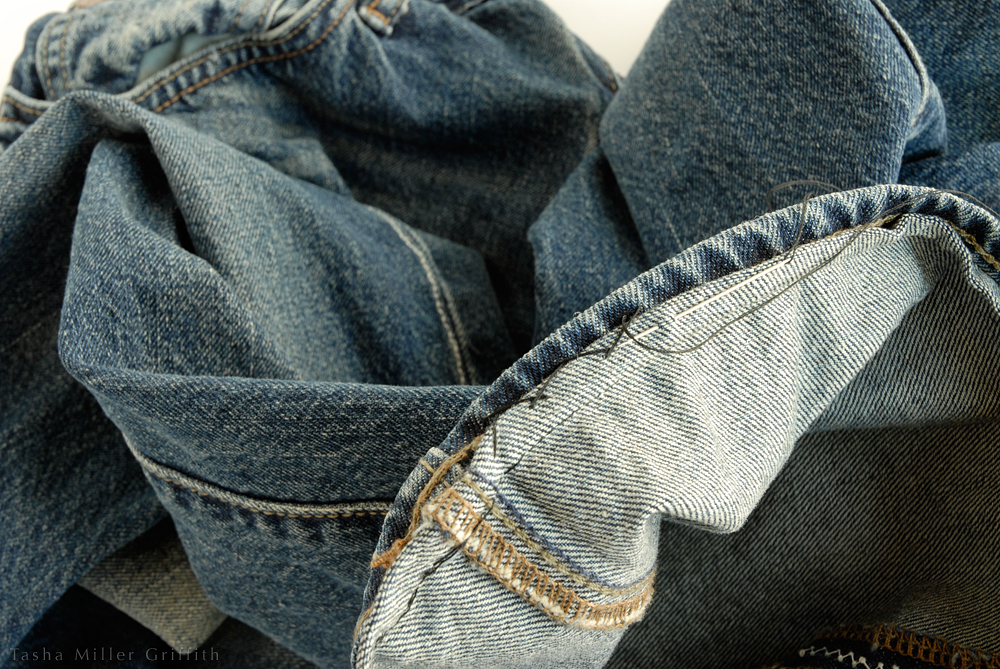
Continue alternating taking a stitch in the fabric fold and one in the original hem.  Make each stitch towards you/to the left, then move a little bit away from you/to the right, and to the opposite side to take the next stitch.

When you get to the seams, you may want to make the stitches smaller and/or closer together, since those areas are thicker and more likely to flip up.

What if you run out of thread?  No problem.


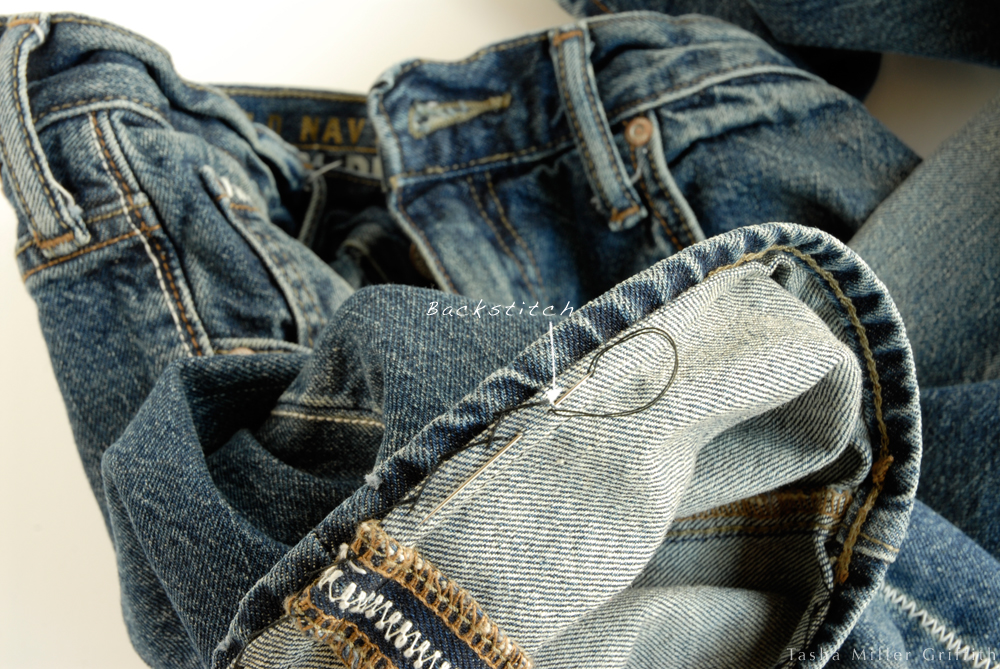
Jeans hem backstitch


When you get near the end of the thread, secure it by taking two small backstitches a little way apart.  It’s fine to only go through one layer of fabric, and the stitches can be tiny, as long as they loop back on themselves.

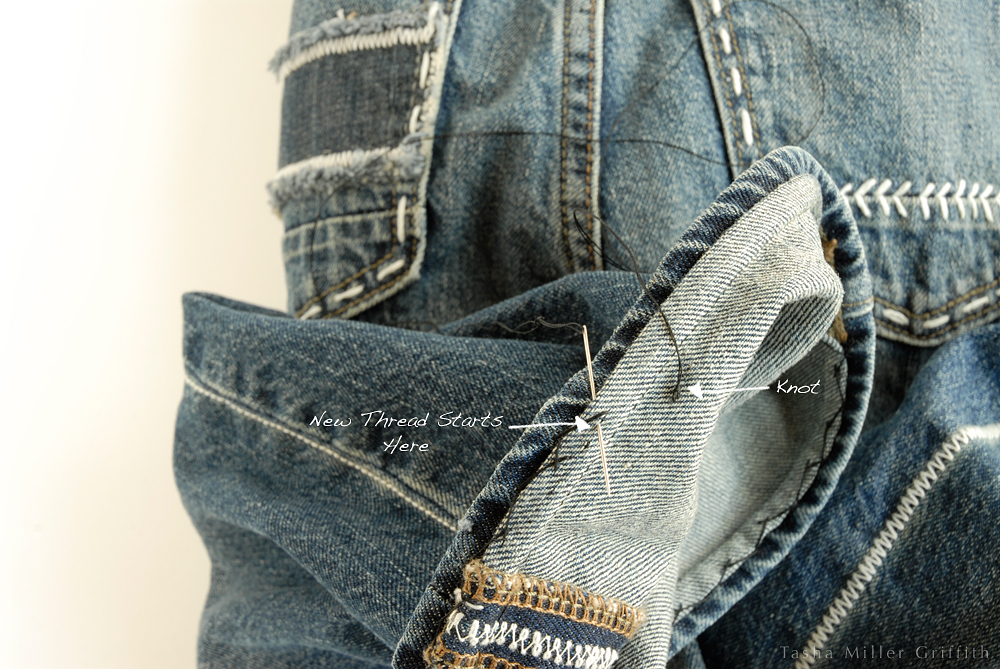
Bring the needle out a little way from the second backstitch, and snip off the thread where it emerges.  Get a new length of thread, and tie a knot in it.  Stick the needle inside the fold (to hide the knot again), and bring it out where you left off stitching.  Keep stitching around the hem until you reach the place where you started.


Jeans hem new thread


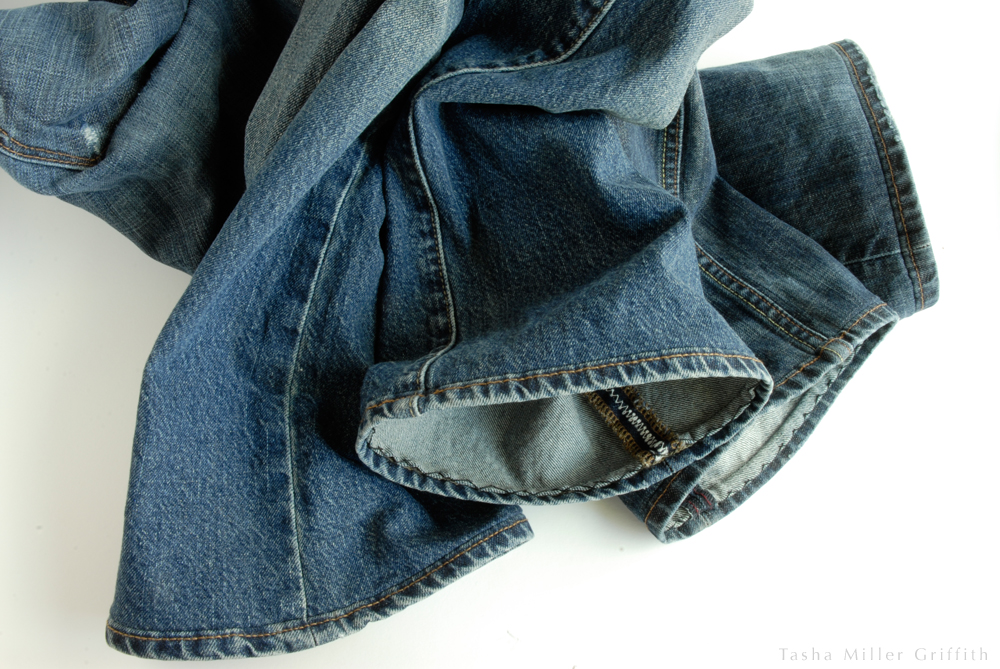
That’s about it!  Backstitch again when you get to the end, to secure the thread.  Bury the ends and clip them off.

Enjoy your new hemmed pants!

Get Your Sewing Questions Answered with Me and Sew,Mama,Sew!

cartoon with both threaded small


Here is the first exciting event in celebration of the release of my new e-book Hello Sewing Machine – I’ve collaborated with the lovely ladies at Sew, Mama, Sew! to answer your sewing questions!  Head on over there and put in any basic questions you have, and I’ll answer some of them in a post coming up soon.  I’m curious to see what you want to know!


How to Hem Your Own Jeans, and Keep the Original Hem


Jeans hem finished hems


Once you get started sewing, I’m guessing one thing you’ll want to tackle is to hem your jeans.  You can definitely do it yourself, and keep that distressed hem just as it is.  You’ll need just a few more pieces of equipment than for normal sewing.

(If you need to start with some basic instruction about how to use your sewing machine, check out my e-book for beginners!)


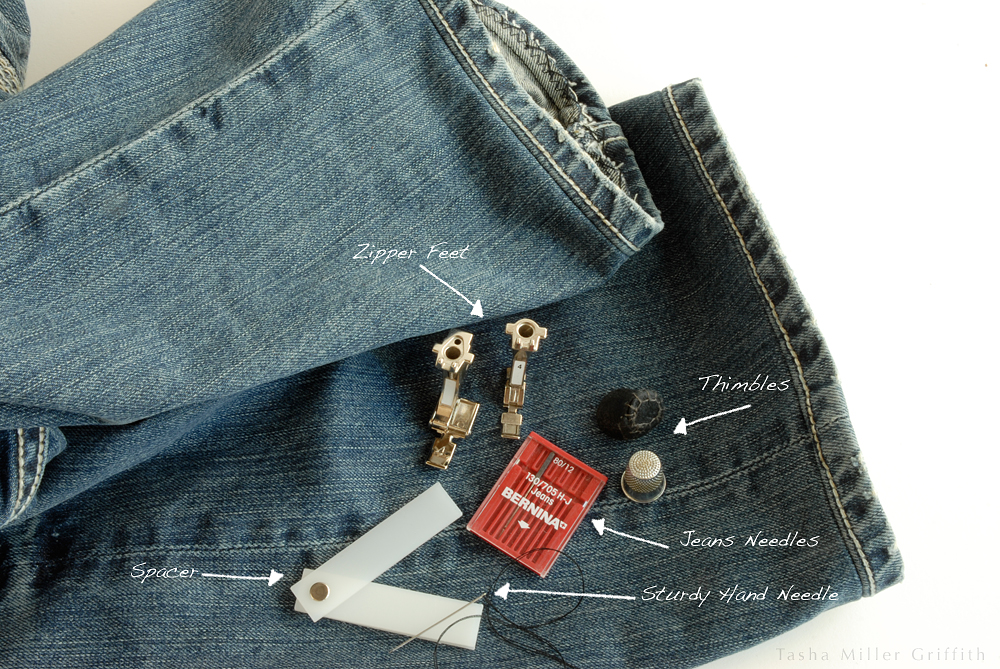
Jeans hem equipment


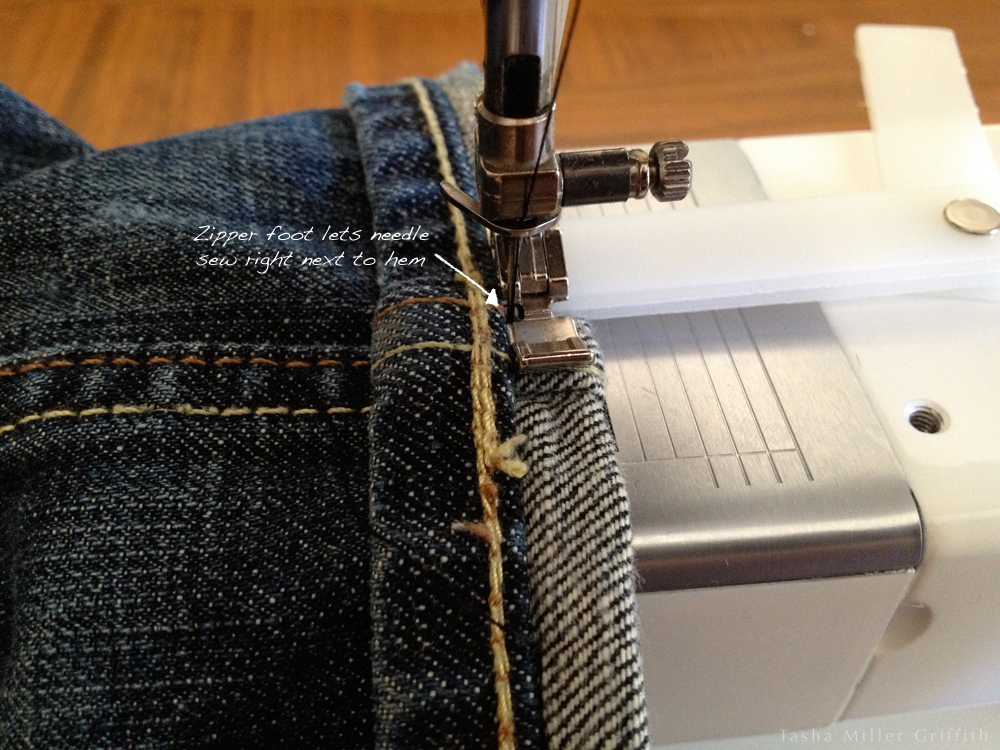
A zipper foot lets you stitch with the needle to one side of the foot, right next to the original hem.

Jeans needles for your sewing machine have a sharper point and a longer eye, for sewing through layers of denim.  For the most part, you won’t have to stitch through too many layers with this method, but it still helps.  If you don’t have jeans needles, use a sharp rather than a universal needle.

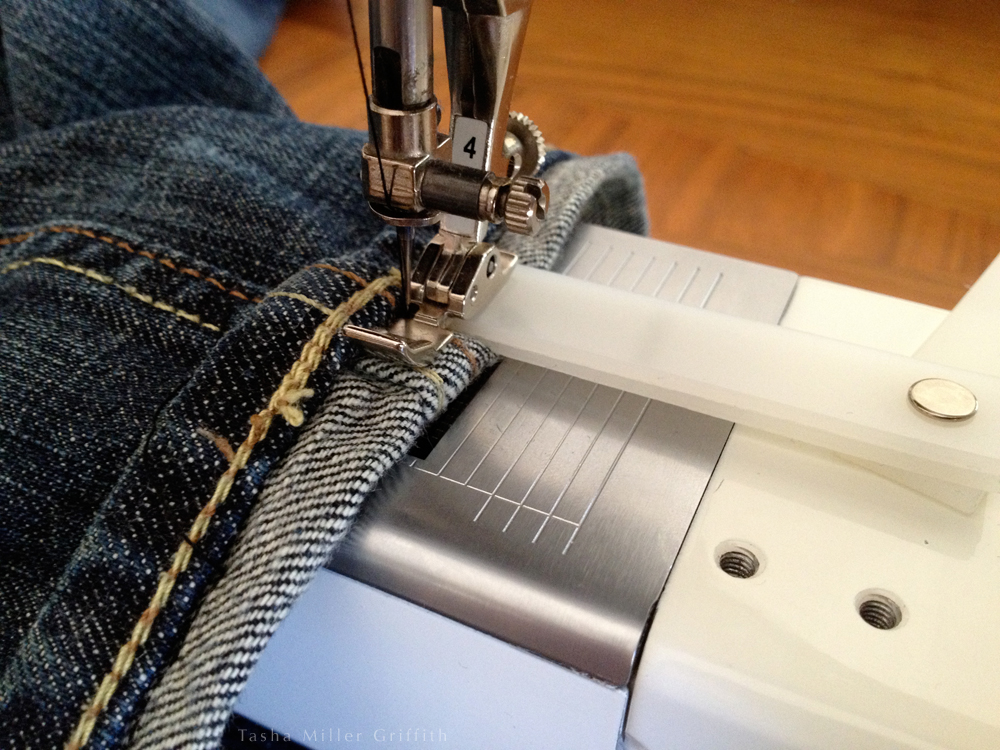
It really helps to have a spacer, something you can prop up part of the presser foot with as you sew over thick seams (you’ll see why below).  This one came with my sewing machine, but you could also use something not too wide and about 1/8 to 1/4” (3 to 6 mm) thick, like maybe a popsicle stick.

A sturdy hand-sewing needle, and a thimble to push it with, is essential for the finishing of this method (I’ll go over that in the next post).

You’ll also need pins and thread.  The ones you use for regular sewing are fine.  I didn’t happen to have matching thread, so I used black.  It doesn’t show at all on the finished jeans.  Darker thread colors usually blend in easier than lighter ones.

Once you gather your equipment, try on your jeans, and fold up the hem to figure out where you would like it to fall.


Jeans hem measuring


You can get someone to help measure how much you want to hem your jeans up, while you try them on.  Or pin, try them on, and adjust until you get the hem where you would like it.

Figure out how much in total you want to take out of the length.  Make a fold that measures half that much, starting at the inside edge of the original hem.  You’re going to stitch right next to that original hem, effectively removing the fold of fabric from the length of the jeans.  Whether you’re using cm or inches, the principle is the same, your fold should be half the amount you want to take out, since both sides of the fold are removed from the length.

Make sure your fold is on the inside of the jeans, so it won’t show when you’re done.

Pin the fold in place every couple of inches.  Put the pins in perpendicular to the fold, or at an angle as shown, to make them easy to pull out as you sew.

Pay special attention at the seams, making sure that the original seam lines and topstitching match on both sides of the fold.


Jeans hem zipper foot


Set up to sew right next to the original hem, using a straight stitch (width 0), length about 2.5 mm.  Use your zipper foot so that the foot can sit flat on just the fold of fabric.  Move the needle position all the way over to your left, towards the original hem, so that you can stitch right next to it (and not hit the foot with the needle).  Let the edge of the foot touch the edge of the hem as you sew.

When you get to the leg seams of the jeans, you’re suddenly sewing through a whole bunch of denim layers, instead of just two.  When this happens, the presser foot ends up at a steep angle, which makes it much more likely to skip stitches (resulting in a weak seam).  This is where the spacer comes in.  When the front of the foot reaches the seam, prop up the back of the foot with the spacer to make it level.  Then as you stitch over the seam, move the spacer to the front of the foot, to keep it level until you are past the bulky seam.  Be careful to keep the spacer in front of the needle, so that you don’t hit it as you sew!


Jeans hem spacer


If your machine still skips a few stitches, try sewing in reverse and then forward again over the part that’s giving you trouble.  Going slowly over the bulky parts will also help.  You can even use the hand wheel on your machine to make just one stitch at a time.  If it’s skipping a bunch of stitches in a row, check to see if the bobbin thread has broken.  If so, stop and cut the top thread too, then start again so that you overlap a few of the last stitches before the thread broke, to hold them in place.  If the leg seams are giving you a lot of trouble, you can also try flattening them as much as possible using a steam iron, or pounding them with a hammer.

When you get all the way around the leg, sew over the first few stitches that you made, to hold them in place.

Do not skip this step: once you sew around the hem, try on the jeans again to check that the length is where you want it.  If not, at this stage all you have to do is pull out this one line of stitching, and start again.  If the length looks good, you’re ready to finish off your hem.

If you took out more than about an inch in total, it’s likely that your folded out fabric is long enough to show below the hem if you turn it down.  If so, trim it to about 3/8″ (10 mm), or a bit smaller than the original hem (I repeat, try on the jeans and check the length of the new hem before you do this).  To keep these cut edges from unraveling, overcast them with a zigzag stitch.


Jeans hem overcasting


Use a regular sewing foot for this (zigzag and a zipper foot don’t mix).  Stitch close to the edge.

This whole process is pretty darn simple once you get the hang of it.  You can also use this method to hem other pants, when you want to keep the original hem intact.  It will be even easier if you don’t have think layers of denim to sew through.

In the next post I’ll go over my method for tacking down the extra fabric to make the hem look natural.  In the meantime, if you have any questions, just leave a comment!


Start Sewing with my Brand-New E-book!


HSM cover small


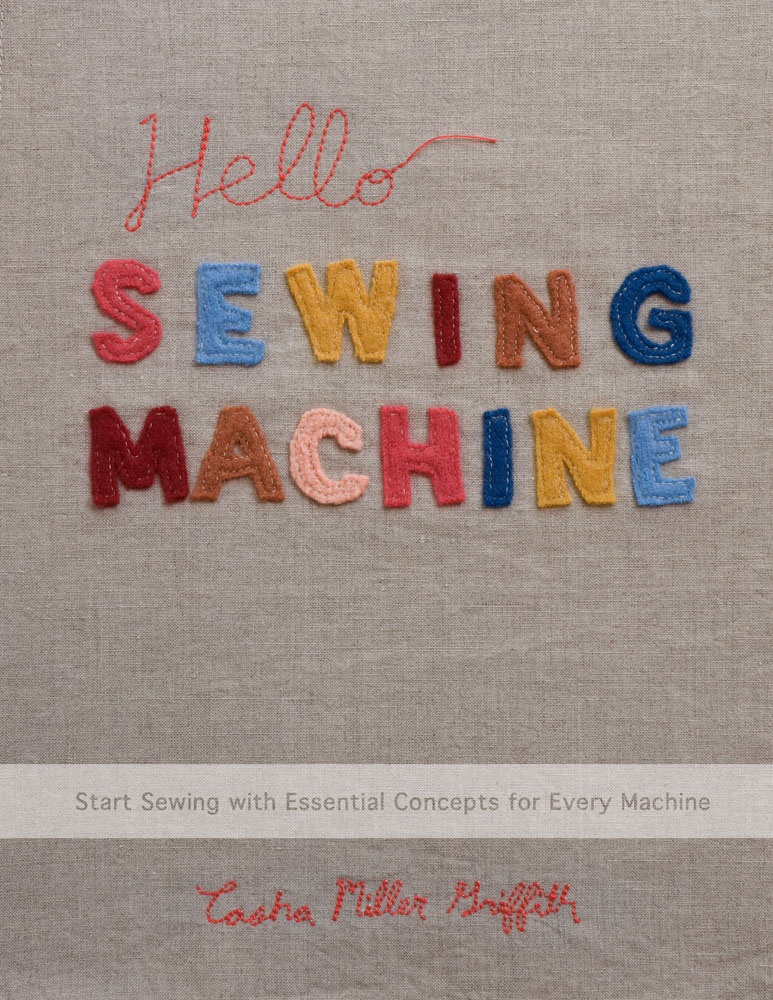
It’s the reveal of the super-secret project I’ve been working on for so long!  And it’s safe to say I’ve never been as excited about a post, or a project, as I am about this one.  Nearly a year ago, I had an idea to make a tutorial that would get people started sewing.  It would assume the reader knew nothing, and explain as clearly and approachably as I could make it, how sewing machines work and how to use them.

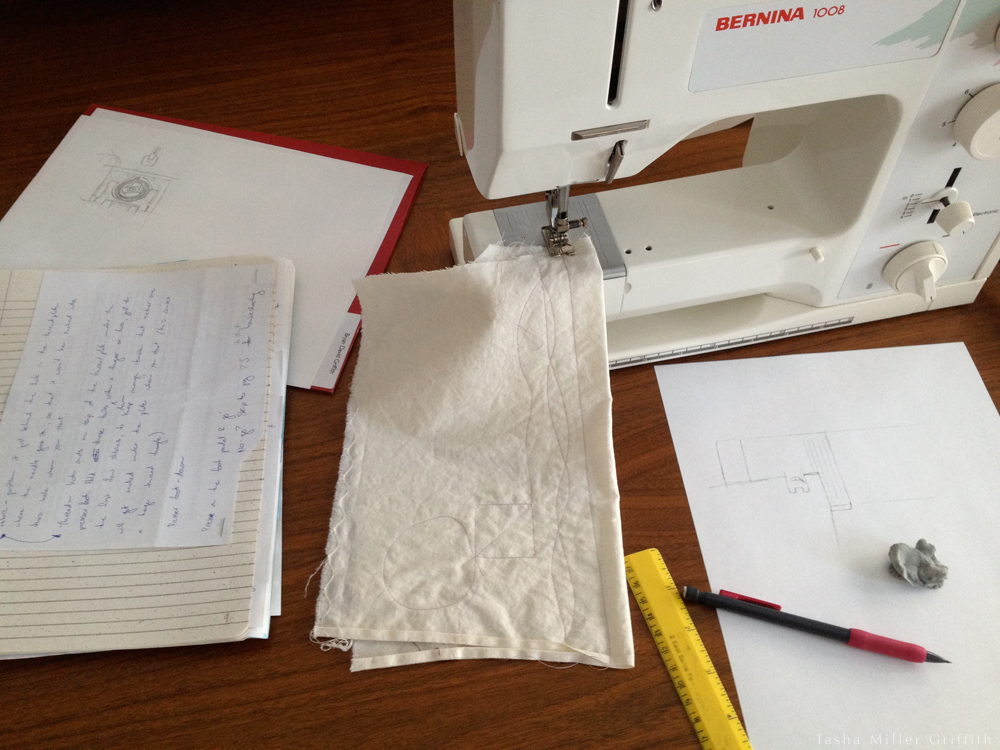
Well, it’s here, today!  Hello Sewing Machine is a PDF e-book, available for instant download from my Etsy shop!  I’ve spent the past year dreaming about it, writing it, drawing the illustrations, editing, doing design and layout, and learning so much about all of the above as I went.  It’s kind of unreal to finally see the finished product on a screen in front of me.  


HSM in progress


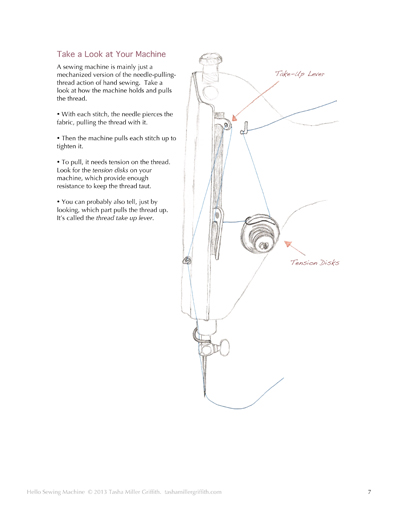
So, do you have a sewing machine sitting in your closet?  Would you like to get it out and start sewing?  Do you already sew, but you have someone you’ve been wanting to teach?  Do it today!  This guide will get you going.  It has everything you need to know about how your sewing machine works.  I want Hello Sewing Machine to be a bridge between would-be sewers and all the patterns, sewing blogs, fabric stores, everything that’s out there to help you make whatever you want.  All you have to do is take the first few steps to get started!


HSM page 7


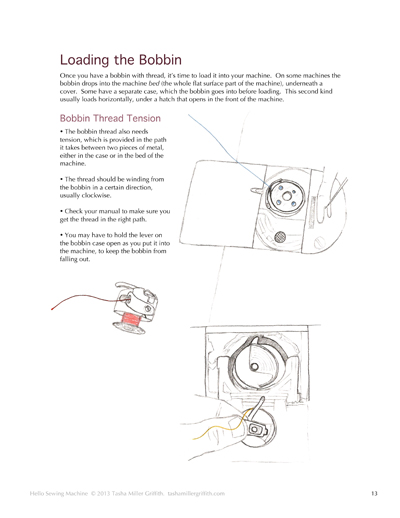
As you know if you’ve been reading this blog, I’m a firm believer in handmade, and that by being makers, we make our lives better in just about every possible way: more connected, more sustainable, more grounded, more satisfied, more joyous.  It’s my hope that this little book will give more people the tools they need to realize those benefits in their own lives.


HSM page 13


I’ll be celebrating this release with some very relevant beginning sewing posts (including an all new one on hemming jeans) plus some other very exciting things, so watch this space!


In Which I Read My Diary From Last Year, and Re-Up for Me-Made-May!


If you were reading this blog this time last year, you no doubt remember that I signed up for Me-Made-May ’12, hosted by the fabulous Zoe.  I just think this is the best idea, it encourages all those of us who make clothing to actually wear it in our everyday lives, and thus think about what we make and use and why.

I had a great time doing it in 2012, and learned a lot.  My pledge was to wear one item of me-made clothing every day, which I succeeded in doing.  Sometimes you would not have been able to tell, since I made underwear count.  I also pledged to blog about something MMM related once a week, which I almost succeeded in doing.  I did draw and post a cartoon of my summer wardrobe, an extension of the way keeping track of what I wore for the month helped me clarify what I wear and what I would like to wear.  My overall favorite thing I did was to get three other lovely bloggers/sewists to share their thoughts on style and how sewing allows them to express themselves, in this post.

I knew that I wouldn’t take a picture of every outfit I wore, so I decided to also keep short notes for each day.  I dug them out recently and I was surprised at how much is in there, about my thoughts and how far I’ve built up my me-made wardrobe in a year, so I thought I would share some of them.  If you are bored by reading other peoples (very brief, not edited for grammar) diary entries, please skip to the bottom of the post.  I’m going to include a couple of explanatory notes – May was as usual for us, a busy travel month, and even with the notes it’s going to feel pretty disjointed.


Me-made skirt.  I'm kind of tired of these two tops together, but they work well. . .


Day 1 – wore green Deva yoga pants, blue Henley. I felt more proud and self-sufficient than I thought I would!

Day 2 – I wore Henley & pjs to clean, then grey pants & ‘Bethan t. I thought about the various imperfections of those pants and vowed to make better ones.  (On this day we flew from home to pick up our truck and continue our summer art show circuit.  I promise to write a post about what exactly that means and what it’s like, soon.)

Day 3 – Wore cropped drawstring pants and strapless top. Found myself wishing I could wear all me-made outfits!  Wanting more time to sew since this month is good inspiration.  (When we are on the road I am separated from my sewing machine by hundreds or thousands of miles.)

Day 4 – wore all me-mades! Shorts & blue tank to set up, then new sundress + undies.


booth setup outfit

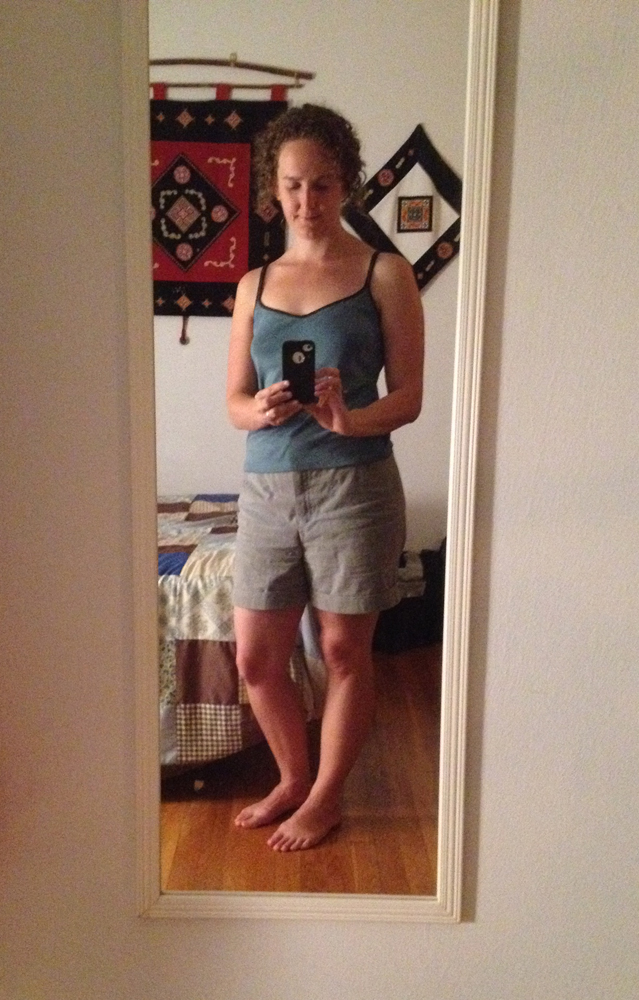
This is my standard booth-setup outfit, shorts that were a test make, and a tank that’s near the end of its life.

Day 5 – washed undies the night before to wear, wore those under too hot for anything else dress. Thought about need to make another airy dress, fabric is key.

Day 7 – laundry day. Repeat of plane ride outfit and thoughts about pants.  (We are camping out between shows, as we drive to the next one.)

Day 10 – wore B’s jeans & mm pink top in anticipation of City Museum. Maybe I should make some jeans? Would it be more work to find or make? Is either worth it – probably I will stick with the no jeans plan.  (We stopped off at City Museum, in St. Louis, which is like an amazing cross between mixed-media sculpture and playground.  It’s awesome.  Wear sturdy pants.  I once lost a fair amount of corduroy on the multistory slide.)

Day 12 – blue skirt/jeans for hiking with mm black tank. Dressing this way may mean laundry sooner. It’s cool and I’m wishing I brought mm hiking pants/another sweater. Thinking about how what we wear is a compromise between what we’d like, what’s available and the weather.

Day 13 – still camping, wearing mm tanks with alternating skirts & B’s jeans. Kicking myself for not bringing mm hiking pants.

Day 14 – now wearing B’s socks as well with more of the above and freezing!  Raining out and did laundry.

Day 15 – with fresh laundry! Wore grey mm pants, tank & sweatshirt. Thought about the ideal summer wardrobe – two pairs of pants, one for setup/camping, one nice enough for town/at show if cold. Thought that I have as much affection for the non-mm clothes that fit well, color I love, etc.

 
The pink shirt is the me-made


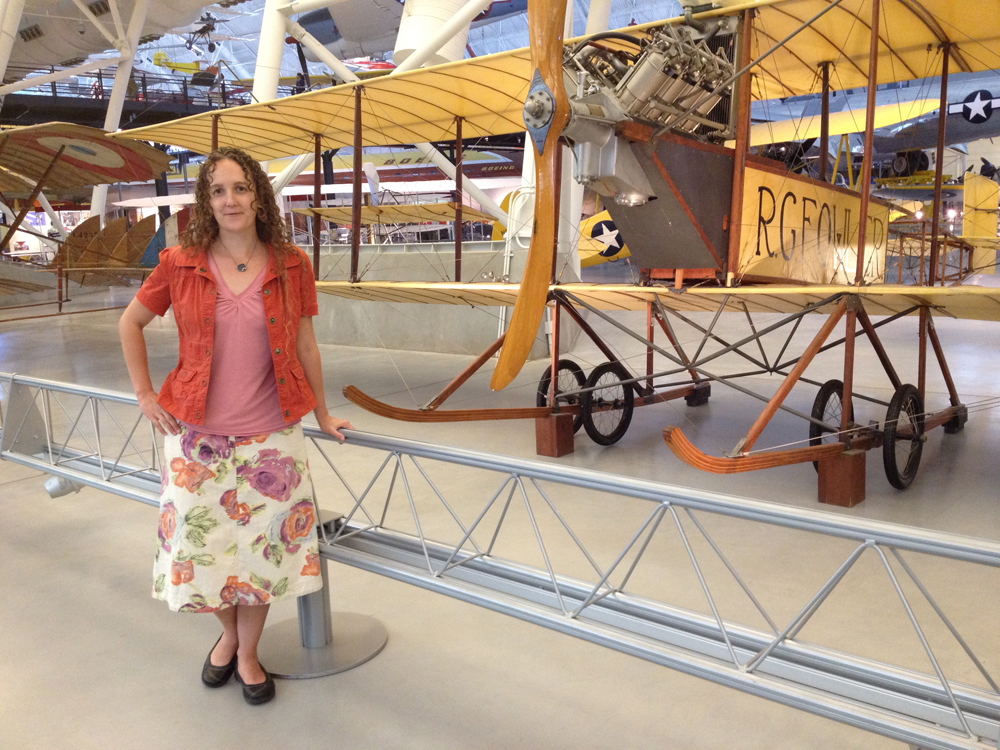
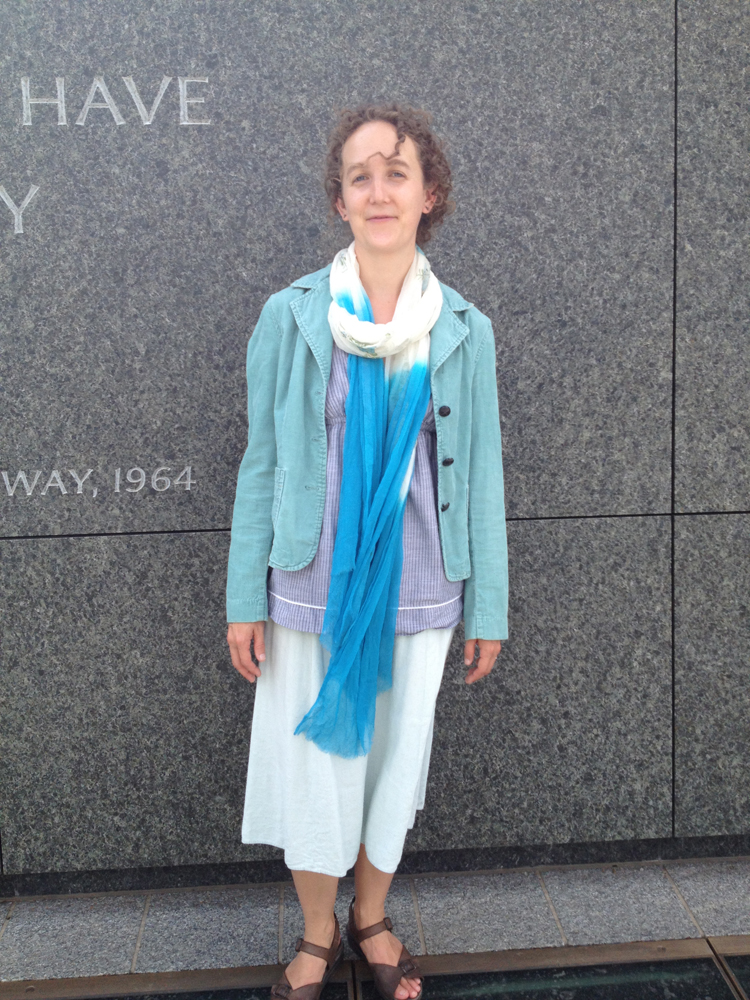
Day 18 – all mm! Shorts and blue tank for setup, wedding test dress for show. Thought of a plan to shorten/line dress.  (This show is in Reston, VA.  I love the DC area – the picture above is at the Air and Space Museum Udvar-Hazy Center, and the one below at the MLK Memorial.)

Day 21 – lounging/computer work/groceries and cooking at friends – good day for mm cropped pants & berry T.

 
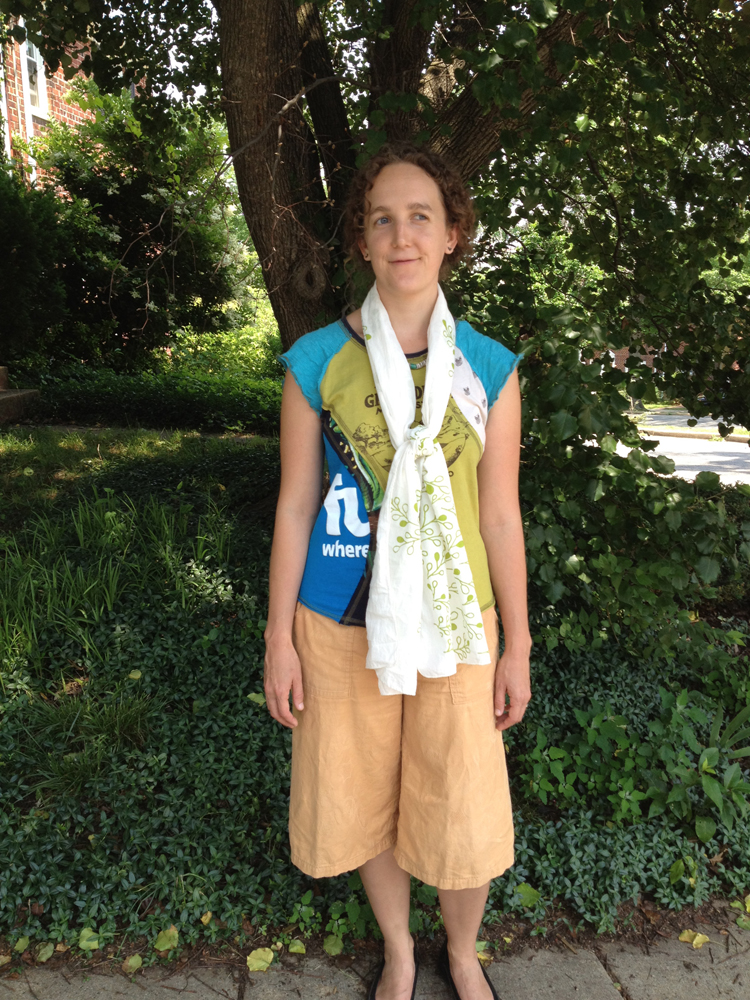
Same me-made skirt.  I've really just discovered scarves lately. . .


Day 23 – same outfit as day 16, boring!  Me made pjs for laundry.

Day 24 – sorely tempted to cheat, but we are almost done  & I can stick to my pledge. Mm black tank & pink stripe skirt. Stuck in Floyd Bennett Field.

Day 25 – in NYC. Mm linen skirt (loving it!) & dk blue top stitched tank with blue cord jacket.

Day 26 – poor packing leads to undies only today –  with ‘bethan top and blue tea dyed skirt with flowers.  Also no bra – but fabric shopping in NYC!!!!  (This really happened.  Maybe I’ll tell you about it some time, we had quite an adventure.)

Day 28 – Mm drawstring pants & pink shirt w/ mm bra. Good for driving/hanging out with nieces. Wishing I could wear all mm pieces for the rest of May  but don’t think I have enough.


pink shirt drawsting pants

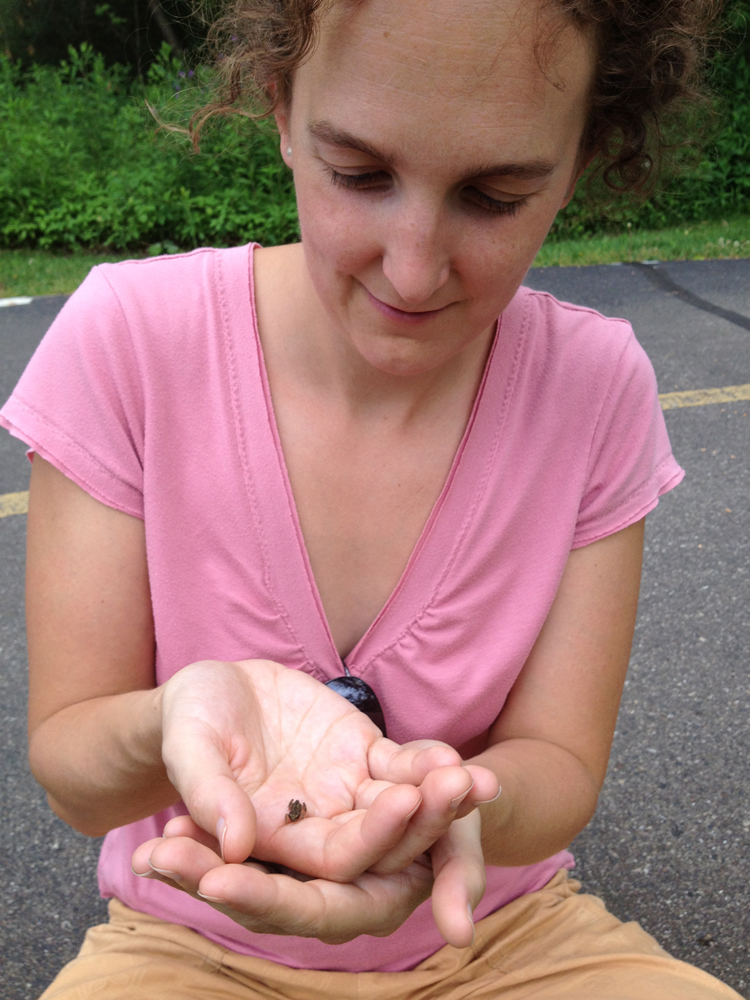
Catching tiny frogs with our little nieces at a pond in MI


Day 30 – grey pants even got a compliment from Mandy! With pink mm shirt and sweatshirt.

Day 31 – same as day 30 – camping out – cool again. Even though at times frustrating, I’m a little sorry to see the end of mmm.


bethan shirt, pants and scarf


So, um, there you have it!  Reading these over, I think I should make another shirt like the pink one, it was probably the most-worn item.  I’m certainly glad to report that my me-made wardrobe has grown by a few of the pieces I most needed last May – now that I have good me-made pants I shouldn’t end up wearing Bryan’s jeans this summer!   I also thought more about what I would pack this year (we’ll be on the road again for most of May), there are plenty of me-mades in various layers ready to go.  And I made a new airy dress, which I hope to show you some time during Me-Made-May – knowing that I wanted to up my pledge this time was an incentive to get it done in time.
My pledge for this year is: ‘I, Tasha of Stale Bread into French Toast, sign up as a participant of Me-Made-May ’13. I endeavour to wear two handmade garments, of which underthings may count for only one, each day for the duration of May 2013’

I’ll definitely take some pictures, although probably not every day, and put them up at the MMM Flickr group.  It was really fun last year checking out what everyone else was wearing there.  I’ll make notes again too.  I’m looking forward to seeing what new ideas I come up with during this year’s challenge.  There’s still time to sign up, until the 30th, and all are welcome, so go check it out, I highly recommend it!
 

Three Long Sleeve Tops, and Experimenting with Sewing Knits

brown silk front piece


So, here is the sewing update I promised! I finished all three of these shirts months ago, but I haven’t got around to photographing and putting this post together until just recently.  The snow you see here has all melted away, in fact it’s almost warm enough to wear just one shirt outside!  Well, some days yes and some days no.

After I finished my fabulous purple pants, I was ready for a faster and easier/less fitted project, and also getting desperate for some long sleeve knit shirts of any kind in my wardrobe.  I had one looser, comfy knit top in cotton with a little lycra, definitely on its way out, but I liked the fit and decided to copy it.  It also helped that I found two big pieces of cotton knit fabric in the stash I share with my mom.


grey shirt on


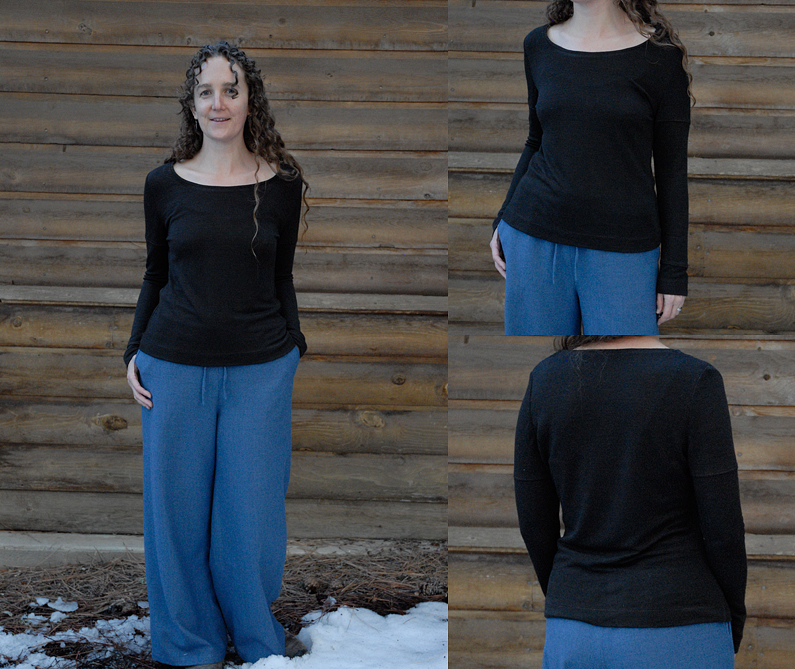
I made this grey version first, and was overall pretty pleased, the fit isn’t totally perfect, but it’s, um, a knit shirt!  Since it was something I needed, I started wearing it right away and it’s lovely to have a soft new long-sleeve top.  It went together like lightning, no edge finishing, some double needle stitching for the hems and it was done.  And I thought it was close enough to what I was going for to try in silk.

I bought this silk knit fabric at Promenade Fabrics in New Orleans.  That store is such a treat to explore, it’s full of the loveliest wools, linen, ribbons, it’s very NOLA in that it’s unusual, but high quality.  There aren’t rows of the same thing next to each other in different colors, I swear each bolt I looked at was totally unique, so naturally I had to dig through as many as possible (which was a lot, since luckily I had all morning).  I knew I wanted to make more long sleeve tops, and I was hoping to find some wool knit, which I didn’t really, but I did find this rather amazing silk, knit in two layers, shiny inside, heathery soft and slightly fuzzy outside.  “Where did you find THIS?” the owner’s son asked when I went to have it cut.  Score!


brown silk sleeve


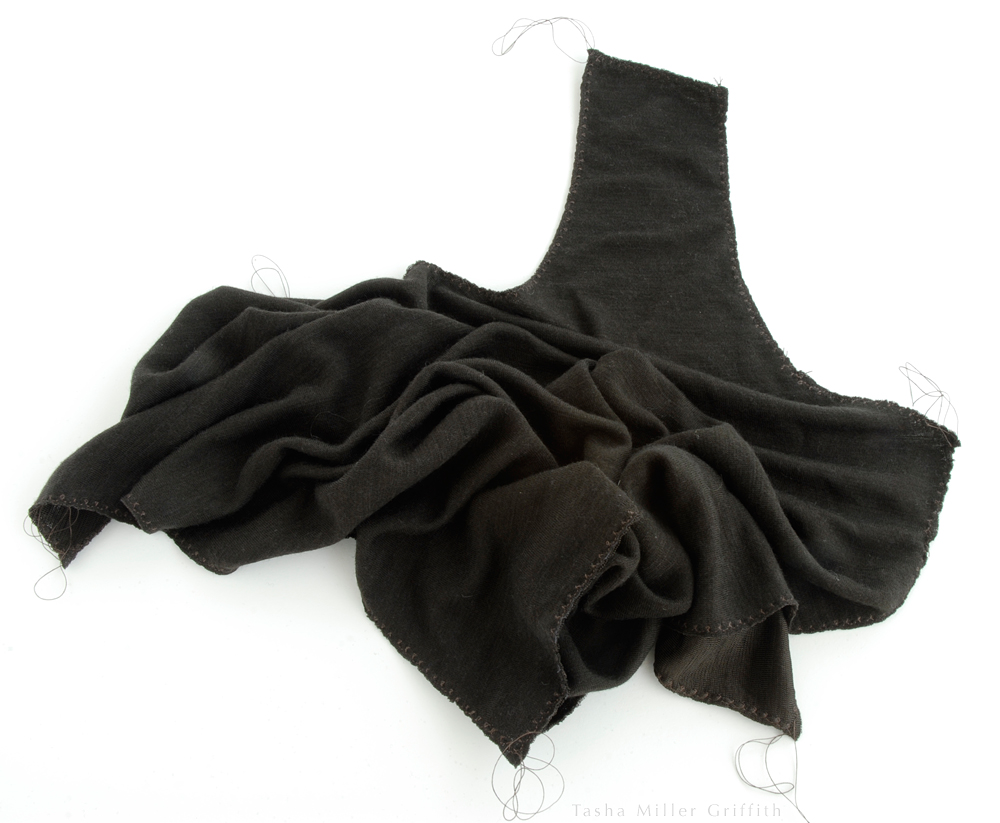
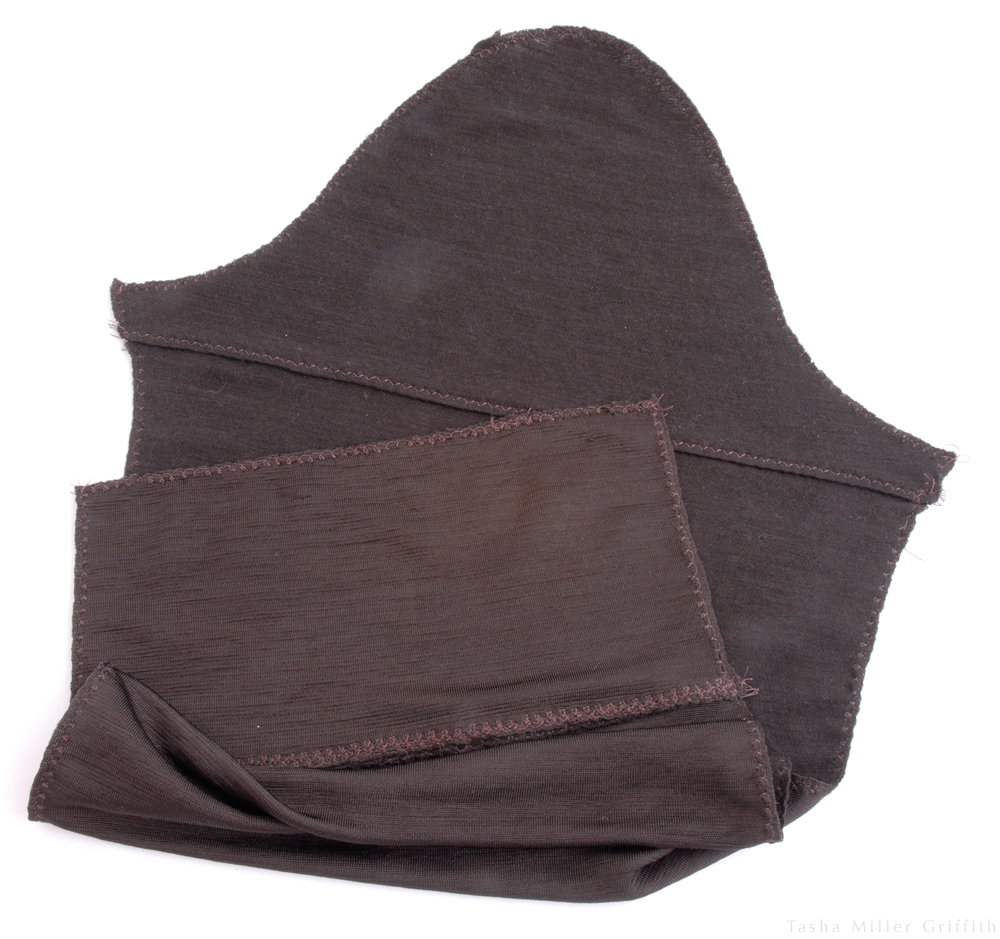
So, having tried out the pattern, and curious to see the differences, I got out the silk.  Only three problems; one, it raveled!  I guess I’ve been spoiled in a way by stable cotton knits, you can imagine my horror when I pulled on one edge and tiny runs immediately started down the fabric, as the two layers peeled apart!  Fortunately, if I zigzagged the edge it seemed to hold everything in place, even when I tugged on it, so I decided to play it safe and overcast all the edges of all the pieces, before sewing them together.

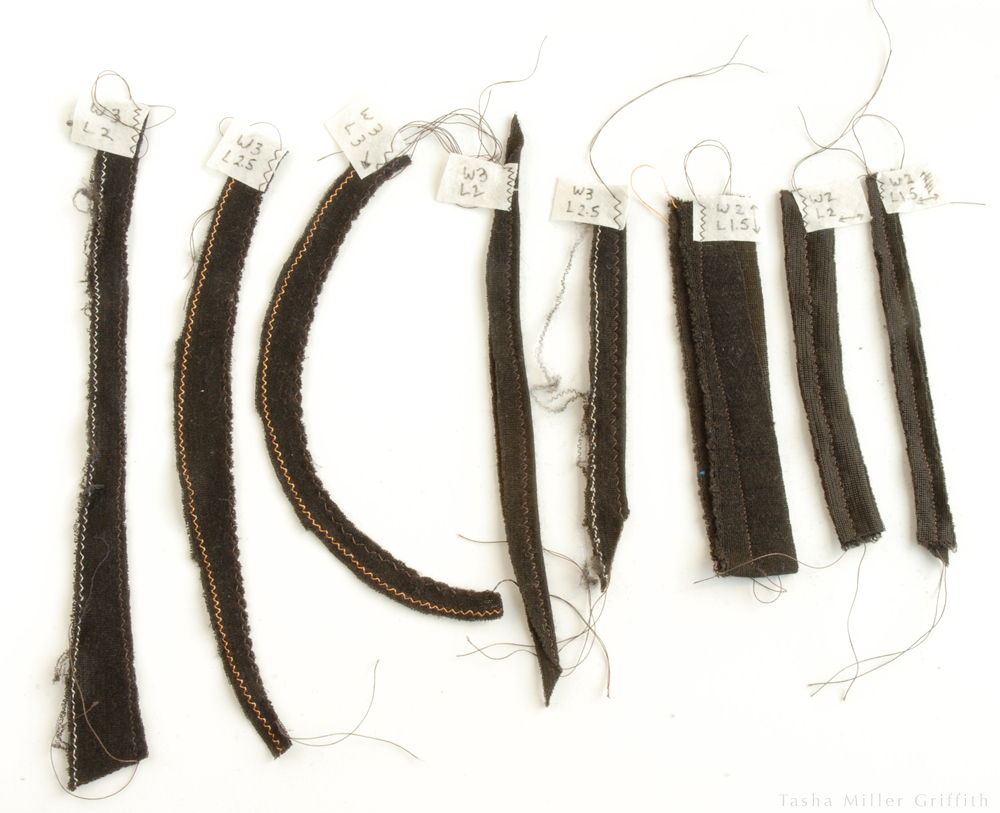
The second problem wasn’t really a problem, more like me being thorough/not having enough knowledge of silk knits to dive right in – I just took a lot of time making samples.  Since this fabric is incredibly slinky, plus stretchy, I knew that it would be easy for the seams to come out either baggier or tighter than the rest of the fabric, which would make my finished shirt look decidedly amateur.  So yeah, I made a LOT of samples.  I definitely recommend making as many test seams as it takes, especially if you are working with an unfamiliar fabric!  I decided to tag all these with a little bit of muslin so I could write down what I changed.  I think the most interesting thing I learned was that by increasing the stitch length, I could get the seam to pull the fabric in a little more, shortening the seam.  The colored stitching is my first, just to make sure the silk would not get runs as I washed it (by hand).  See how the other edge goes from stretched out to pulled in?  I also found that some stitches worked well on one layer, but not as well on two.  Eventually I settled on using a mock-serger stitch to overcast around the pieces and sew seams, and a regular zigzag for topstitching.  Although I have to admit that I decided matched seams and a total lack of skipped stitches were too much to ask for in this project, overall I’m really pleased, the seams neither draw in nor pooch out, which is exactly what I wanted to achieve.


brown silk samples


Oh, the third problem?  I totally didn’t have enough fabric.  This seems to be a theme of mine lately . . . I ended up cutting the sleeves in three pieces each.  Eight more edges to finish, four more seams, but the first thing that Bryan said when he saw it was, “I like the sleeve seams!”  Still, next time I’ll try to remember to just get two yards, having enough for full sleeves and a matching tank top is NOT a bad thing.


brown silk shirt on


When I first finished it I couldn’t decide if it was worth all the extra effort for the fancy fabric.  But, the more I’ve worn this top, the more I’ve been bummed when it’s in the wash.  It has the kind of drape that makes wrinkles disappear or just look elegant, it feels divine on my skin, and it looks like something just a little special.  In short, I’ll be hunting around more fabric stores for unusual silk knits.


color grown cotton shirt and samples


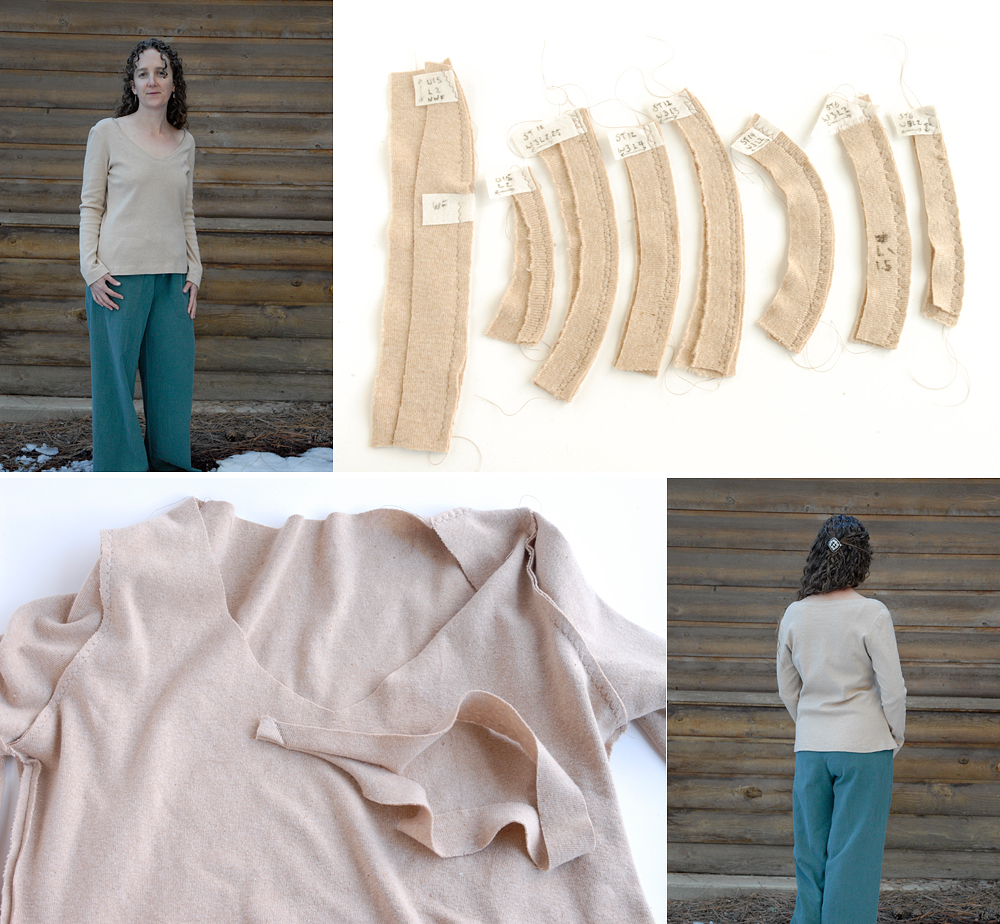
While I was at it, I decided to make one more shirt from stash fabric, and play with the fit a little.  I narrowed the back around the waist, and flared it out again over my hips, to try for a little less puddle of fabric at the back high hip area.  It did help some, but I’m left wondering if I need a center back seam to make a big difference, and if so, wouldn’t princess lines work better and look better?  Or should I just reserve this pattern for slinky fabrics – this one is decidedly not.  It’s a lovely color-grown cotton, but the fabric has very little recovery from being stretched, meaning it tends to hang a little bit loose, and it’s kind of thick.  I made a few more samples before sewing it, mainly to try for a stitch that wouldn’t stretch out the seams.  I like this shirt and I’ll definitely keep wearing it, but it’s not a perfect match of pattern and fabric.

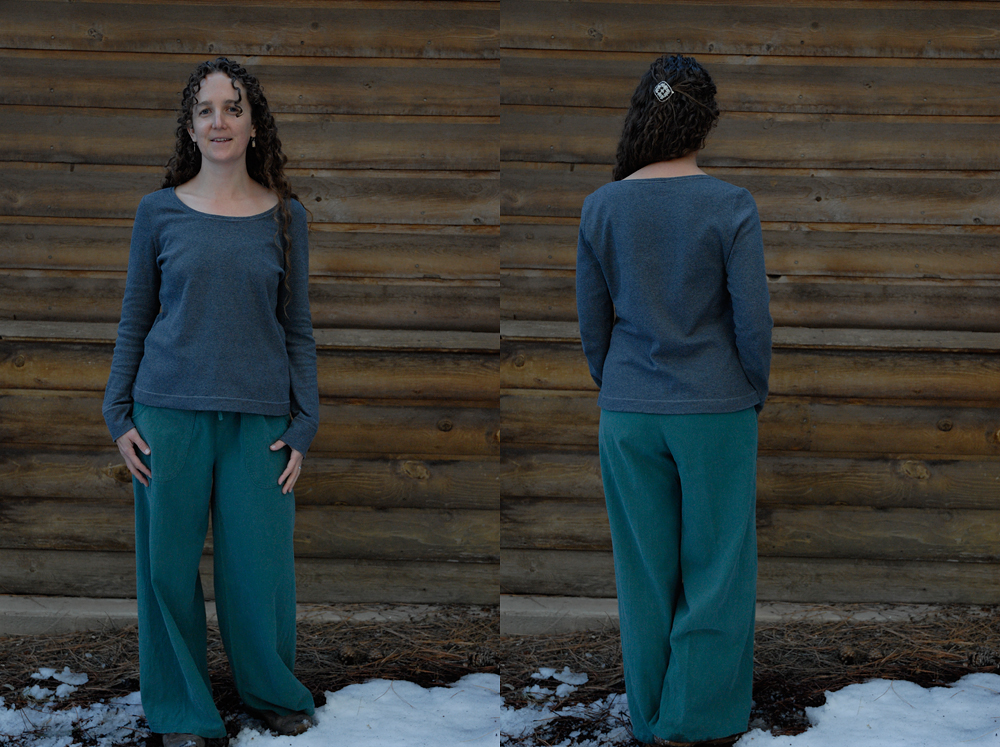
Since I was playing with different fabrics, I thought it would be fun to show the tops with a similar contrast in pants.  They’re the same pattern (another one I copied from an existing thrifted garment) of no-side-seam drawstring pants.  The green pair are a textured cotton, I wear them to yoga a lot, and sometimes to lounge around in.  The blue pair (which aren’t quite as electric blue in real life) are wool crepe – the result of a time when I really needed some new pants, hadn’t fit regular ones well enough yet, and had some lovely wool just hanging out in my stash.  I’ve worn them teaching a lot, and to swing and tango dancing, and they’re great for travel, but I would definitely not wear them to yoga!  Again, I think it’s the drape and the body of the fabric that makes them look so much more elegant.

Next up for sewing: summer stuff!  Especially a dress, for Me Made May ’13 . . .