Making Jeny’s Stretchy Slip Knot Cast On with Lumpy Yarns

Or, how to make it easier in any yarn.

I love this cast on*; how easily it stretches and bounces back right along with the knitting, how invisible it is (it’s like whatever pattern you’re knitting just appears fully formed, without a visually different edge), and the bonus that since it only uses one end, you don’t have to worry about starting with a long enough tail.

But it’s notoriously difficult to do with uneven or thick-and-thin yarns, since the yarn has to be able to slide easily past itself to make the required shape.  Or does it …  My knitting students were having a hard time with this cast-on, even in a relatively smooth yarn, which got me wondering if I could figure out a trick that would help keep the yarn moving.  I decided to try it with my first handspun project (a thick and thin yarn if there ever was one).  And I did figure it out!  It may have helped that I was stuck on an airplane at the time without too much else to do …  It turns out that there’s one place that the yarn gets hung up on itself, and if you can get past that, you can do this cast on in a lumpy yarn too!  I’ll show you how below.

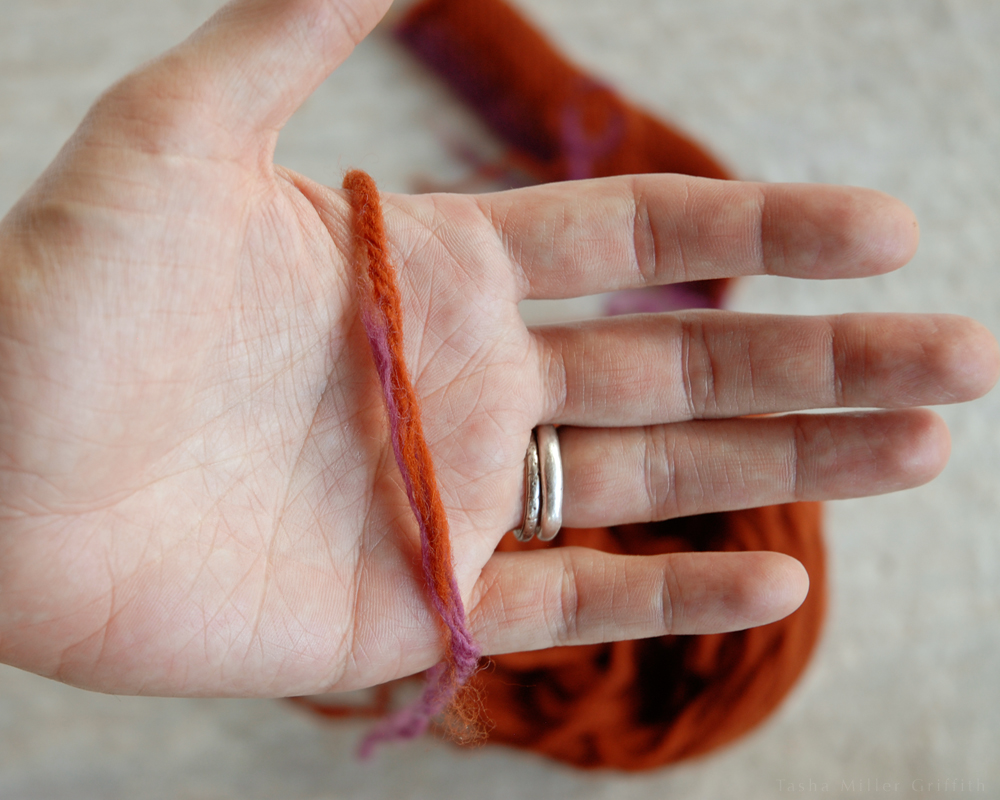
First, a quick review of what makes a slip knot, since that’s the structure this whole cast on is based on—you’ll essentially make one slip knot after another.  First of all, you need a loop.


slipknot cast on 1I’m going to show you using a bit smoother yarn—otherwise it would be hard to see what’s going on.  This is “Sheridan” from Mountain Meadow Wool—yummy!


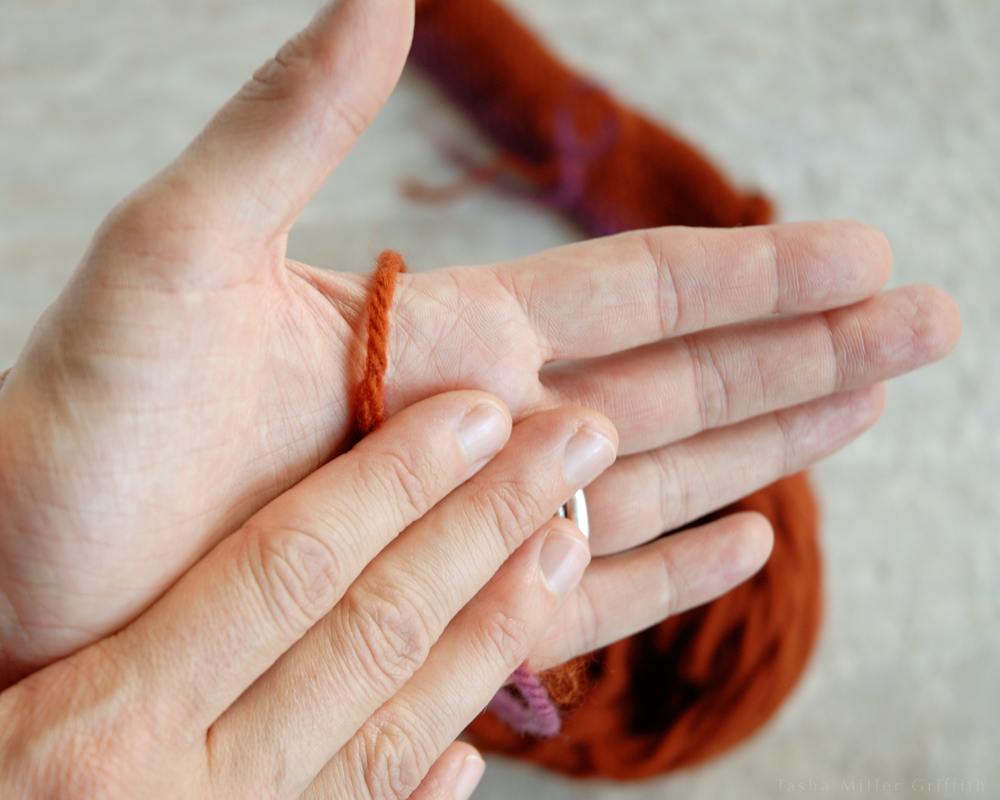
Next you need another loop, and to put that second loop through the first one.  Remember that the ends must cross each other for the loops to stay in place.  So, you can either make a second loop in the bottom strand of the first loop and bring it through the top, or make a loop in the top strand and push it up through the bottom, which is what I’ve done below.
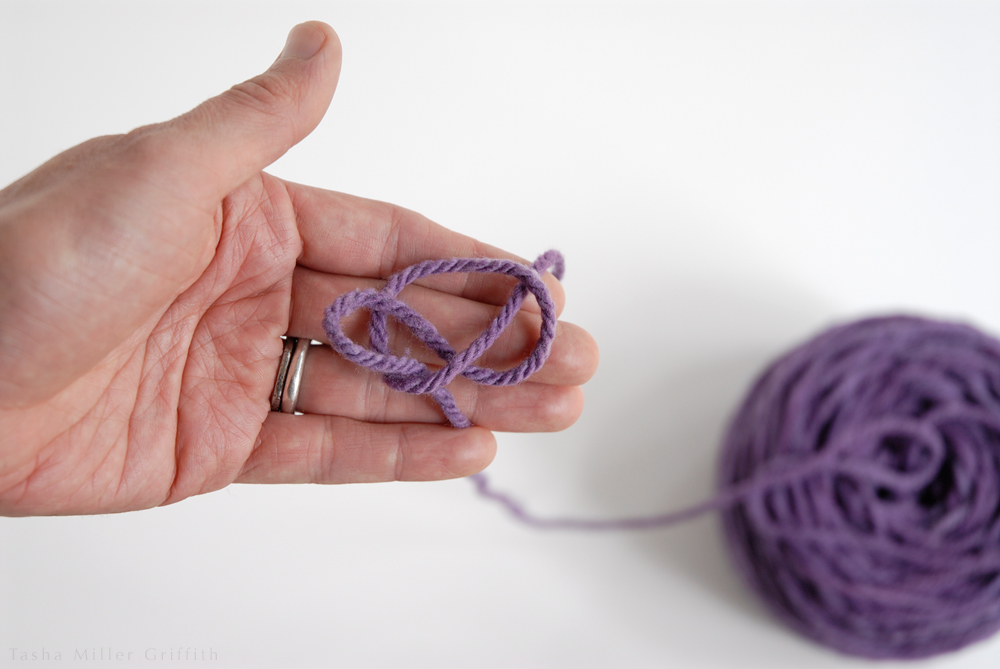
 

slipknot cast on 2


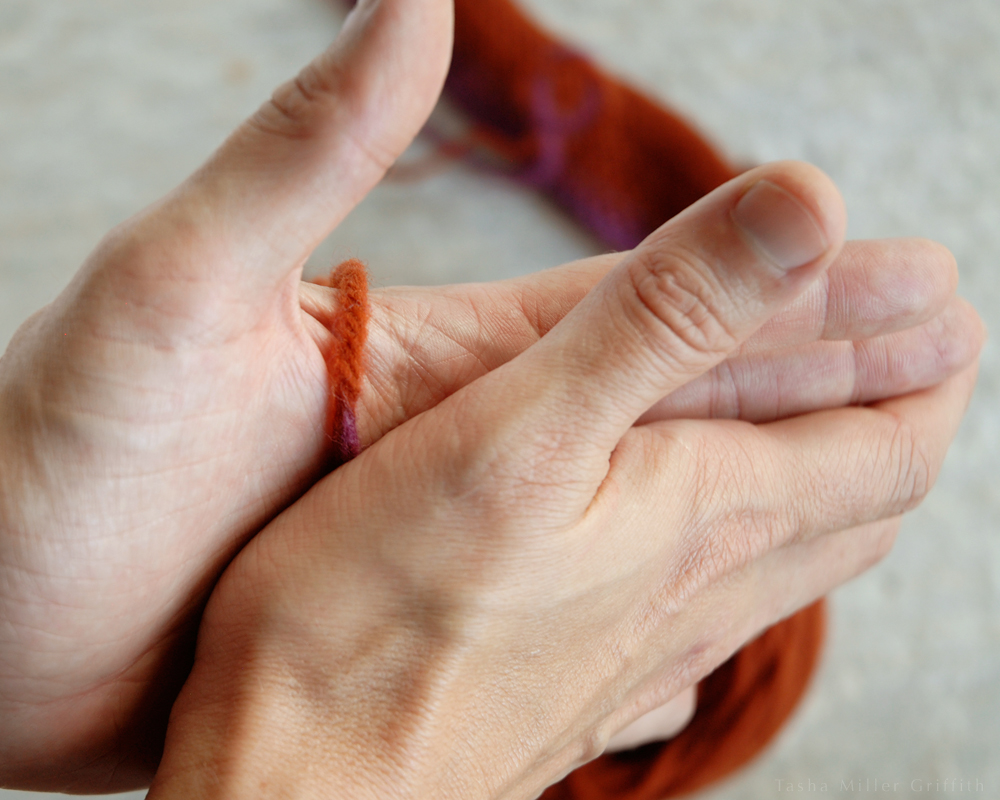
Tighten it up by pulling the second loop through until the first loop closes around it.  If you’ve made a successful slip knot, it will go away if you pull on both ends of the yarn.
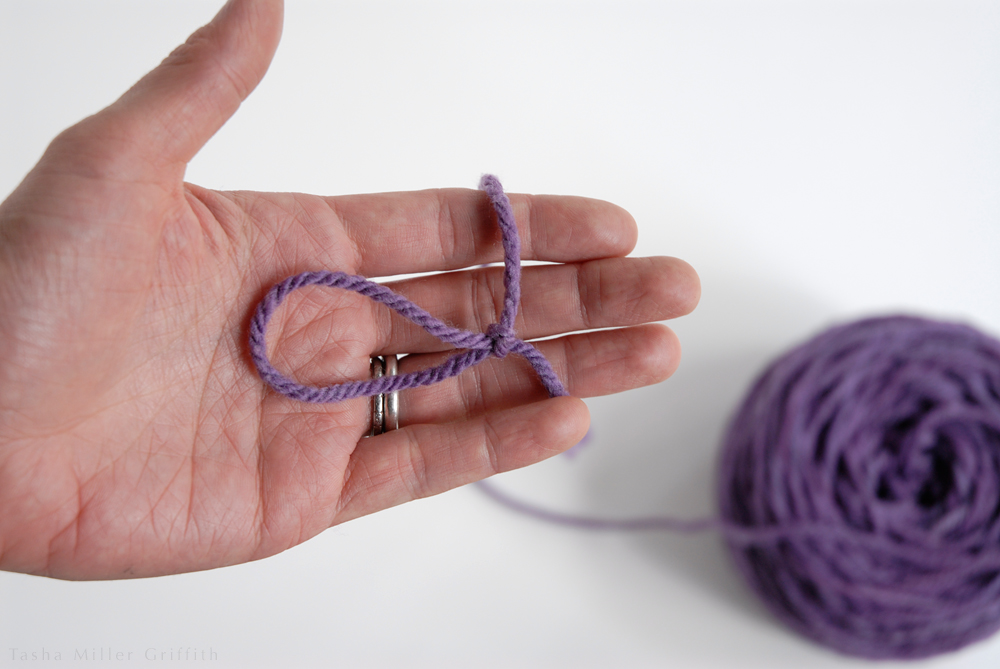
 

slipknot cast on 3


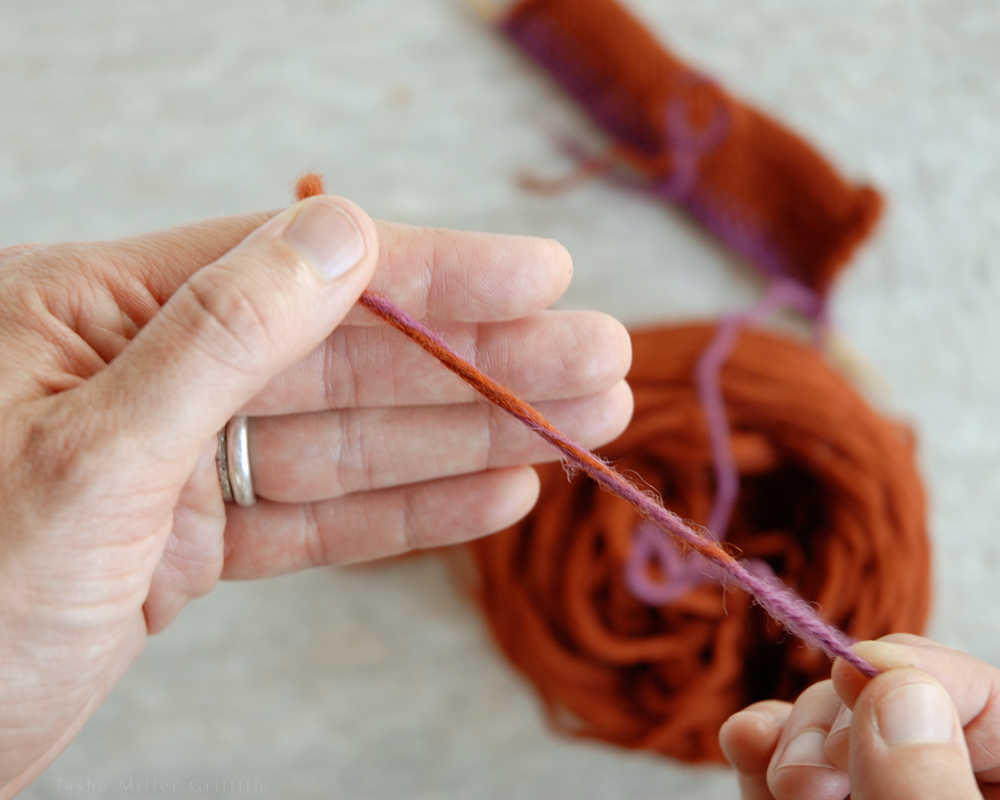
Put this first knot on a needle, and you’re ready for the cast on.  I like to put the working end of the yarn (not the short tail) around my thumb, and hold the end with the last two fingers of my hand, as shown below.  (There are other hand positions and motions that work perfectly well to make this cast on, these are the ones I use.)
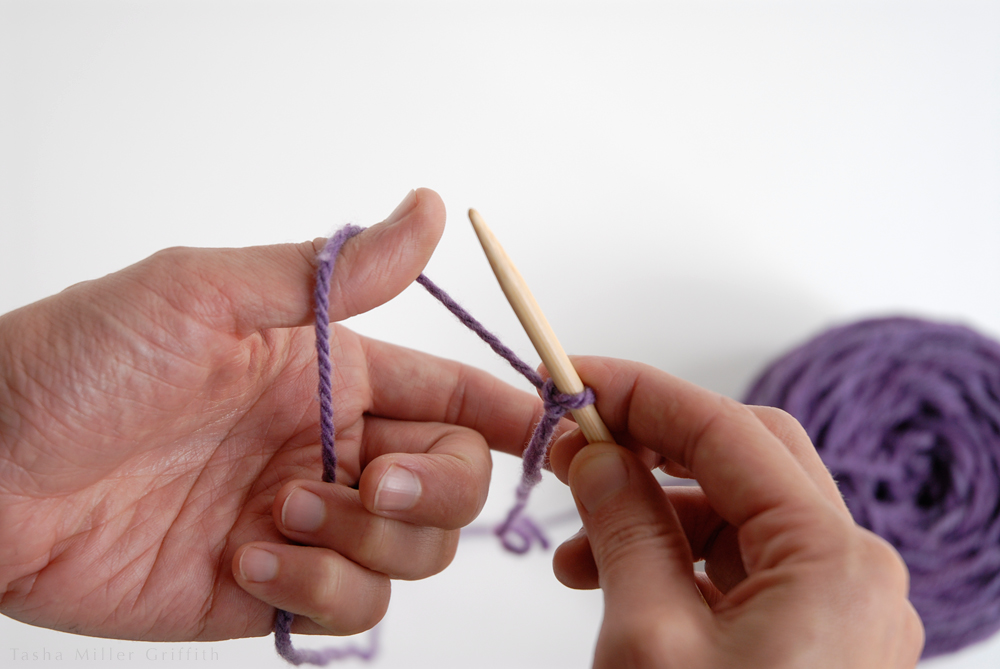
 

slipknot cast on 4


To make the first loop, I use the needle to scoop up the strand nearest me around the thumb, moving from the bottom up.
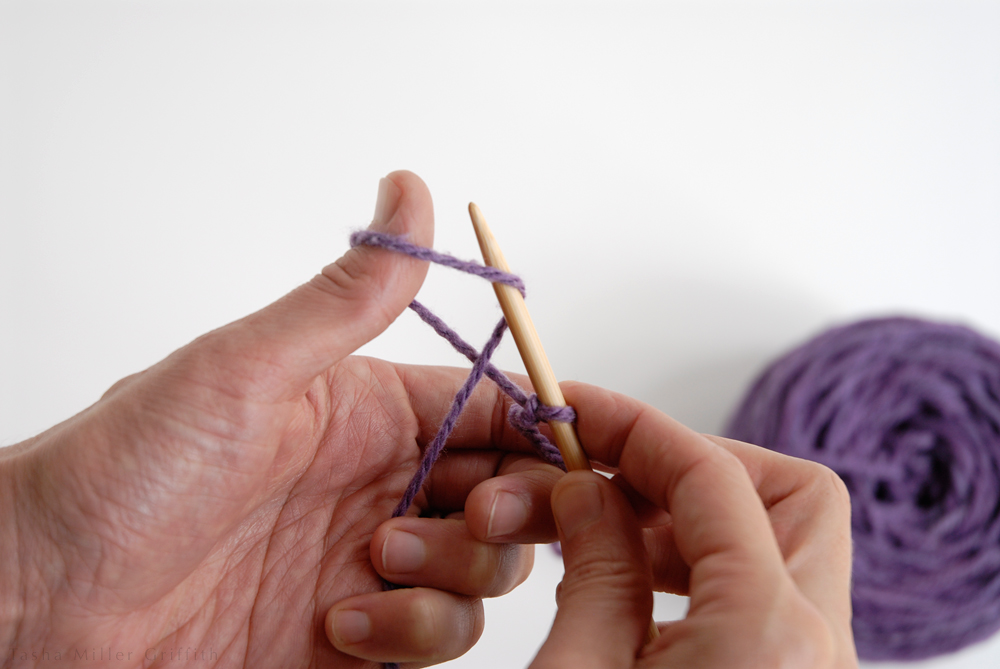
 

slipknot cast on 5


Leaving this first loop on the thumb, I use the rest of my hand to bring a second strand of yarn over the needle, making the second loop.

I used to think that looping this strand one direction vs. the other over the needle might make it easier to pull the yarn through in the last step.  That might be true, but it also (of course, silly me) determines which way your first round of stitches sit on the needle.  Chances are you want them as shown below, so wrap the yarn starting at the front and moving to the back.  If you’re a “combination” knitter or you learned in a tradition that knits through the back of the stitch, you’ll find your stitches ready to go if you wrap the yarn the other way, starting at the back and moving to the front.


slipknot cast on 6


In either case, now we have two loops on the needle.  We want to move the first loop over the second one, so that it makes a collar around the base of the second loop, just like in the first slip knot we made without the needle.  To do this, I use my thumb to lift the first loop up and over the tip of needle, and then let it go.
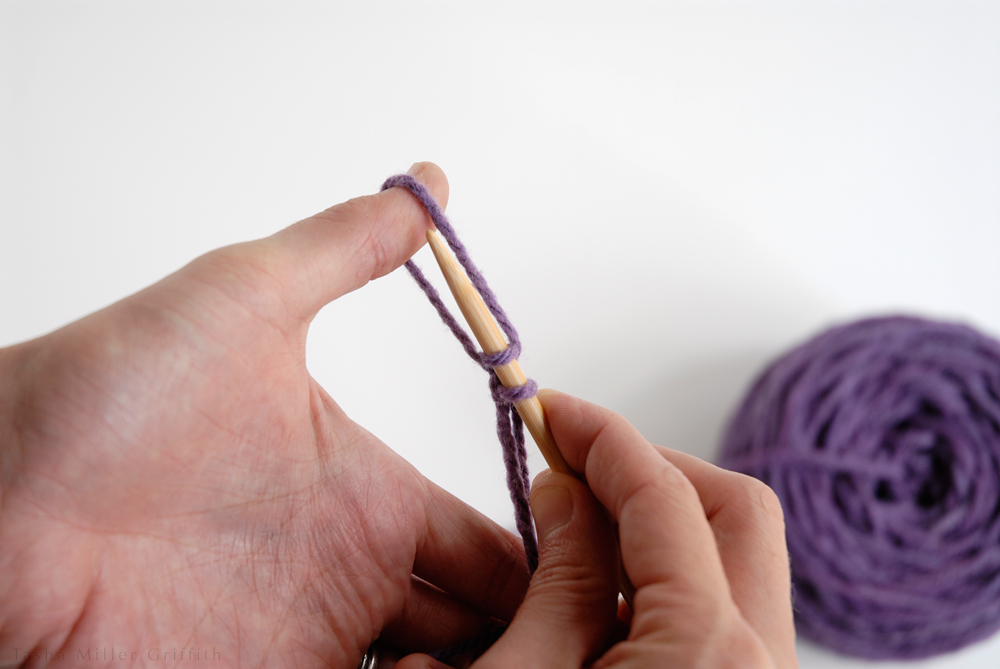
 

slipknot cast on 7


In the instructions I’ve seen before, the next step is to hold the new loop against the top of the needle, and pull on the end of the yarn so the collar around it tightens up.  Sometimes this works great, but if your yarn has any resistance to sliding along itself, it will probably get caught up, stop short, and cause you to curse, tug on all the ends available, and try again.

The reason the yarn gets caught easily is that there’s one place in its path where it has to loop quickly around itself, making almost like a little knot (indicated by the arrow below).
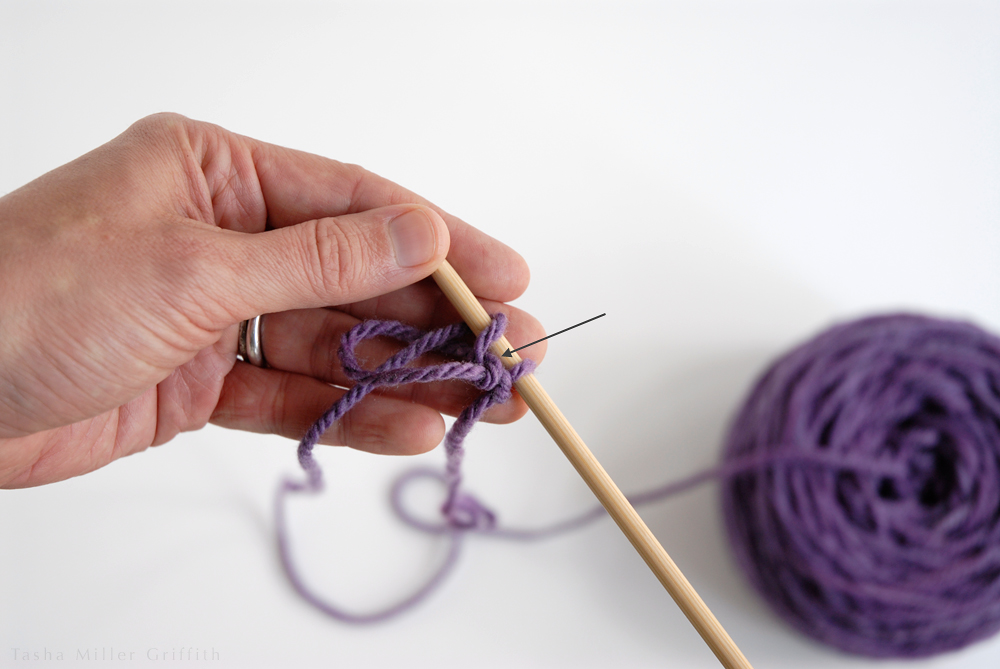
 

slipknot cast on 8


What I found was that if I pull the yarn through this tight place first, I can then pull on the end and the stitch will tighten up smoothly, even in my lumpy handspun!

I take hold of the outside of that little loop-de-loop, and pull it out, so that the collar starts to form around the bottom of the new loop on the needle.
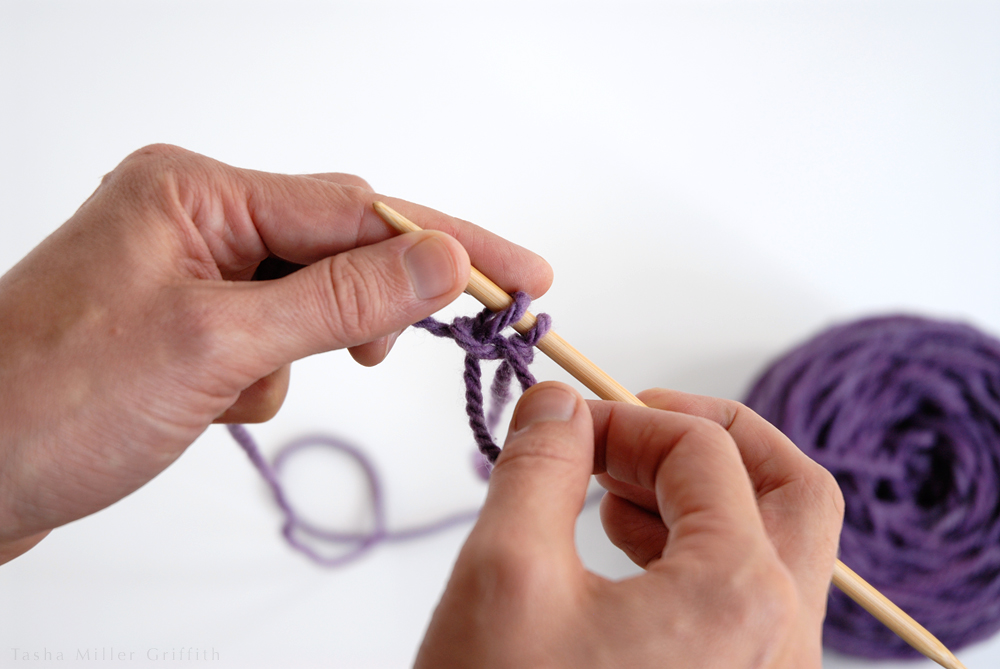
 

slipknot cast on 9


I’ve found that it works best if I get the new loop pretty snug, right up against the stitch before it on the needle, and the collar almost snug as well.  Then with it set up, I hold the new loop against the needle and pull on the yarn end to finish the new stitch.
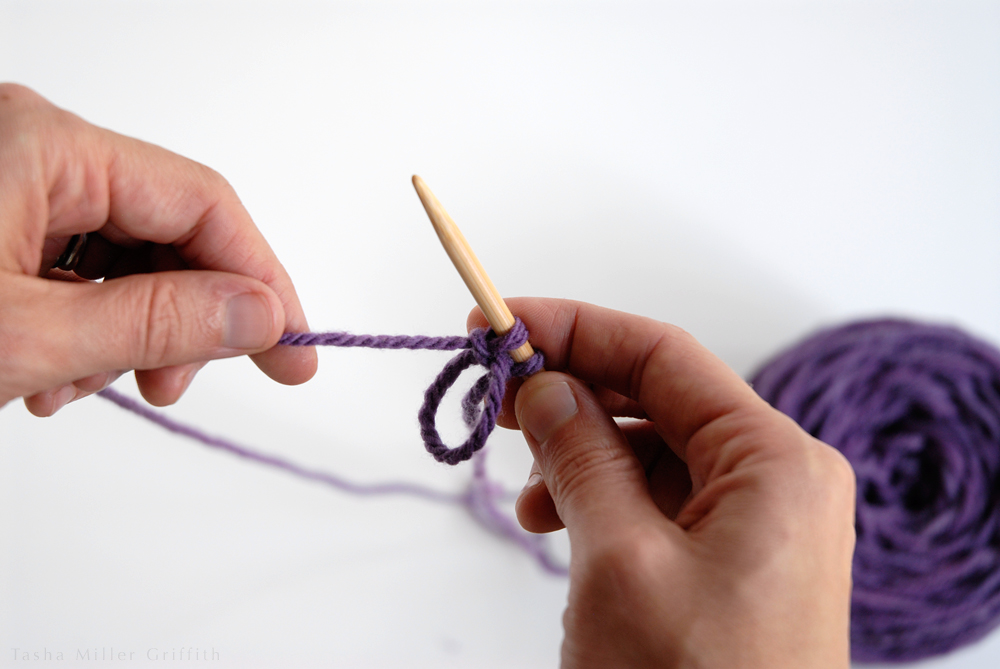
 

slipknot cast on 10


Although this undoubtedly adds a step, to me it’s totally worth it, since I can now use a whole lot more yarns with one of my favorite cast ons.  And I don’t know about you, but I would rather have a slightly more complex but smooth process, rather than cursing and tugging on the yarn every few stitches because it keeps getting stuck.
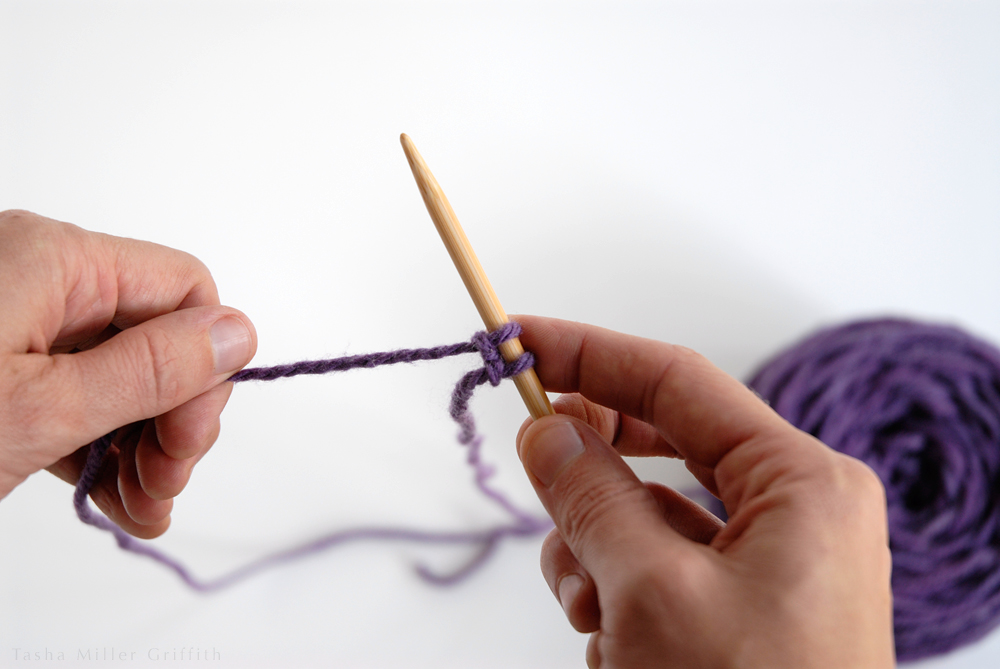
 

slipknot cast on 11


*One of the many bonuses of going to a workshop with Cat Bordhi in person, is that she tells you all kinds of cool little tricks, and that’s where I first learned about this cast on.  The original post about it on Jeny’s blog is here, she links both to her own video of the steps, and to another one which uses different motions.  If you’d prefer not to hold the yarn around your thumb, there’s also a variation using two needles demonstrated by Tillybuddy on YouTube here.


Happy knitting!
Treadle Magic


I’ve been wanting to write about sewing on my mom’s antique treadle machine when I was a kid, and now on the one from Bryan’s family that I’ve been restoring, for what feels like forever.  Sewing on these machines is something like magic, and I kept dreaming about sharing that with more modern sewists.  As of today, it’s happened!  Any minute now, the August issue of Seamwork magazine should be up, and with it, this treadle article of mine, which I’m super excited about.

So excited, in fact, that I also made my first-ever YouTube video as a companion, to show you how the bobbin winder works in motion (it’s a thing of beauty):


Are you excited yet? Do you have a treadle sitting in your garage? Let’s get it out! I’d love to help answer any questions that might get some of these beauties back into service, so ask away and I’ll do my best.

Also, stay tuned, I have a couple more treadle extras in the works for the coming weeks.

Have a great weekend!


Simple Textures

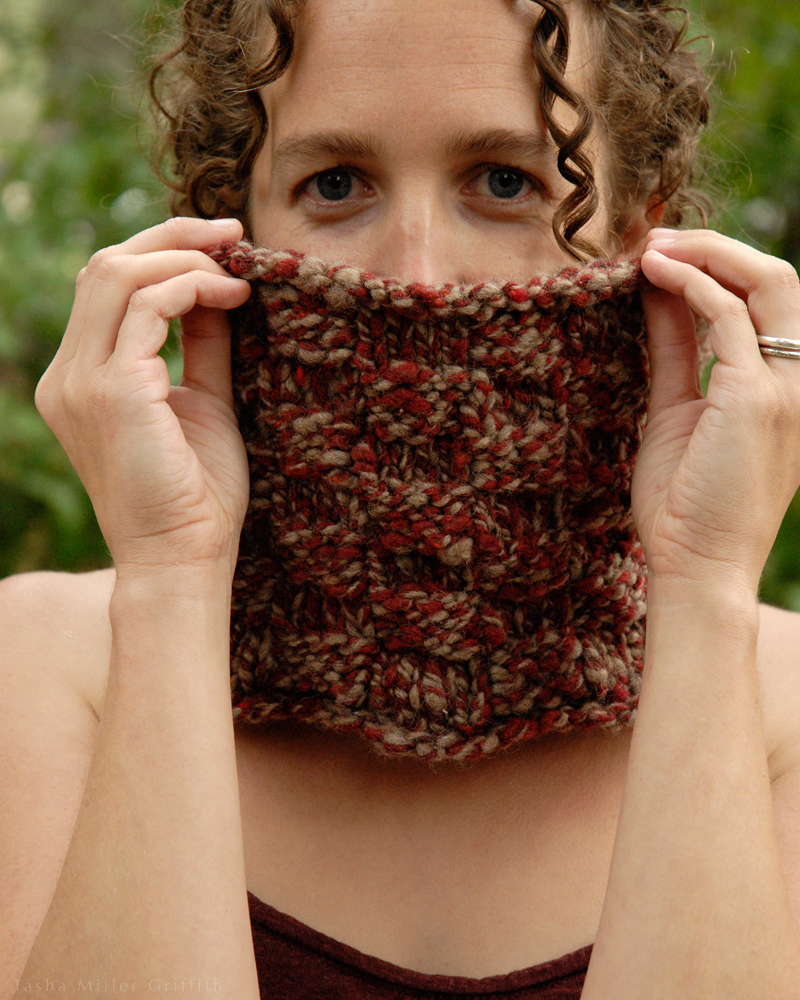
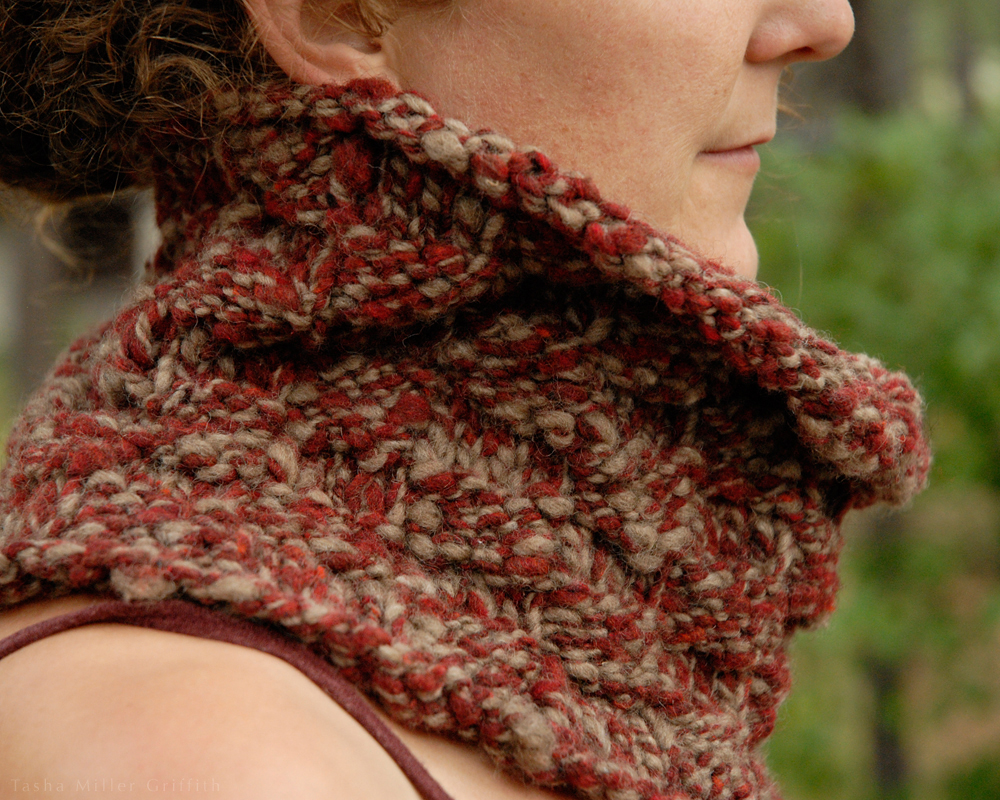
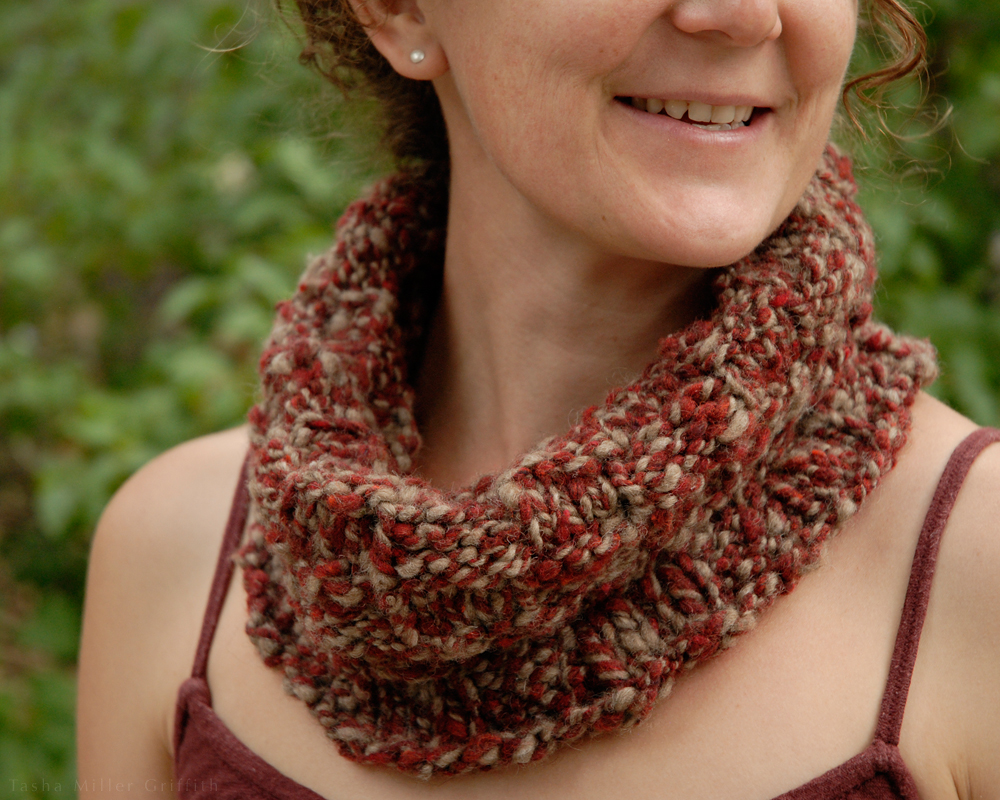
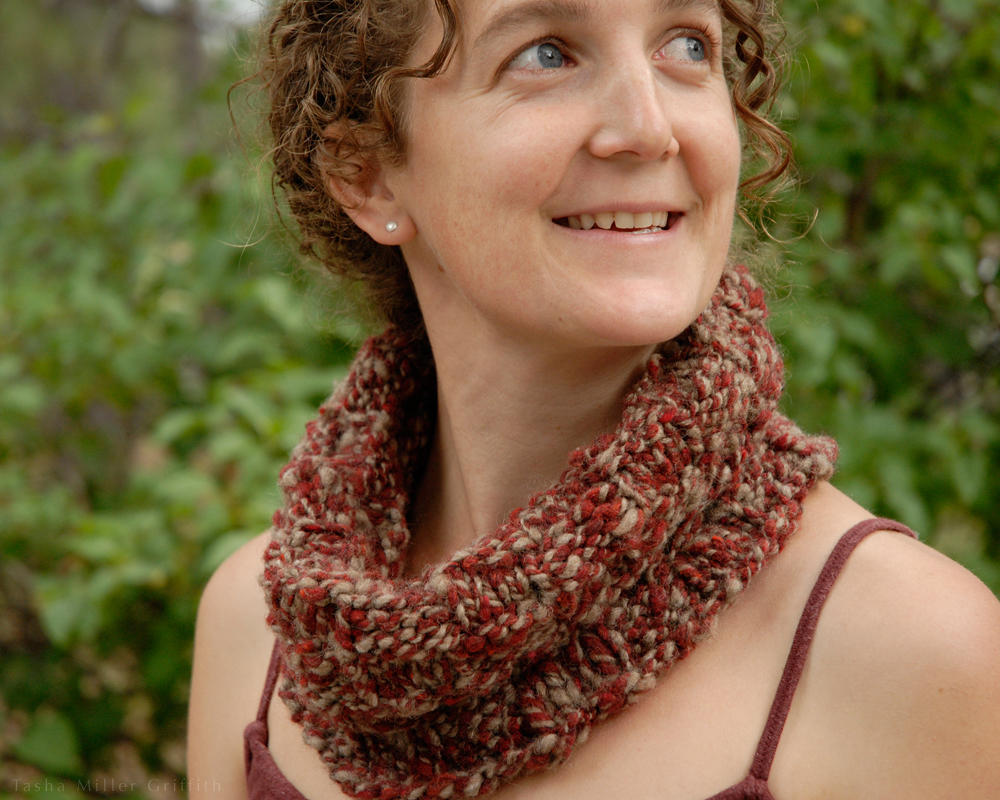
Here’s what I made with that first batch of my handspun yarn.  And how to make something similar yourself, if you’re interested!


first handspun cowl 2


I really wanted something simple, that would let the (ahem, very thick-and-than-thin) nature of the yarn shine through.  But, I’m not a knitter who’s happy with endless rounds of stockinette.  No offense to those that are, but I just need a little something pattern-wise to keep my brain engaged, and let me see that I’m making progress.

My gut-instinct guess was that I’d have enough yarn to make a small but substantial cowl.  Of course, there’s no label on my handspun to let me know the yardage, but I was able to estimate how much knitting I could get from the yarn pretty successfully.  I knit a swatch in my pattern, measured the dimensions, and weighed it, so I knew about how many square inches of knitting I could get from a certain amount of yarn by weight.  Then I weighed all the yarn I had, and used that number to figure out about how many square inches of total knitting I could make from it in this pattern.  I tried on a cowl I had, and estimated how big it would need to be to comfortably fit over one’s head, and how tall I would ideally want it, and arrived at a compromise number to cast on.


first handspun cowl 4


The finished cowl is 25″ around, and 7″ tall, which turned out to be plenty big!  At my gauge of 2.5 stitches/inch, I cast on 64 stitches.  I used Jeny’s Stretchy Slipknot Cast On.  (In this yarn—yes really!  More about that here.)  I did two rows (or maybe three? Forgot to write that down …) of plain knitting to make a little roll at the bottom, then switched to my pattern; alternating blocks of four knit and four purls stitches, and switching them after 4 rounds.

Of course you could use another simple pattern for the body of the cowl.  Just make sure that the total of your pattern repeat (in my case 8 stitches) divides evenly into the number of stitches you cast on.


first handspun cowl 3


When I was getting near my estimated total height, and at the end of a pattern repeat, I knit a couple more plain rows, and then bound off, using Elizabeth Zimmerman’s sewn bind-off.  I ended up using almost every bit of the yarn, which was definitely my intent!

I almost never buy yarn this chunky, so it seemed like the whole thing took about 5 seconds to knit.  In reality, it took parts of two days of traveling, and it was done!  So far, it seems like spinning is actually speeding up my production of finished knitted items, if that’s possible.  I actually have another finished handspun thing that just needs photos … and this one is off to live with someone dear to me, hopefully it will keep her neck warm this winter!


first handspun cowl 1


In the meantime, I hope this is helpful if you’re looking for something to make with a special bit of
thicker yarn, whether made by you or not!


Maybe I’m Over It

Over the purple corduroys, the NYC garment district, the whole thing.

I’ve been to New York City twice ever, both times since I’ve had this blog.  Both times I went to the garment district, and I haven’t written a thing about it either time. The first time, a couple of years ago, it was just crazy and overwhelming. We had the truck with us, and let me just say I will never, ever, drive any vehicle to NYC again if I can possibly help it, much less one that qualifies as quasi-commercial and definitely oversize. The truck is fine in Chicago, but as it turns out, not all at fine in New York.


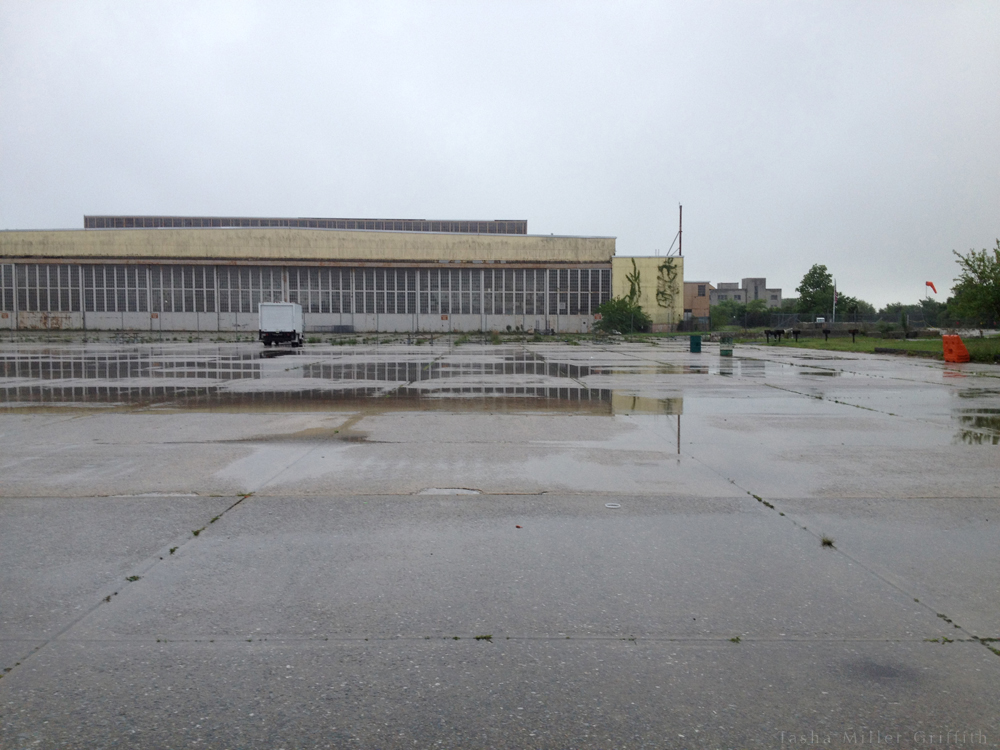
floyd bennett field camping 3Our truck in the parking area for camping at Floyd Bennett Field, by far the most post-apocalyptic National Park Service site I’ve ever been to.  It’s staffed by friendly New Yorkers who, when they find out it’s your first time in the city, will tell you everything, starting with “So there’s five boroughs …” to making sure you have quarters for the bus.  I am not making any of this up!


Anyway, we went to NYC again this past winter, along with traveling to an opening of Bryan’s work at the Griffin Museum of Photography outside Boston. I actually have a dear cousin who lives in Brooklyn, so we made a side trip to go and see her (completely vehicle-free, with only the luggage we could carry). I thought it would be much better and I would love it. It was better without worrying about the truck, but I was still overwhelmed. I’m the kind of person who naturally absorbs most of the stimulus coming at me in a given day, and likes to have a while to process it. There is a whole lot of stimulus coming at you all day, every day in New York—before you even get to the shops full of ceiling-high mounds of fabric in every color.


nyc street view


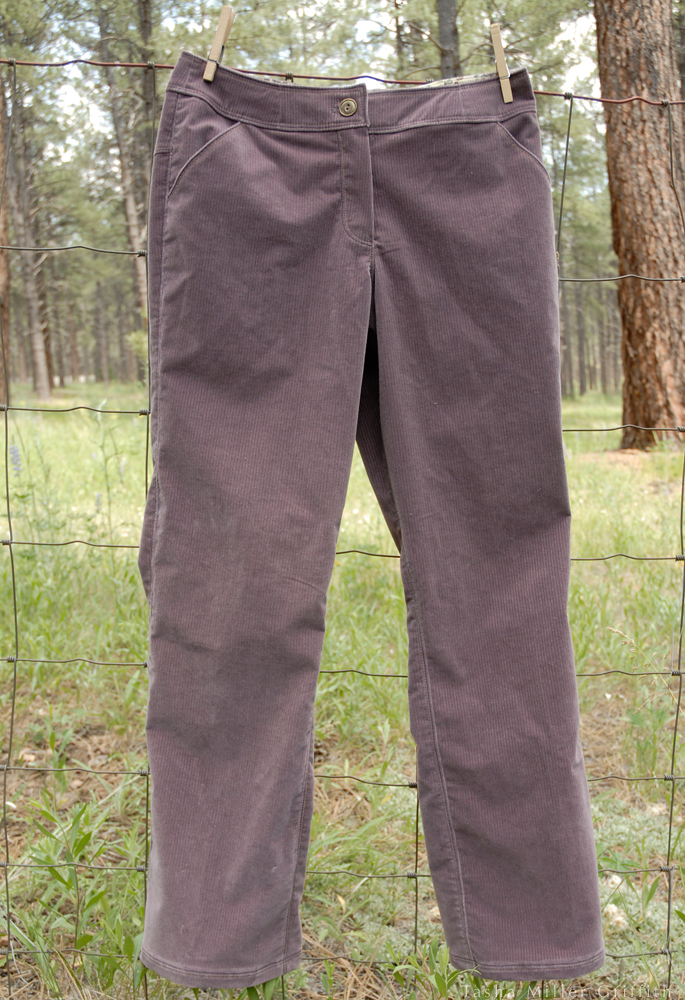
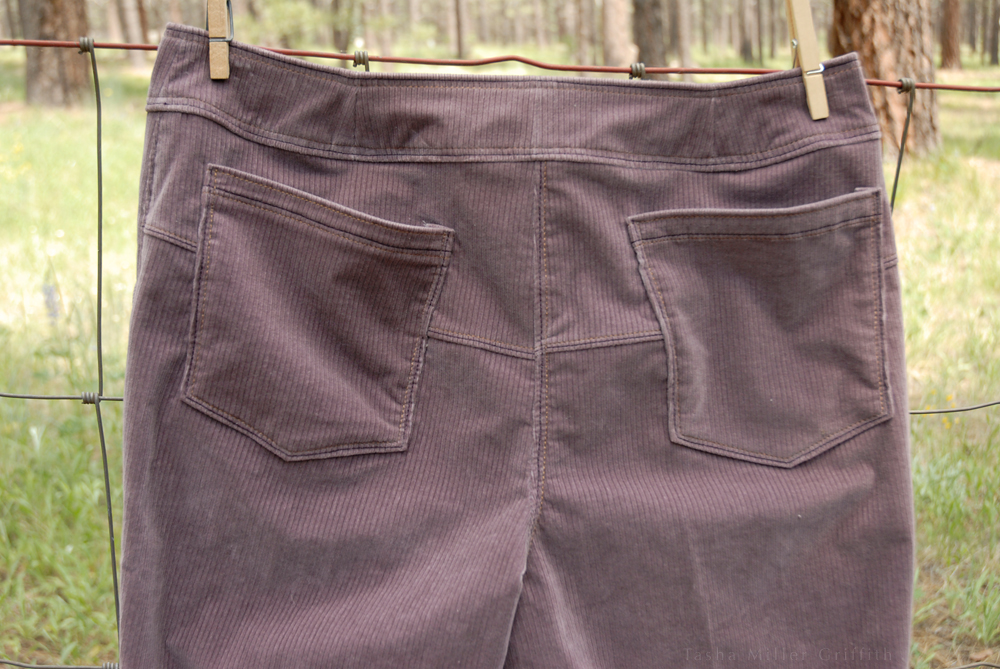
The garment district, while fascinating, is not geared for a thoughtful experience. It’s fast-paced. There are millions of choices packed together, but not a lot of background on any of them (any, really, beyond the fiber content and maybe a country of origin). I’ve tried to be more conscious about my fabric choices for a while now, but I knew I wanted some fabric to make another pair of pants, and it seemed ridiculous to be surrounded by what felt like all the fabric in the entire world, and go home with nothing for my project. So after some debate, I chose something purple and stripey and soft, brought it home, and a couple of months later, cut it out.


over it purple pants 1


And I got exactly what I deserved for picking fabric I had no background on, no relationship with, and so no idea what to expect—it behaved terribly. There’s some stretch in this stuff, which I’ve avoided in wovens in the past, and I’m going right back to avoiding it like the plague. It kept stretching as I was sewing it, throwing off my alignment and topstitching, moving the pockets around even though I basted them in place, etc. Plus, it’s weirdly clingier around my bum than the non-stretch fabric I’ve used in this pattern before.


over it purple pants 2


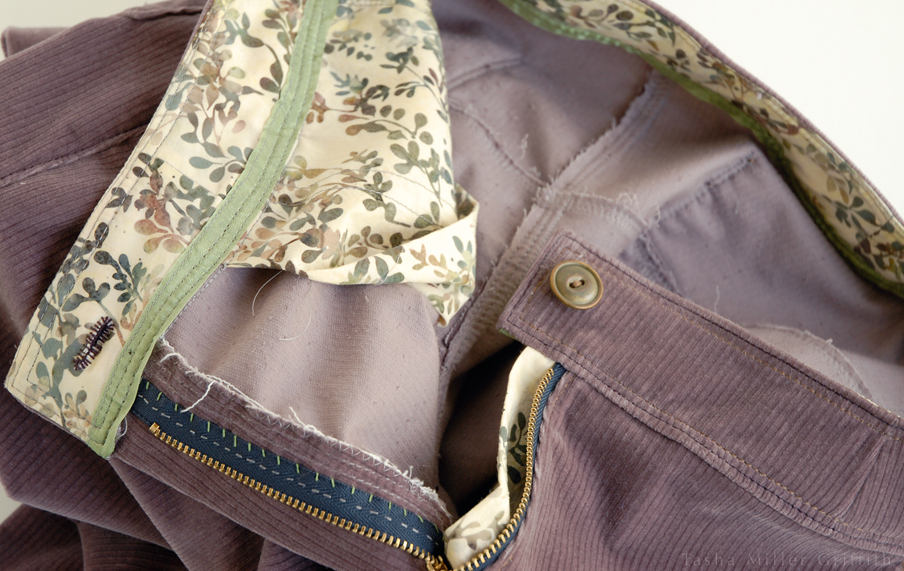
Don’t get me wrong, these aren’t the worst pants ever.  I like the color, and they fit me reasonably well, which is enough to almost certainly ensure they’ll get wear when the weather gets cool again. And, they have the nicest inside waistband and zipper tab of any pants I’ve made so far, so I learned something there.


over it purple pants 3


But, the whole experience just brought home what I hadn’t been able to articulate. In my head, before I went there, the garment district was a mythical paradise of fabric. But it turns out; it’s not my Mecca. It may sound a little blasphemous to say so, but I don’t think the garment district even has the fabric I want. I think I’m over it.

So what, exactly, is the fabric I want, you may reasonably ask? Well, what I really want is unreasonable to ask for in our current culture. I want fabric that not only do I know where it comes from, what labor conditions went into it, and how the fiber was cultivated in the environment where it grows, but I want to feel good about the answers to all those questions. I want to buy some fabric now, see it how it wears, and in 5 years, when I like what I find, buy some more of that exact same fabric. I want fewer, but better choices.


floyd bennett field camping 2


I have tried before to find some fabric closer to these ideals. I went on an online quest for organic wool a couple of winters ago (when I eventually bought this lovely stuff from New Zealand).  I had a few interesting conversations with fabric store owners through email. Mostly what I learned is that they don’t know any more about the origins of their fabrics than I do.  Often times even by writing to their suppliers, the most information we could possibly get was what factory the fabric came from.

At that same time I wrote to Mountain Meadow Wool, an American yarn company I feel really good about supporting, and suggested they think about making some knit fabric out of their American Merino. I got a really nice response back … but since then some blankets and finished knit goods have appeared in their line-up, no fabric yet … I do get it, I see why market research would indicate a much bigger market and profit by skipping the fabric and going right for finished goods.   Imperial Stock Ranch took it one step further and produced a high-fashion collection. But knowing that they are taking high-quality wool, sustainably grown in USA, all the way from sheep to fabric also in-country, and that none of that fabric is available for sewists to buy (that I know of, I’ll write them too, we’ll see)—it makes my fingers itch. I think it’s phenomenal how much single-breed, known-origin, small-farm-type wool yarn is available to knitters right now, and I know there’s a niche for fabrics made from the same materials.

The fabric for my first pair of purple corduroys was organic cotton & hemp, but made in China (under supposedly good working conditions). The biggest problem with it was that it didn’t hold up to wear long enough to be called well-made. How sustainable is anything that has to be replaced every couple of years, or less?

The best news in thinking about all this, is that there are other sewists out there on similar quixotic journeys to find (or make!) sustainable fabrics, and thanks to the magic of the internet, I can find them. And there is a lot going on right now.

I’m throwing my lot in with one Year, one Outfit, a project on this is moonlight to source “fibershed” textiles in your area, and make them into an outfit by the end of the year. Although I may not make a whole outfit by the end of 2015, I’m pledging not to buy any new fabric for (at least) that time, unless it meets (at least!) these minimum requirements: 100% made in the USA, sustainably grown also in USA, and not dyed with synthetic dyes, bleached, or processed in other ways that use toxic chemicals. At the very least, it will be a kick in the bum to do my homework, and some experimenting!


one year one outfit logo


While I’ve been thinking about this, some other thoughtful bloggers have also been researching and sharing around similar topics. This post of Zoe’s about organic cotton and whether it’s really better got me thinking about the fabric I really want to find. The other bloggers in the one Year, one Outfit project have done some good research. Mari’s post about what she’s found available in the Southeastern US was really interesting, and there are people around the world taking part and sharing what they find, there might be someone near you.  Then just the other day, Ginger posted about a designer making sustainable sweater knits available to home sewers! If you’re curious, I also definitely recommend listening to this 2010 interview with Rebecca from the fibershed project, which I also linked to from one Year, one Outfit.

Phew!  So, do you want in on some crazy back-to-basics fabric hunting? Interested in dyeing/printing your own textiles (because I think that’s going to be a big part of it)?  Stay tuned, updates will definitely be coming!


The End of the Yarn


end of the yarn 1


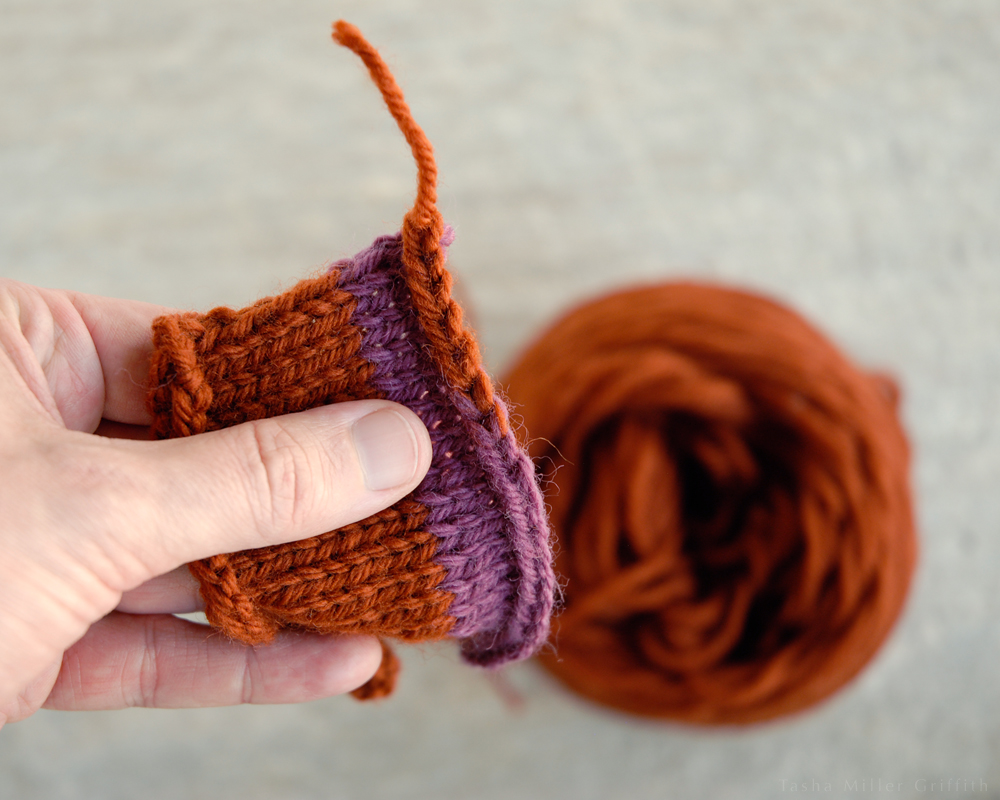
My knitting students inspired this post. I do explain in class what to do when your skein of yarn runs out and you need to add more, but it’s a little tricky to visualize without actually cutting the yarn, and easy to forget when you get home and you’re left alone with an internet full of confusing videos … so here you go! These are my favorite, simple, fairly foolproof methods. The first one works with practically any yarn, any project, any time, and the second one makes a totally seamless join in any feltable yarn.

Personally, if I can’t felt the ends together (see below), I almost always just leave the tails, and I don’t mind sewing them in later. There are lots of methods for weaving in the tails as you go, by wrapping the new yarn over/under/with the old yarn, and most of them work just fine. You may find one that you love. But, you don’t need to do any of them. Leaving the tails to work in later is perfectly good. And if you’re still thinking about how to knit, you don’t need anything more complicated going on when you get to the end of a skein.

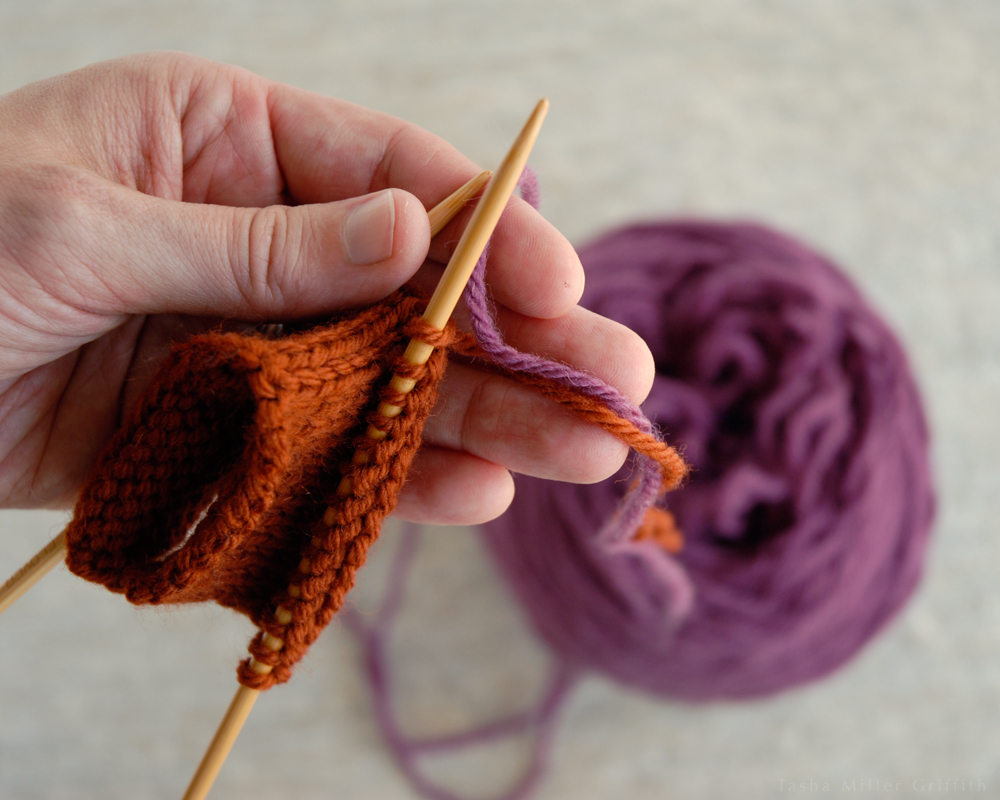
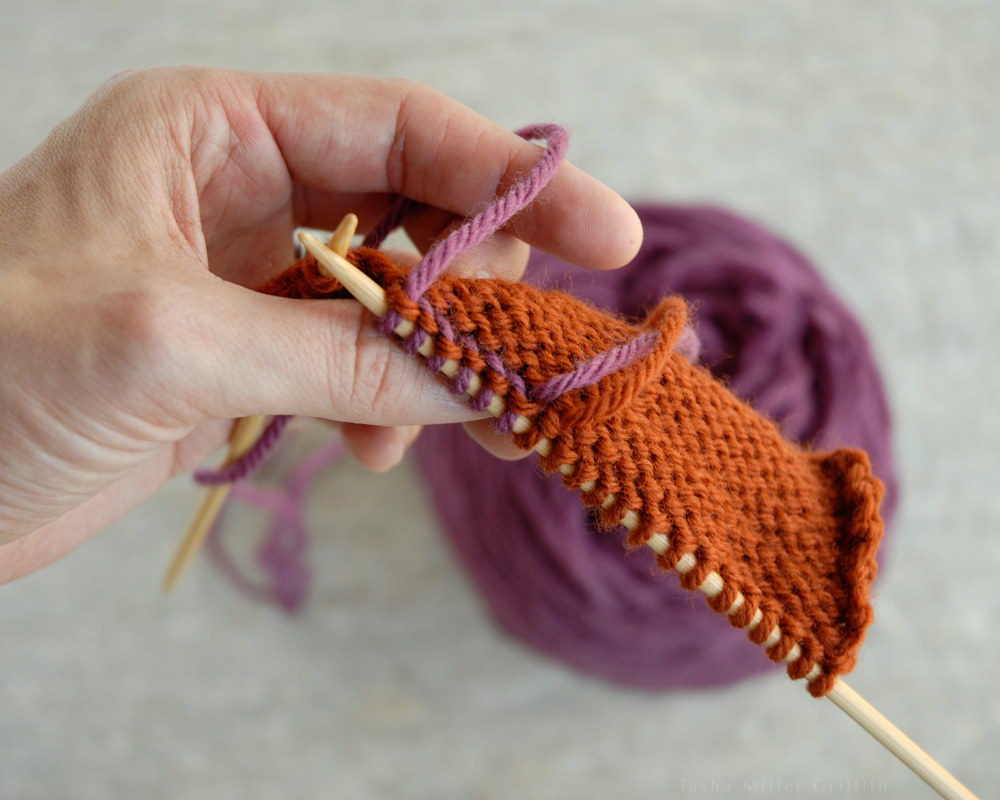
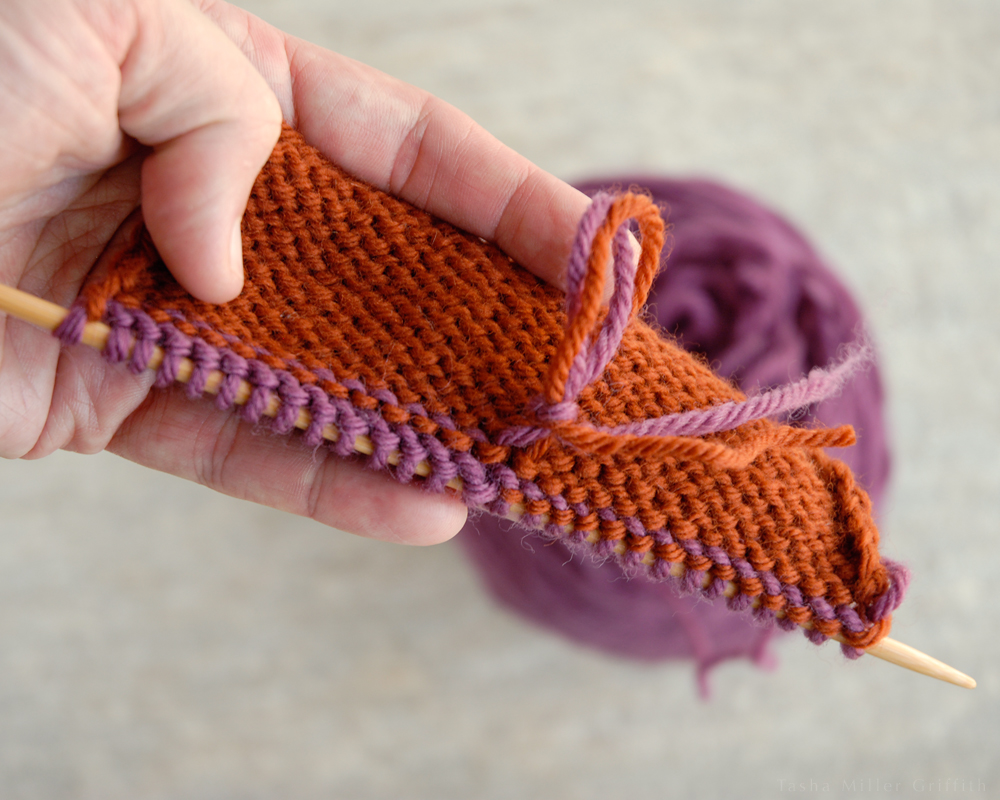
So, just stop knitting when you have about 6 inches of yarn left unknitted. Pick up your new ball of yarn (mine is purple) and, leaving another tail of the same length, start knitting with it. The stitches on either side of the tails will probably be a little loose, but you can cinch them up later to match their neighbors when you weave in the tails, so don’t worry about it for now. If you like, you can tie the two ends together into a slipknot to keep things neat while you’re working on the rest. That’s it!


end of the yarn 2


end of the yarn 3


end of the yarn 4


As long as we’re talking about joining yarn ends, I wanted to include my very favorite method, which takes advantage of the felting properties of wool to join two lengths of yarn without any tails left at all.

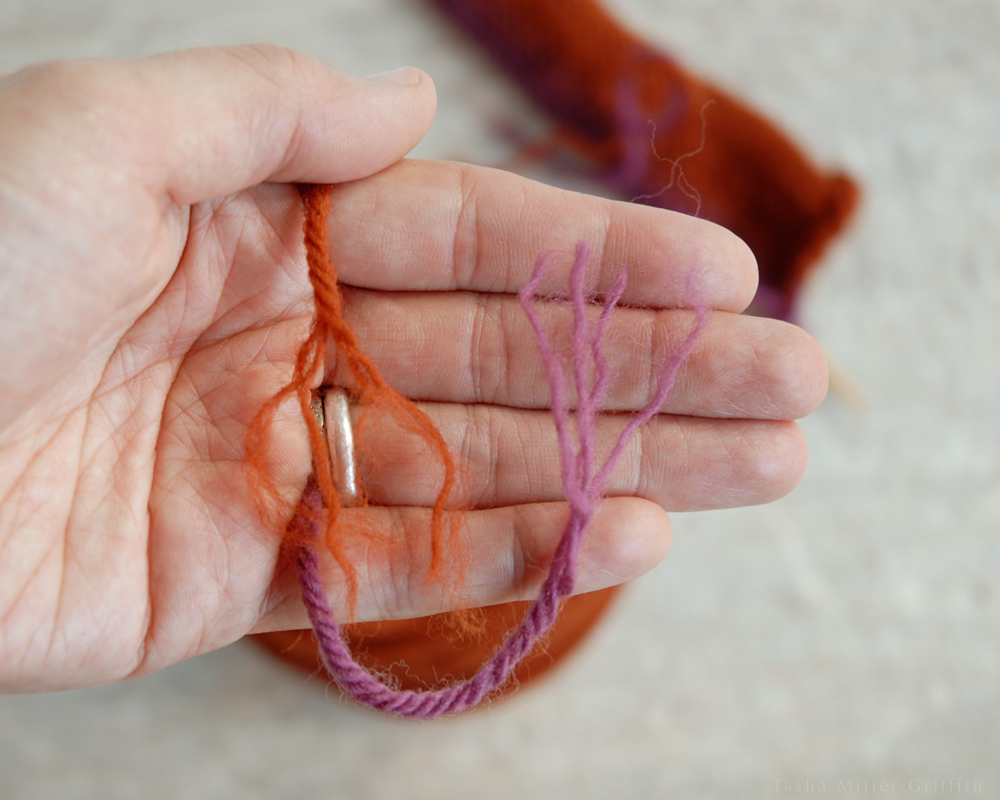
Untwist and fluff out a couple of inches on both ends. The first key to this method is to get the fibers as separated as possible. Just like in any other felting, fuzzy, loose fibers will attach to whatever is next to them, and fibers that are already joined or clumped will attach mainly to each other.


end of the yarn 5


The second key to this method is to mix the fibers from the two ends together thoroughly before you start rubbing them. You want as many places for them to meld as possible, so move the strands around so that all the ones from one end are not on the same side.

Add just a little moisture (I usually use spit unless water happens to be handy). The fibers should be barely damp. Squeeze the join lightly between your hands, and start rolling it back and forth. You want to agitate the fibers together without disturbing their orientation.


end of the yarn 6


end of the yarn 7


end of the yarn 8


Small areas like this felt very quickly. The join is done when you can pull gently on it from both sides and the fibers don’t slip. It’s possible to go too far, so that your little felted area becomes noticeably stiffer than the rest of the yarn, so stop when it’s holding together.


end of the yarn 9


Other than with non-felting yarns (superwash, plant fibers, silk, synthetics etc.) the only time I wouldn’t use this method is if a slight difference in yarn texture will be noticeable in the knitting, like in a very smooth or shiny yarn. A felted join is basically invisible in fuzzy singles, and it also works well with textured and handspun yarns, as well as your more “standard” multi-ply wool yarns like Cascade 220 (shown here, you can see the felted join in the bind off near my thumb below). And, if for any reason the felted method doesn’t work or you don’t like how it looks, you can always cut it off and go back to the first method.


end of the yarn 10


Happy joining!


Grateful and Lush

A quick Me-Made-May ’15 wrap-up, plus some totally unrelated spring thoughts and photos …
Tasha teaching felting Flag Wool

Photo by Louisa Ballard

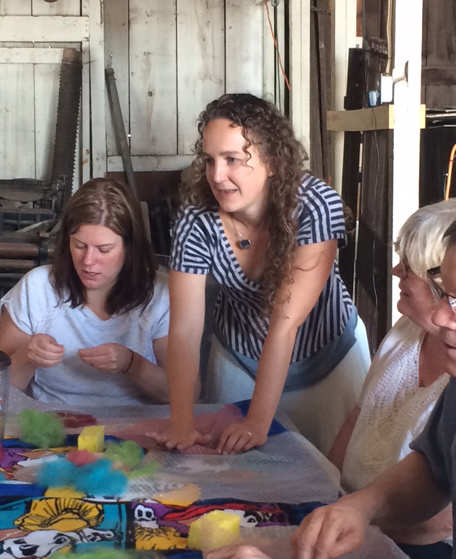
This shot of me teaching felting at Flag Wool is the closest thing I have to an outfit photo for the whole month of May! I decided not to worry about documentation for MMM this year, which was mostly a good choice, even though I felt a little more alone in my handmade-wearing.  It was such a busy month in the best way, and I just didn’t need any other thing to try and do every day.  Plus I felt like my best thoughts around a handmade wardrobe happened at the beginning/planning stage this year, and once I set it up I basically dressed like I normally would, except for the items I couldn’t wear because they didn’t fit my pledge, which were quarantined in the back of my closet.  I fell back in love with one old me-made skirt.  And discovered that while I may technically have enough me-made or me-repaired socks to make it through the month, I don’t have the will to keep on top of the laundry so that they’re always clean and ready to go … I also decided that any situation which calls for truly expendable work clothes doesn’t count. I was definitely looking forward the end of my self-imposed restrictions by the end of the month, although I enjoyed the challenge. I have a small wardrobe in any case, so maybe my goal for next year should be to add a few more me-made pieces. Also, I’m going to try harder to come up with some kind of documentation that works for me.

This May we traveled out to the Washington DC area for two art shows, and saw a bunch of friends, which has been part of our May plan for the last few years.  But we were also home more than normal, including for the wool festival here, which was super fun.  I had great students, and enjoyed the vendors (there was some totally beautiful handspun, among other things) and sheep as much as anyone.  I also worked on writing & photographing two new articles for Seamwork while we were back—I can’t say much about them yet, except of course that I’m really excited!  I can’t wait for you all to see them too.

Throughout all of this, I felt like I’d fallen into a pond of gratefulness.  Our trip went well.  Friends and family lent me their tools and knowledge at the exact time I need them.  I had enough me-made/altered/repaired clothes to wear for a whole month.  I was in the home I love, working and learning around things I’m passionate about.  To top it all off, that home was not on fire, or anywhere close to it.  We’ve had an unusually wet spring, and it’s mind blowing to think that just about this time last year our neighborhood was under evacuation orders from the Slide Fire.  (It didn’t get that close in the end, but it was such a scary time).  The forest is so lush right now.  Well, lush for here, a little carpet of green grass and small yellow flowers under the pines.  I tried to take a photo, but it just doesn’t look full of water and life unless you live here … but every time I look out the window I breathe a little sigh of relief.

Instead I’ll leave you with a few photos from earlier this spring, near Mammoth Cave in Kentucky.  Spring anywhere out East still fascinates me, having grown up in a land where a little grass and extra flowers count as lush.  More fiber stuff is on the way!


spring mammoth branches


spring mammoth ripples


spring mammoth moss and flower


Sweet Coriolis Socks


sweet coriolis socks 6


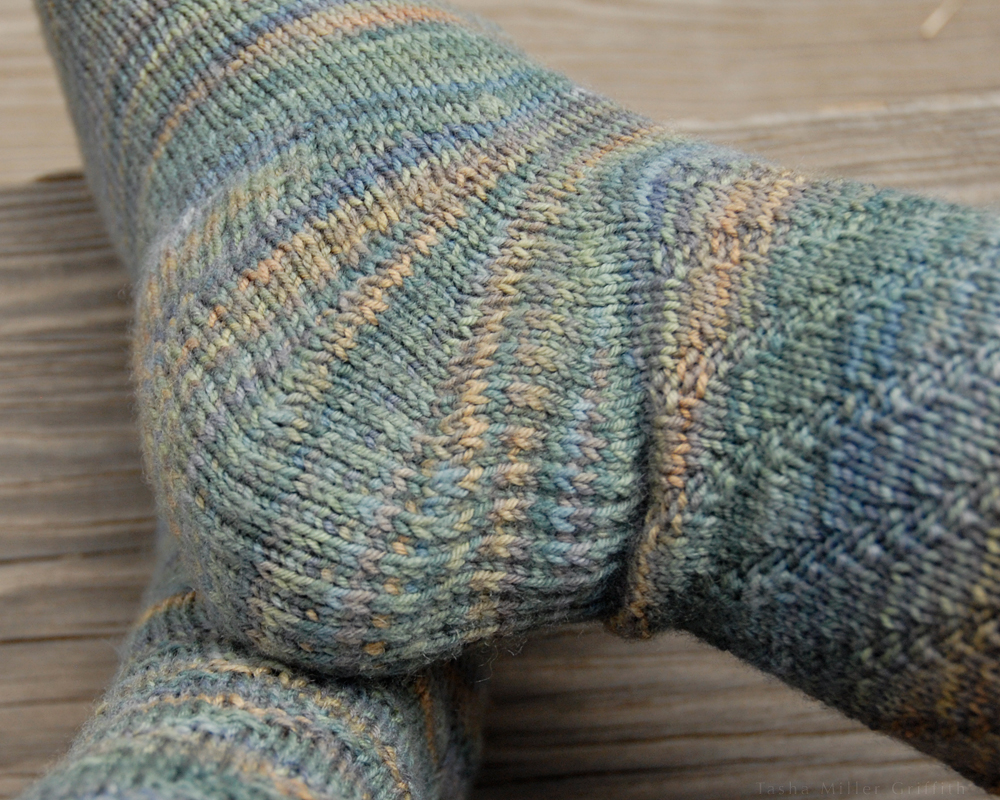
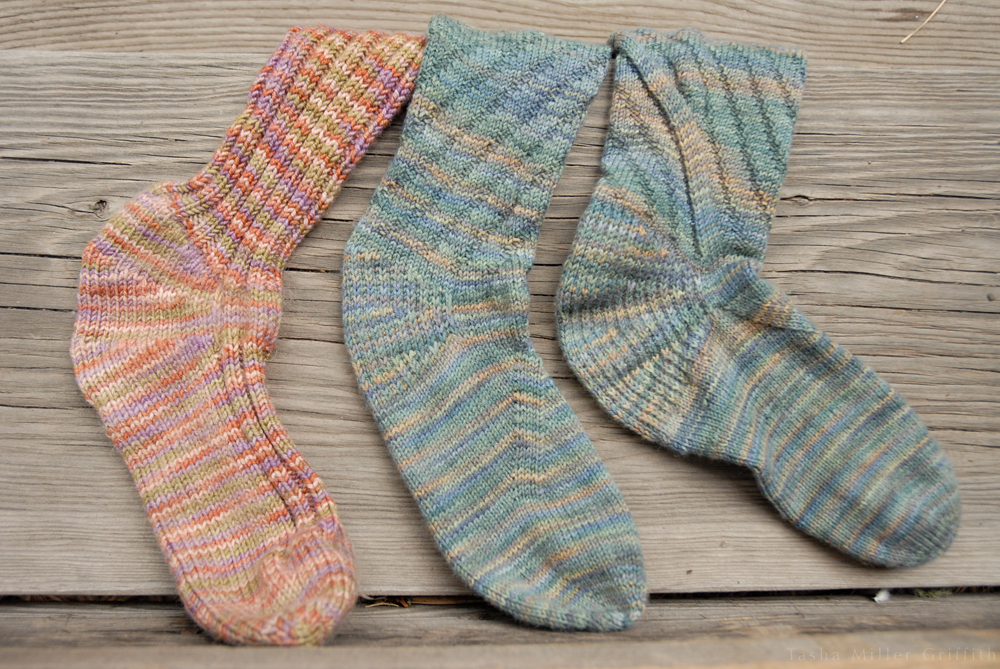
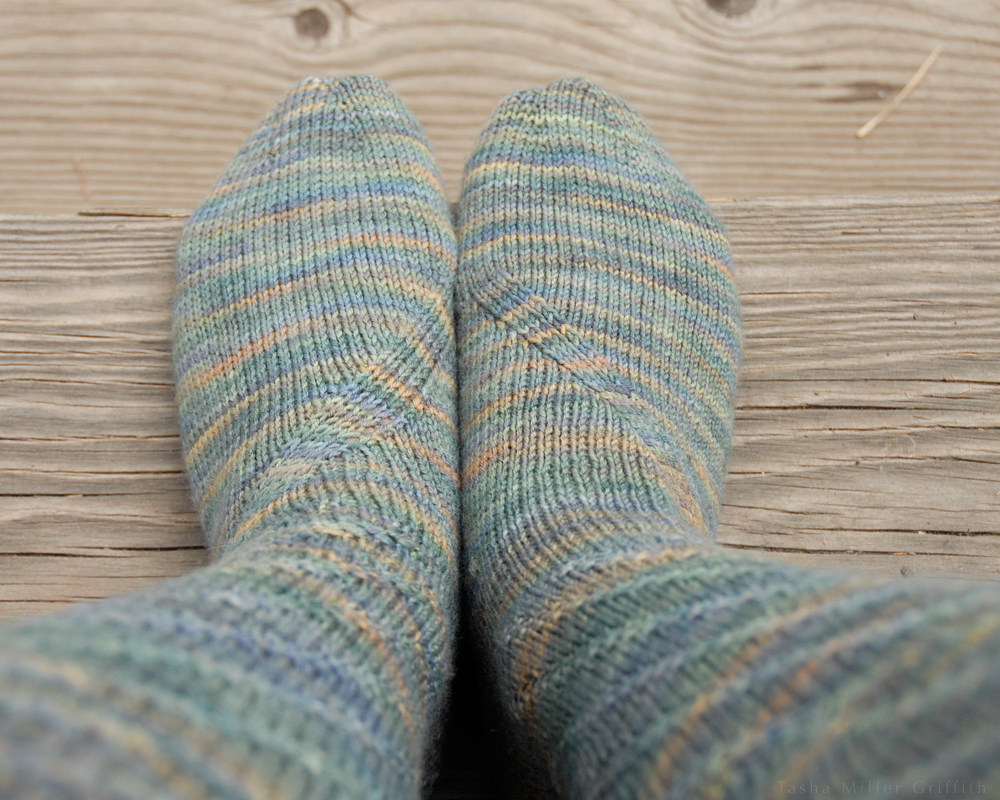
Hello everyone! So, I knit some more sweet tomato heel socks over our last couple of times on the road. After making a few pairs using thicker-than-normal sock yarn, I wasn’t sure how I’d feel about using the “real” stuff. But as it turned out, I thoroughly enjoyed watching the tiny neat stitches appear one after the other, and it didn’t bother me that it took a little longer.

I divided the yarn by weight, thinking that way I could make both socks from the toe up, stop when I ran out of yarn, and they’d end up pretty much the same length. But, I threw in enough experimenting that my yarn usage wasn’t the same at all on the second sock … I should have known that would happen! Next time I’ll either make both at the same time, or, if after the first heel I want to try something different for the next one, I’ll wait to finish the legs until I see how much yarn is left.


sweet coriolis socks 5


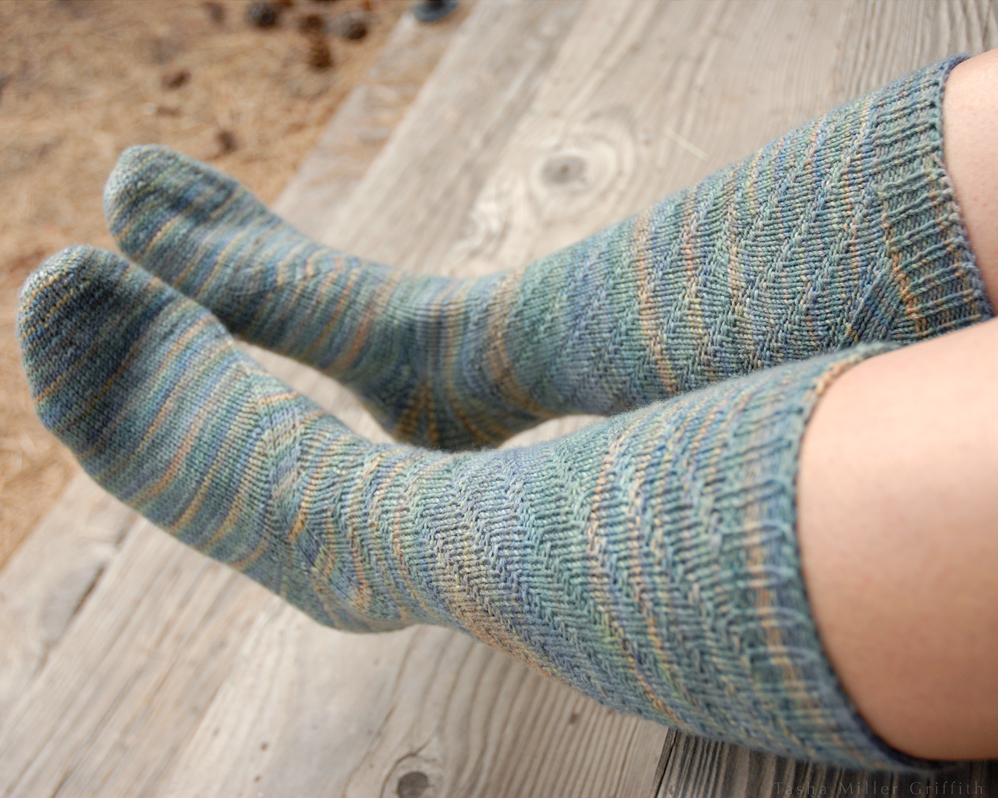
Another thing I learned while making this pair is that for my feet and legs, 425 yards of fairly standard sock yarn will make a boot sock, tall enough to overlap leggings, but not tall enough to reach over my calf. As far as I know, no force on Earth will keep socks of this length up, unless they have something that provides more friction than a leg to hold on to. I like wearing these, in fact they’re my favorite socks right now. However, having substantial leftover yarn drives me crazy, and next time I’d like to get enough to make knee socks, so maybe I’ll look for two smaller skeins, or a really long one.


sweet coriolis socks 3


If you’d like to make a similar sock, or see the knit-nerd details about the two heels and what I’ve learned about fitting sweet tomato heels so far, all that is on Ravelry.

This pattern is the “Sweet Coriolis Socks” from Cat Bordhi’s Sweet Tomato Socks ebook. She also recommended this yarn in a workshop I took, it’s Mountain Colors Crazyfoot. This particular color (“Chinook”) called my name at Purl in the Pines. I liked working with this yarn, although a fair amount of blue-green dye bled off in the first washing. We’ll see how they hold up!


sweet coriolis socks 1


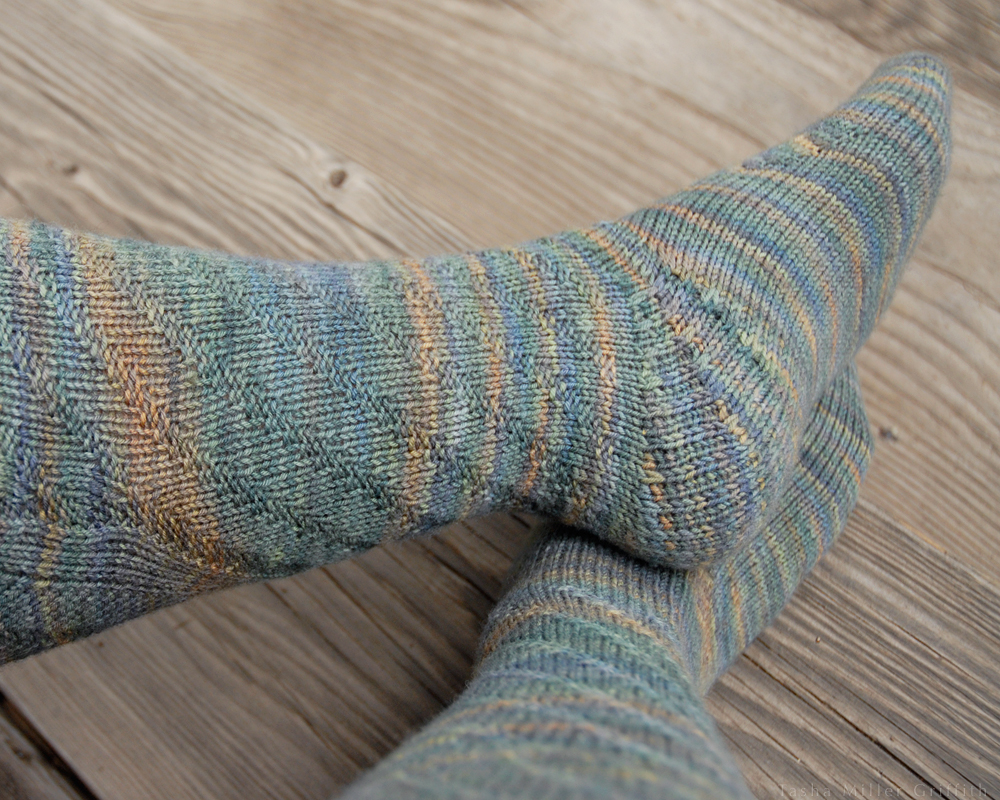
Cat Bordhi is one of my knitting heroines, and I know variations of this pattern have appeared in several of her books, so I was excited to try it. Although I like how the finished socks look, my brain and this pattern weren’t quite in harmony. I never really got into a flow with the coriolis ribbing, and I kept having to check to make sure I was in the right spot. And, the experiments I tried with the heels threw off the expected path for the coriolis band at the hinge of the foot, especially on the second sock, where it got lost for a while. If you’re still experimenting with the fit of your heel/foot, I’d recommend sticking with a pattern that holds steady on top of the foot, until you figure things out and can do some calculating ahead of time.


sweet coriolis socks 4


I’m getting really close to a great fit with this heel, and I liked the padded variation I tried this time a lot. Still, I’m thinking I may knit some non-sweet-tomato socks for my next pair, if for no other reason than to get some perspective on the different heel techniques … there’s always more to learn, which is what keeps me knitting!
 

Me-Made-May and Putting My Best Self Forward


mmm15 sleep top 2

Hi guys!  This year I’ve decided to give myself a harder challenge for Me-Made-May, and it’s definitely leading to some good thoughts about how dressing handmade pushes me towards making and wearing more of what really reflects me and how I’d like to be seen, rather than just wearing what I happen to have.

I wrote a piece about all this for Zoe, the lovely host of mmmay, and it’s on her blog today, so do head over there if you’d like to read more about what I’ve been thinking and making (the top at left) in preparation for May.  Here’s my pledge for this year:

“I, Tasha of Stale Bread into French Toast, sign up as a participant of Me-Made-May ’15. I endeavour to wear only garments I have made, altered, or repaired, for the duration of May 2015. The only purposeful exception will be my raincoat, which isn’t any of the above, but I will definitely wear if the need arises. Everything else is included!”  Gulp!

There’s still time to sign up and participate yourself, I highly recommend it, and you can make a pledge no matter how many or few handmade things you have to wear … I hope you’ll do it with me!


Four Upcycled Winter Tops

In which I think about the difference between fit and flatter, ways to seam knits for a pear shape, and the pros and cons of sewing with recycled sweaters.


Last fall, I knew I could use some more long-sleeve cozy tops for the coming winter, and I decided to see if I could find some “fabric” (in the form of large garments) at our local thrift stores, figuring that it would be cheaper than ordering quality wool knit, and I would be more willing to experiment if I wasn’t super attached to the materials.

Many things still take longer than I think they will, so I just finished the last of these a couple of weeks ago … luckily they still work as light sweaters for spring, and I’m now set for next fall/winter. Some people would probably call these light sweaters at any time, but for my winter wardrobe they’re shirts, something soft and warm that goes under a bigger sweater. (If it’s winter, I’m pretty much always cold. Heck, if it’s Texas in Spring but I’m inside and the is AC on, I’m still probably cold.) I’ve switched pretty much exclusively to wool (or cashmere etc.) and silk for winter wear, and I just love it that way, so those were the fibers I was looking for.

One of the biggest problems I’ve found with trying to upcycle tops for me out of existing tops, is that for there to be enough fabric to cut a new garment, the original sweater must be truly huge. Yet in the past, trying to reshape something without treating it as fabric and cutting new shapes has been a recycling nightmare that eats up way more of my time than the results are worth …

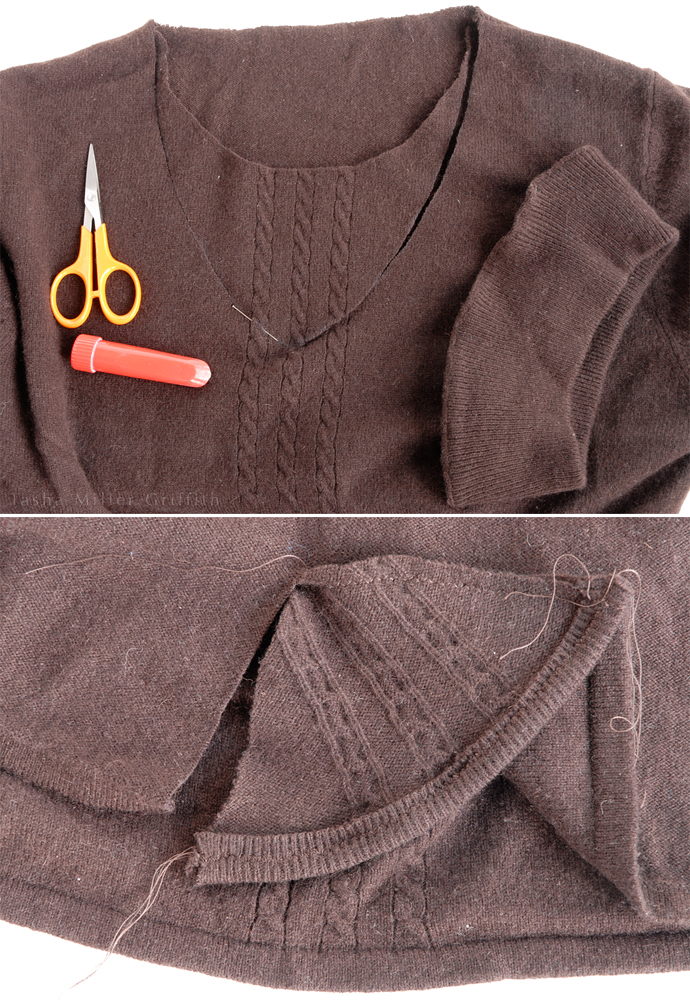
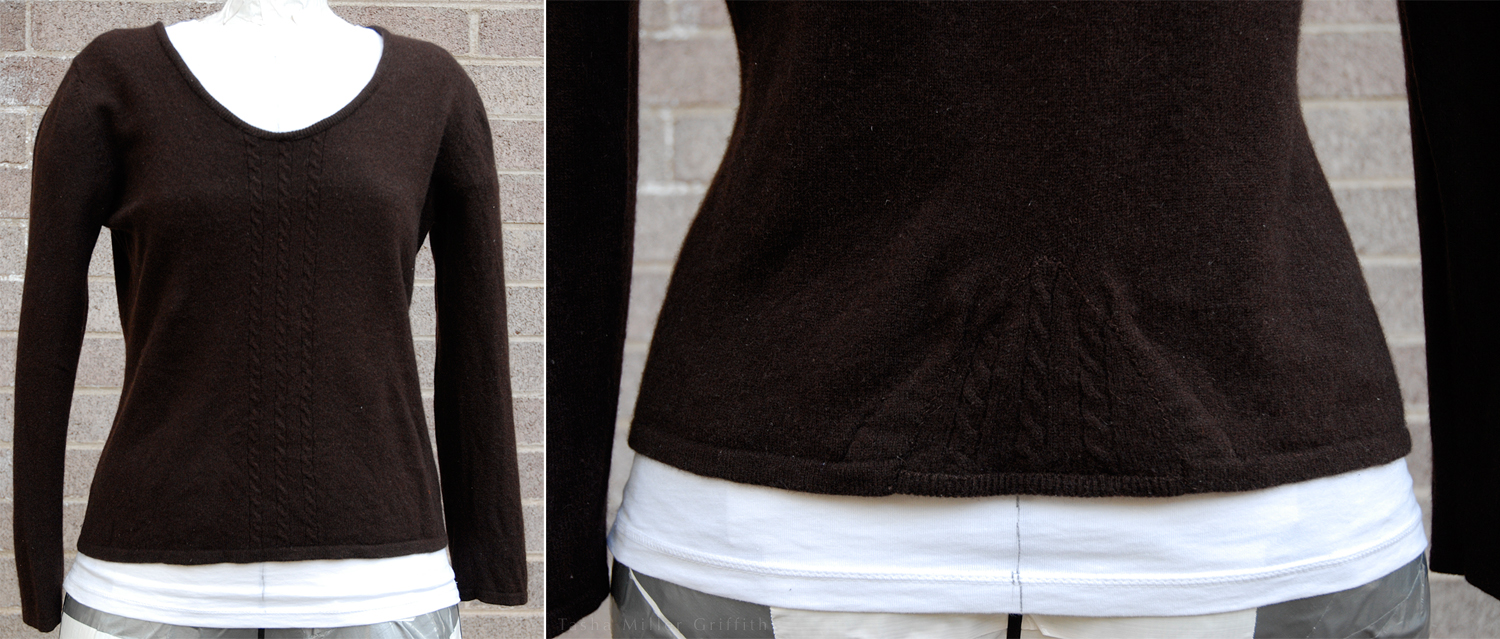
The first top I found this time was a women’s size large, with a pretty awful turtleneck, but in a nice brown cashmere. There just wasn’t enough fabric to dramatically reshape it, but it definitely needed a new neckline, and some ease around the hips (not a surprise to my pear-shaped self). I decided to take a wedge of the cable pattern from the old neck, cut a slit at center back, and splice it in.


brown winter top alterations


This worked—and I learned a few things. Probably the most obvious thing is that the wedge can’t be too large, unless you want it to ripple like a little peplum. I ended up folding in the sides and sewing them down again to make a flat wedge. It doesn’t look perfect, but I was experimenting. If I did this again I’d also add a little more pull-in factor to the neckline, probably with some slightly stretched clear elastic in the neck seam. But the biggest issue with this shirt is that it just isn’t that flattering. It fits OK, but I’m aiming for better. This one found a good use as my new winter sleep shirt.


brown winter top on form


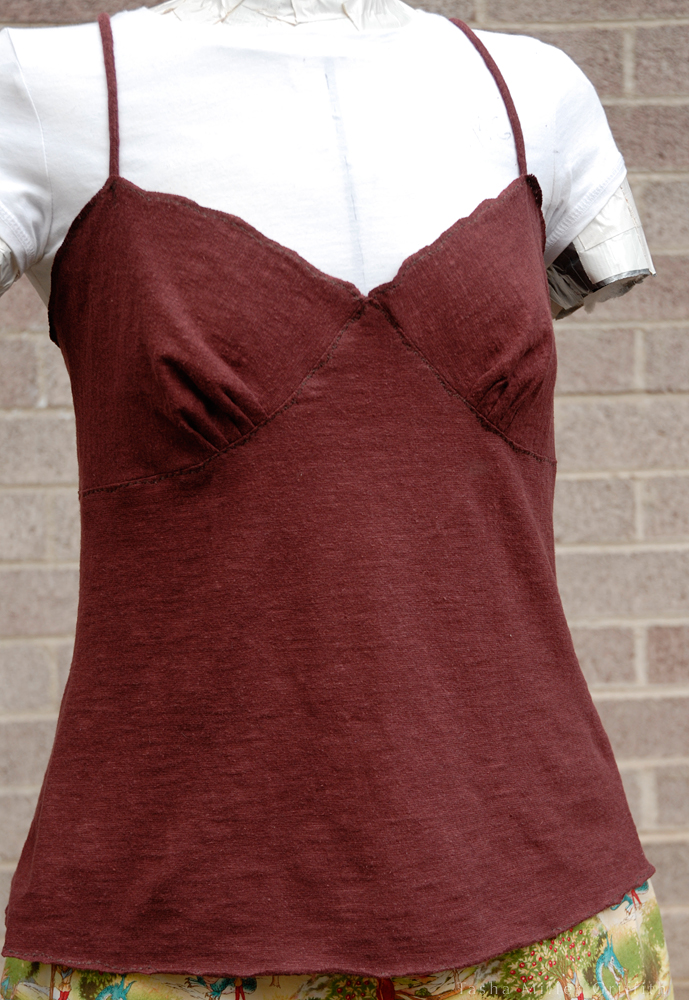
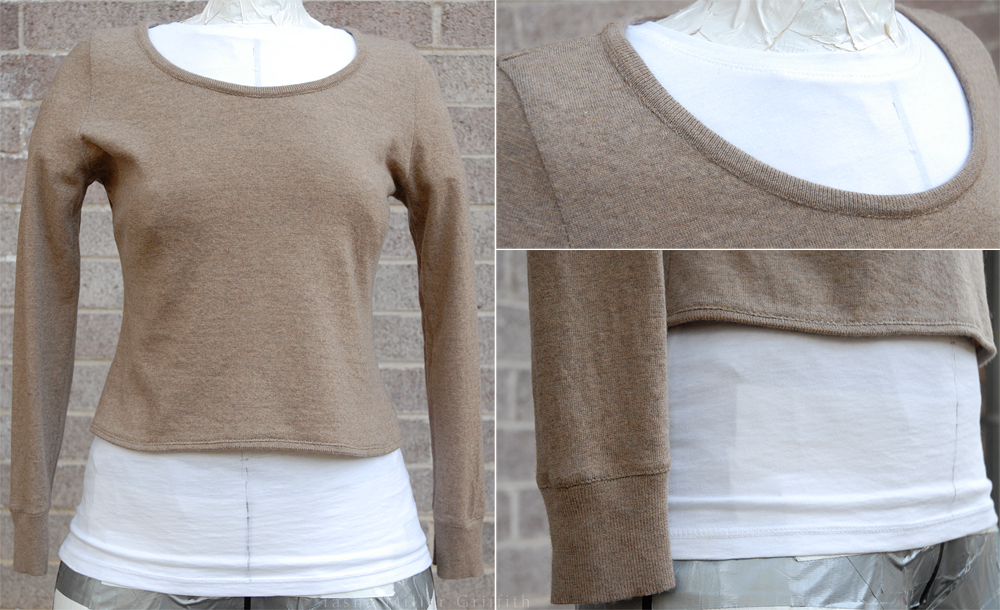
The next top I found to use was a little bigger, at least big enough to cut out new pieces from it. My favorite part about this one is the fabric; it’s Merino, and just the perfect amount of stretchy, cozy, soft and wooly. If I could buy a bolt of this I probably would. This top came out quite a bit shorter than I’d like (again due to lack of fabric—by the time I cut the old sweater apart and put the pieces for my regular knit top pattern on it, this is what I got), but I’ve been wearing it all the time.

I played with the ribbing on this one a little more, cutting and sewing lengths from the original hem ribbing and treating it more like elastic, stretching it to sew around the neckline. That worked well, the ribbing on these sweaters has a tighter structure, and I suspect some added stretchy fiber that makes it behave quite differently from the rest of the garment. Sewing ribbing on things reminds me of the late 80’s, when my mom would order fabric by mail to make tops for us, along with coordinating ribbing in various colors. I wish I’d had a little more of the matching ribbing for this project, as it is the tiny hem on the bottom has to be encouraged to lie flat as it’s drying, otherwise it will flip up, and I had to baste it on before sewing to keep those little bits in place.


tan winter top on form


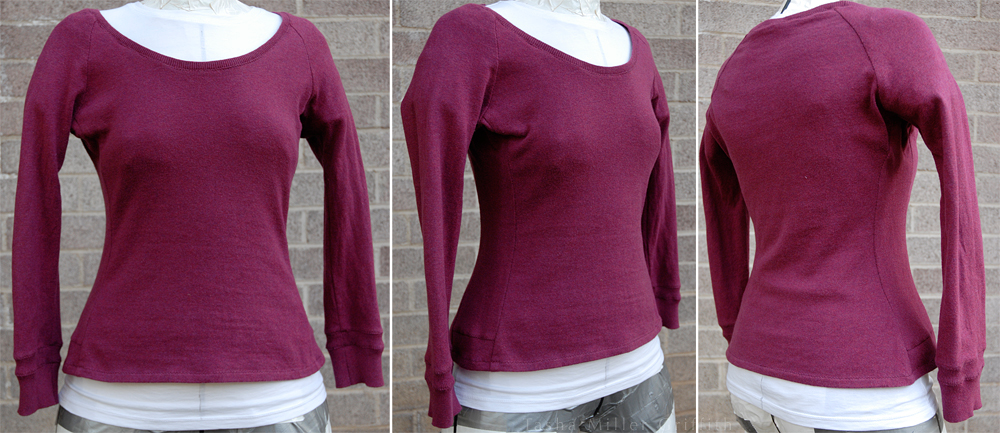
I’d been thinking how, in order to fit my figure better, I really need more seams, even in a knit fabric, than just one at each side. I love princess lines, but I thought that traditional ones would be more structure and more of a closely fitted, formal look than I want in a knit top. I was thinking of making a curved panel at each side, when I realized that I already have a top/sweater like that, it just fits a little looser than I’d want for this. So, I tried it on and pinned out the extra to get a fit I liked, traced a new pattern from the old one following those modifications, and cut it out.

This berry colored top was my most frustrated moment in this batch of upcycling. It came from a men’s XXL sweater in “cotton (90%) cashmere (10%)” which I went for despite the fiber content, going on color and the fact that I could definitely treat this one as a “muslin.” At first I was kind of miffed that even starting with a sweater this big, I couldn’t cut the sleeves long enough and I had to piece the side panels … but as soon as I gave up wanting it to work out “right” and embraced the experimentation and improvisation of working with recycled materials, suddenly it was fun again.

I really like the ribbing on the side panels, but the double sleeve ribbing came out wonky no matter how you look at it, the back neck has too much ease, making it slide off one shoulder sometimes (again with the 80’s), and the whole thing has all the baggy/low-recovery properties of thick cotton knit. However, it’s good to have at least one top that I don’t really care what happens to, and I brought it on the road for that purpose, it’s great to throw on in the truck etc.


berry winter top on form


I’m also having an ongoing thought process about the difference between fit and flatter. I want things to fit well, as in to harmonize with my shape—but maybe not to hug every curve. Sometimes if I aim for enough ease to really skim my hips it ends up emphasizing my pear shape instead, in a way I don’t find flattering, especially if I don’t also add ease around the bust. Also, if I curve a back seam in enough to fit close around my waist, the amount of curve required to flare it back out again over my hips is not really workable or looks a little crazy.

With that in mind, I cut the last shirt a little less curved in at the waist and out at the hips in back. I also added a side seam, mostly so that I could cut set-in sleeves (doesn’t save as much fabric as I thought it would vs. raglan) and set them in flat, then sew the side seam and underarm in one go, which apparently I like so much better than setting in knit sleeves in the round that I’ll do extra pattern tracing to get it.

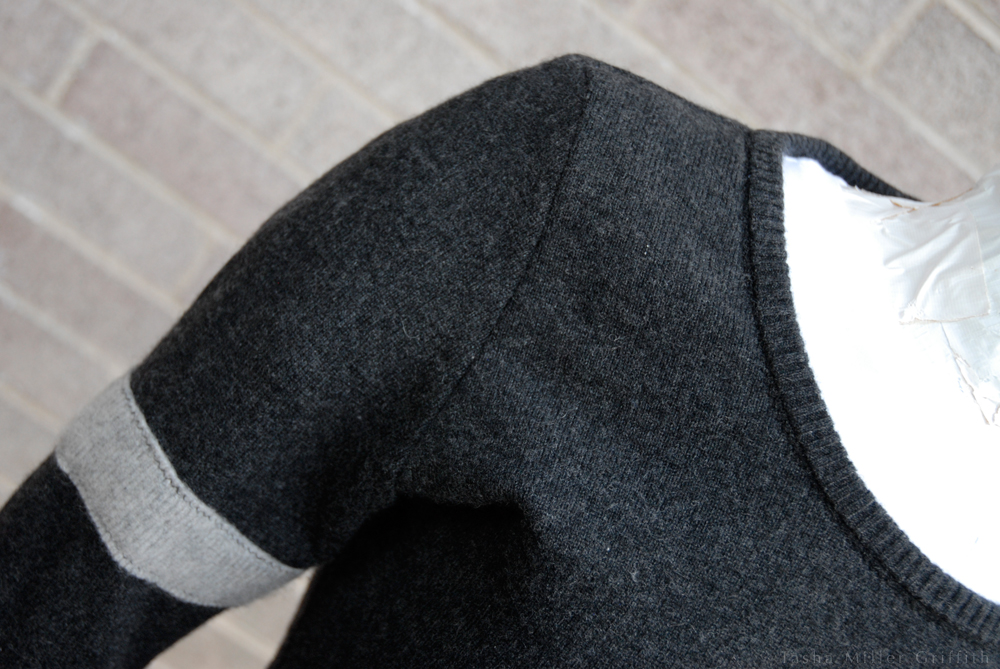
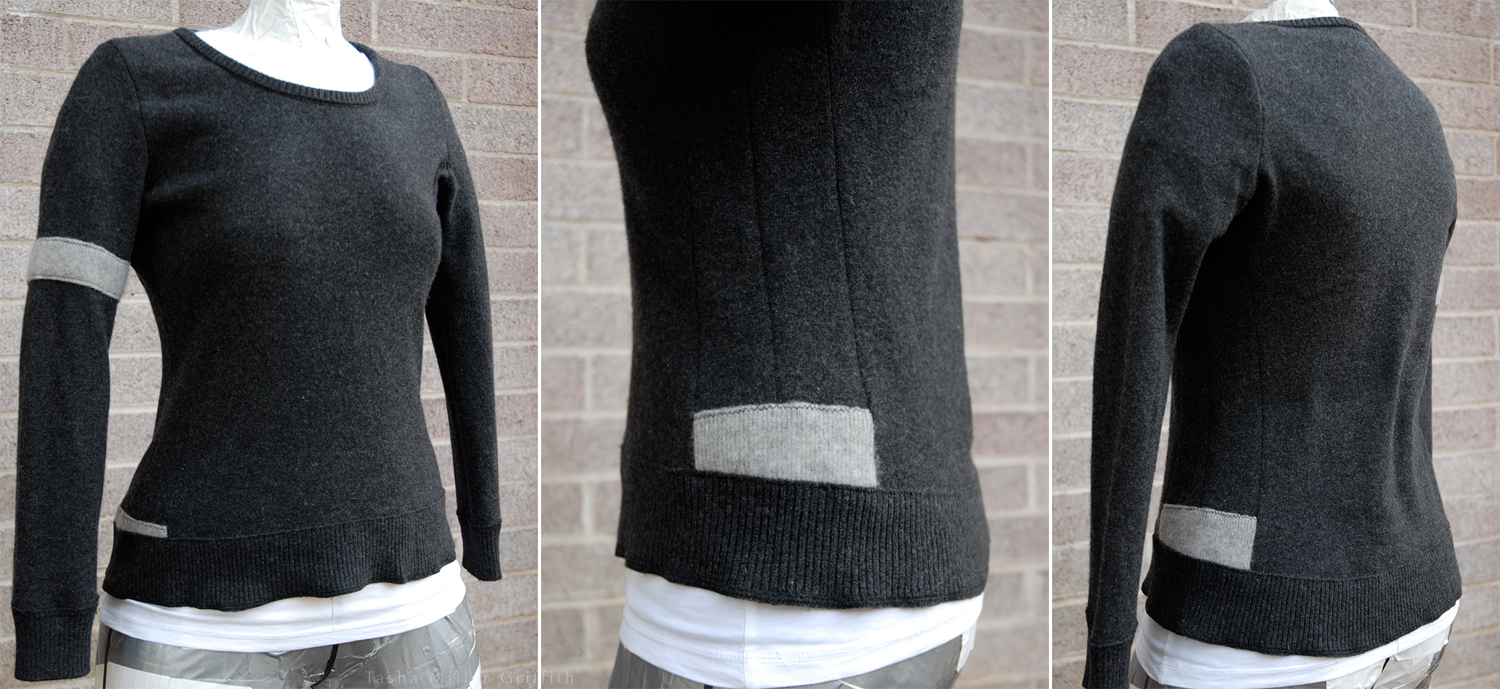
I’m so happy with this last top. I dig the length, the slight high-low hemline, the side panels, and even the lighter accents (piecing again). And the bottom ribbing! This is every single millimeter of the ribbing at the hem of a men’s XL cashmere sweater (a bit frightening) and it’s just right. I flipped it over so that the original seam is at the bottom, so if anything it flares out a bit at the hem rather than cupping in. It hugs in just enough to feel cozy without riding up too much—like the dream of what ribbing could be on my figure. I’m still undecided about the extra fabric around the small of my back. It’s definitely a bit baggy there, but is that a bad thing?
 

grey winter top on form


Since I had to piece in a little lighter grey scrap at the side panels, I decided I should also add some to at least one arm to make it look purposeful. I also decided, after the berry ribbing, to make a real effort at getting the two knits to play well together, rather than sticking them under the machine together and hoping for the best. I tried sewing with tissue paper under the bottom layer (inside the sleeve) and it actually worked really well. However, I’m not in love with trying to position the paper around the free arm inside the sleeve, or with picking out tiny bits of tissue from the seam, so further experiments are still necessary.


grey winter top detail


I may have to go for another round of cozy top upcycling at some point, I’m getting kind of fond of the built-in matching ribbing. Although, I think I should resign myself to the need for an extra sweater for every couple finished tops, one to one just doesn’t quite work. And then, since I can’t be nearly as efficient with layout as I could with the same amount of raw fabric, it feels a little wasteful to cut up a shirt which is really perfectly good as it is … unless it has holes in it etc. So there’s a Holy Grail of thrift shopping, as if finding huge sizes in quality fibers wasn’t hard enough, now I need two or three that all coordinate with each other or with another one for extra fabric, preferably damaged! Maybe I’ll just order some nice fabric next time …
 

Fixing Store-Bought Socks


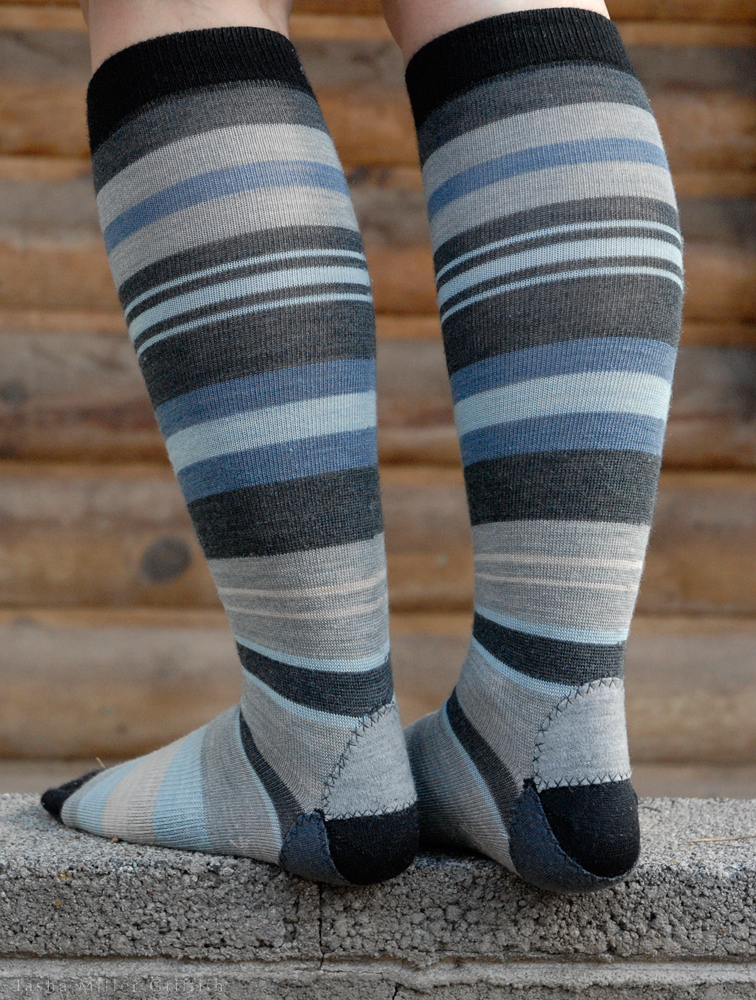
fixing blue stripe socks 3

Isn’t the phrase “store-bought” kind of funny when you think about it?  Maybe I should have said mending “factory-made” socks?  Maybe not, that sounds weird too.  Fixing “non-me-made” socks … never mind!

Anyway, I get a little depressed any time our society expects me to get rid of something which is mostly perfectly good, but has one flaw/broken part/hole/mold on just one corner.  Although I do accept that there’s a point at which socks are well and truly worn out and need to go, what happens to most of mine is that they develop one or two really worn places somewhere around the heel first, while the rest of the sock fabric still seems totally intact.

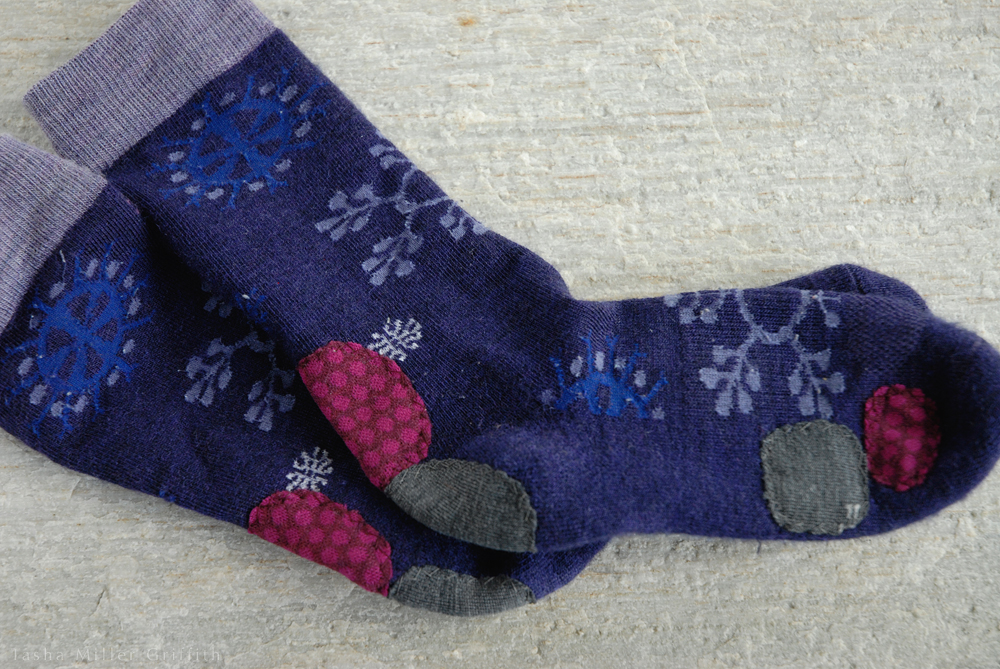
The really tiny gauge which commercial socks (I might like that phrase best so far) are knit in makes it hard to darn them in the traditional needle-and-yarn ways.  I’ve been experimenting with patching them, using compatible knit fabrics, and it’s been working well.  Experimenting over some time now, so please forgive the different lighting in the photos, I’ve been documenting the socks as I fix them.

As most of you reading probably already know, I love the idea of “visible mending”, of showing the world that I fixed something and I’m using it.


So, should you have the audacity to mend a store-bought sock, here are some things I’ve worked out:

The fabric for the patches should be similar to the socks: knitted (stretchy) and fairly sturdy.  I’ve been using wool knit fabric swatches, scraps from making these leggings, and parts of other socks.  Although I’ve been seeking out wool patches, I think cotton knits would work too, as long as they are fairly thick/tough.  Check that the care requirements for the patch fabric work with how you wash your socks (I usually machine wash & line dry mine, occasionally they go through the dryer, and the wool patches have worked fine for me).


patched purple hobo socks


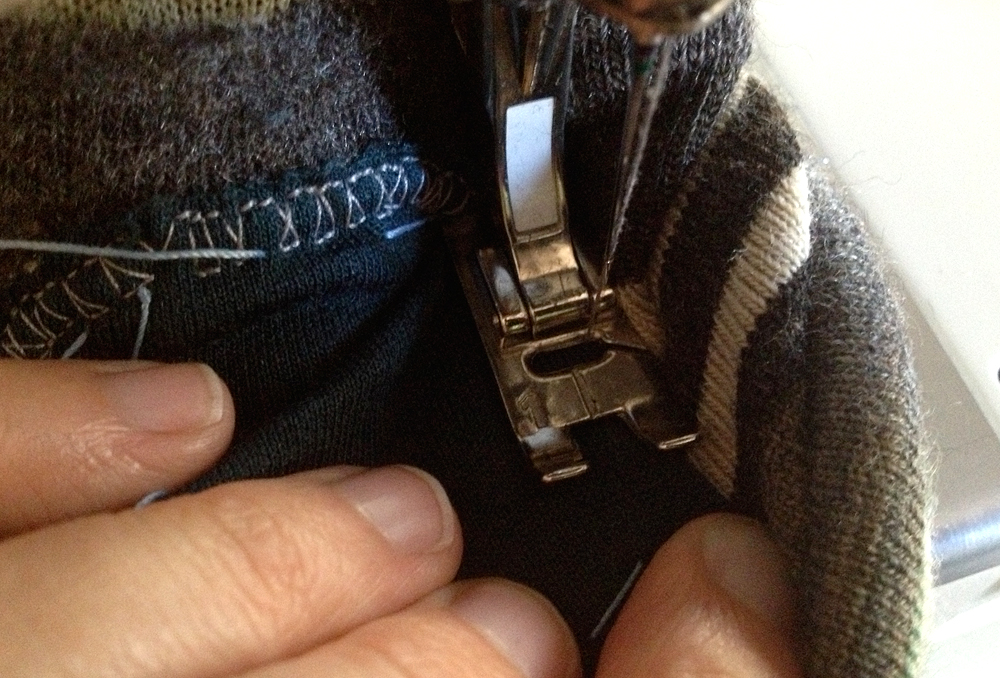
sock under machine It’s totally possible to mend shorter socks with a sewing machine, any time that you can scrunch the rest of the sock out of the way (kind of as if you are turning it inside out), so that just the layers you want are under the foot of the machine. I used an overlock stitch for maximum stretchiness & sturdiness.  As with any knit project, you may need to experiment a bit to figure out which stitch and settings work best.  Expect to do a lot of lifting the foot with the needle down and repositioning things while sewing on the patches.  You can cut down on that somewhat by basting the patches on first (takes about 30 seconds).


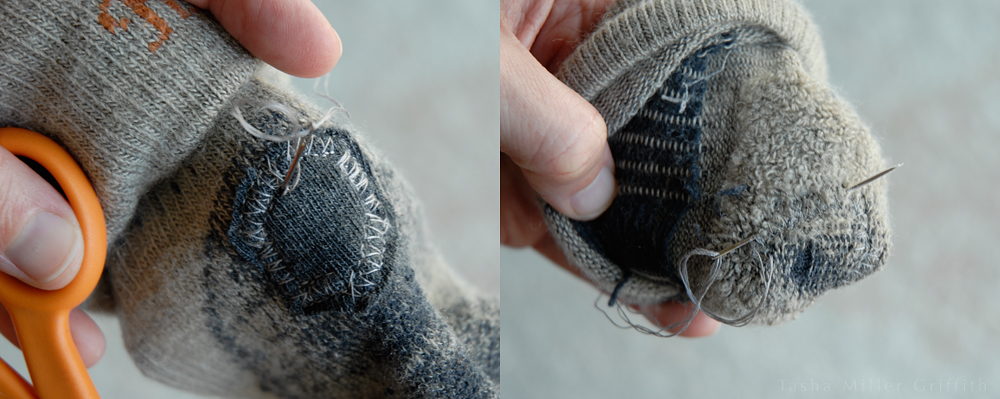
When the patch is done, I finish by getting all the thread ends to the inside, and burying them before trimming, using a hand sewing needle.  You can also trim the edges of the patch outside the stitching if they come out funky looking.


thread ends fixing socks


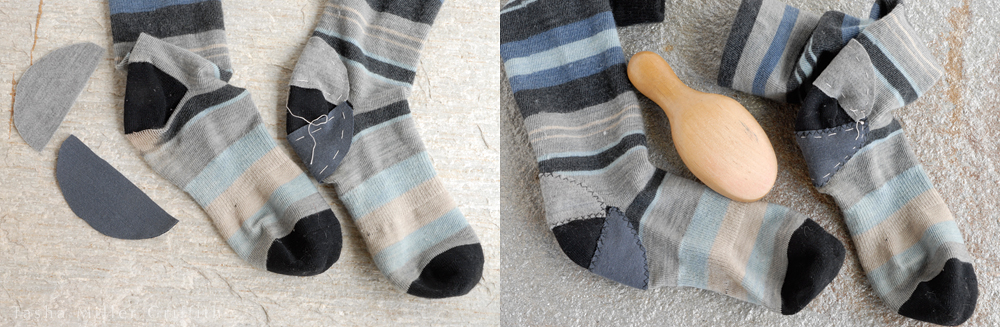
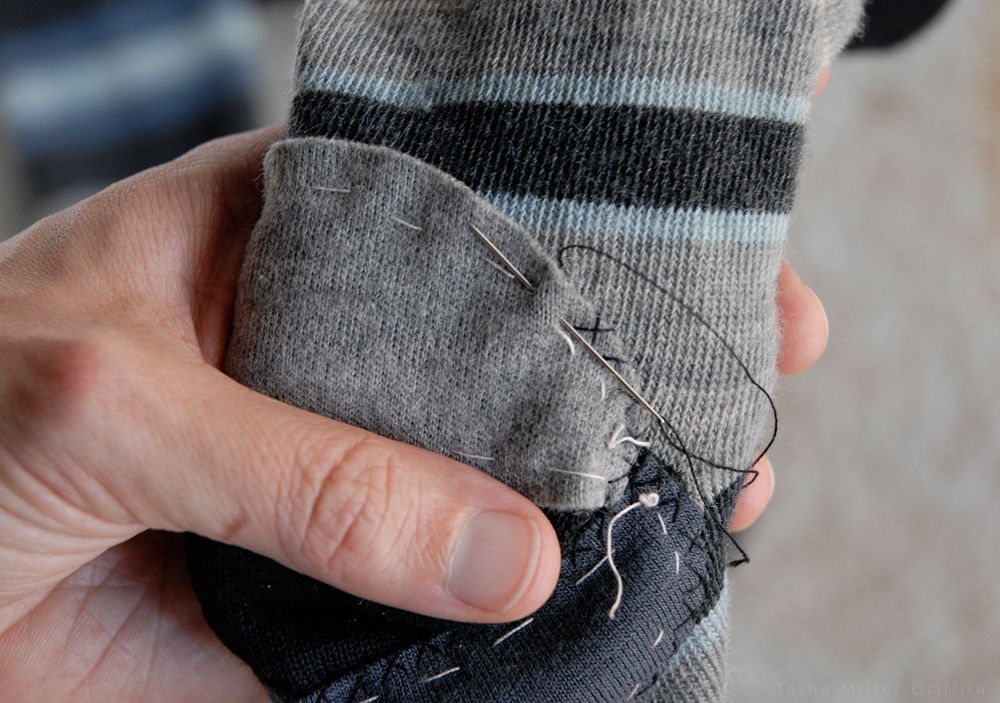
For heels and toes of knee socks, and any time I can’t easily get the part of the sock I want under the machine, I find it just as easy to sew the patches on by hand.  (I like hand sewing, and I don’t like fighting with my machine.)  I’ve been using a catch stitch (explained in more detail here) around the edges, sewing through both the patch and the sock when possible.  An old-fashioned darning egg (or improvise with a small block of wood etc.) inside the sock is so useful here that it’s almost essential, making things much easier by assuring that you only sew through the layers you want.


fixing blue stripe socks 2


fixing blue stripe socks 1


For either method, cut the patch definitely bigger than the worn place/hole, otherwise it will quickly wear right along the edge of the patch.

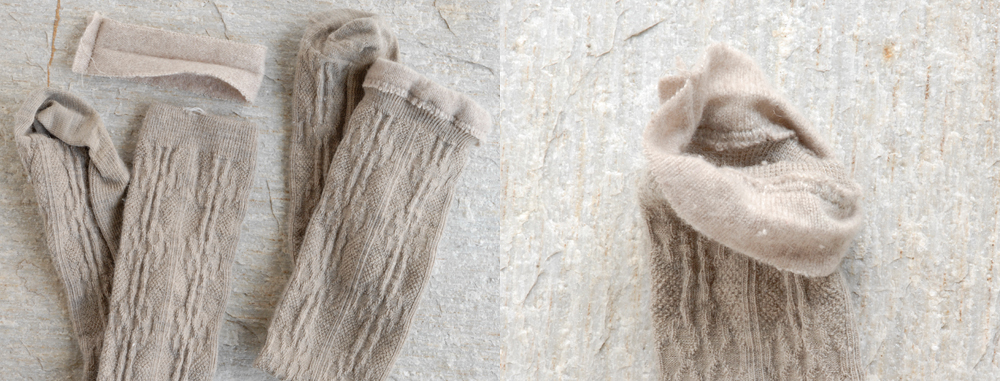
  For cuffs, you can use a scrap of ribbing to cover worn places and/or make a new cuff.  Make sure the ribbing is long enough to stretch around the widest part of the leg which the sock will go around.  Mark and sew the ribbing together, then stretch it evenly around the sock.  I find it’s easier to sew two seams, one on the inside and the again around the outside edge of the ribbing, than to try to catch both edges perfectly in one seam.


fixing sock cuff


Both my hand- and machine-sewn patches have worn well, adding a year or more to sock life, and lasting until the rest of the sock fabric gives up the ghost.


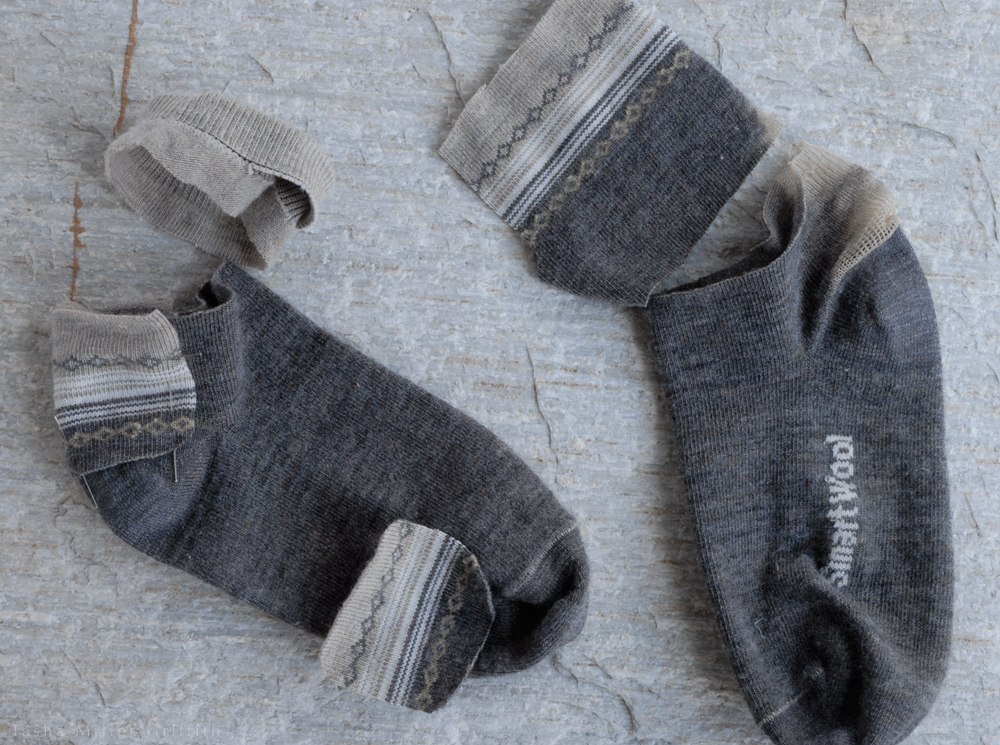
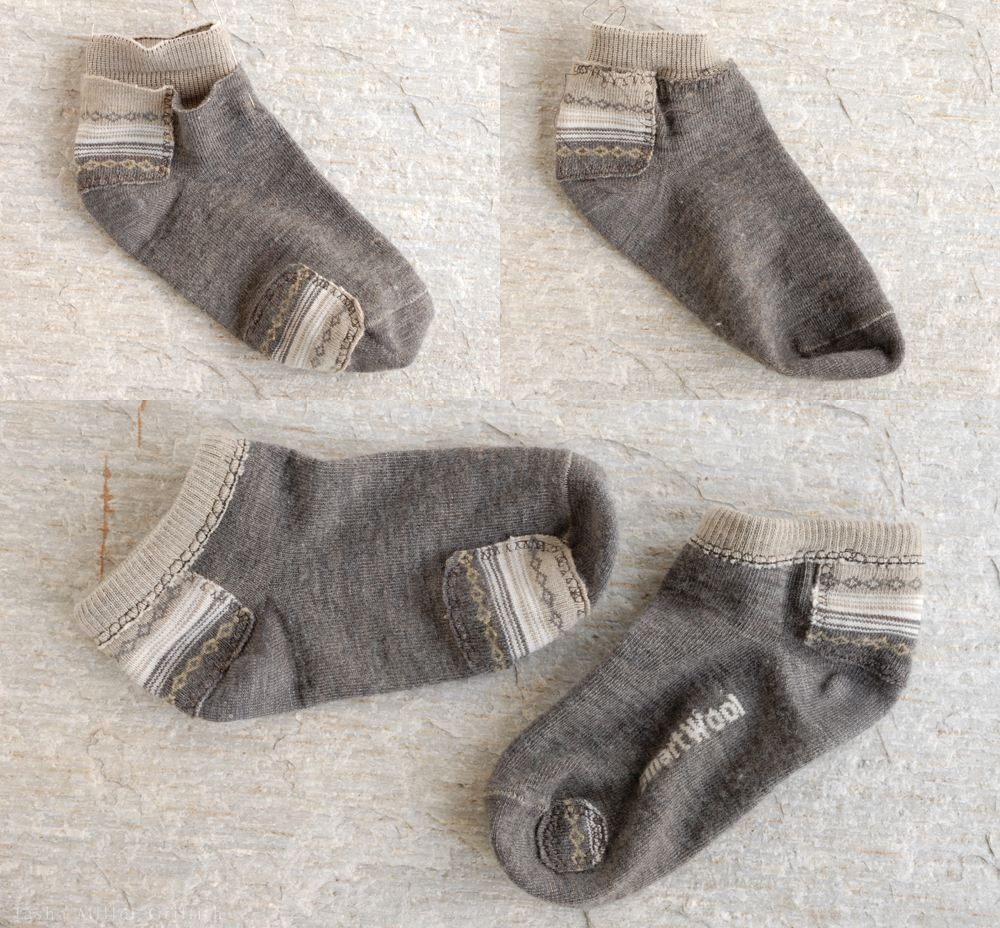
The socks below I didn’t even mean to fix, but they ended up being some of my favorites.  They’re the ones I wear in the summer when we’re setting up the booth.  I was going to buy new ones, but in the end I couldn’t bring myself to spend real money on new socks for such a humble purpose, and I knew cheap socks would wear out super quick under those conditions.

The new short length is perfect for when it’s hot but I still have to wear shoes, and I love seeing my little mended socks during what can be a stressful situation.


mending set-up socks 1


mending set-up socks 2


Finally, just in case you’re thinking that I have a magical house where socks are fixed as soon as they develop holes, let me tell you, it ain’t so.  I’ll admit that I tend to let them pile up until my sock drawer is looking sparse, and I’d forgotten about the very existence of some of these by the time I got around to mending them … when I start to run out of socks that don’t need fixing, then I settle down and do one or two pairs a day until they’re all fixed.

Happy mending!