Things I’ve Sewn: Blue Stripe Trousers


blue stripe trous and wool knits 1


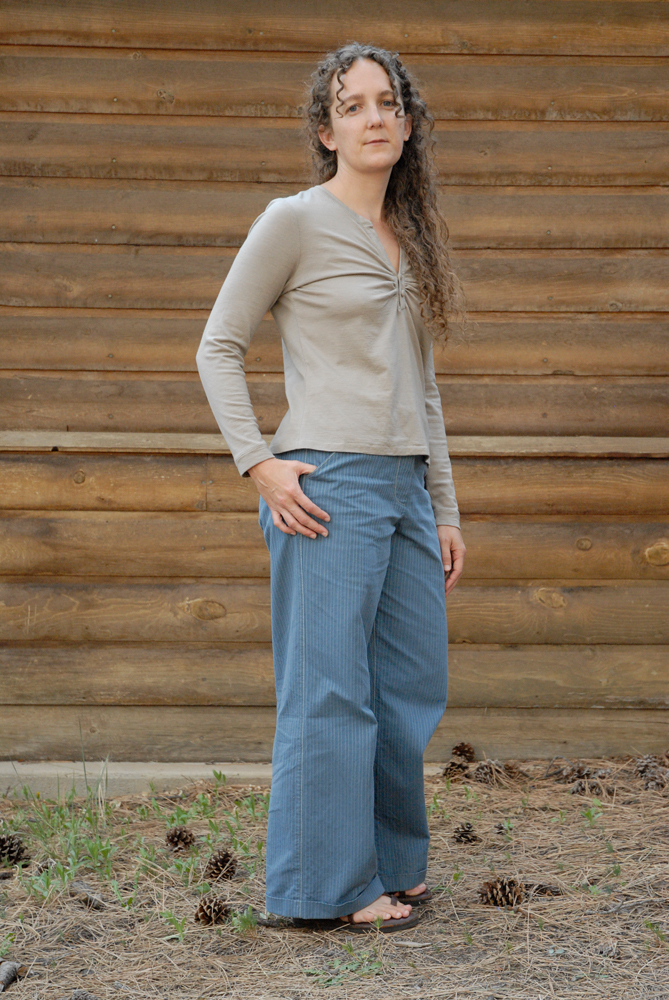
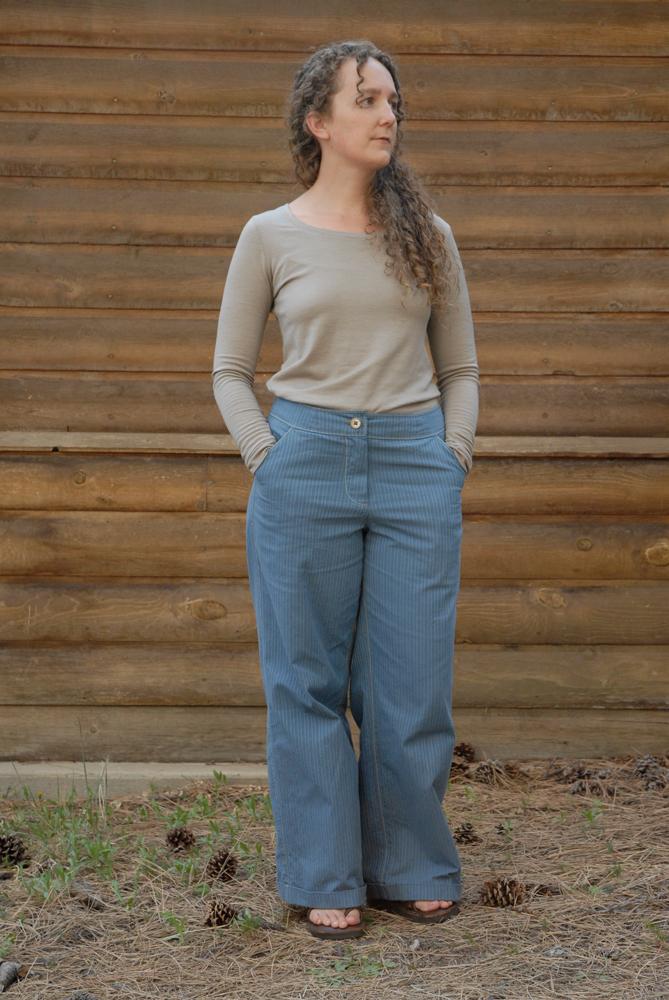
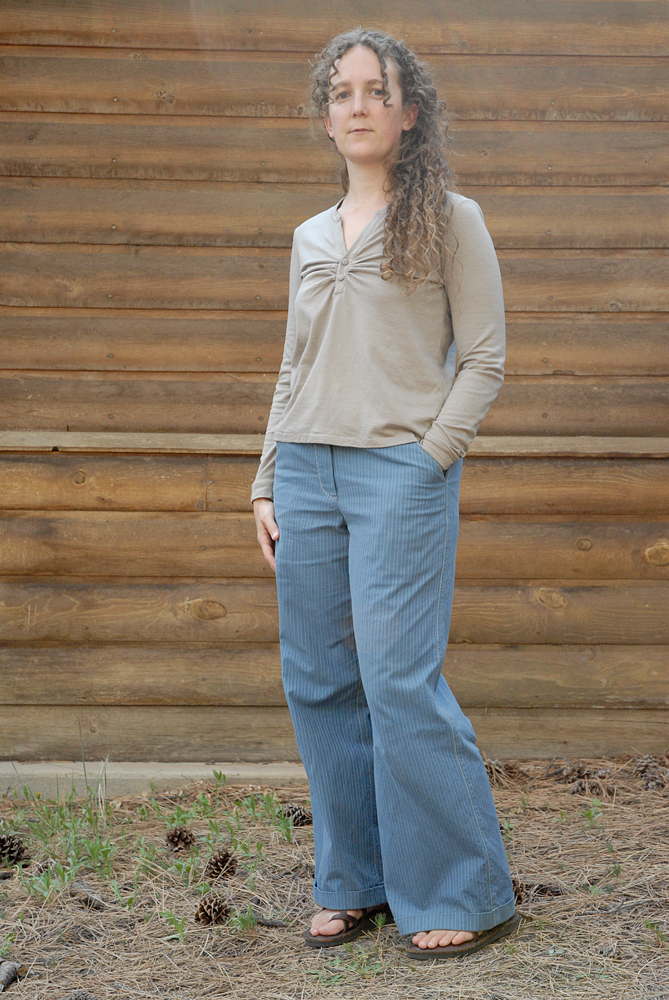
So, after talking about these tops last time, it’s time to talk about the pants!  They’re more of a trouser style (which is good since folks on both sides of the pond can agree what “trousers” means, right?).  I bought this fabric last summer at Nob Hill Fabrics in Albuquerque.  I wasn’t 100% sure about it for trousers, but it looked promising.  In truth, I am not 100% sure about it for trousers now.  But, after the untimely demise of my fantastic purple corduroys (so sad!) I really needed a new pair of pants nice enough to wear at shows (in public where I am supposed to look somewhat professional, or at least not like a bum off the street).  The odds of my finding a pair to buy that fit and that I like are close to zero, so I pulled out the blue fabric.


A pattern epiphany

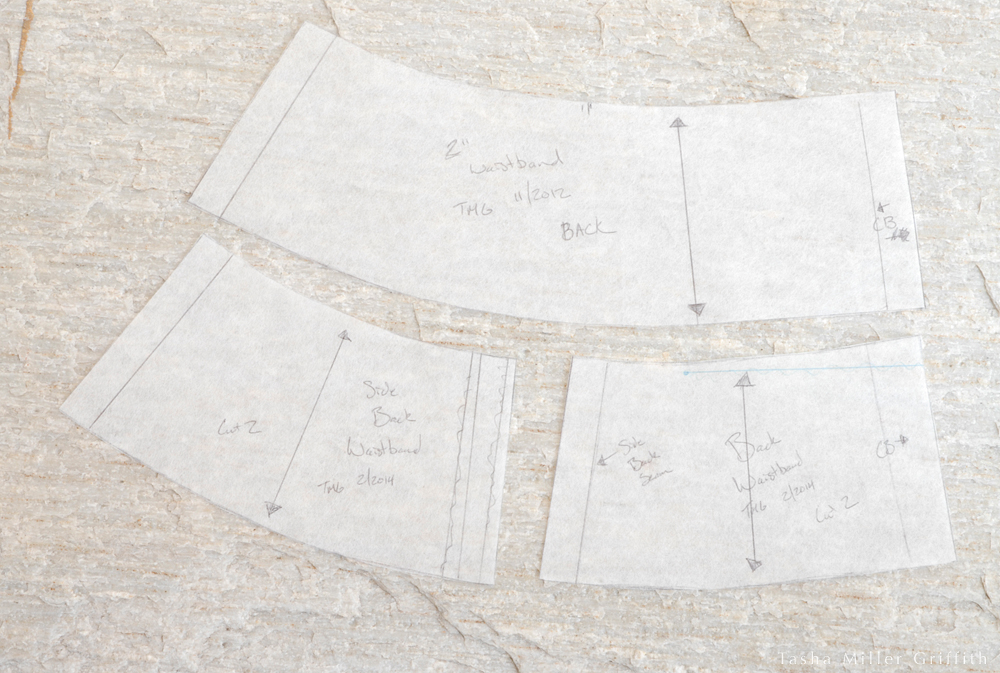
While I was cutting it, something pretty cool happened.  As I looked at the back waistband pattern, I got a sudden flash of insight: this piece is trying to take in too much curve, and it would be much better as two pieces, with a seam in the middle as well!  So I traced it into two pieces which matched the existing width at the bottom of the waistband, and took in a little more at the top.  If you do this, don’t forget to add seam allowances to the edges at the new seam!  This approach fit the shape of my body so much better that I ended up doing the same thing on the front, so that I now have four waistband pieces instead of two.  A step forward in fit.


pants waistband back pattern pieces


Fitting

This is the next evolution of the traced from-existing-pants-and-extensively-altered pattern I used to make the grey pair.  The main problem with those is that they are a little tight around the crotch seam, especially when I sit down.

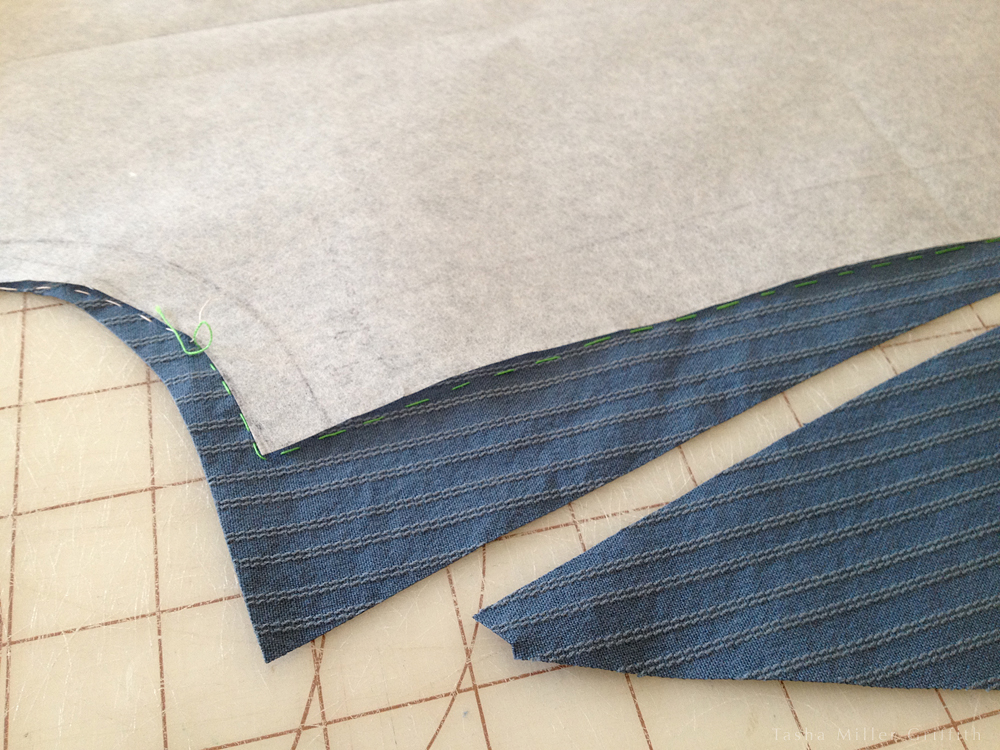
I will say that I’ve gotten a lot better at diagnosing what needs fixing in the fit of my trousers in the last year or two.  At first, the fact that every part of the fit affects every other part made it nearly impossible for me to tell what I should change.  But now, after fitting a few pairs, when I try some on I can feel which seams need more or less fabric in order to be comfortable and fit my shape.  So I already knew (from wearing the grey pair) that I needed to let out the front inseam a fair amount.  I wanted to cut the fabric outside of the pattern to make sure I would have enough in that area, so I decided to trace with thread the outline of the pattern.  That way I’d be able to see where my new seam is in relation to the pattern, and transfer my changes back to it for next time (I can always add more paper to the pattern using this method).  This worked great, I could see right where the pattern line was as I worked on the fit.


blue stripe trous cutting inseam


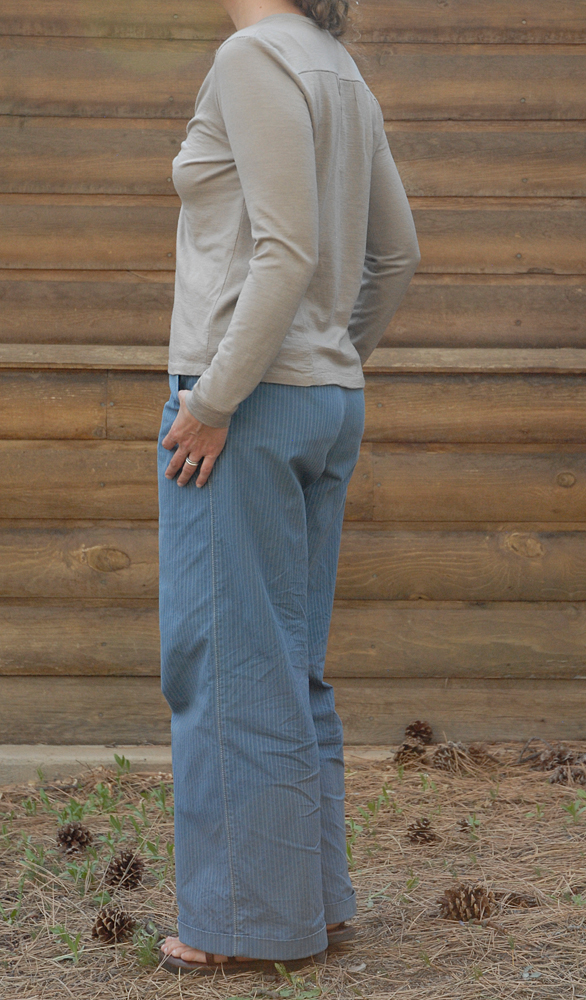
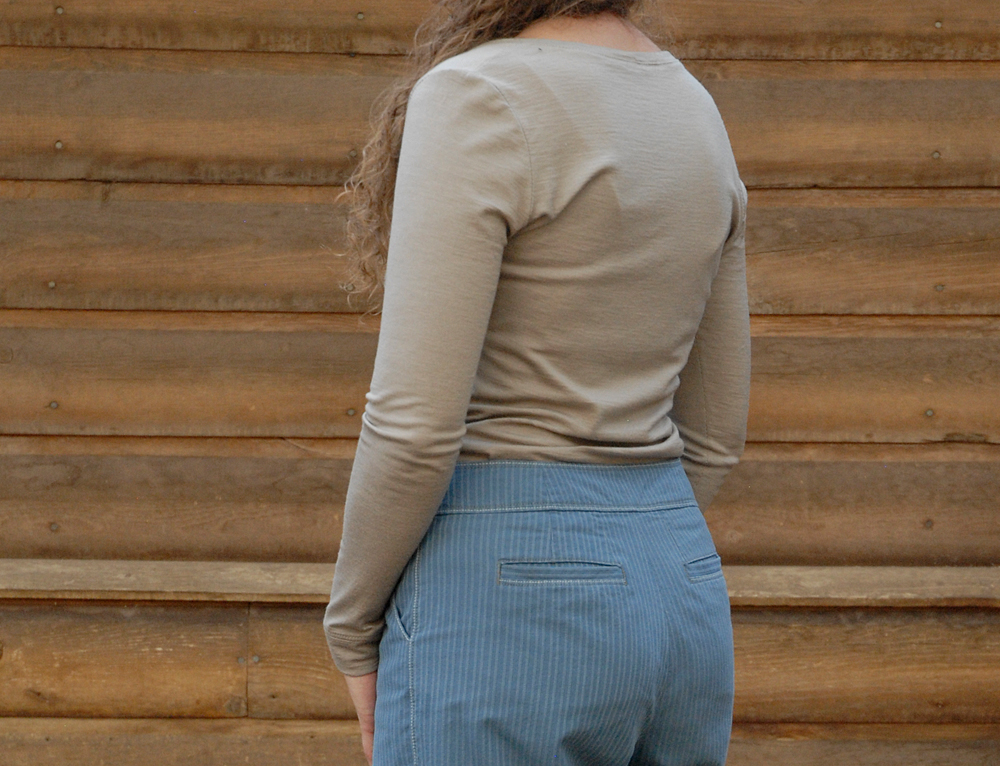
So, I let out the front inseam until it felt comfortable, and then played around with the crotch seam and back inseam to get the look and fit I wanted.  I want the trousers to show that I have a bum, without hugging it too tight, and then drop into a wide leg somewhat reminiscent of 30’s style.  I got pretty close!  To be honest, I may have overdone it on the amount of added room around the inseams, these feel so comfortable that they border on I’m-wearing-my-pajamas-outside.  But when I put them on and sit down it’s sooo nice!


blue stripe trous and wool knits 3


Those back pockets

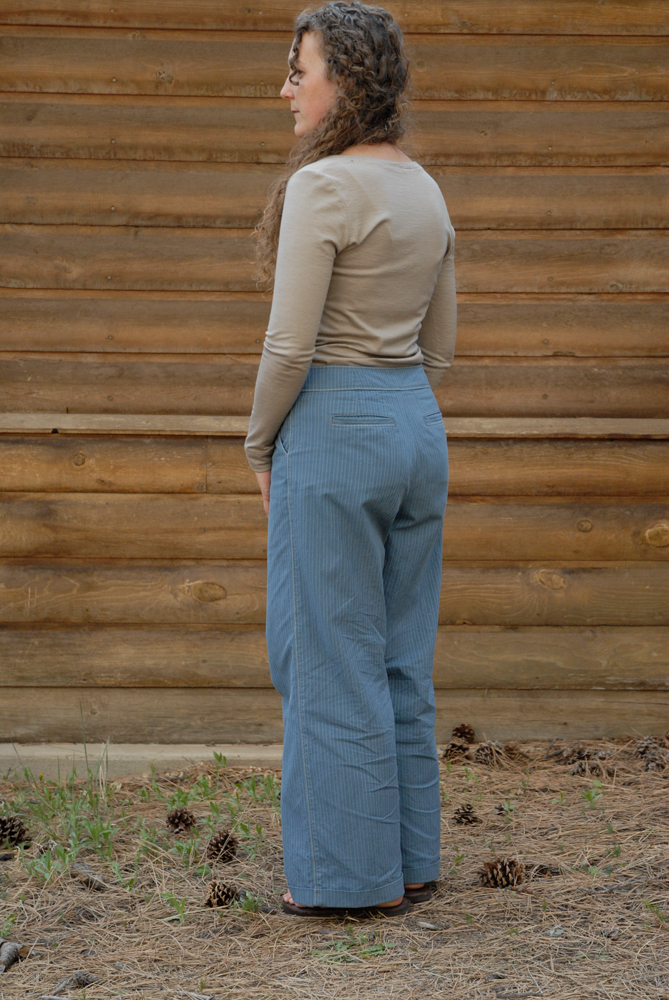
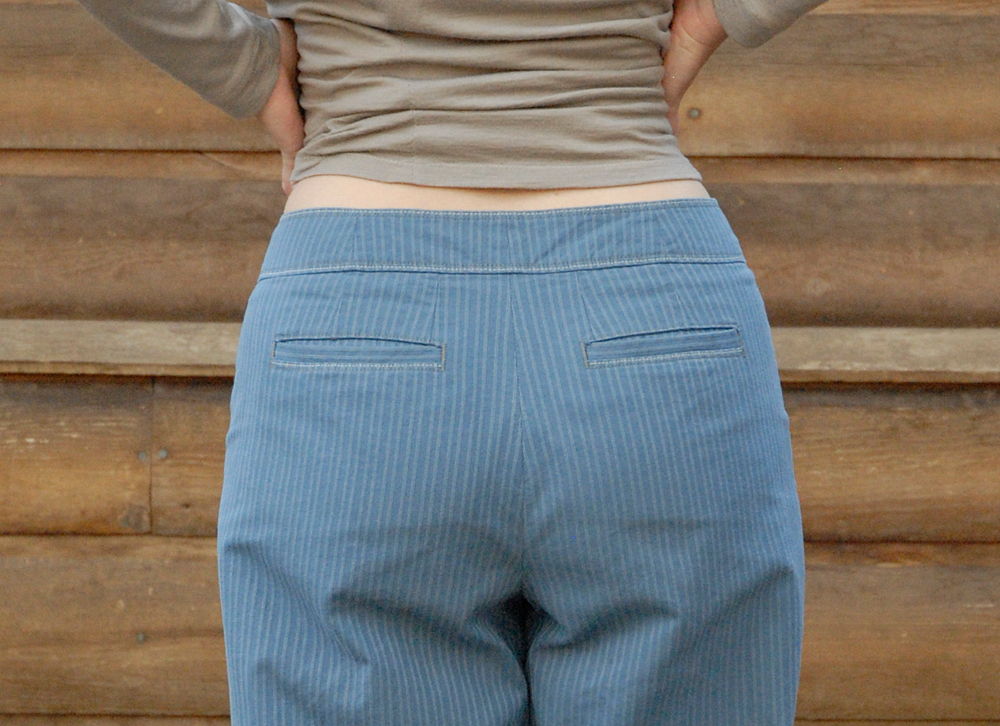
The back welt pockets are pretty sweet, yes?  This is something I’ve really been wanting in trouser-style pants.  I have one old pair of thrifted Gap wide-leg pants that has them, with little flaps on top too, and I love them.  I almost skipped them for this pair though, just because I was running a little short on time before we left for Texas, and I really needed to get these trousers done.  You know how sometimes, these decisions are made for you, just by the circumstances?  Well, as I got close to finishing the fit, two things became inescapably apparent: I could not figure out any way to get the tips of the back darts to look good (hidden by patch pockets in earlier pairs), and under some conditions, you could see the line of my undies through the fabric.  So, pockets it was, and since patch pockets don’t go with the trouser style I wanted … I basically just kept those Gap pants next to my sewing machine and figured out the steps from looking at them inside and out as I went.  Fortunately, I didn’t hit any major snags.  I have to admit, when I first tried the trousers on after finishing the pockets, my reaction was “no one told me they would look THAT cool!”  I have a few tweaks to make next time, but overall, those back pockets are probably my favorite thing about this make!


blue stripe trous and wool knits 5


Fabric verdict

I had a hunch when I went to add the pockets that it wasn’t the fabric being pulled tight that was showing my undie-lines, it was the fabric being just a little thin and just a little clingy.  I was right.  Now that the pockets are in, you can see that there’s plenty of room for them.  Sometimes you can see a shadow from the pocket lining, but that’s much better!

While this fabric turned out fine, next time I will look for some with just a little more body for making trousers.  I wouldn’t want it to be stiffer, just thick and soft enough to hold its own and skim over curves a little more.

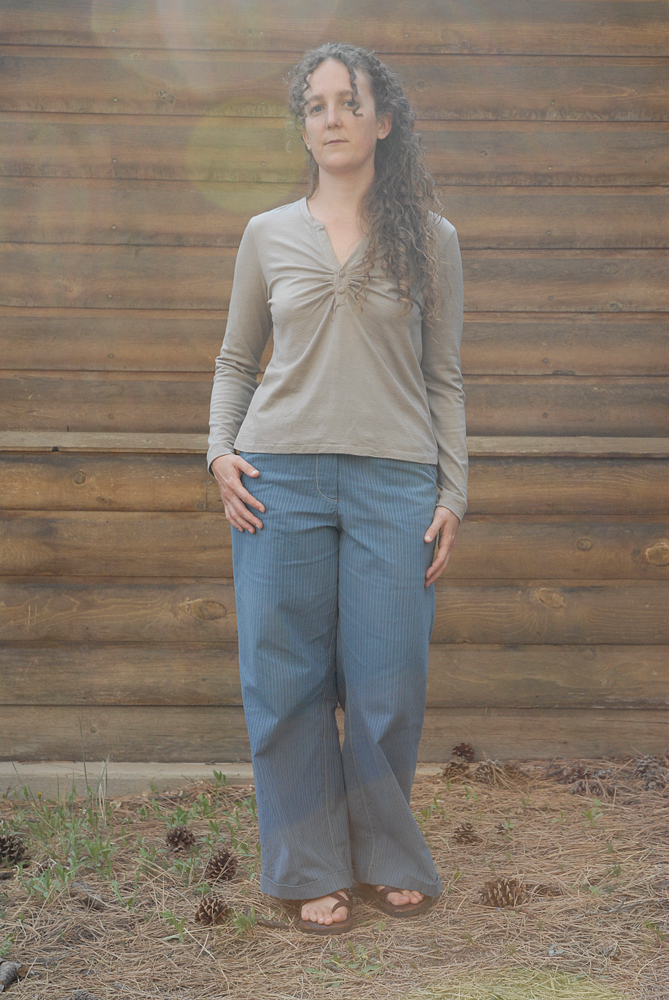
And, did you notice it wrinkles like all get out?  I swear, I pressed the trousers before setting up to take photos, but 10 minutes of adjusting the camera, kneeling by the tripod in the sun and moving around, and it was pointless.  I do think that wrinkles are less noticeable in real life than they are on camera though.


blue stripe trous and wool knits 7


Have I mentioned before that fitting and sewing trousers is a journey, not a destination?  (Hint: yes.)  I’m glad to get these under my belt, and to have a new pair to wear in public this spring.  Happy May Day to all!


Things I’ve Sewn: Merino Knit Tops

In which I find some truly lovely fabric.


blue stripe trous and wool knits 2


I’ve made a real effort to make the things that I really want to do (mainly creating for myself and for fun) a priority.  No matter what, (unless I’m so busy I can’t think straight) if I’m home, I’m working on sewing something.  And if I’m on the road, it’s knitting and drawing, etc.  So sometimes it surprises me when I look back at posts here and realize that nothing I’ve made for myself for a while is visible!  It’s time to catch up a little bit on sewn projects, especially with Me-Made-May’14 right around the corner.

I think I’ll talk a little bit about the tops here first (and save the pants for another post) mainly because there’s not a whole lot to say, except about the fabric.  Last fall, I stumbled into the fact that a fabric store called The Fabric Store, based in Australia, had just opened a store in LA.  This meant that a whole bunch of New Zealand merino knit fabric was suddenly within reasonable shipping distance of my house!  And, AND they had organic merino knits, something I have been searching for, as a way to hopefully buy wool which is raised responsibly.  (If any of the lovely USA-grown-made-processed yarn folks are reading this, some of you should mill some fabric!) Anyway, The Fabric Store doesn’t have direct online ordering, but if you call or email them, they will find out what you’re looking for, and send you several lovely cards of generous swatches.


blue stripe trous and wool knits 9What lens flare?  Clearly I am floating in a sea of magical bubbles …


I chose organic merino knit in the “mushroom” color, and I love, love, love, this fabric.  It’s soft, it has drape but it also has body, and great stretch and recovery.  There’s something substantial about it that just says “wool” (I love wool) and it has a subtle sheen to the right side which makes it look just a little special.

When it arrived, I was in desperate need of a few more long sleeve tops for winter, so I made a simple T-shirt style first.  In this fabric, my pattern (the same one I used for these tops) is just the tiniest bit tight/clingy (you can see my cami straps, which is not my favorite thing) but boy, it is a terrific layer for winter.  And spring—I’m wearing it as I type this!


blue stripe trous and wool knits 8


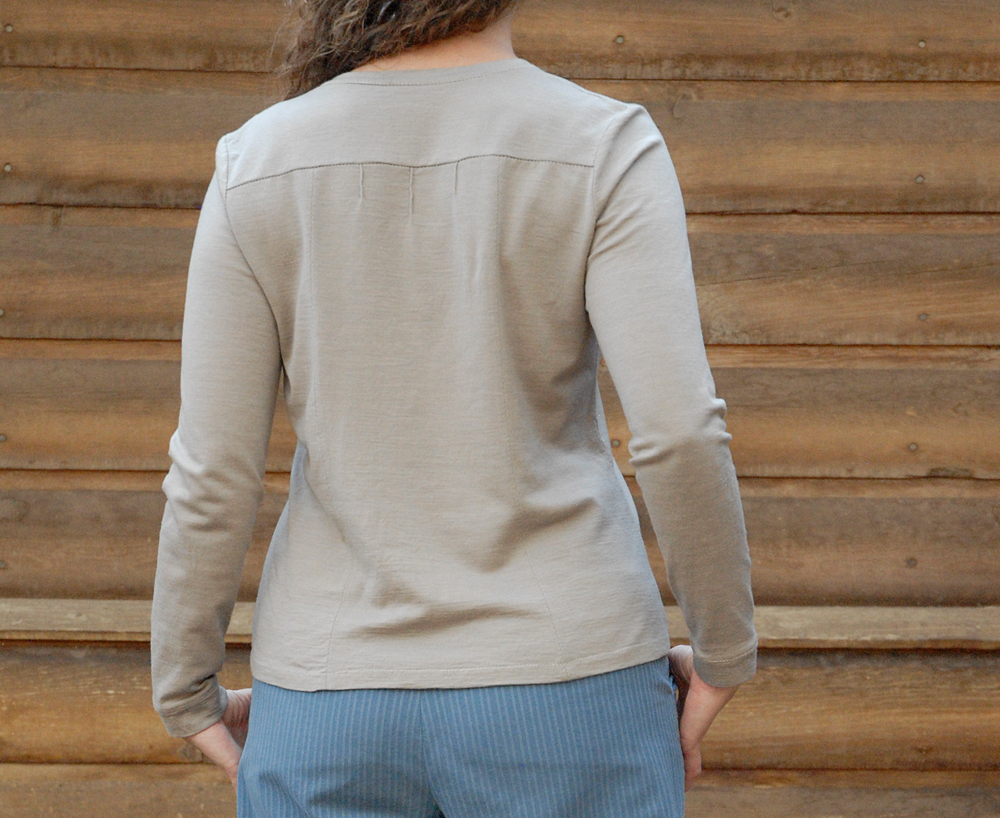
The second shirt I made just a little more complex, using another pattern that I copied from one of those lucky thrift store finds with fit and style I love.  In an ongoing experiment to see if I can get knit shirts to more closely follow, and still flatter, my shape, I tried dividing the pattern into princess lines in back, so that I would have two extra seams to add width over the hips.  If I do this again, I’ll curve the lines more so that they come in at the waist, and then out again, yes?


blue stripe trous and wool knits 6


And I have fabric leftover!  Somehow, despite an earlier failure to squeeze one uninterrupted long-sleeve knit top out of one yard, by careful placement and a somewhat generous cut, it looks like I will get 3 tops out of 3 yards of this.  I was debating maybe dyeing the last top’s worth, until Bryan mentioned that he liked the way this color looks with my skin.  That settles that—I’m looking forward to making another style, same color, this coming fall.

I wore this exact outfit, new top and pants, on both our way out to Texas AND my flight back.  It’s just really versatile, comfortable, and perfect for the varying temperatures of spring.  More about the pants coming soon!


blue stripe trous and wool knits 4


Recycle Fabric Scraps and Worn Out Clothes at Goodwill


fabric scraps for recycling


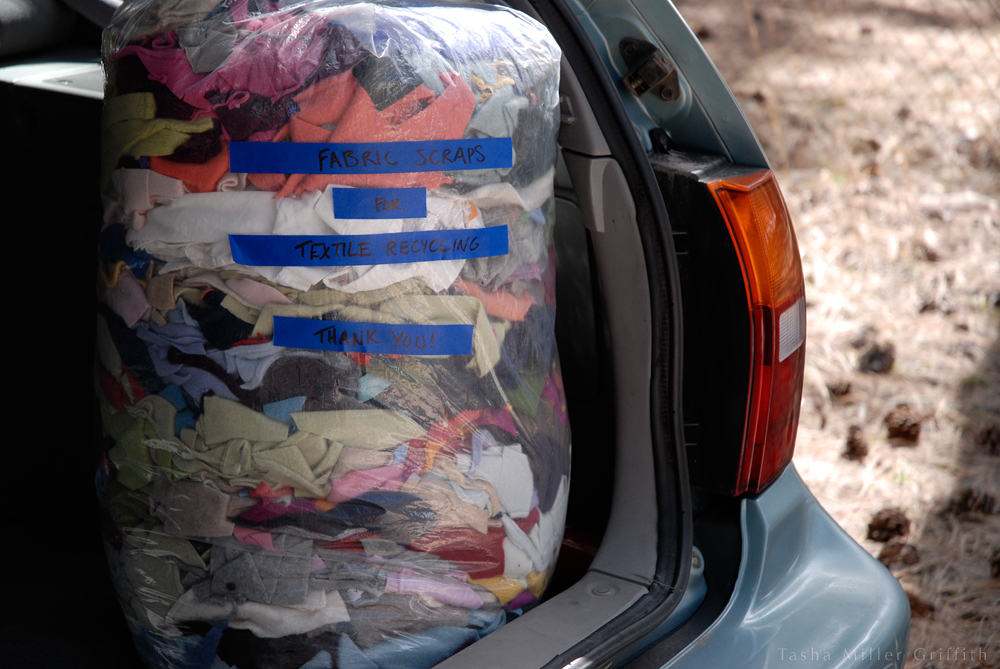
I like saving scraps of fabric from my sewing.  They usually come in handy for other projects.  However, there is a point when a scrap is just too small to be worth saving, and I don’t want to clutter up my storage space with tiny little bits.  On the other hand, I feel like the scraps are perfectly good clean fibers, and I hate to just send them to the landfill.

A while back, Zoe mentioned that in the UK, the charity she used to work for (TRAID) sent scraps on for textile recycling—to be turned into insulation and stuffing and whatever else uses short mixed fibers.  I wondered if any of the thrift shops on my side of the pond were doing the same thing.  I started saving a (large) bag of just the fabric scraps too small to keep, which took a surprisingly long time to fill up, considering it had all the scraps from this fall’s batches of Fiddleheads.  (Probably due to the fact that I can’t bring myself to part with any piece of slightly felted cashmere big enough to be remotely useful.  Want some cashmere pieces? Let me know!)  I also had a few garments that weren’t really fixable any more, but I figured had life left in at least some of the fibers.

I thought about contacting charity shops every once in a while, but basically put it off until the scrap bag was too full to ignore, and then sent out emails.  Good news, USA-dwelling, fabric-cutting folks: Goodwill will take your scraps!


This was my message:

Hello,

I have some worn-out clothing and fabric scraps which I don’t think a thrift store would be able to sell.  However, I would still like to keep them out of the landfill!  I know that some thrift stores pass on worn out clothes and scraps to recyclers so that they can be remade into something else, and I am wondering if your store does this?


And this is what I got back:

Yes, most fabrics that cannot be sold continue to be recycled in the manner outlined below at all our locations.


Hooray!  Now I don’t feel like an idiot for saving a big bag of tiny fabric scraps can be a good citizen and recycle.  I also took some things I was ready to part with that I thought Goodwill would be able to sell—seems only fair as they are providing this service.

A note: if you don’t have a Goodwill store in your area and decide to contact local thrift shops, I’ve had much better results via email than over the phone.  The people I got when I called were more likely to assure me that they try to sell everything before sending it overseas, etc., than to have the answer I was looking for.

Good luck!


How to Felt Basics, and Felting FAQ Part 2:

Fulling, Felting Your Knitting, Felted Fabric, and More Questions Answered


If you read Part 1, you already know what felt is and how to get started making it by hand.  For Part 2, we’ll start with how to finish your handmade felt, or felt something you’ve knitted first.
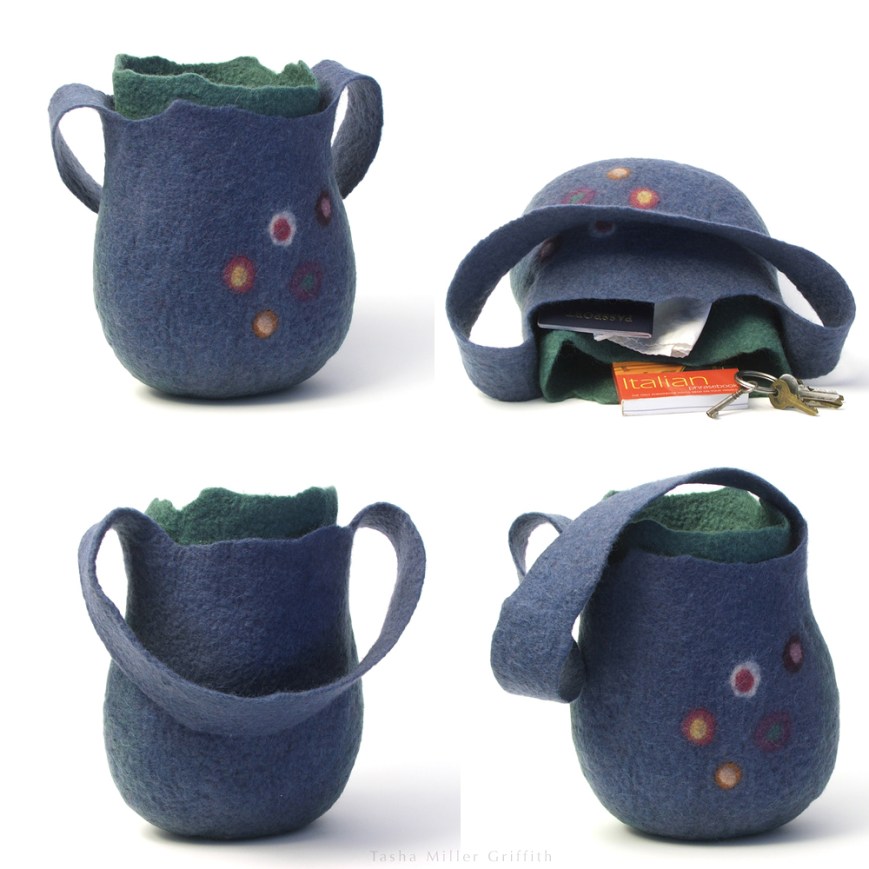
wet felt bag exampleAn example of the bags I made.  These are made entirely by wet felting; they start out as fluffy wool like the example in Part 1.  As you can see, it’s possible to make complex sculptural shapes without any stitching or even yarn!  I formed the pockets by using resists to keep the two layers from felting together where I didn’t want them to.


What is fulling?  Or, how do I felt knitting or fabric or old sweaters?

Fulling is a term used for the second stage of felting, and for felting fabrics which are already knit or woven.  This makes sense because in either case, the fibers are stable enough to take some more vigorous agitation.  Although, when you’re felting something like your knitting by hand, it’s still a good idea to gently encourage the fibers to cling together at first, rather than rubbing them around as hard as possible.  Keep in mind that at any stage, gentle agitation can actually work better.  Try it and see.

There are lots of ways to full, or harden, your felt.  This is where the majority of the agitation takes place.  In Mongolia (where there’s an amazing heritage of felting, think yurts), the tradition is to roll a new rug up inside an old one, and drag the bundle behind a horse!

By Hand

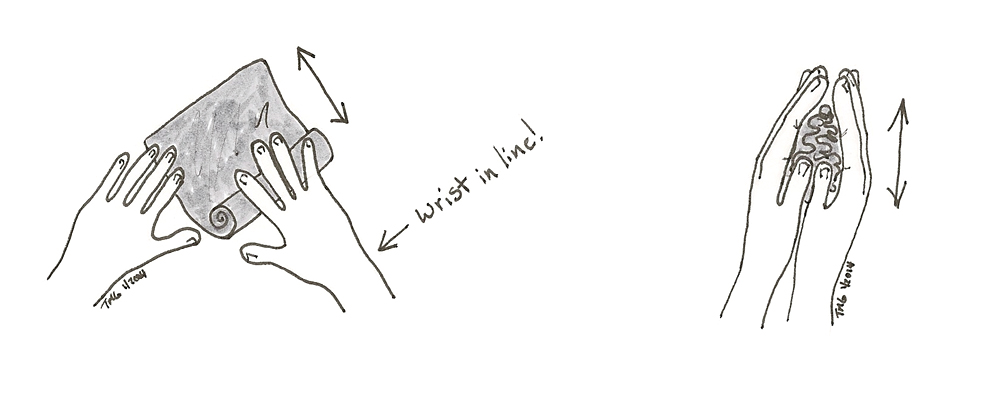
When I’m felting knitting by hand, or fulling a felt piece like the one illustrated in Part 1, I have a bowl of water about as hot as my hands can stand.  I dip the piece into the water, squeeze some of the water out, and rub it.  Two effective motions are rolling, and scrunching the felt between your two hands.  You can also scrub it around on the bubble wrap, or even throw it against a hard surface to get the shrinking going.  Whatever you try, remember to keep your hands in alignment with your arms and wrists in good alignment.
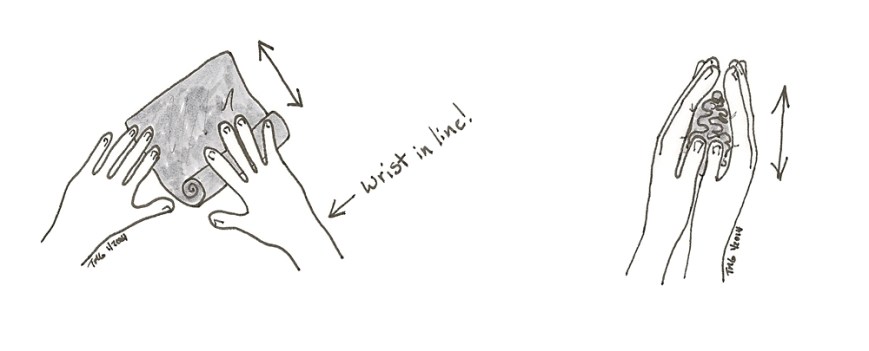
 

felting motions drawing

The advantage of felting and fulling by hand is how much control you have.  The exact parts of your felt you rub are the ones that shrink, and they shrink dramatically more in the specific direction you are agitating them!  Try it by rubbing a corner in towards the middle of the felt, and you’ll see what I mean.  For even fulling, make sure to rotate the direction in which you’re rolling and rubbing.

Stop and stretch your felt (and your hands & arms!) from time to time, stretching out your work will actually help it shrink down further.

For felting my gloves/mittens, I put them on, dunked them in the water, and rubbed them all over and around each other, concentrating on areas that I wanted to shrink more, and alternating taking them off for stretching and rolling with more rubbing while on my hands.
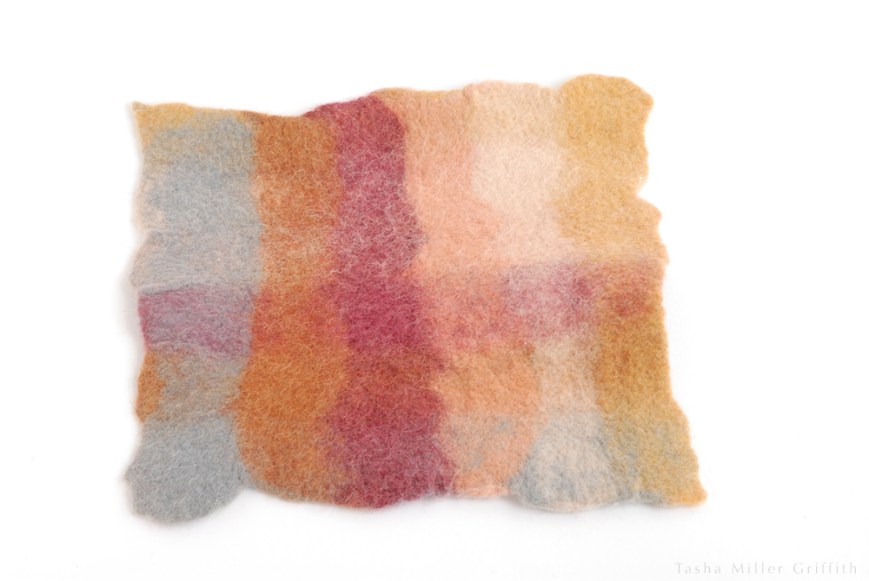
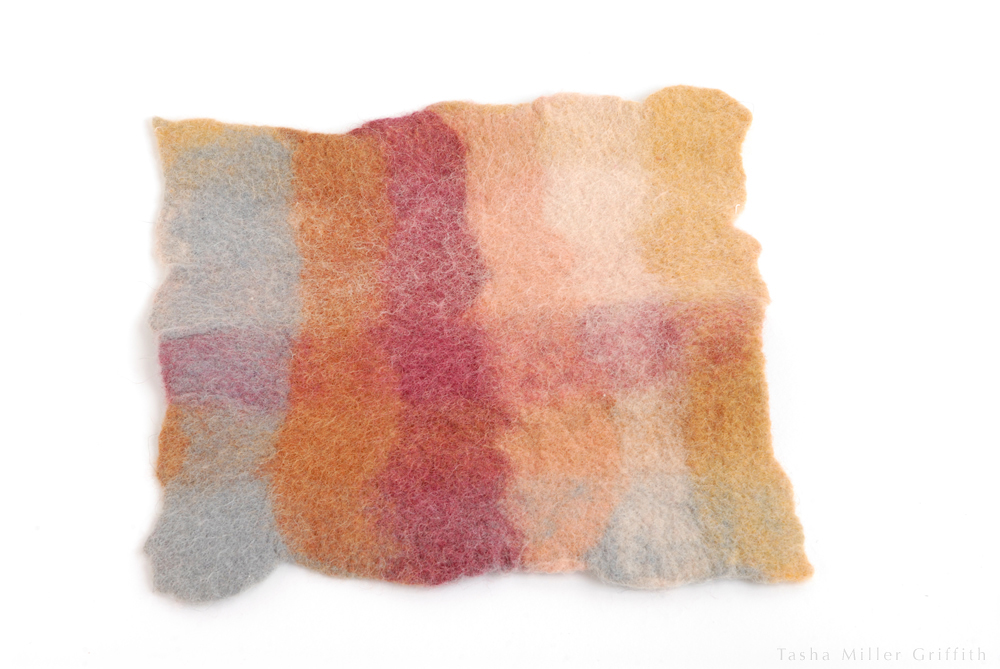
natural dye felt color sampleIn this wet-felted color sample, you can see how fibers from each side of the piece worked their way to the other side with thorough felting.


In the washing machine

You can also shrink knitting, fabric, and even hand made felt that’s getting good and sturdy, in the washing machine.  Proving that agitation trumps any and all other factors, even though the fibers are swimming in water and the water may not be that hot, you can quickly get dramatic results.  The downside is that you don’t have much control over what happens.  I usually use the washer to help with fulling when I’m felting something big, but I check on it every few minutes, getting the felt out of the water and stretching or rubbing certain parts to help it take on the shape I want.  Top-loading washers produce the most agitation, and are the easiest to use for checking the felt frequently. Front-loading washers also work, especially if you are trying to felt something as much as possible, so you’re planning to leave it in for the whole cycle.

Set the water level for lowest amount that will cover whatever you’re trying to felt, and the most soil/most agitation setting, with hot water.  Put your piece in a zippered pillowcase, to prevent the wooly lint which some pieces shed a lot of from clogging the washer pump (ask me how I know about that!).  If your washer has a removable lint filter, you don’t need the pillowcase, just be sure to clean the filter when you’re done.

I don’t recommend felting large pieces of fabric in the washing machine, the agitation is just too uneven over such a large piece, and it will probably come out with some areas much more felted than others.  If you want to felt fabric for a sewing project, try cutting it into smaller pieces first (be sure to account for shrinkage when planning the size of the pieces, see below).  Even then, you’ll get the most even results if you can alternate being in the washer with stretching and rolling the pieces.

Some people use the dryer to felt as well.  If you’re trying to shrink your felt as much as possible, throwing it the dryer certainly won’t hurt.  Also feel free to experiment with putting damp felt in the dryer, and checking on it frequently the same way you would for felting in the washer.
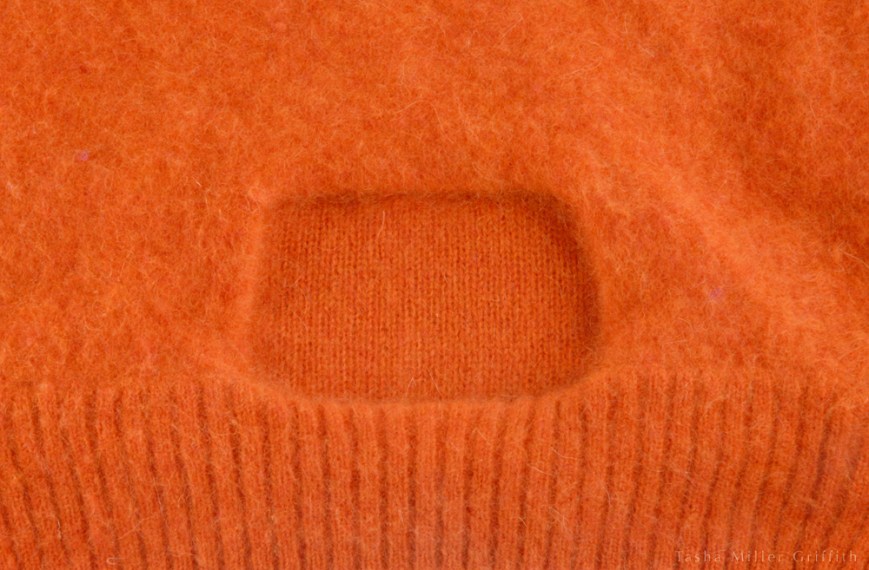


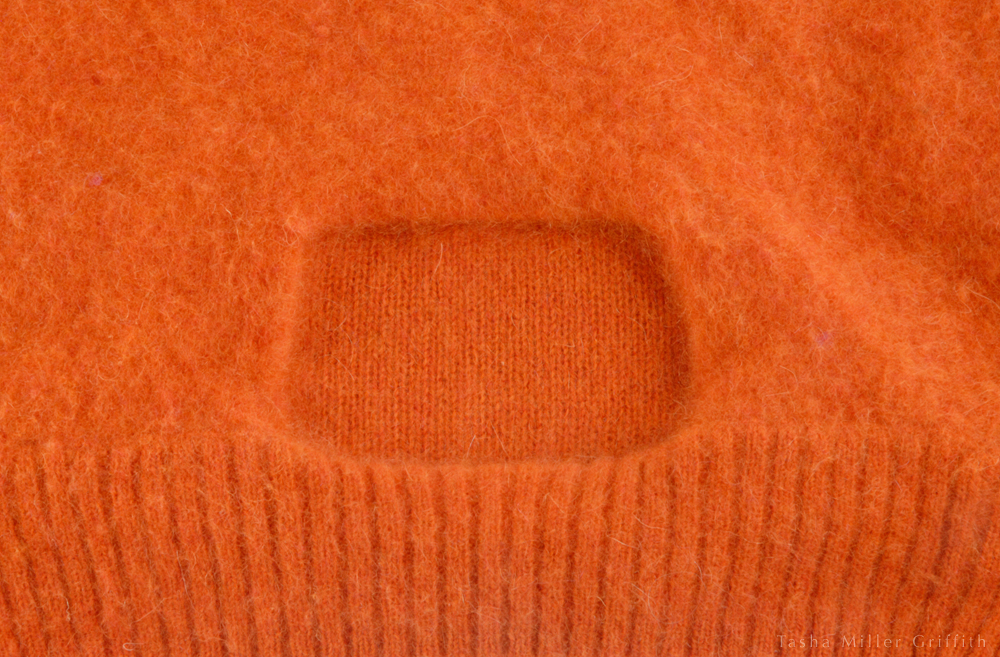
orange felt with unfelted labelThe body of this sweater felted well, except where the stitches were held in place by the sewn-in tag.  Since those fibers weren’t free to rub against each other and felt, they still look the same as they did before going through a few hot washes!


Will felt keep shrinking forever?

No.  At some point, the fibers have locked down as much as they are ever going to, and you really can’t get your piece any smaller, even if you want to.


Can I decide that my felt is done even if it hasn’t shrunk/hardened as much as it could?

Absolutely.  As long as it’s sturdy enough for its intended use, you can stop whenever it’s the size and thickness you want.  Sometimes the maximum that your felt could shrink would be much too thick and stiff for what you intend, or just too small, especially for felting knitting and fabric.  On the other hand, if you are making hand-felted boots or handbags, you’ll probably want to plan on the maximum amount of felting you can get, so that as many fibers as possible will be locked in, and the finished item will be as long-wearing as possible.


How much will my felt shrink?

It depends on a dizzying number of factors, but there is one sure way to find out: test it, by making a sample and measuring it before and after, as I illustrated in my post about the magic purple mittens.  This method works for wet felting too, just measure the dimensions of the wool you lay out before you felt it. If you’re trying to get a sense of how much fiber you used, any dry felt weighs the same as the fiber used to make it.

Wool from different breeds of sheep felts dramatically differently, some from sheep raised for meat may not felt at all!  Even different individual sheep can produce wool which felts differently from the next sheep over.  The hat at the beginning of Part 1 is Churro wool, which shrinks a lot, as you can see from the pattern!

If you’re buying yarn or fabric to felt, unless it’s from a local herd, you may not know what type of sheep it comes from, but most quality wool will felt to some degree.  The yarn or fabric should be at least 50% wool, alpaca, cashmere, or other feltable critter, and not be treated (“superwash” etc.) to prevent felting.  Bleaching can be hard on the fiber scales that make felt work, so lighter colors often take longer to felt.  Like I said, there are a lot of factors, so if it matters what size the final felt is, test first!
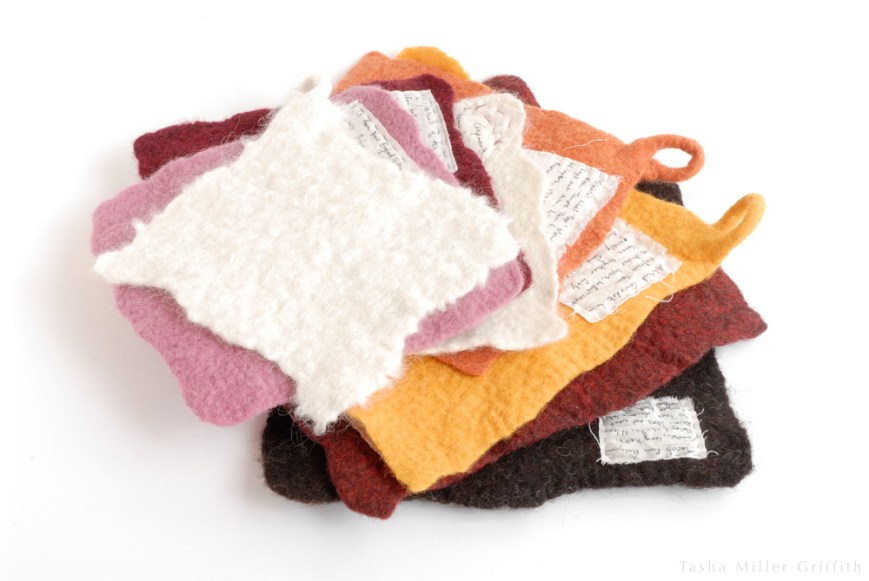
 

felt breed samplesWhen I was looking for a wool to make my wet felted bags from, I made a lot of samples!


Can felt happen by accident, or with wear?

Definitely.  As you’ve seen by now, the conditions for felt are readily available in your washing machine, which can be disastrous if your nice sweater accidentally gets in there.  And, as I found out the hard way, even if it seems like a garment made from wool fabric is not felting, over many many washes, it eventually will (illustrations and happy ending here).

I also know from experience that a garment can felt as you wear it.  I have a pair of alpaca and wool blend fingerless mitts that, as they are exposed to warmth and moisture from my skin, and agitation as I wear them while I grab my keys, the steering wheel, etc., are slowly becoming more solid.  We shall see what the end result is.  This is something I’m really interested in at the moment, so stay tuned for more findings.  For now, my best advice is: don’t make an article that will be exposed to felting conditions out of a material that felts easily, or plan for shrinkage and felt it first.


What should I do with my felt when it’s done?

Let it go through the spin cycle, or roll it up in an old towel and squash it, to get out as much extra water as you can.  In this damp state, the felt is super malleable, so plan on doing some final shaping.  You can rub, tug, scrunch, stretch, and otherwise push the felt around into exactly the shape you’d like.  If you’re felting something like a hat, it helps to have an object to “block” (shape) it on, try a bowl a little bigger around than your head.  When you get you new felt shaped just as you would like, leave it alone to dry.  If the felt is thick, this can take  a couple of days.

Once the felt is dry, you still have another chance to shape and smooth it, with steam from your iron.  All wool responds especially well to steam (think about tailoring), but on felted wool steam is a minor miracle.  It can straighten out lumpy areas and smooth the whole texture of your felt.  Placing the iron right on the felt will also smooth and flatten the surface fibers, so if you don’t want that, hold the iron above the surface to fill the felt with steam, then put the iron down, and shape with your hands.


Don’t I need soap to felt?

My current experience says not necessarily, except under special circumstances.  Historically, all kinds of harsh chemicals were used in felting, to roughen up the fibers’ scales and speed up the process.  These were also highly toxic.  Most felters now just use a mild soap.  Olive oil soap and liquid soap are popular choices.  This soap doesn’t do much beyond decreasing the surface tension of the water.  Lately I have been felting mostly without soap, and I haven’t noticed a difference between using it and not using it in my studio.  You may find soap more helpful than I do, depending on your wool and your water.  Don’t add too much though, if the fibers are too slippery they won’t want to grab on to each other.

When you are hand felting, if your hands are sticking to the fibers rather than sliding over them, a little soap on your hands should help.  A mixture of solid soap and water can be a very effective “glue” if you are hand felting two things that don’t want to stick together.

If you are felting in the washing machine, you definitely do not need to add soap.  There will be enough left from the last load to make plenty of foam.

If you do use a soap that’s alkaline (most are), make sure to rinse it out thoroughly when you are done felting.  Animal fibers, like your own hair and skin, are slightly acidic, and being left in an alkaline environment for long periods can damage them.  Include a splash of vinegar or lemon juice in the last rinse, and let the felt soak in it for a few minutes to neutralize any remaining alkalinity.
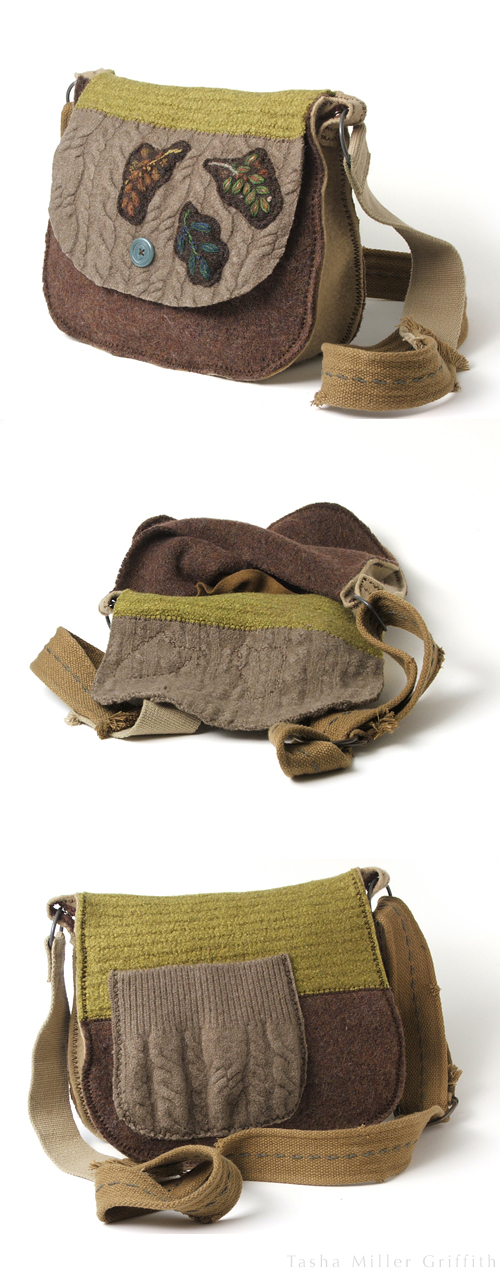
 

sewn felt bag exampleI made this bag from felted wool sweaters.


Why would I want some felt anyway?

Felt is fabulous!  It’s a dream to work with.  As you sew it, you can ease in what seems like an impossibly large piece onto a small one, just using your fingers.   It doesn’t ravel when you cut it.  It wears like iron (assuming it’s tightly fulled).  It’s so insulating that I can iron the outside of one of the wet-felted bags, with lots of steam, with my hand inside, and feel nothing for minutes.  It’s breathable and odor-resistant and has all the other lovely properties of natural fibers.  Plus it’s beautiful, natural, and fascinating.  It can be sculpture with fiber.  It’s the perfect next stage for a sweater that’s been attacked by moths or pets, or just has cuffs too worn out to repair—felt it and make it into something else.


Finally, how not to felt

To care for precious article you’d rather not felt, basically do the opposite of what you would to felt it.  Hand wash it very gently: place it in water with a little bit of pH neutral soap.  Let it soak clean, press down gently to move the water through it, and drain the water off without agitating.  Keep the rinse water the same temperature as the wash (lukewarm is fine) and avoid letting the water run directly on the article.  Spin it out (spin only) in the washer, or roll in a towel and mash on the roll.  Reshape, and leave to dry flat.


Further reading

My favorite felting book is Uniquely Felt by Christine White.  It covers, in detail, methods for just about every type of wet felting you could think of.  Pat Spark, who I mentioned in Part 1, has been at the forefront of bring felting to the internet since the very beginning, and she has a ton of useful info on her site.


I packed as much as I could in here without going into exhaustive detail, so I hope it’s helpful and not too overwhelming.  If you have more felt questions, send them my way!

 

How To Felt Basics, and Felting FAQ Part 1:

What is Felt, and How Do I Get Started Making it?


felted hats with patternA hat I made early in my felting experiments (top) and a commercially felted hat.  The hats are sitting on the pattern I used to lay out the wool . . .


As I mentioned in the post about my magic purple mittens, felting is probably the fiber technique I have the most claim to be an “expert” on, and, until now, I haven’t posted much about it here at all.  Most of my deep explorations into felt happened before I started this blog, and as I’ve been digging into my research and photo archives, compiling what I want to say as an intro to felting, it’s clear there’s enough material here for a least two posts.

I’ve organized this roughly as a list of felt FAQ.  I could go on at length from any one of these starting points, but I’ll try to keep it concise.  The photos and illustrations here are necessarily going to be a little mishmashy, as they represent work over a big swath of time.  Click on the photos to enlarge for an better view of the felt texture.  Ok, let’s get started, shall we?


What is felt anyway?

The short answer: Fibers (for real felt these must grow on an animal: a sheep, an alpaca, a cashmere goat etc.) which have matted together into a permanent fabric.  It’s the scales on the fibers (like the ones on your hair, visualize the close-up from a shampoo commercial) that open up and cling together.  It doesn’t sound permanent, but if you’ve ever tried to pull apart a piece of felt, or un-shrink a sweater that accidentally went through the wash, you know it is.

There are lots of types of felt.  It can be made from combed fibers alone, or from fibers that have already been spun into yarn and woven or knitted into fabric.  In either case, as long as there are at least 50% feltable fibers in the mix, the fabric should be able to felt.  It’s easy to make felt at home (even by accident) and there are factories that make felt on a commercial scale.  I’d love to visit one sometime.

Wet Felt

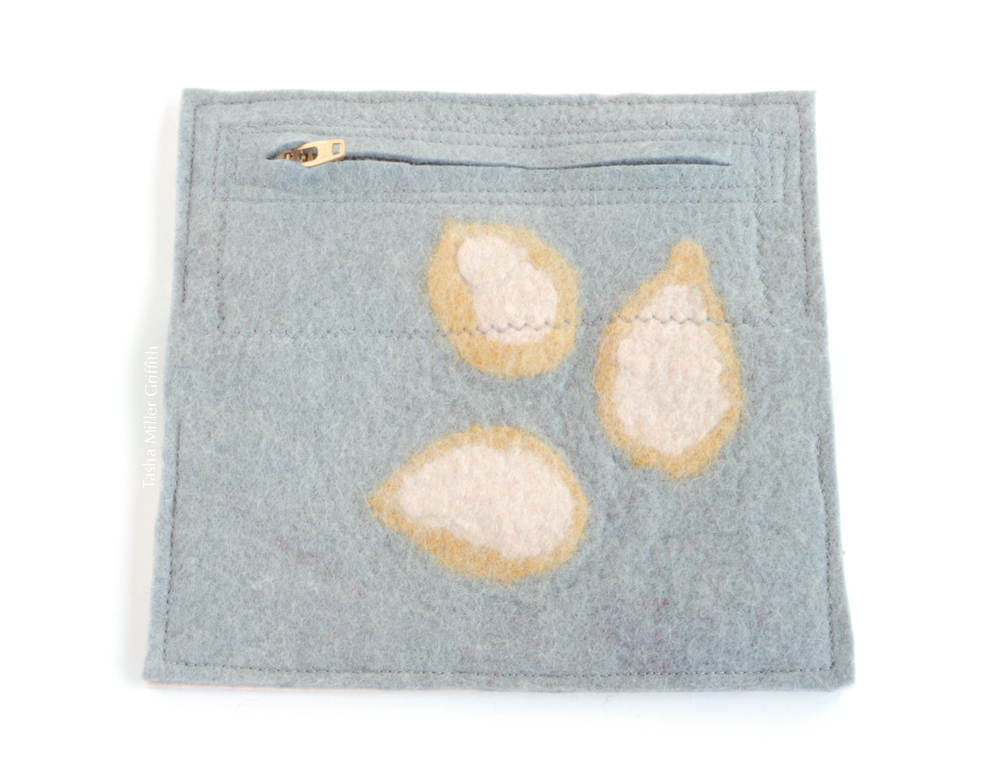
When someone says their work is “wet-felted”, they’re probably talking about the seamless, stitch-less felt made from only fluffy brushed wool fibers (read on for how to make your own).  Below is a piece of my hand made wet felt, which I cut and sewed after it was done, to make the wallet.  The decoration was made at the same time as the fabric.

Most commercially made felt, whether starting from fibers or fabric, uses some kind of wet or steam process.  When you felt your knitting, recycled sweaters, or fabric, you’ll also use water and heat.


blue petal wallet 2


A couple of special types of felt that I won’t cover in depth, but wanted to mention, in case you’re curious:

Nuno felt

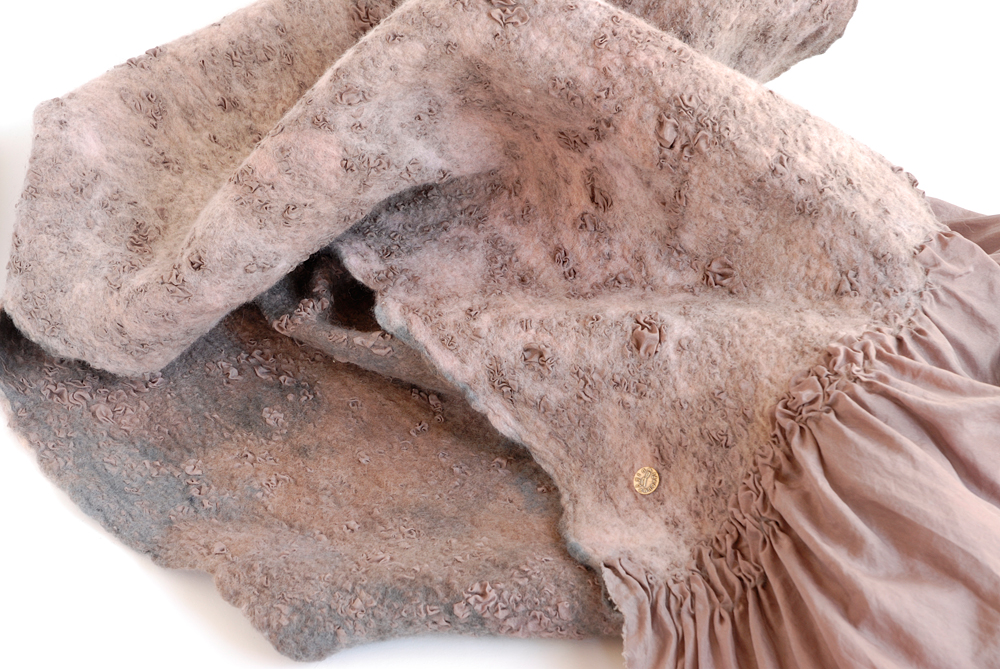
Nuno felt is made with thin layers of wool on either either side of a piece of fine fabric, usually silk.  We traded Bryan’s work for the totally gorgeous example below by Gina Pannorfi at one of our art shows this past summer.  (Lucky me, it’s just the loveliest thing.)  Because the silk provides some of the structure, nuno felt can be quite thin and drapey while holding together.


Gina nuno scarf


Needle felt

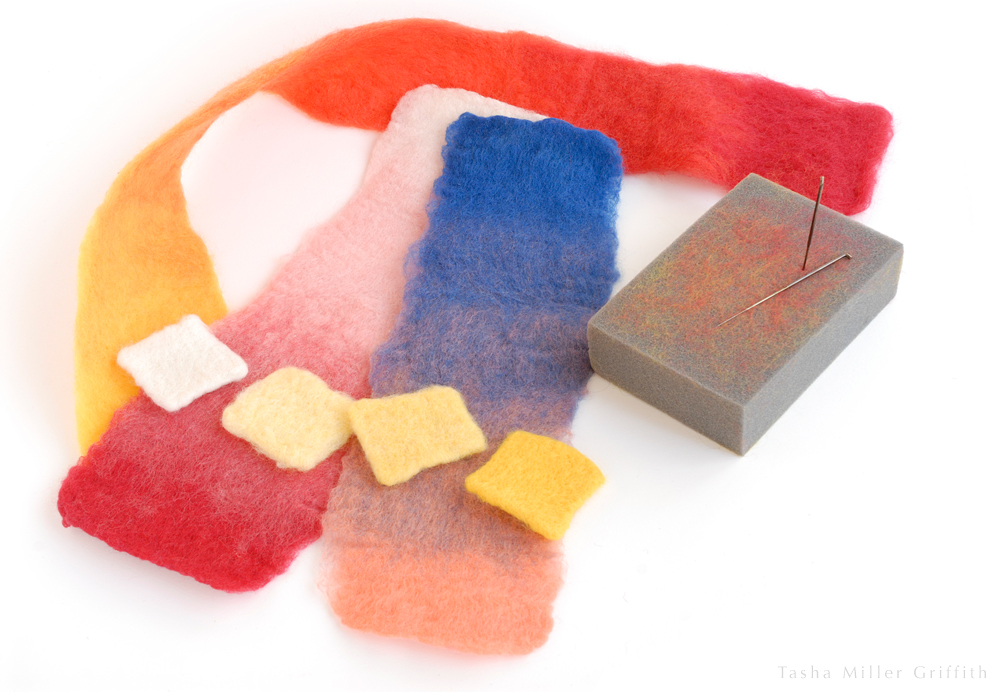
Needle felt is what it sounds like, made by pushing fibers together with a special barbed needle, or a collection of them.  Although it doesn’t make a sturdy, hard-wearing fabric the way that wet felting does, amazing detail is possible with needle felt.  Do a search for “needle felt” with your favorite animal name on Etsy, and you’ll see what I mean.  I made the examples below in a class on color theory for felters—with Pat Spark!  She has a whole bunch of good felting information and tutorials on her site if you’re looking for more felt info.


needle felt color studies


Fake felt

That slightly sticky, slightly glittery “craft felt” at the hobby store is usually made from polyester.  The fibers are punched together with needles and/or held together with glue.  It really has none of the lovely properties of real felt.  Commercial wool and wool-blend felt is more readily available than it used to be (at least in the US), so you may be able to find it at your craft store as well.


How do I make felt?

The short answer: Most importantly agitation, combined with at least a little moisture, and optionally heat, on wool, alpaca etc. makes felt.  There are about a million ways to apply these, depending on what you’re working on and what equipment you have.

I’ll start with a quick intro to making felt from just combed wool.  I think that way, the rest of the felting process will make more sense, and it’s interesting to know, even if you only plan to felt from knitting or fabric.

If you’re looking for to buy wool for felting, it’s usually sold as roving (a loose roll that spinners use) or batts (which are more convenient for felting, since you can pull off big thin layers).

These photos are from my felt flower tutorial, which will walk you through the whole process if you’re interested.

Step 1

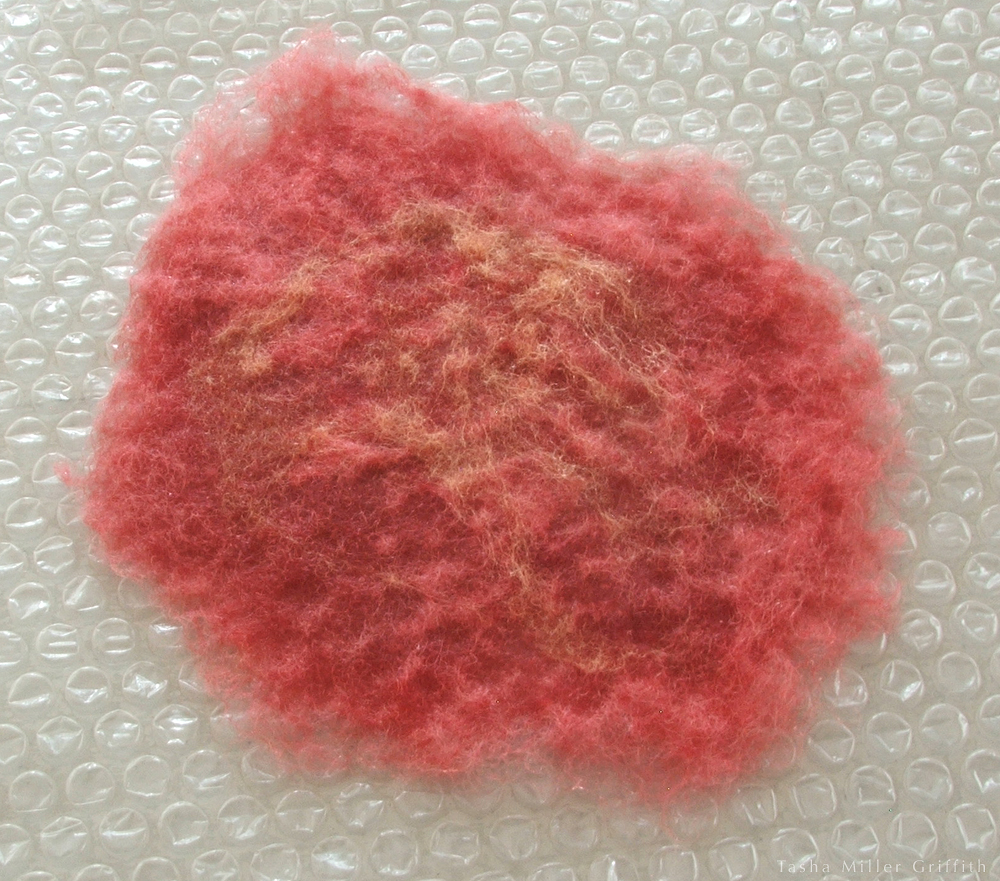
Lay out thin layers of wool, with the fibers alternating directions.  Keep in mind that your finished project will shrink in as the fibers pull in toward each other, so make it bigger than you want (I’ll go into how much bigger in the next post).  The wool is very fluffy and will seem thick, but it will compress to almost nothing once it’s wet.  Use several layers for a cohesive piece of felt.  Squish it down with your hand to get an idea of how much fiber is really there.


dry wool layers


Step 2

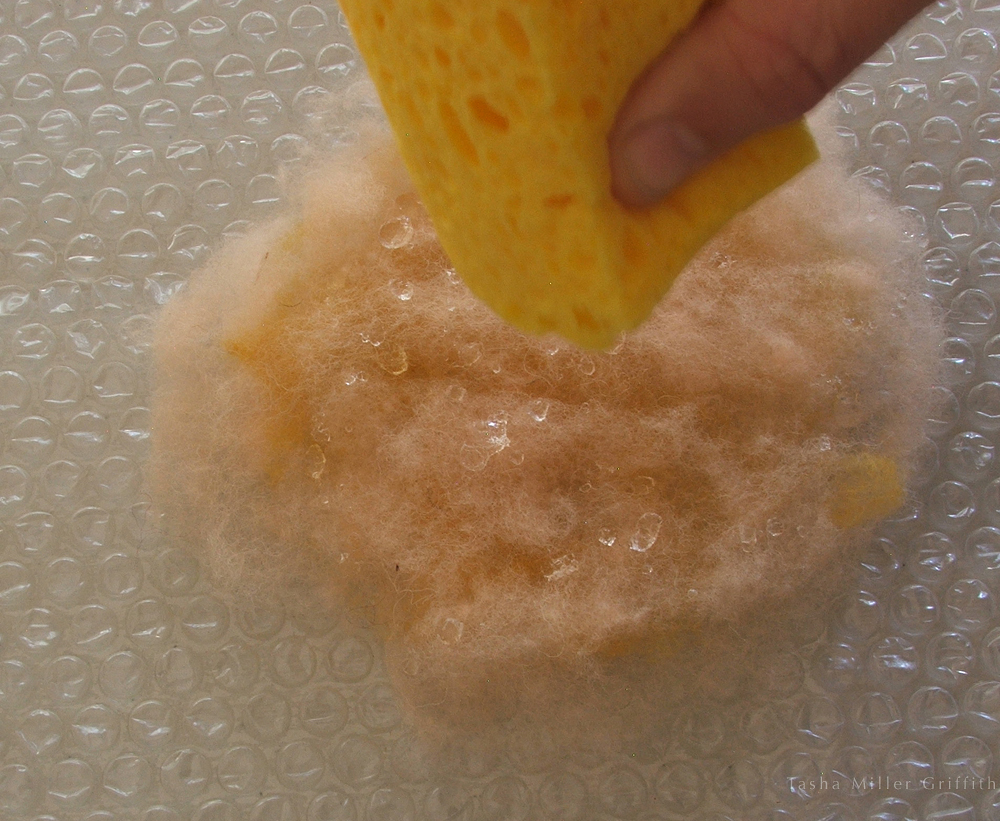
Add a little water.  Dripping it from a sponge is a good way.  You want the wool to be all wet but not swimming in water.  You can squash on the wool gently with the sponge to get it all wet.


water from sponge


Step 3

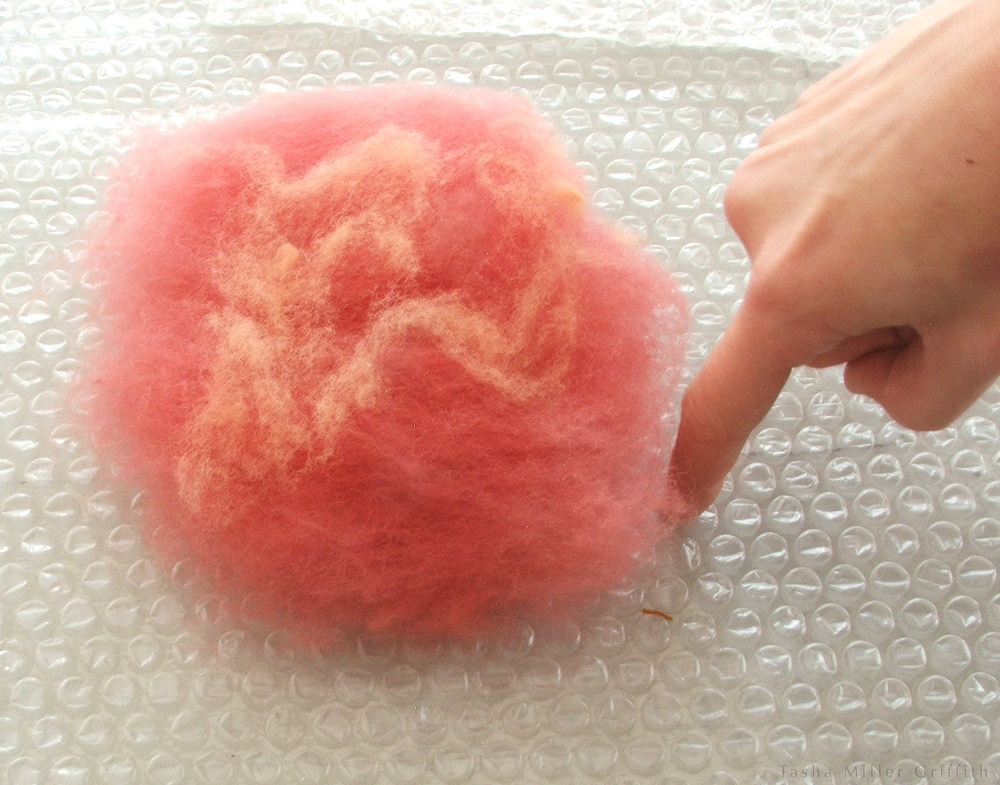
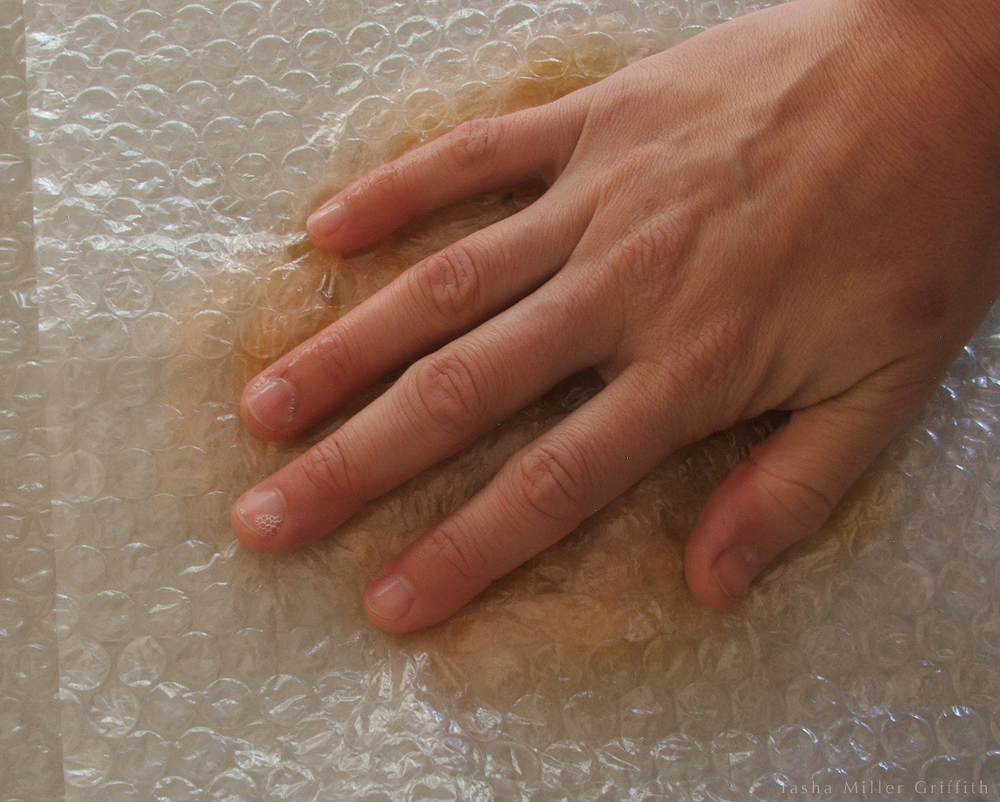
Agitation.  Arguably this is the last step, but there are a few stages to it.  At first, you’ll need to rub the felt very gently.  You want the fibers to cling together, which they won’t do if they’re being shifted all over the place.  For wet felting small pieces like this, I like to use two layers of bubble wrap (the ordinary, small-bubble kind), one underneath the fiber and one on top.  The bubble helps spread and soften the motions of your hands.  Think about getting the bubbles to massage the wool, not about moving your hands on the bubble.

Important!: Felting by hand involves a lot of repetitive motion.  As you work, make sure your wrists are in line with your arms and not bent at a strange angle, to avoid injury.


bubble wrap rub


Rub for a couple of minutes, then lift the bubble and check on how things are coming.  You’ll probably need to rub some more.  As you practice felting, you’ll start to notice subtle changes in the texture of the piece that show how it’s coming along:


wet wool layersWet wool layers.


slightly rubbed wool layersThe wool is starting to cling together, but there are still a lot of loose fibers.


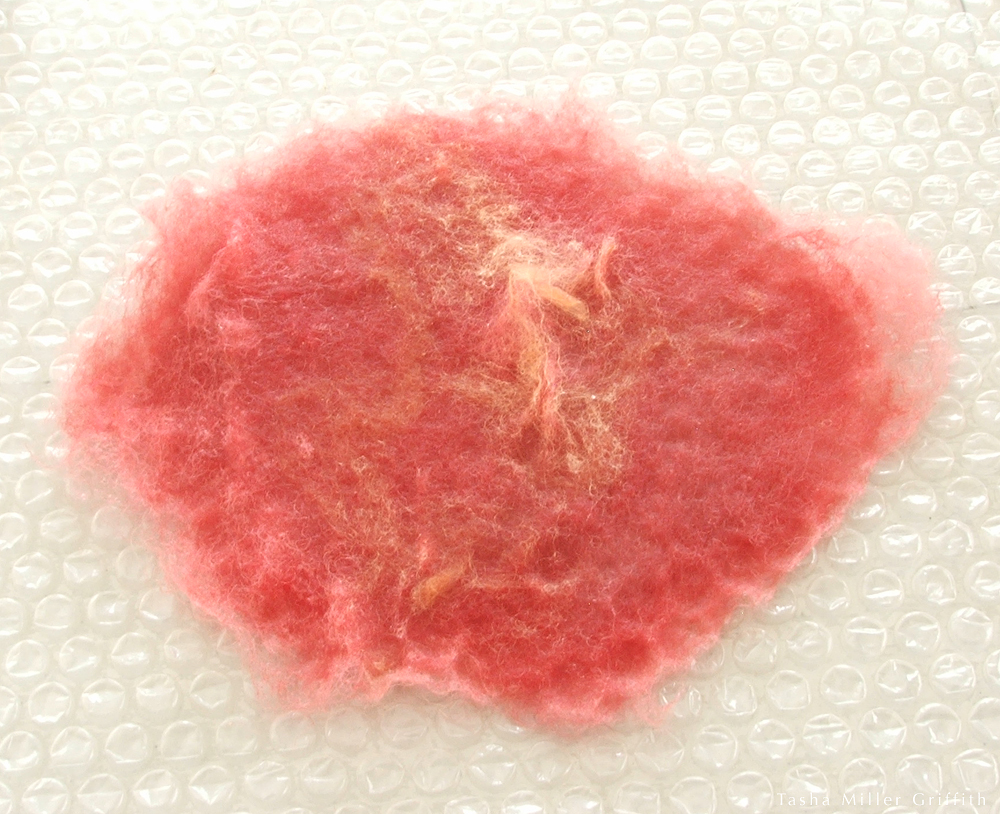
more rubbed wool layersAlthough still soft, this prefelt is now a cohesive unit.


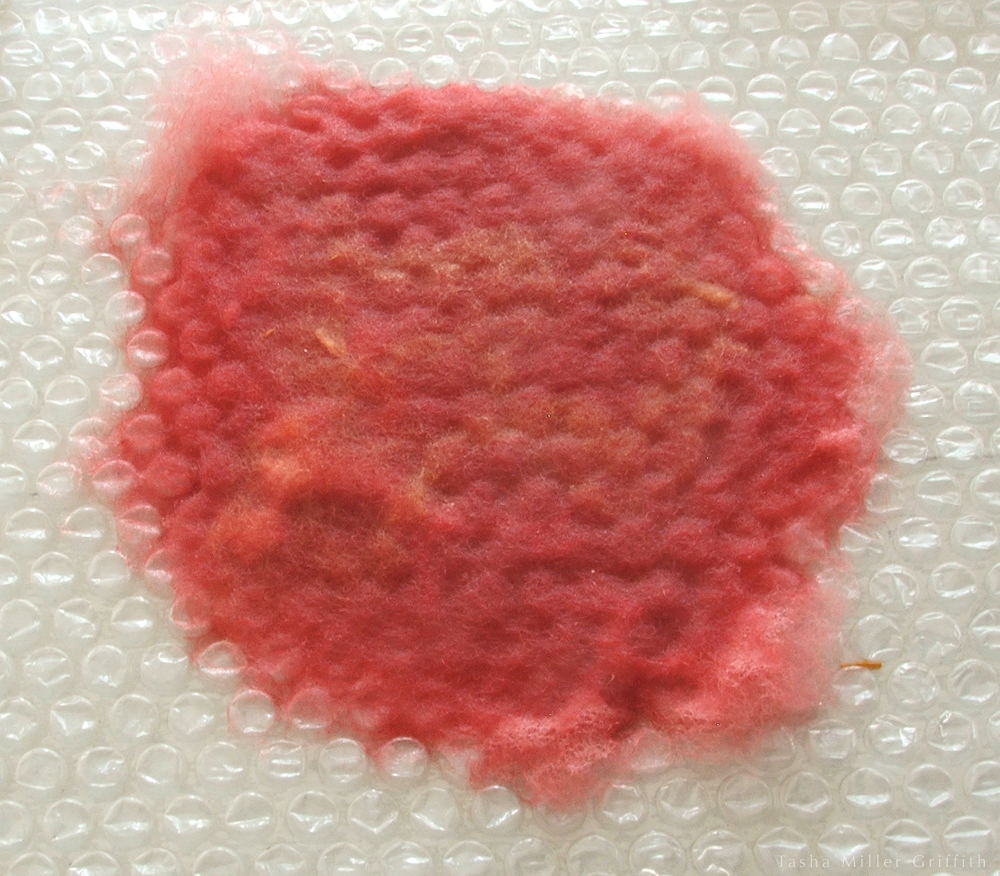
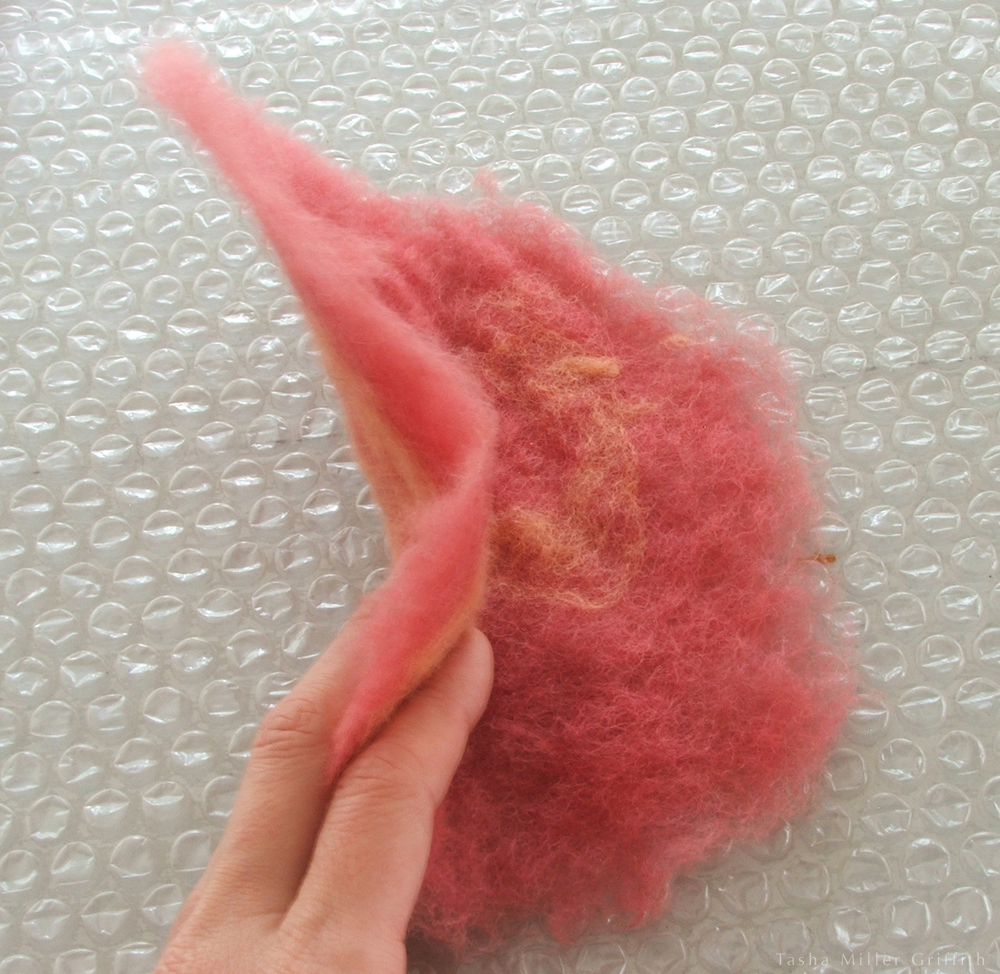
Once your wool is holding together enough that you can pick the whole thing up and it stays together, it’s what felters call a prefelt.  A prefelt isn’t strong enough to be a finished object, and it has lots of fibers that are still ready to cling to each other or to other parts of your project.  You can check by pinching up a few of the top fibers to see if they’re attached to the ones below.  At this point, the felt is ready for whatever you have in mind for its next stage.  It can be easier to work with if you dry it off, by squashing it between two layers of an old towel.


prefelt


So, my wool is holding together, now what?  Read on to Part 2 for how to finish felt like the piece above, how to felt your knitting, more questions answered, and even how not to felt . . .


DIY Crib Rail Covers for Teethers — A Tutorial


So apparently, small teething children will chomp down on wooden crib rails like beavers.  I really had no idea until, visiting our dear friends at the end of the summer, I saw the evidence first hand, little teeth marks right through the wood finish.  My friend the mama was thinking about ordering some covers for the crib rails, but I knew we, ok I, could easily make some, and I would get to sew!  In August, after months away from my sewing machine, this seemed like a gift from the universe, plus it would be so useful and cute for friend mama and her little one!  I’m going to share my notes and method, which should work for any crib, below.  This is a fairly quick project, so if you are still looking for a gift for a young family, it could be a good one.


crib rail protectors onTo make up for only having quick snapshots of this project (did I mention there was a baby involved?) I’m making it my illustrated post for this month.


First things first, I measured the crib.  I wanted the covers to go around the whole rail easily, so I added a little extra ease to my measurements.  The back rail is against the wall, apparently too awkward an angle for little one’s head to chew, so I didn’t worry about that one.

crib rail protector mathI know that the quilt batting (which I want here for padding) will shrink a little bit, probably not enough to affect the width, but for the length I’ll include a bit extra.  I usually use 1/2″ seam allowances, which I did for the width.  I decided to use 1″ seam allowance on each end for the length, since that is where I am likely to want more wiggle room.  To figure out how much fabric I need, I made another diagram, since I’m really a visual thinker.

crib rail protector fabricSo here are the supplies I got, including a little extra fabric for shrinkage, since it’s 100% cotton:

Two yards fabric (Modern Bliss design #13662 by Robert Kaufman)

One yard super wide cotton quilt batting, for two layers of batting in each cover

Eight yards of totally beautiful soft cotton ribbon for ties

All of this came from Stitchin’ Post in Sisters, OR.


When getting ready to sew, don’t forget to preshrink your fabric!  Wash the fabric and dry it the same way you (or the recipient) plan on treating the finished project.  I also put the ribbon through wash and dry, in a lingerie bag, just in case it was going to bleed any dye, etc., since a baby might be chewing on it.  I didn’t pre-shrink the batting.  The package it came with says it will shrink 3%, which will give the covers a bit of that puffy quilted look once they are washed.  After washing, I ironed the fabric and ribbon to get rid of wrinkles and make it easier to measure and work with.

Cut or rip the fabric and batting into strips 10″ wide (or the width you picked for your crib), and then divide them for the length of the covers, as in the diagram above.  Take one fabric section with its corresponding batting to the crib, make sure the size seems close, and decide where you want to put the ties and how long they should be.  We decided on 7″ for each tie, which divided fairly neatly into 8 yards, 20 ties with two sides each.  I just cut the ends of the ties at a diagonal to keep them from fraying, and left the other end, which will be sewn inside the cover, squared off.

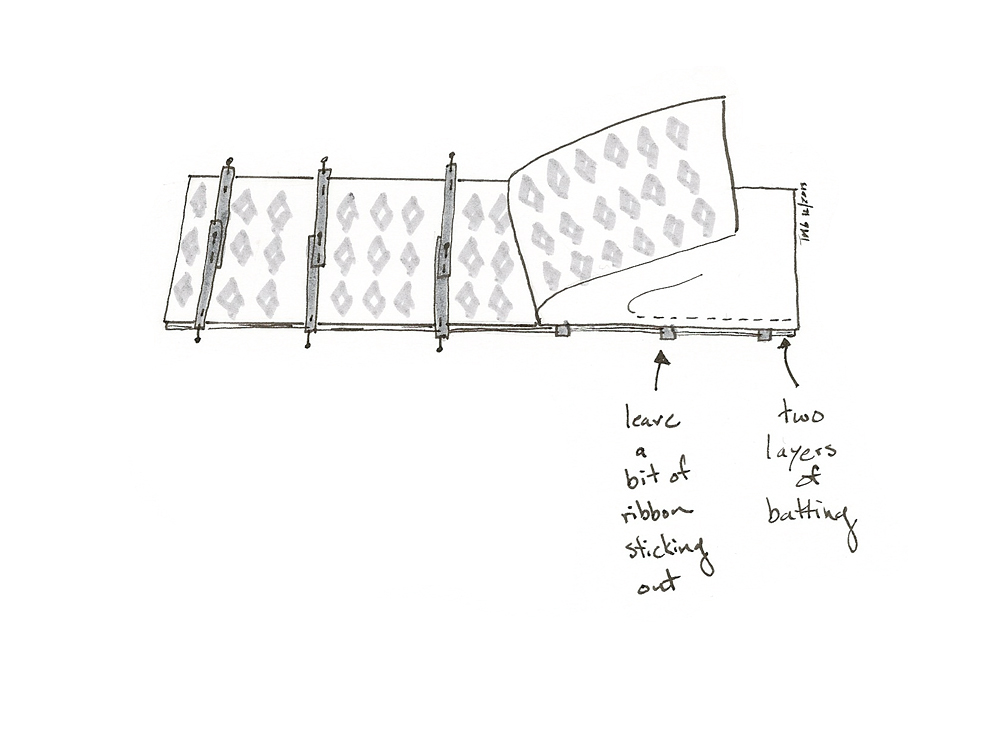
I pinned the ties to one side where I wanted them to go, and then with the fabric off the crib, folded it in half to match and pin the matching tie. It’s helpful to leave just a bit of each tie sticking out beyond the fabric, so you’ll be able to see where they are when you’re sewing.

Make a fabric stack for each cover, with two layers of batting on the bottom, then one layer of fabric (right side/public side up) with the ties pinned in place (I pinned them in the middle too, so that they wouldn’t shift around and get caught while sewing).  Then top with the other side of the fabric, right side down towards the ties.

crib rail protector sandwichHold the whole sandwich together with a few pins, and sew down each long side with a straight stitch, 1/2″ from the edge—our planned seam allowance.

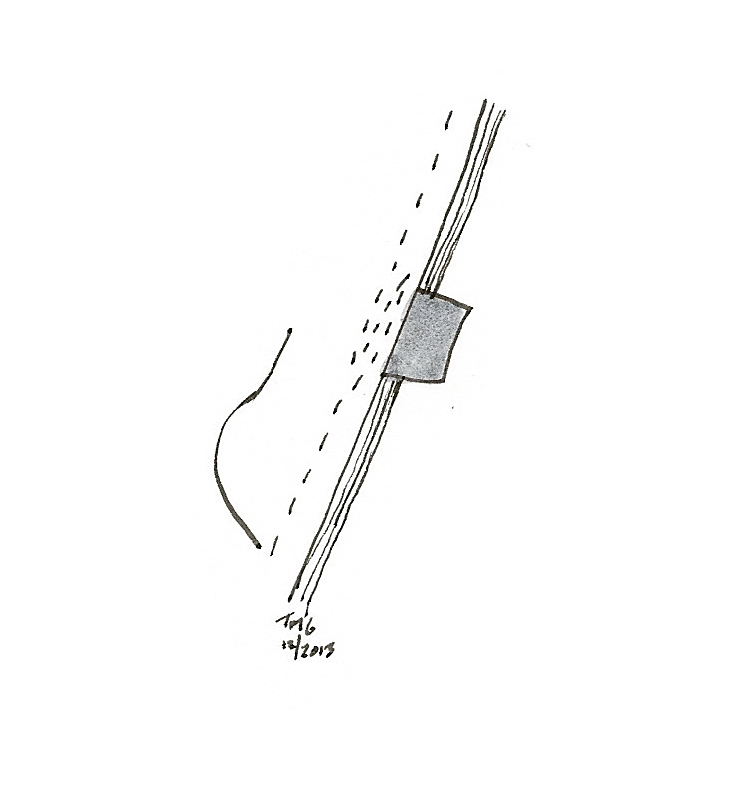
Each time you come to one of the ribbon ties (which you’ll know because the ends are sticking out) sew over it, then back up and sew forward again, so that there are three lines of stitching holding each tie in place.  Blend back to your seam allowance line, and keep sewing to the next tie.

crib rail protector sewing ribbonOnce you have sewn down both sides, turn the whole thing inside out and tada!  The batting is on the inside and the ties are on the outside.  I had thought I would trim the batting from the seam allowances, but when I got to this stage it didn’t seem necessary.  I just pressed everything in its new orientation, smoothing things out and using the iron with steam.

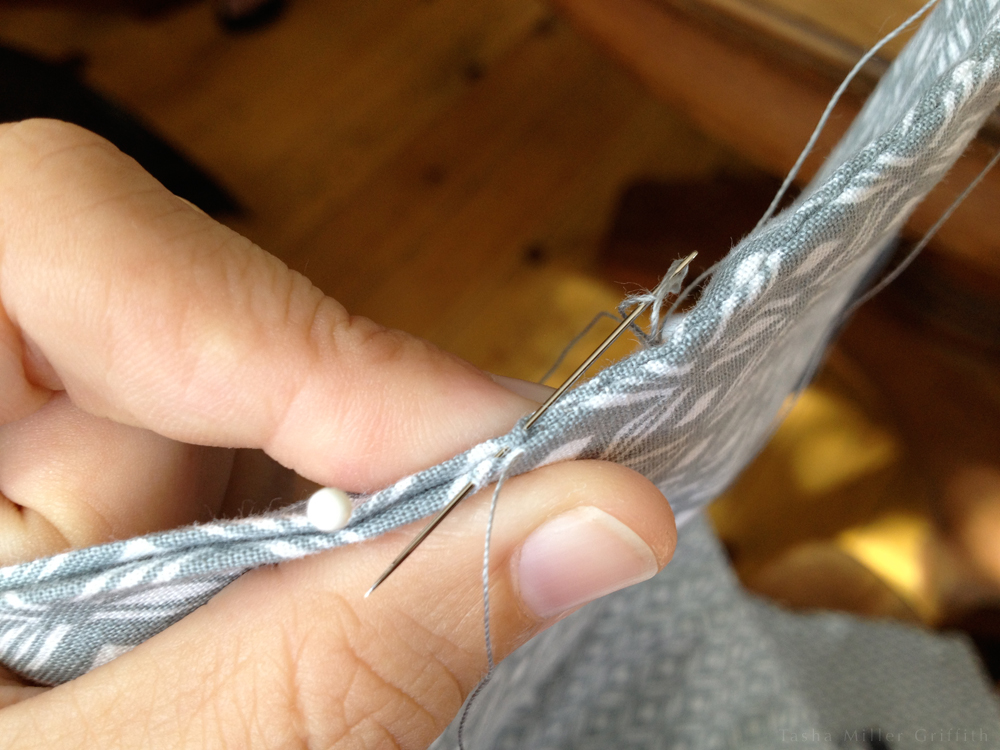
Check the size of the cover on the crib, the fold the ends to the inside to get the length you like.  I decided to stitch them closed by hand, using a ladder stitch which picks up a little fabric from each side.  It just looks better, and I can also add a line of stitching near the ends when quilting so that the hand stitches won’t take much strain.  The white UFO near my fingers in the photo is the head of a pin . . .


crib rail protector sewing ends


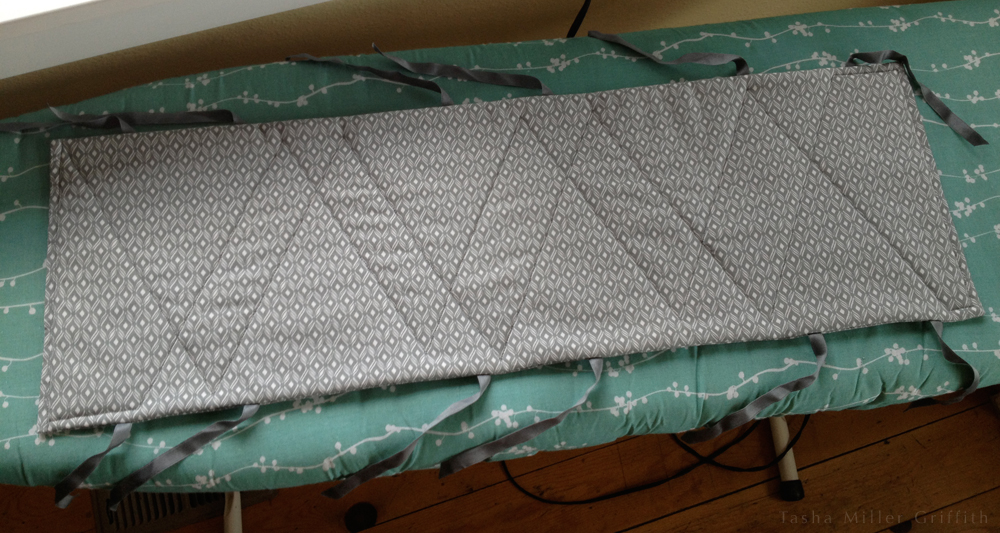
All that’s left is the quilting!  I don’t usually quilt; I’m too obsessed with the properties of different fabrics, their drape as a 2-D material wraps a 3-D body, and the possibility of walking around all day protected and flattered by garments I made.  I do see how quilting is perfect for something like this though, and I don’t mind the quilted look, but it does bug me when the stitching totally contrasts with the fabric, especially when I like the fabric as it is.  I decided to use the diagonals in the print as guides for my quilting stitching, and not to worry about them being exactly all the same.  It gave the covers more of a modern look, which the mama and I loved.  I did check the batting instructions, which said to quilt no more than 8″ apart, and make sure the maximum distance between my lines was not more than that.  I quilted to one end, checked the measurements and then did a second round.  I didn’t have access to a walking foot, so I spread the fabric and batting sandwich outward from the foot with my hands as I went, and it worked just fine.


crib rail protector finished


I just loved making these, mostly because at the time I was thrilled for the chance to take a project from idea in my head to finished object in my hand!  I’m sure I could have looked up someone else’s directions, but I didn’t want or need to, and I love how my version came out.  I played with the balance between making something as good as I can, because it’s for my best friend’s baby, and going with the flow, letting it be a bit inexact and show its handmade-ness, because it’s the real world, and because I always think handmade things are the most beautiful.

If you try this project, I hope you’ll agree, and have as good a time as I did!  Happy week everybody!
 

Free Yourself to Make Something Ordinary


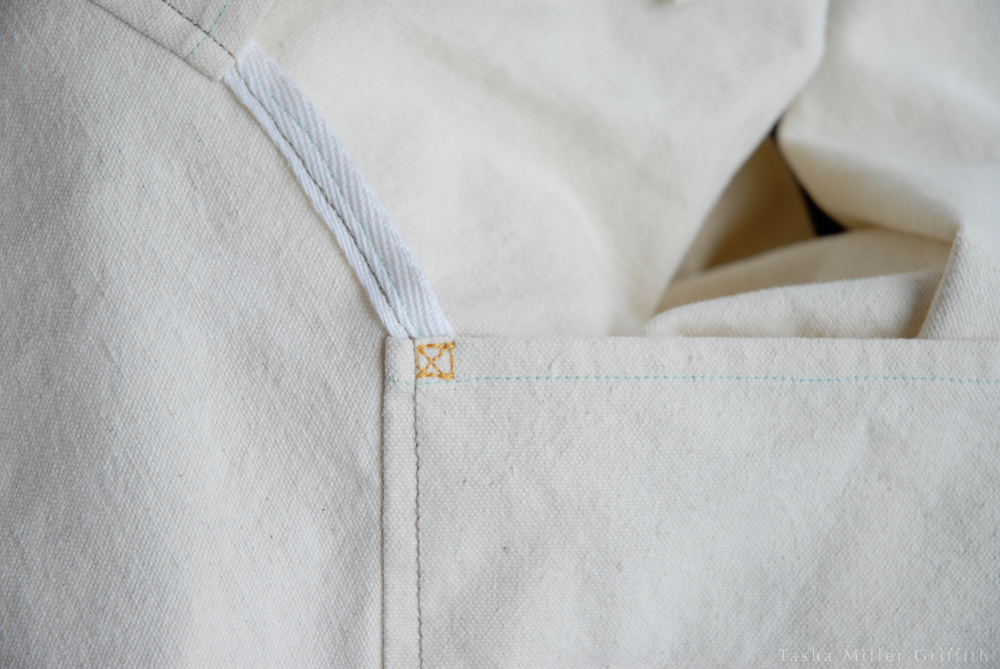
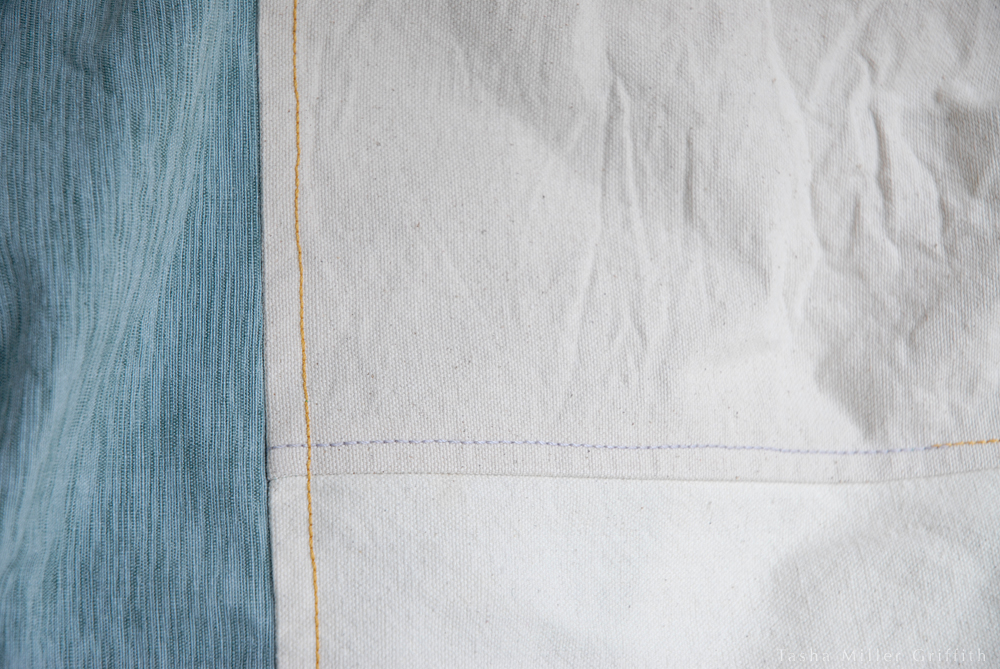
garment bag stitching


Now that I’ve told you a little more about why we travel most of the summer, I can also share some things I’ve made for our trips.


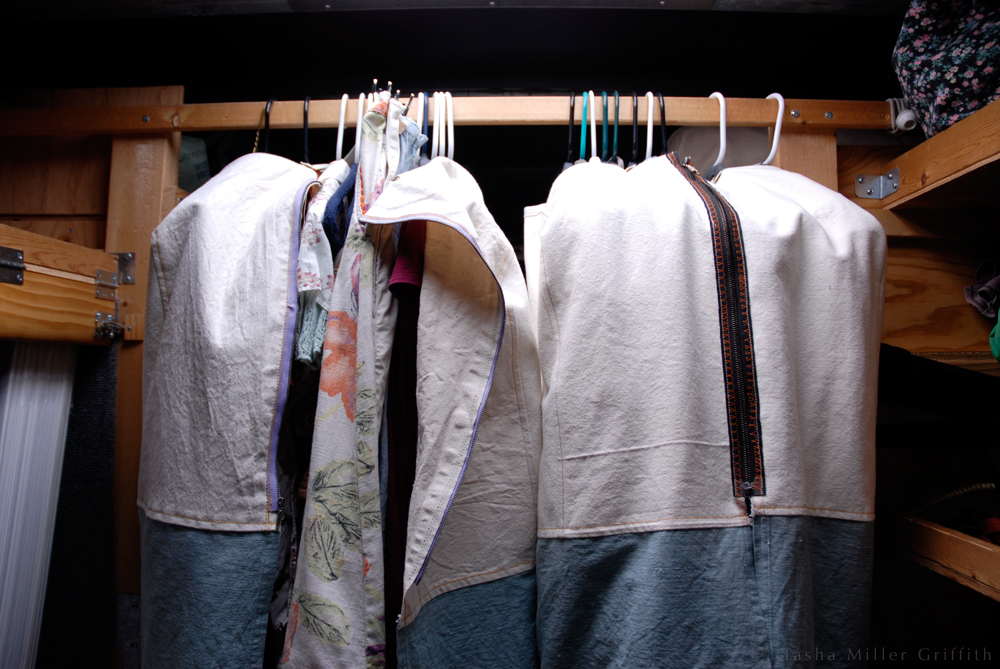
Our clothes spend a fair amount of time in a “closet” consisting of a thin strip of wood between the shelves we have built into our truck.  It’s much better than keeping them in a suitcase, but still not ideal since they are unprotected.  At the end of last summer, when we unpacked the clothes from truck to house, I noticed that one my jackets was significantly more faded on one side than the other.  Maybe hanging it with the same side to the skylight for the whole summer was not the best idea?  The same thing happened to Bryan’s jacket, so I’m pretty sure that extra UV light on one side was the problem—combined with the fact that it was warm last summer and the jackets didn’t come off the rack very often.  I had been thinking vaguely for a couple of years about making some kind of garment bags to protect our clothes from getting dirty/scratched up as we move things in and out of the truck, especially as I have started to take more me-made garments on the road.  This was the final straw, I had to do it.


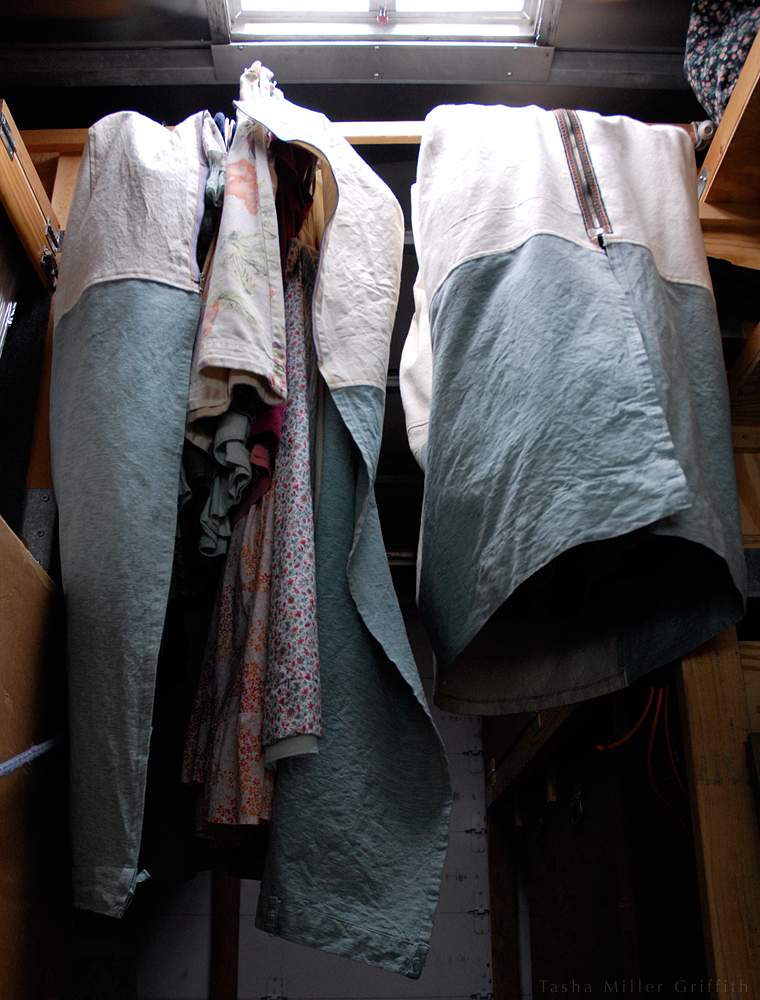
garment bags hanging 2


I decided to make two, each half the width of our “closet.”  One would be slightly longer than my summer dresses, and the other just long enough to protect shirts and pants.  I traced a plastic hanger for the shape of the sides, and left a split in the front to close with a zipper.


This was the perfect scrap/thrift store shopping project.  Since it didn’t matter exactly what the garment bags looked like, as long as they worked, I could use practically anything.  I used the last of some heavy canvas from old curtains that came with our house, plus another small curtain (made out of some great textured blue-green fabric) that I bought at Goodwill.


garment bags hanging


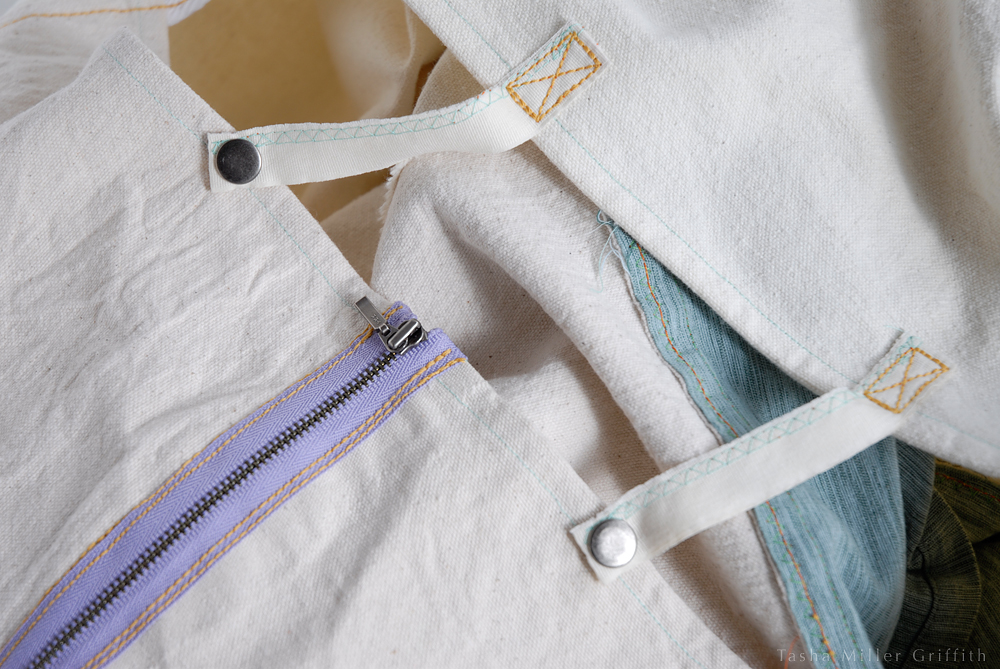
This may seem like a strange project to wax poetic about, but here’s the thing: as I cut myself loose from trying for aesthetic perfection, not caring what anyone would think of my topstitching or pieced fabric, sewing felt more like sculpting; using what I had on hand, and my hands, and just making something almost like I was pulling it out of the air.  I was free to use my creativity in any way I wanted, to use whatever I could find, odds and ends of colored thread, salvaged zippers (really nice ones actually)—and I started to see an unexpected beauty in my intentionally imperfect stitching, one that I hope comes through in these photos.  I was free to do whatever I wished, and yet cared enough to add little touches and experiments.  I was trying things, enjoying the process, and making something useful as I went.  With enough practice behind me to be comfortable with fabric and thread, I was able to just play, and it felt pretty magical.


garment bag snaps


garment bag corner stitching


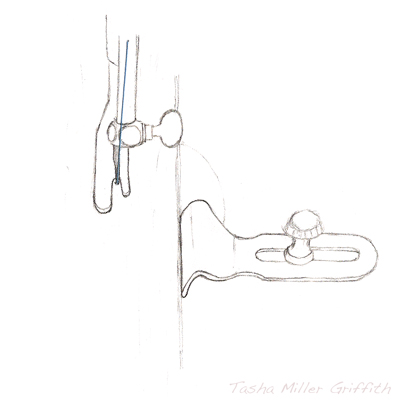
Around the same time, as we both worked on various projects for the truck and Bryan’s display before the summer season, he was refinishing the director’s chair that he uses in the booth.  He did a really nice job, dissembling and sanding the chair before applying the new finish.  After all that, I decided it needed a new bag to protect it from getting scuffed all over again as it’s loaded in and out.


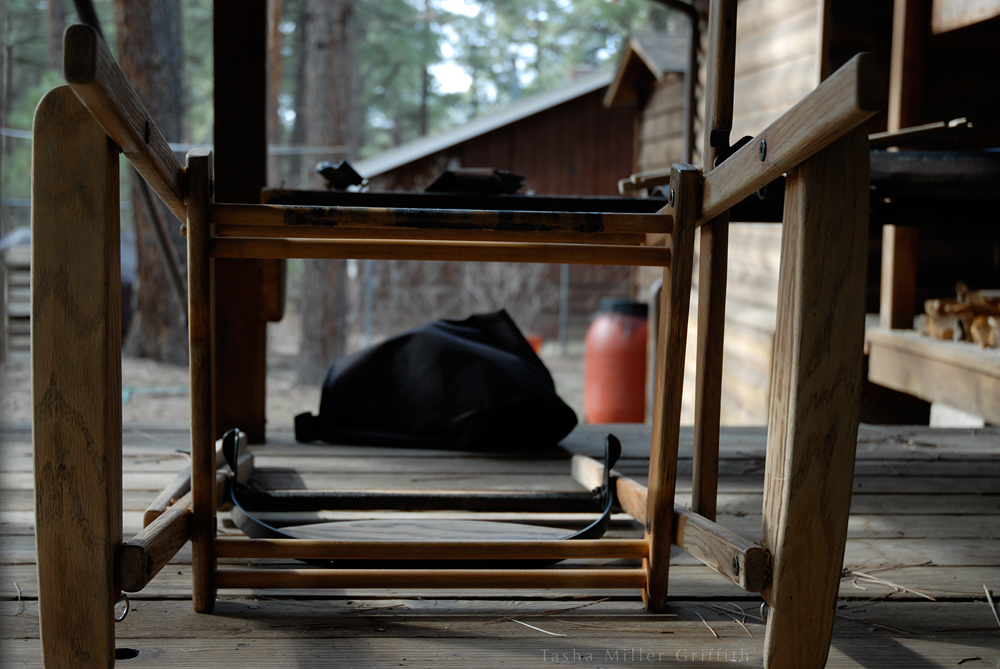
disassembled chair

Chair in the process of disassembly—we’re looking through where the seat would be.


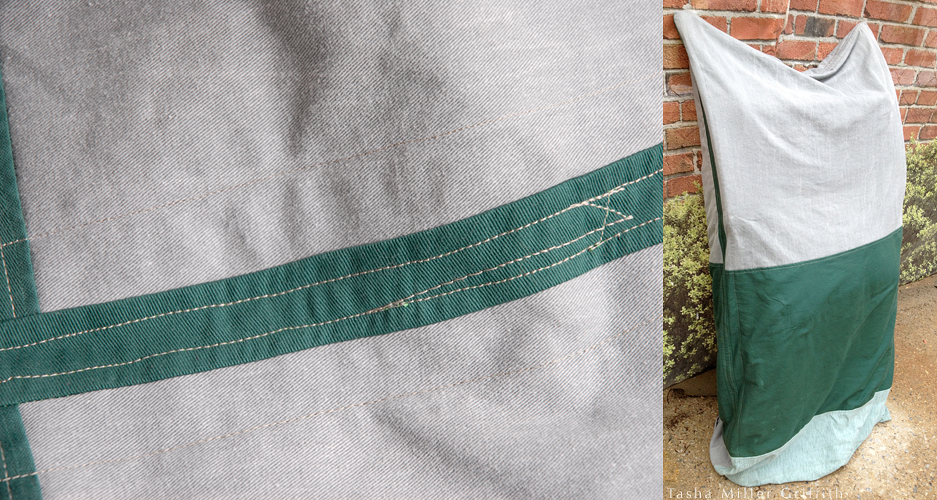
I went back to the thrift store looking for something to line my chair cover with.  I loved searching through the housewares section, looking at everything as a material instead of a finished product (always my favorite kind of shopping), and letting the serendipity of what I found help shape my project.  I decided on two vintage towels for padding the front and back, and a second-hand piece of fabric to round out the outside.  I think the green stripes with my other leftover fabrics make it look like something for sailing.


When I announced that I was going to spend our penultimate evening in Flagstaff sewing (this chair cover), I got an enthusiastic “Ok!” from my notoriously goal-oriented husband.  Remind me to try this trick again next year . . .


chair bag stitching


It’s weird, but having all these me-made covers on our travels this season has been quite a boost to my morale.  Every time I see them, or touch them, I’m reminded that I have a spring of creativity and ingenuity which I can use to make whatever I want, and whatever I need.  That’s pretty much all I need to feel good about life in general.


How about you—have you done any creative and/or freeing projects lately?


Giveaway and Sewing Tips from Me on Sew,Mama,Sew! Today
 

smsseamguide


I’ve been waiting to see what questions everyone would ask on Sew,Mama,Sew! this week.  I admit that I was a little nervous, kind of like when I first started teaching sewing years ago.  What if someone asked a question that I totally didn’t know the answer to?  Actually, I did get one—but it was a very specific one about piping around corners on a pillow, and since I’ve never done that, I think I can be excused.  In general though, all the questions were great!  And really relevant for beginners.

If you’re wondering about the tension on your sewing machine, or how to clean and oil it, I talked about that.  If you have trouble sewing around curves, or with slippery fabric and knits, I’ve got some tips to help you out.  If you’re not clear about when to finish fabric edges and how, I covered that.  And at the end, there are a few resources to help with fitting and selecting interfacing.  Most of the answers were excerpted or adapted from Hello Sewing Machine, where of course you’ll find a lot more answers to basic sewing questions.

Phew!  Thanks to everyone who wrote in with questions, it was great to see what readers were curious about.  You can read the answers over on Sew,Mama,Sew! today.

Plus, I’m offering both a chance to win a free copy of my new e-book, and a coupon code for a discount if you order one on Etsy, so go check it out!

decoration spool 1


Stamping on Fabric – With Hand Carved Stamps and Household Objects


Ok, so now you have a hand carved stamp.  Or, maybe you don’t yet.  How about stamping with something you already have around your house?  And, what gets me excited about either of these options: being able to use them on fabric and clothing.


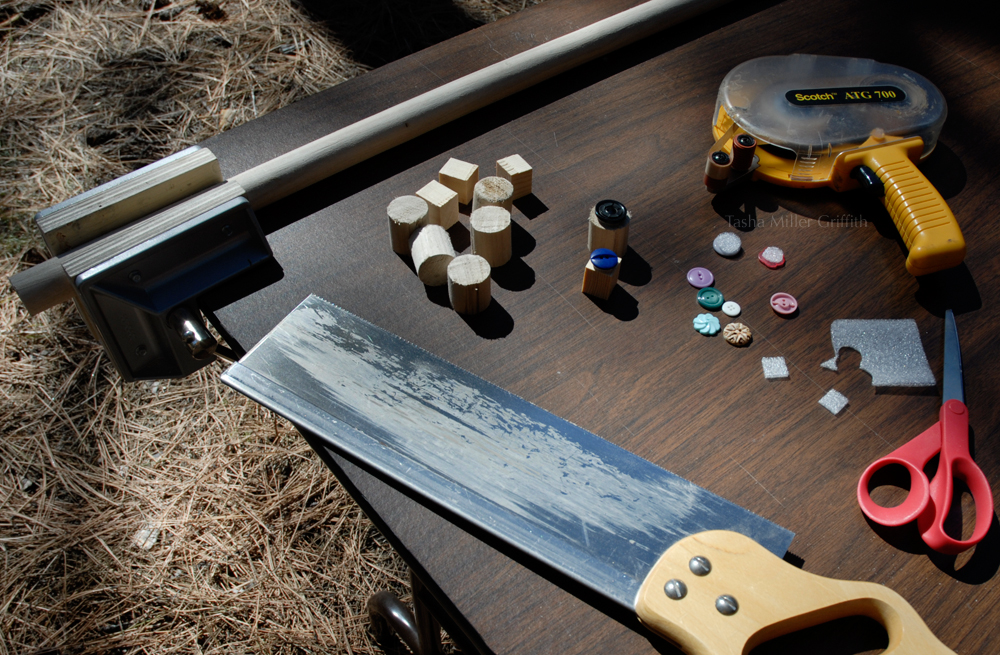
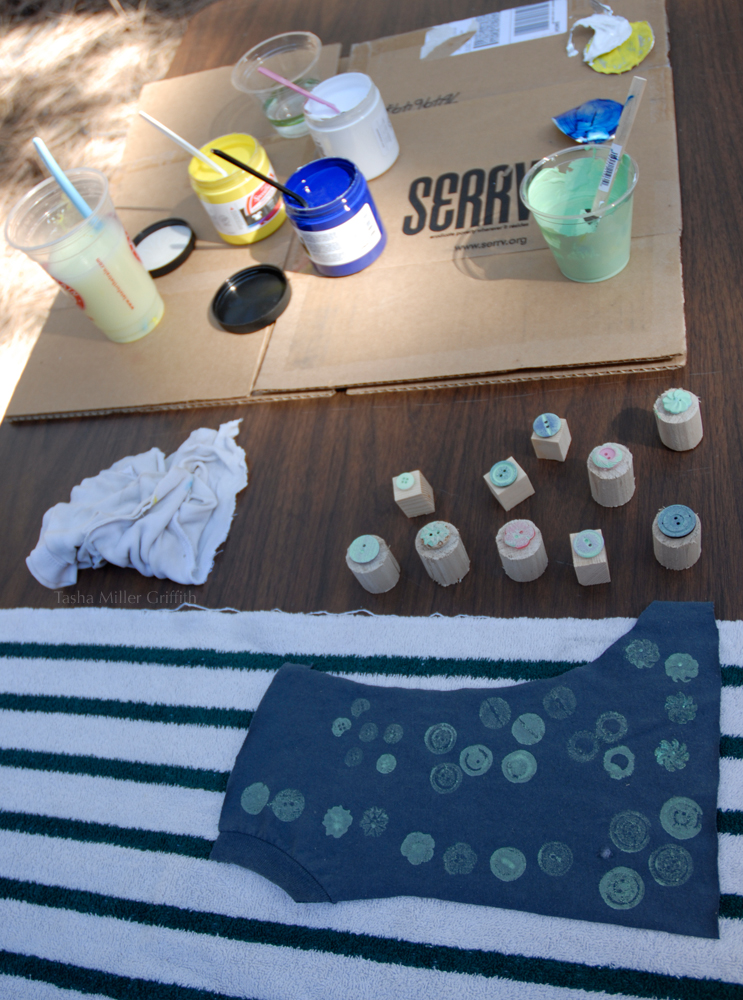
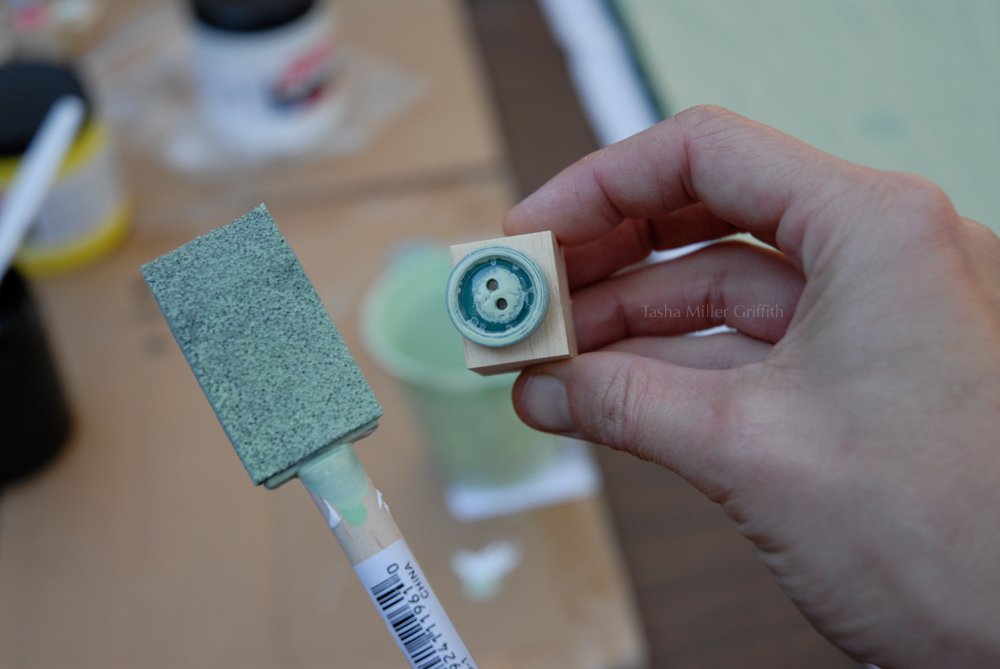
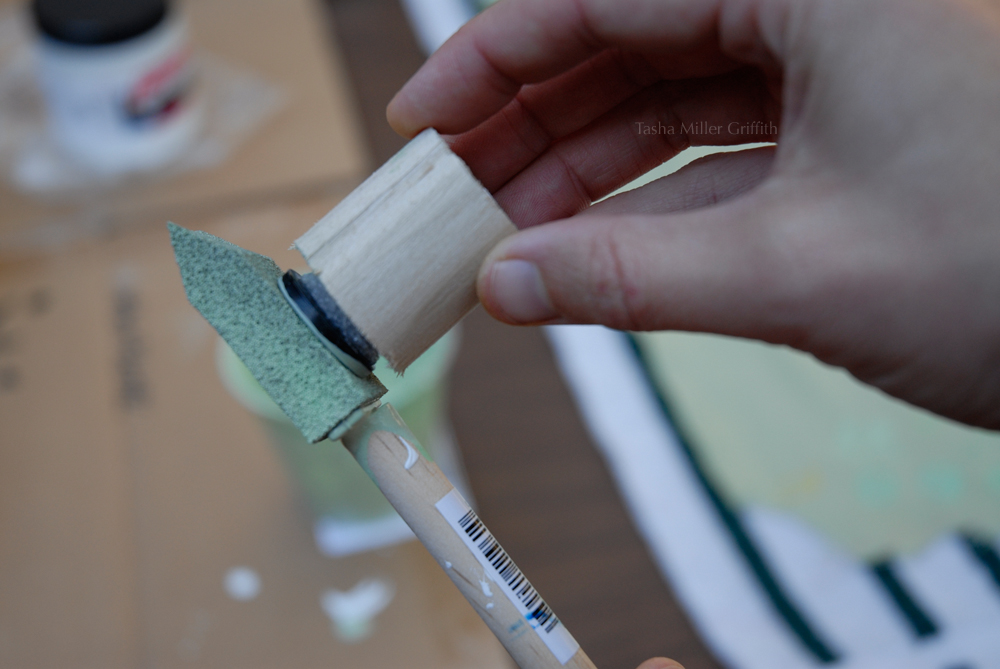
Before we discuss fabric ink and stamping, let me talk briefly about how I set up these buttons as stamps.  I got this idea from a really creative slideshow (on Martha Stewart of all places) which illustrates using all kinds of things you might find around your house to make some interesting designs.  My favorite was the buttons.  Some things already have an easy point to grab them by without getting your fingers covered in ink (like long pieces of wood, which you can see printed in the top photo), but buttons, not so much.  I cut some pieces from a leftover dowel and a small wood block, just using a clamp and a handsaw, they don’t have to be perfect in any way.  I did some quick online research and a couple of sources suggested using some kind of foam to back your stamps, to give them a little more give for even printing.  This seemed like a good idea since buttons are pretty much hard to begin with.  I used tiny pieces of dish packing type foam (we get it as packing material with some supplies) glued to the back of each button and its piece of wood with ATG, which once again I borrowed from the photo studio.  You can use any type of glue as long as it will hold the object and be water-resistant enough to be rinsed after you stamp.  And, you could use just about anything squishy for the foam, just cut the pieces smaller than your object, otherwise the edges of the foam may print.


Ok, time to stamp!  For ink, I used Speedball Water-Based Textile Screen Printing Ink.  I have gotten it from Blick, local art stores, and chain stores.  On the jar, it just says FABRIC Screen Printing Ink, but if you look on the side it also says water based and non-toxic.  I really like that you can thin this ink as much as you want with water, and you don’t have to worry about it if you get it on your hands, which is pretty much inevitable.  Plus it is permanent on fabric with heat setting.  It comes in lots of colors.  I like to mix my own using the three primary colors; the “process” cyan, magenta, and yellow will give truer mixing results than the regular red blue and yellow.  You’ll also need white and black.  A tip I learned from Lena Corwin’s book Printing by Hand (I highly recommend this book if you are interested in more about printing!) is that mixing in a little of both white and black will give you a more subtle color (less screaming bright) and I love subtle colors.

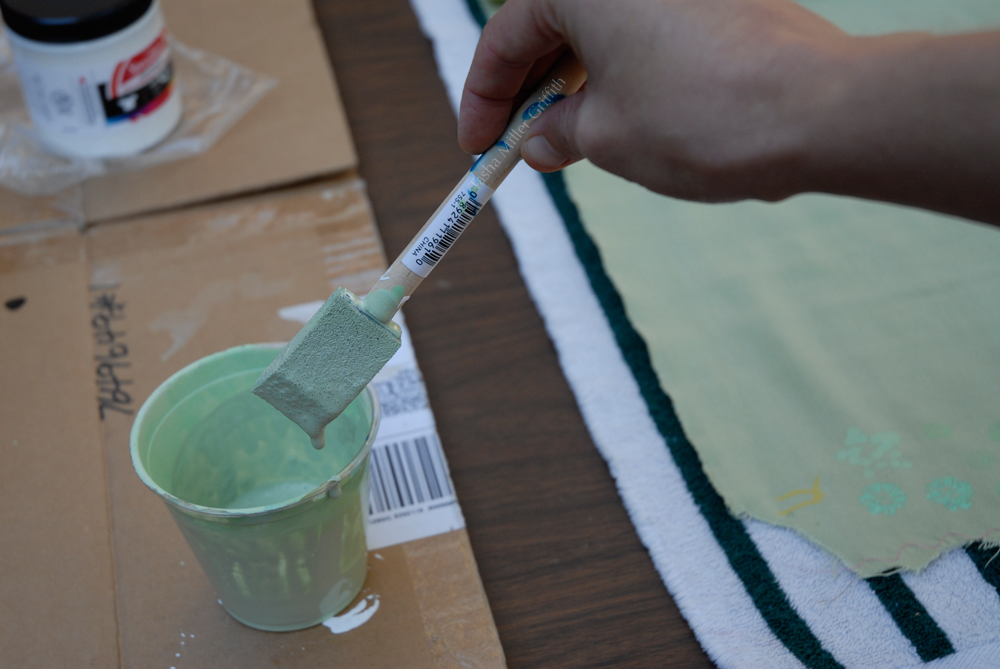
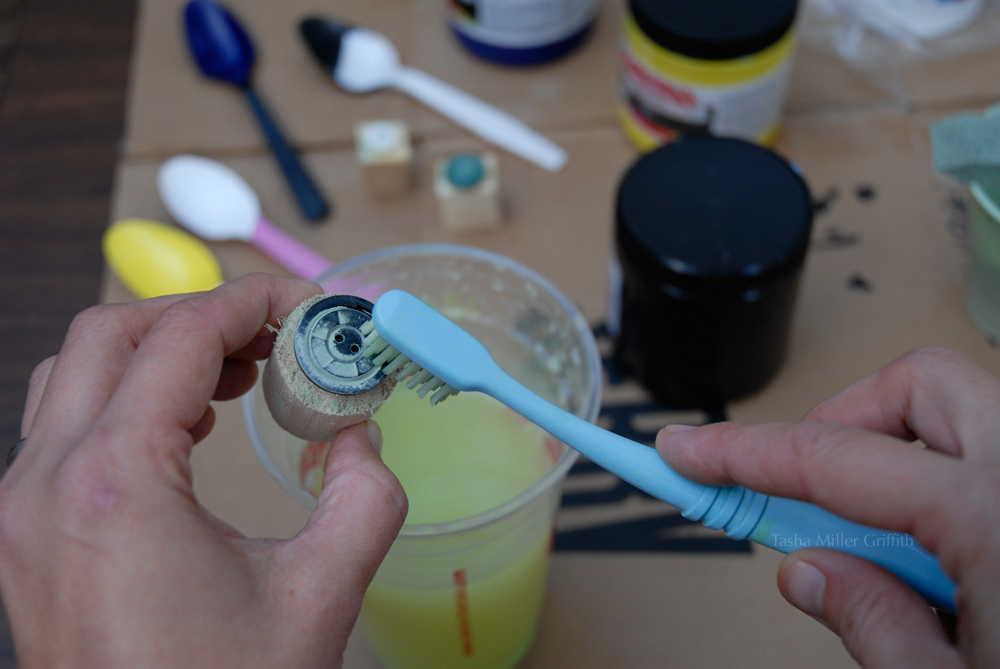
To set up for printing, you’ll need ink, a little water for mixing, and more for washing things off (a big cup full with an old toothbrush for scrubbing is perfect) and a wet rag to wipe your hands and tools on after you rinse.  It’s easier to print on thin fabrics if you put down an old towel underneath to give the surface a little more give, which can allow more details of the stamp to print.  Putting all this on a big table you can wipe off is ideal, and it’s nice to have something under the messy ink part to catch drips.  I used a box since I figured it would still be good for shipping with ink on it.  I used one spoon to get out each color, one to mix my color with, and a small foam brush to hold the ink for stamping.  I let the spoons dry when I’m done, and wash the foam brushes to save for the next time.


When mixing ink colors, start with as little ink as you can, you’ll add more as you decide what to add to get the color you’re looking for (a color wheel can help here), plus you’ll be adding water, and stamping doesn’t take very much ink in any case.  Keep in mind that the ink will dry slightly darker in color than it looks wet.

Having scrap fabric to test on is essential!  The closer the fabric is in type, weight and color to your intended project, the better you’ll be able to see how the stamps are coming out.  For this project, I just used a small section on the edge of my fabric for testing, changing the color or the dilution of the ink a little bit at a time and waiting a couple of minutes to see how the results looked as they dried.

I like the ink to be absorbed into the fabric so that it doesn’t leave a hard or crunchy surface, but looks more like a dye.  To get this effect, I add water until the ink slowly drips from the foam brush when I lift it up.  The consistency you want may vary with your fabric, again, testing is key!


Here is my best fabric stamping tip: squeeze the ink out of the foam brush until it’s not dripping, and only releases ink when you press on it, like a stamp pad.  Then, gently press your stamp or object against the sponge to get a coat of paint.  You can see which parts are going to print by where the ink is on the stamp or object.


Keep the foam brush in one hand, and bring your stamp back to it for a fresh coat each time you print it.  The sponge will hold enough ink for a bunch of stamps before it needs more from the cup.

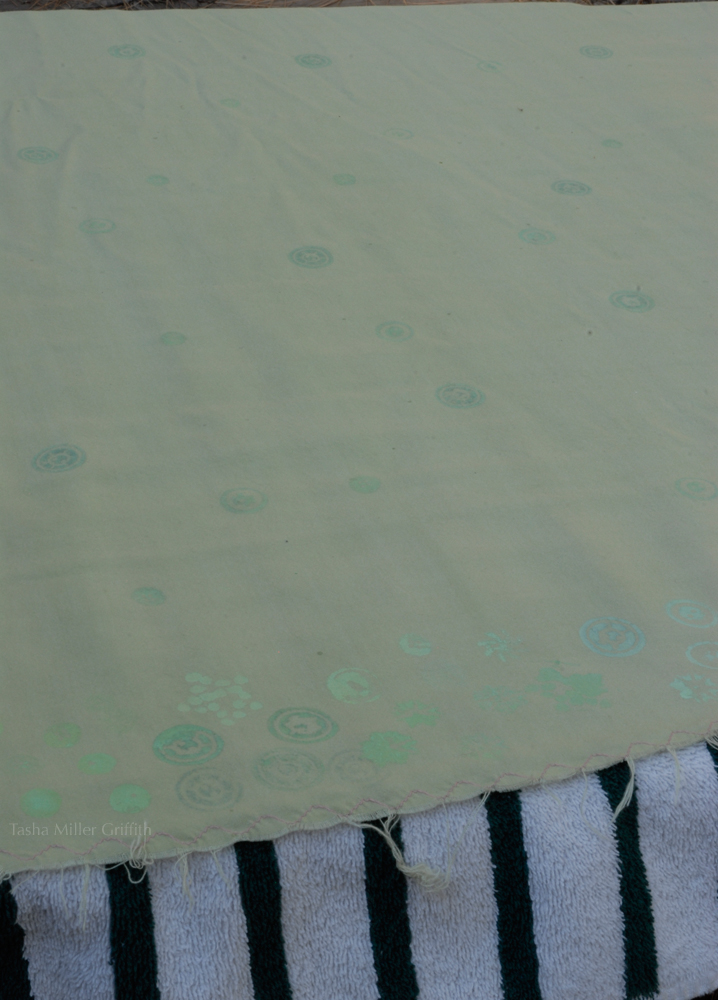
I found that a light coating of ink, and a soft rolling motion against the fabric with each stamping helped the full possible detail of the buttons to print.


That’s about it!  I place my stamps pretty much randomly, alternating whichever ones I am working with until I get a design density that I like.  It helps to step back and take a look, especially if you are printing something big that you can’t work on all at once.

For troubleshooting, take a look at the very top photo (click to enlarge it).  If you have too much ink on the stamp or the ink is too watery, it will spread out all around your stamp and the detail of the design will be lost.  Clean the stamp off, squeeze more ink out of your sponge, press it gently on just the surface of the stamp and try again.  If it’s still too flowy, add more ink to your color to reduce the water content.  If you don’t have enough ink on the stamp, you’ll get a pale ghost of an image.  If the ink is thick, like it comes out of the jar, it will dry harder and raised on the surface of your fabric, which you may want, depending on your design. If your fabric is wrinkled, iron it before you start.  Soft wrinkles won’t get in the way too much, but if you stamp over a crease, you can see it when the crease opens up.

One last troubleshooting thing: some objects print better than others.  Some of the buttons I tried had details too fine to print, but this will depend a lot on what fabric and how much ink you use, so test it out!


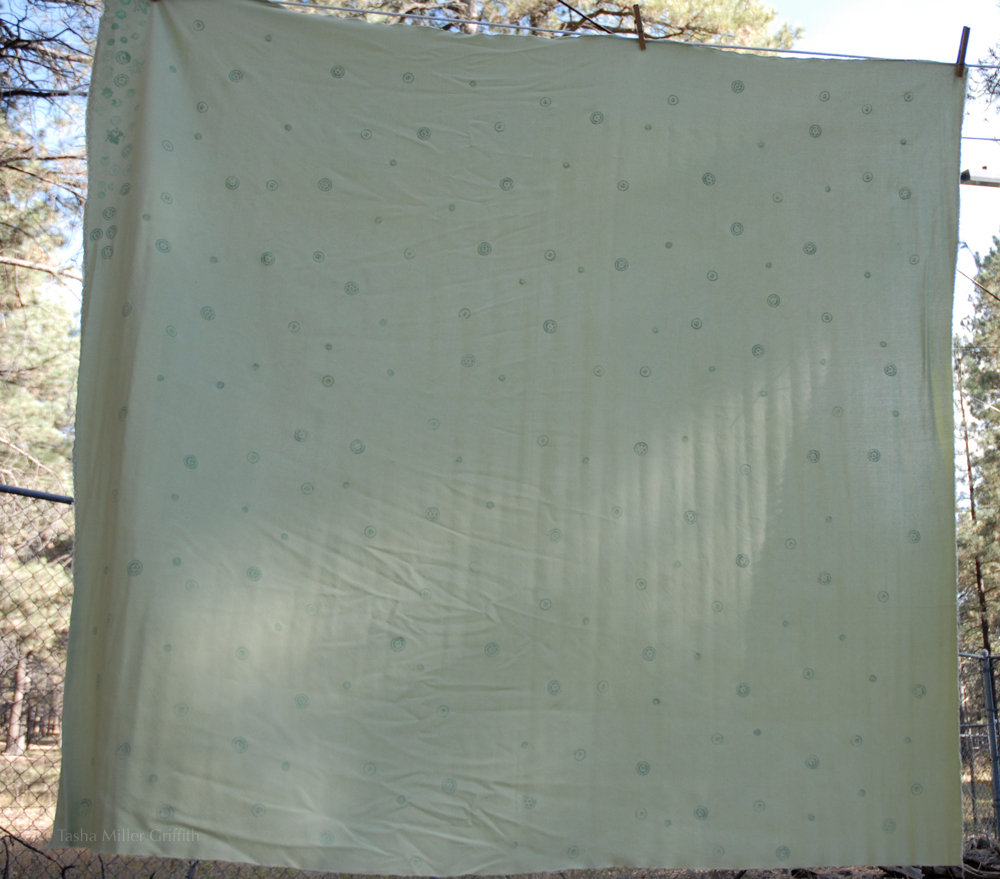
Here’s my finished button printed fabric.  I think it may become a skirt.


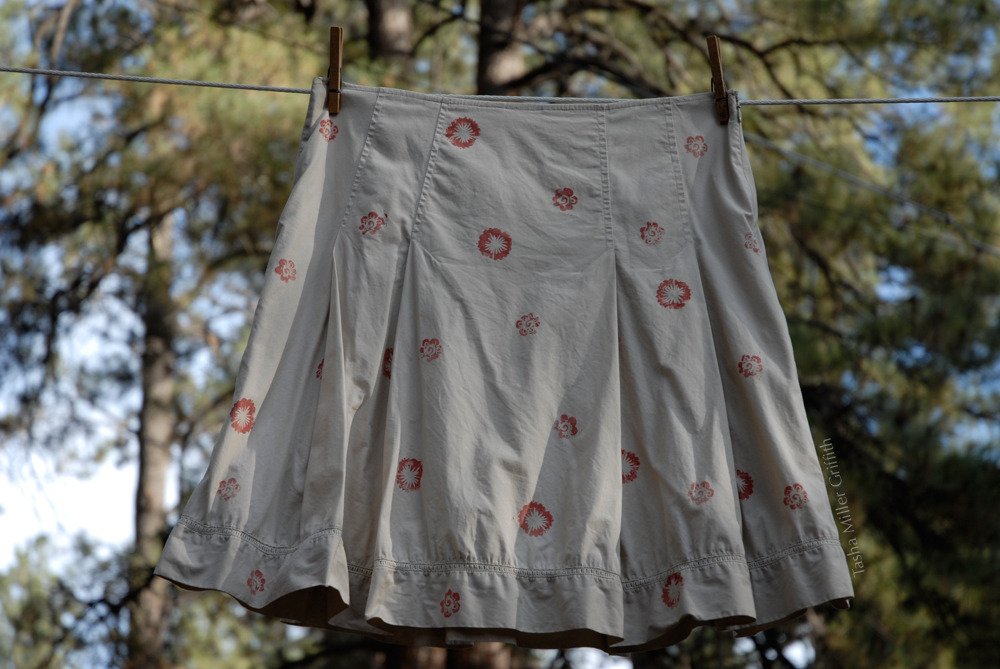
Stamping is also awesome for reviving finished clothes or linens that are a little too plain.  I used some of my aunt Barb’s hand made stamps to decorate this previously just beige thrift store skirt.


While your stamped fabric is drying, it’s worthwhile to clean off your tools, since this ink can eventually clog your stamps if left to dry.  Using the old toothbrush and a little water from your clean-up cup works great.

Next time, I’ll post about heat setting the ink, lots of options for this important step that makes the finished product washable!  Plus, a little bit about “green” crafting and less waste from what we make.

In the meantime, have you tried something similar?  I’d love to know what you did and how it came out!


It’s the Colors . . .


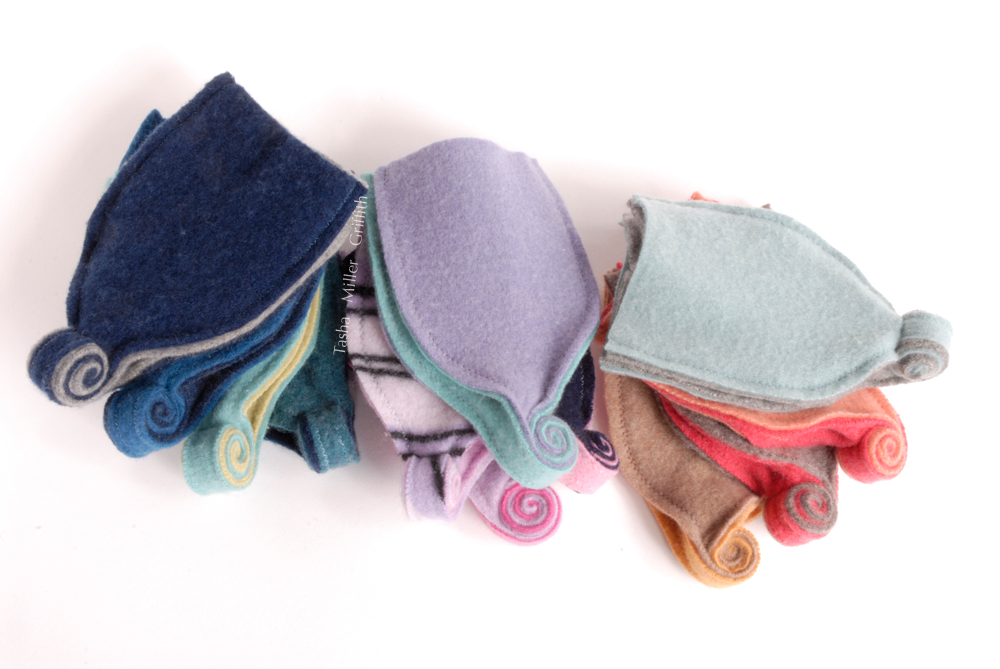
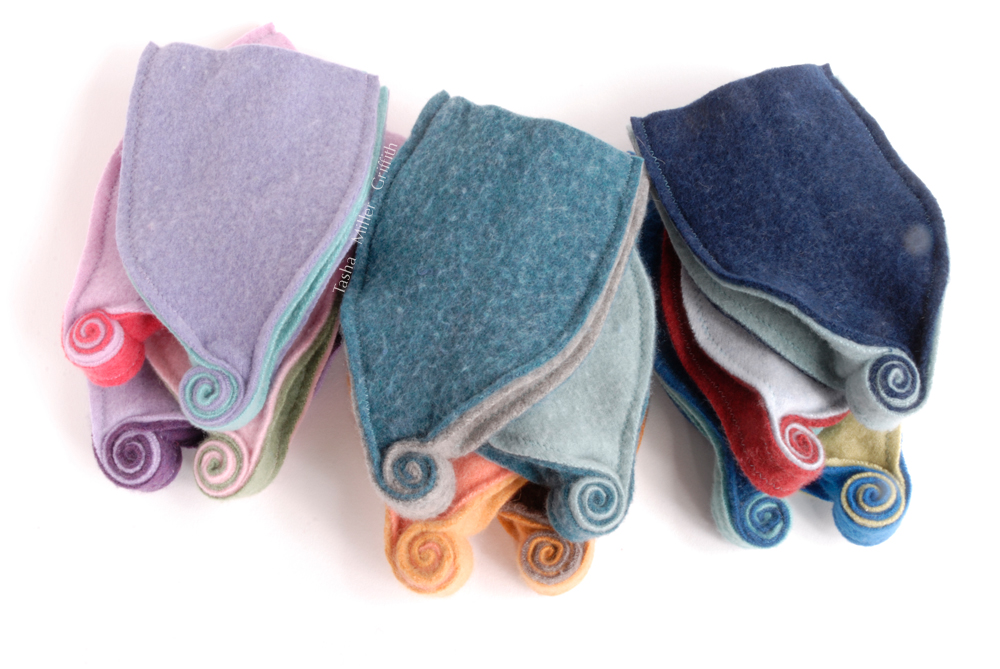
Right now it’s the time of year for big orders from the shops that sell my little fuzzy hats.  After 400 or so of these suckers all told so far, you’d think I would be sick of them.  I still like this design (if I only I could come up with a few more that were as cute and efficient!) but mostly, what keeps me coming back is:


I love picking colors that don’t just go together, they make each other sing.  These remind me of a dusky southwest sunset.  This is what I do when I’m making the hats, I stare at the colors.  Luckily, using recycled materials means there are new colors every time, new ones to find and play with.


As a kid, I would spend hours looking through my mom’s embroidery floss, not really wanting to make anything, just enjoying the colors, they each seemed so vivid and lovely, they lived grouped together in their families in neatly numbered plastic bags.  I remember wishing there was fabric, or something I wanted to use, in all those colors, but not knowing what I would do with it if there was.  I’m still figuring that out . . .