Basting: Thread Magic


new backstitch 1


I kind of feel sorry for anyone who doesn’t like basting, or thinks they don’t.  It’s a like a magic wand for your sewing.  It keeps things exactly in place for exactly as long as you need it, doesn’t distort your final sewing, doesn’t need to be removed as you go, and can be pulled out when you’re done, leaving no mark behind.

I fell in love with basting many moons ago, while sewing a collar onto a button-down shirt.  I had all the layers of shirt and collar scrunched together ready to sew, and no matter how many pins I put in, the fabric kept shifting under the sewing machine as I went and getting terribly uneven, and/or folding over and catching pieces of the shirt I didn’t want in the seam.  After ripping it all out and starting over two or three times, I decided to baste it in by hand and see if that was any better.  Held by the basting, the shirt and collar seam went through the machine without a hitch, as nice as I could ask for, on the first try.


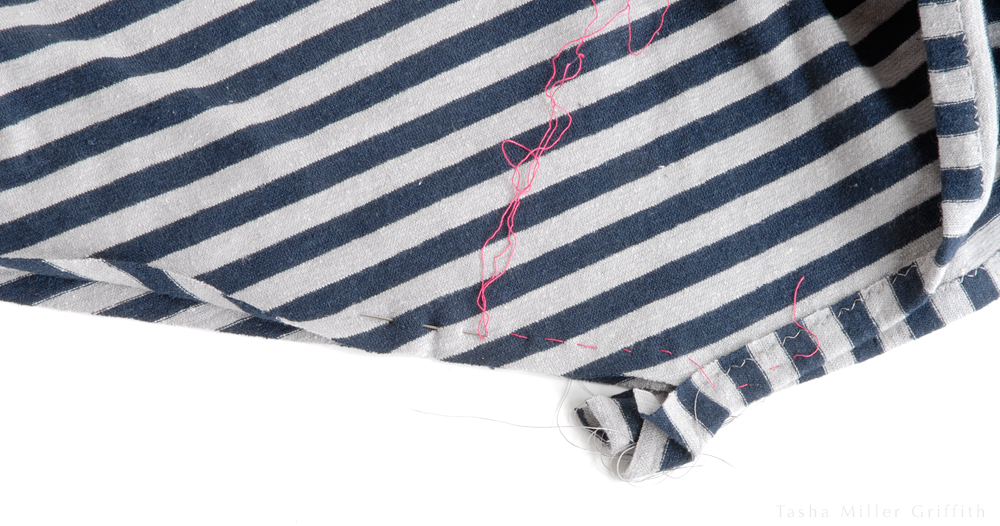
basting stripes


Basting just means any kind of temporary stitching, meant to hold fabric in place until you can get the final stitching done.  The advantage is that the basting doesn’t have to be neat and even, or strong enough to hold up with wear, so you can concentrate just on the fabric while you’re basting, and then just on stitching when you’re sewing the final seam.

If I’m in a situation where I want basting, usually it’s because I need more precise control over the fabric, so I baste by hand.  To baste, simply sew running stitches (illustrated at the top).  The stitches can be pretty big and uneven—concentrate on the placement of the fabric layers with each stitch, rather than the stitches themselves.  I like to begin and end with a backstitch, just to keep the basting from pulling apart until I’m done.

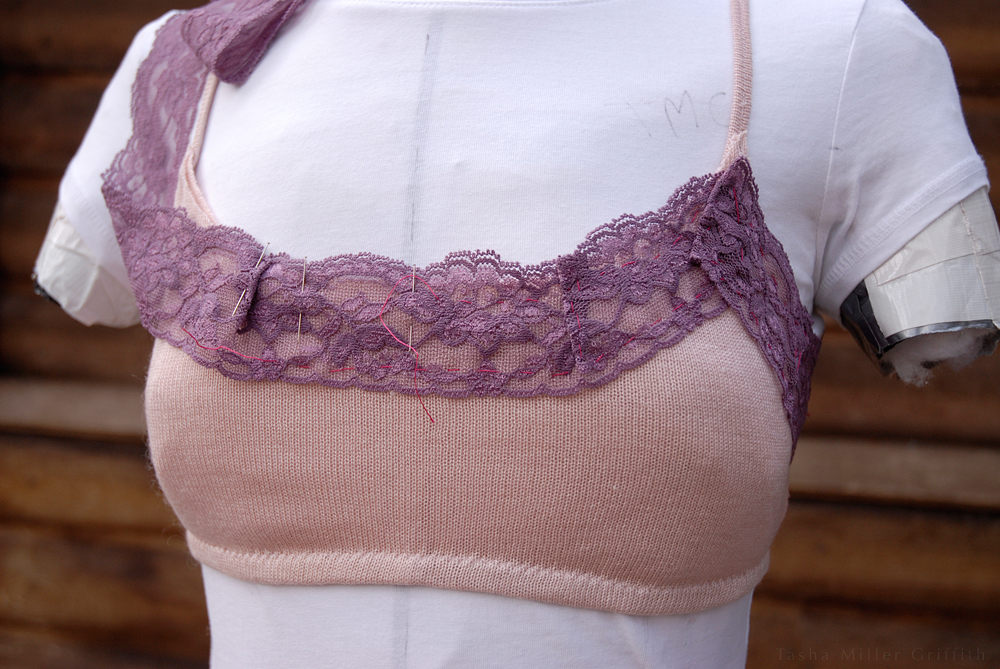
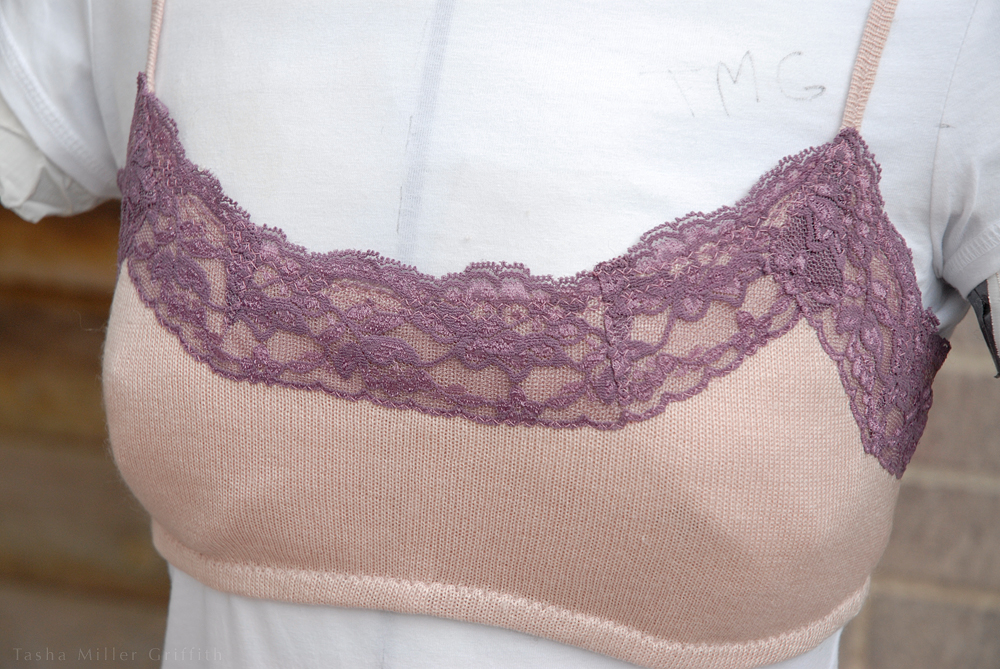
Some good places to use basting are: when you want things to align exactly (like matching stripes), when there are a lot of shifty layers (like the collar seam), or any other time when you want to make sure some part of your project will stay in place while you sew it.  For the soft bra below, I knew there was no way the lace would stay in the folds I wanted against the fabric if it was held only by pins.  Plus, basting allowed me to put everything together on my dress form, seeing exactly how the lace would work on a body, and then take the whole thing off the form and sew it.


basting lace on form


finished soft bra lace


It worked great!  When you’re done with the final seam, you can remove the basting easily.  Pick out the backstitches at the ends and grab one thread tail, then you can often pull out a long basting thread with one pull.  Unless of course you sewed over it in the final stitching, but no worries, that happens.  Just pull out what you can at once, you may have to cut and pick out a few small thread bits.

Although it may sound like a technique for more advanced sewing, I definitely recommend basting for beginners too.  When you’re just starting out, learning how your machine handles fabric, especially in tricky situations, isn’t easy.  You can baste practically anything that you just can not get to stay in place while sewing on the machine, get much better results, and save yourself a lot of frustration.  According to The Mary Frances Sewing Book, back when most garments were sewn by hand, it was more efficient to baste a seam first, and then sew it, than to sew the final stitches while trying to keep the fabric layers in place.

Best of luck with your sewing!


Thoughts about Sewing, Empowerment, and Body Image


As we near the end of Me-Made-May, it seems like a good time to share some thoughts about sewing, empowerment, and body image. Although I get a huge boost of self-sufficiency when I’m wearing the clothes I made, I actually don’t think much about sewing as it relates to how I feel about my body. Except for when I’m making pants. I originally wrote these thoughts as part of a proposed series on the Colleterie, which didn’t get off the ground, but it seems a shame not to get them out into the world. I thought about a lot of this again just recently when I was working on my trousers.


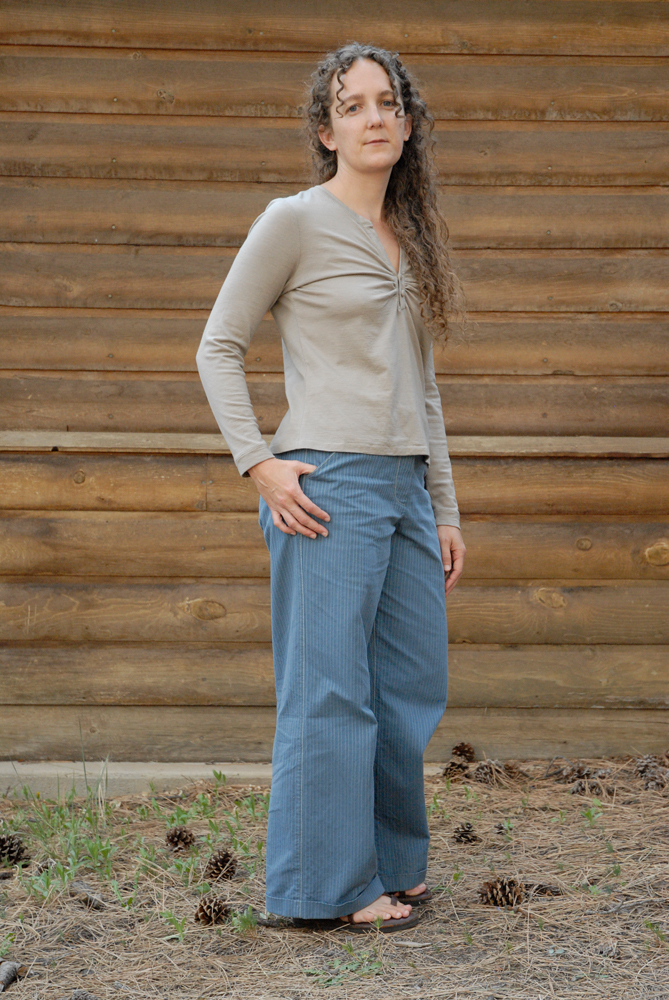
blue stripe trous and wool knits 4


I’m lucky that when I was growing up, my parents always stressed that I’m just fine the way I am. I’ve never had a really negative image of my body. But I have always had trouble finding pants that fit at all, or were remotely comfortable. I would describe my figure in a nutshell as small and pear shaped. When I’m good about exercise, my thighs get firmer, but they don’t exactly shrink. In fact, in High School, when I was doing lots of power yoga every week, and in the best shape I’ve ever been, I just about gave up wearing pants altogether. It wasn’t worth it; they were just too uncomfortable. I have a vivid memory of sitting in class wishing I could just grab the top thighs of my jeans and yank upwards, and that the seams would pop down the sides, releasing my legs.  I never actually tried it, but after that I stopped wearing jeans.


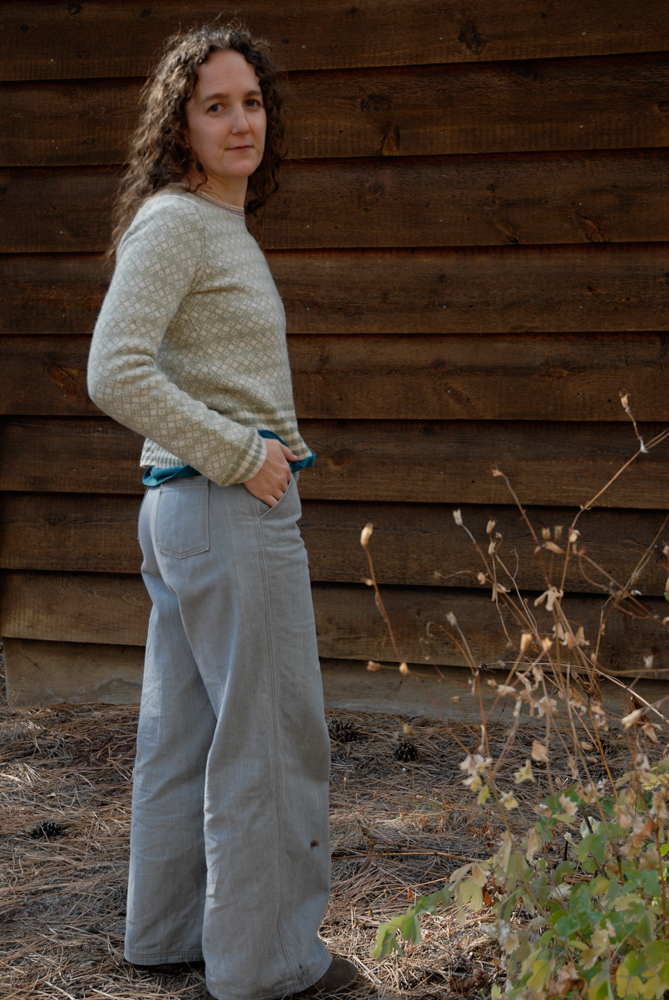
grey pants side


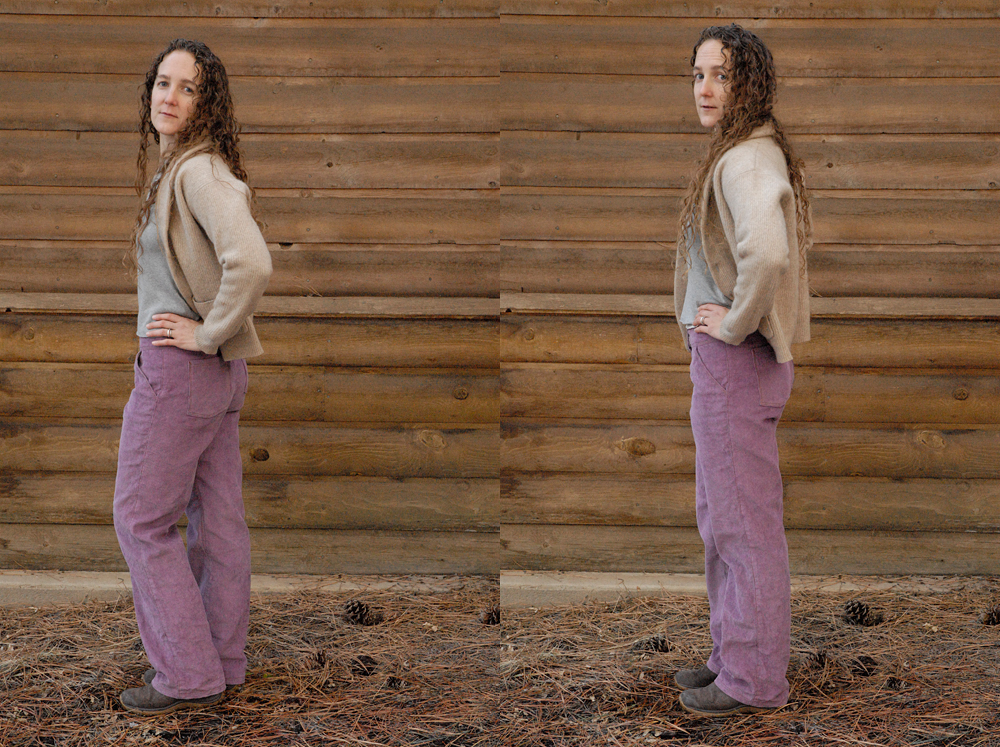
Since then I’ve explored my style, how it relates to my body, and to how others see me, through my sewing—starting with long skirts. As you know if you’ve read this blog for a while, I’ve also been working on and off for years on pants that actually fit me. It wasn’t until I was making the purple pair that I realized how much not being able to find clothes that fit or flatter could affect my conceptions about my body. Those purple pants aren’t perfect, but they show off my shape and are comfortable—a miracle to me. When I’m standing in front of a dressing room mirror and no pair of pants I try on looks good or feels right, I think that encourages me to feel like I need to change, like my body is not right. I was fairly amazed at how, looking at my legs in these new me-made pants, it was so much easier to say, “I love my body! It’s so cute and curvy!” It’s not my body that needs to change—it’s the pants. From my hair to my thighs, I’ve had the best experiences with my body when I realize not only that I can’t change something, but that I shouldn’t be trying to change it, that the beauty the universe gives me is for me to embrace and to work with, not to fight. And I can only do that if I’m willing to think outside the box, to take the time and develop the skills I need to get what I really want and need.


purple cords side


To me sewing, and making anything, is all about empowerment. Since I sew, I can break free from the consumer culture that gives me limited choices, while at the same time encouraging me to find fault with everything, in order to sell me more cheap stuff. Sewing is a way out of that cycle, and also a way in to a deeper and better understanding of my own body and taste, my personality, my unique self. Perhaps the best part is that this kind of freedom is available to anyone who wants it, anyone who’s willing to can their own jam or sew their own jeans.  Let’s go get it, people!


Things I’ve Sewn: Blue Stripe Trousers


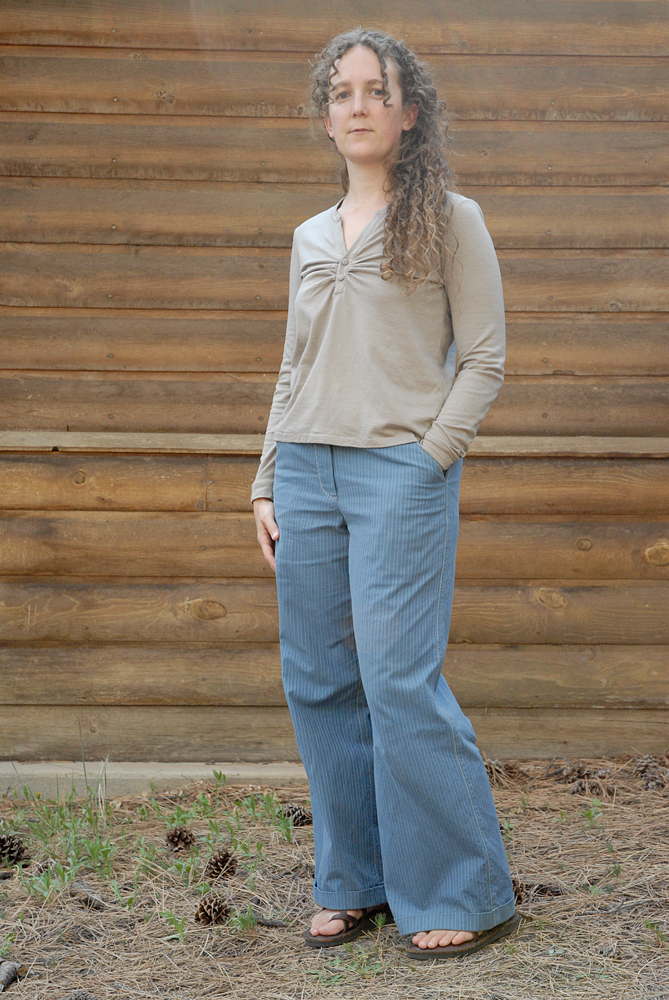
blue stripe trous and wool knits 1


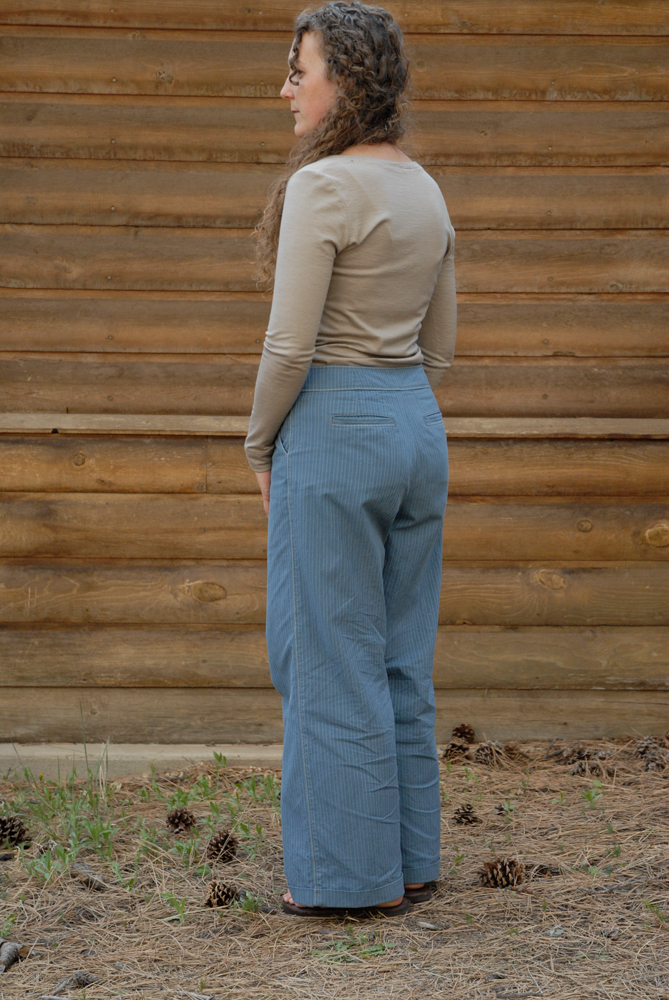
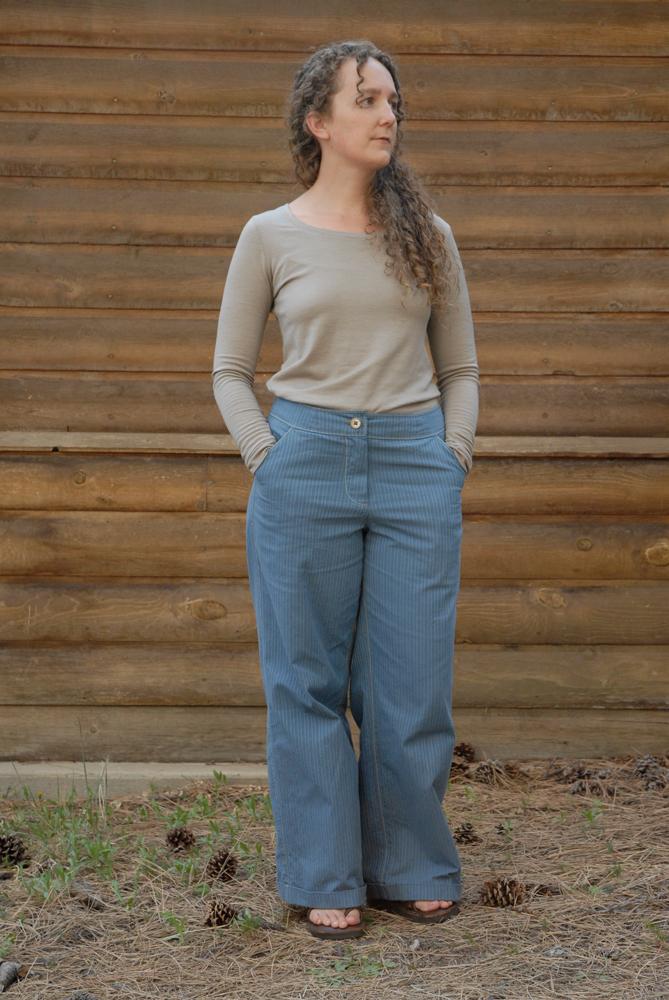
So, after talking about these tops last time, it’s time to talk about the pants!  They’re more of a trouser style (which is good since folks on both sides of the pond can agree what “trousers” means, right?).  I bought this fabric last summer at Nob Hill Fabrics in Albuquerque.  I wasn’t 100% sure about it for trousers, but it looked promising.  In truth, I am not 100% sure about it for trousers now.  But, after the untimely demise of my fantastic purple corduroys (so sad!) I really needed a new pair of pants nice enough to wear at shows (in public where I am supposed to look somewhat professional, or at least not like a bum off the street).  The odds of my finding a pair to buy that fit and that I like are close to zero, so I pulled out the blue fabric.


A pattern epiphany

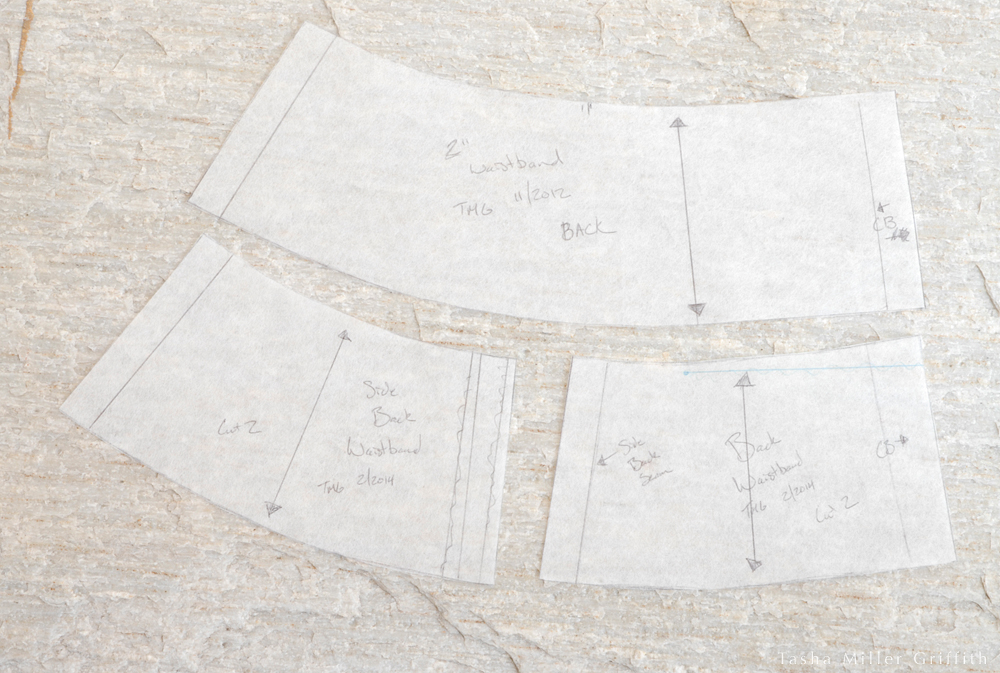
While I was cutting it, something pretty cool happened.  As I looked at the back waistband pattern, I got a sudden flash of insight: this piece is trying to take in too much curve, and it would be much better as two pieces, with a seam in the middle as well!  So I traced it into two pieces which matched the existing width at the bottom of the waistband, and took in a little more at the top.  If you do this, don’t forget to add seam allowances to the edges at the new seam!  This approach fit the shape of my body so much better that I ended up doing the same thing on the front, so that I now have four waistband pieces instead of two.  A step forward in fit.


pants waistband back pattern pieces


Fitting

This is the next evolution of the traced from-existing-pants-and-extensively-altered pattern I used to make the grey pair.  The main problem with those is that they are a little tight around the crotch seam, especially when I sit down.

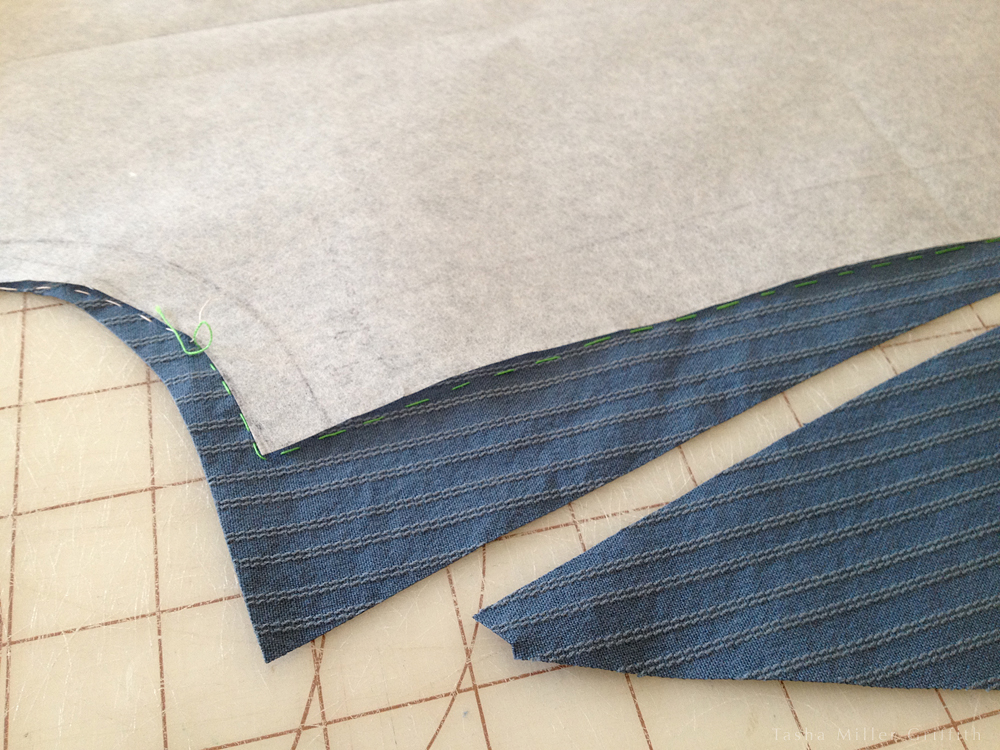
I will say that I’ve gotten a lot better at diagnosing what needs fixing in the fit of my trousers in the last year or two.  At first, the fact that every part of the fit affects every other part made it nearly impossible for me to tell what I should change.  But now, after fitting a few pairs, when I try some on I can feel which seams need more or less fabric in order to be comfortable and fit my shape.  So I already knew (from wearing the grey pair) that I needed to let out the front inseam a fair amount.  I wanted to cut the fabric outside of the pattern to make sure I would have enough in that area, so I decided to trace with thread the outline of the pattern.  That way I’d be able to see where my new seam is in relation to the pattern, and transfer my changes back to it for next time (I can always add more paper to the pattern using this method).  This worked great, I could see right where the pattern line was as I worked on the fit.


blue stripe trous cutting inseam


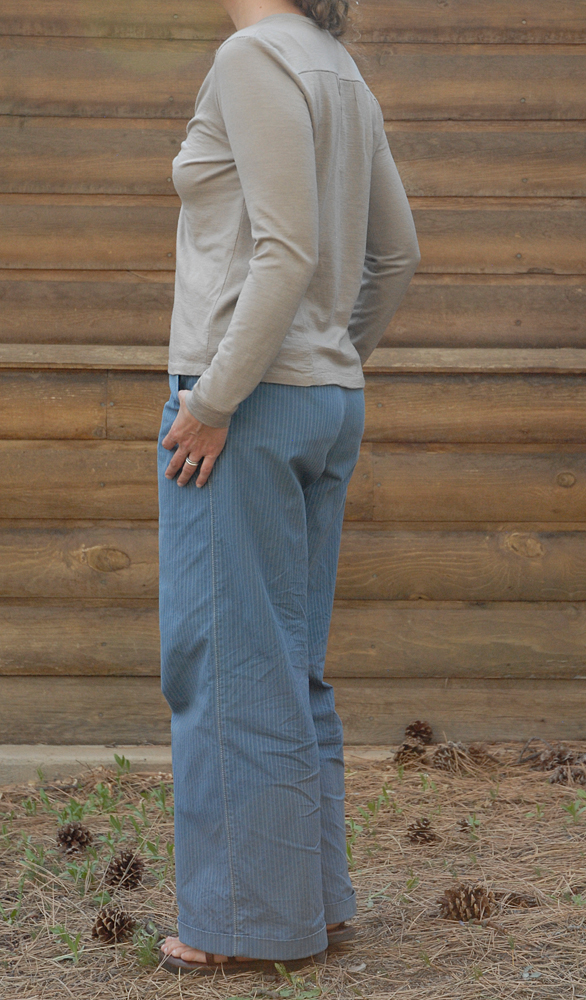
So, I let out the front inseam until it felt comfortable, and then played around with the crotch seam and back inseam to get the look and fit I wanted.  I want the trousers to show that I have a bum, without hugging it too tight, and then drop into a wide leg somewhat reminiscent of 30’s style.  I got pretty close!  To be honest, I may have overdone it on the amount of added room around the inseams, these feel so comfortable that they border on I’m-wearing-my-pajamas-outside.  But when I put them on and sit down it’s sooo nice!


blue stripe trous and wool knits 3


Those back pockets

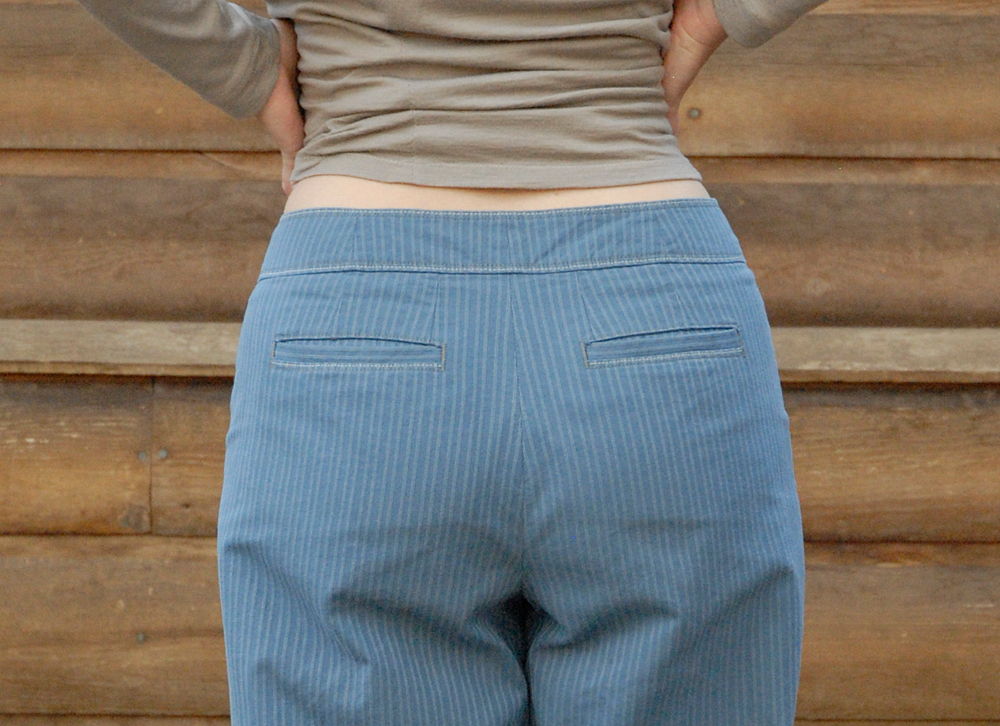
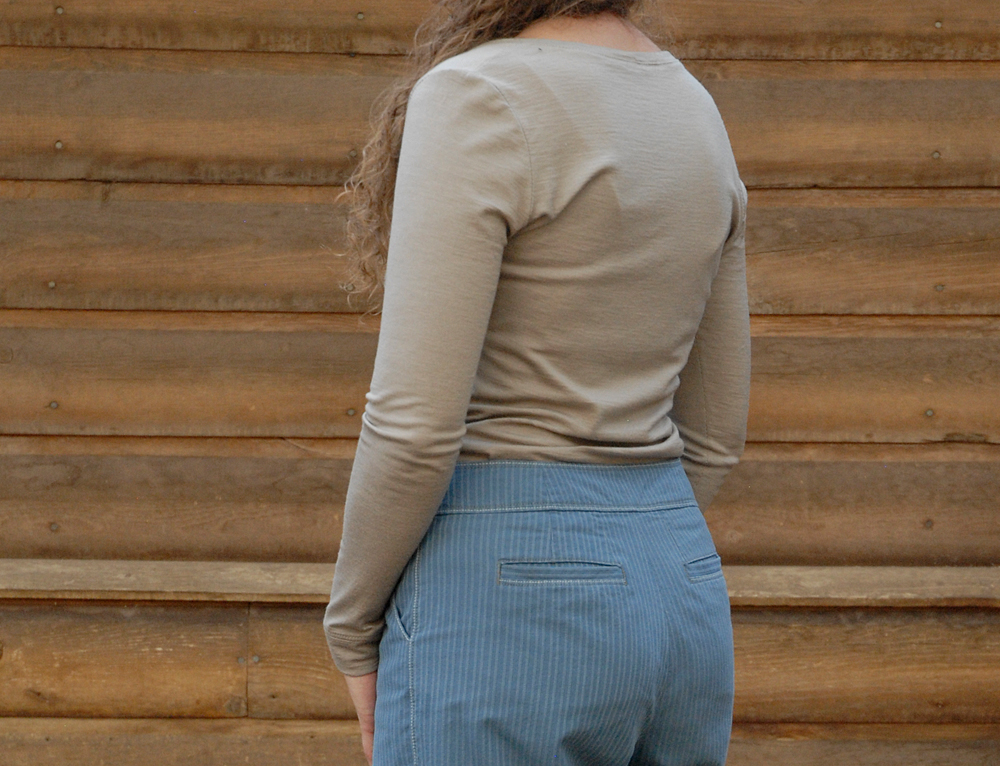
The back welt pockets are pretty sweet, yes?  This is something I’ve really been wanting in trouser-style pants.  I have one old pair of thrifted Gap wide-leg pants that has them, with little flaps on top too, and I love them.  I almost skipped them for this pair though, just because I was running a little short on time before we left for Texas, and I really needed to get these trousers done.  You know how sometimes, these decisions are made for you, just by the circumstances?  Well, as I got close to finishing the fit, two things became inescapably apparent: I could not figure out any way to get the tips of the back darts to look good (hidden by patch pockets in earlier pairs), and under some conditions, you could see the line of my undies through the fabric.  So, pockets it was, and since patch pockets don’t go with the trouser style I wanted … I basically just kept those Gap pants next to my sewing machine and figured out the steps from looking at them inside and out as I went.  Fortunately, I didn’t hit any major snags.  I have to admit, when I first tried the trousers on after finishing the pockets, my reaction was “no one told me they would look THAT cool!”  I have a few tweaks to make next time, but overall, those back pockets are probably my favorite thing about this make!


blue stripe trous and wool knits 5


Fabric verdict

I had a hunch when I went to add the pockets that it wasn’t the fabric being pulled tight that was showing my undie-lines, it was the fabric being just a little thin and just a little clingy.  I was right.  Now that the pockets are in, you can see that there’s plenty of room for them.  Sometimes you can see a shadow from the pocket lining, but that’s much better!

While this fabric turned out fine, next time I will look for some with just a little more body for making trousers.  I wouldn’t want it to be stiffer, just thick and soft enough to hold its own and skim over curves a little more.

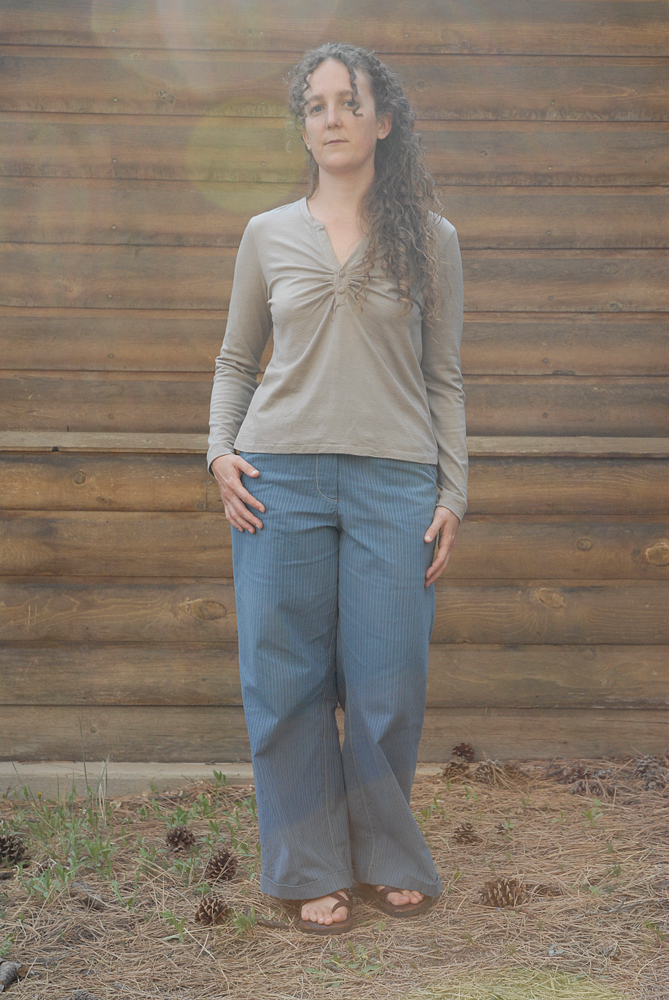
And, did you notice it wrinkles like all get out?  I swear, I pressed the trousers before setting up to take photos, but 10 minutes of adjusting the camera, kneeling by the tripod in the sun and moving around, and it was pointless.  I do think that wrinkles are less noticeable in real life than they are on camera though.


blue stripe trous and wool knits 7


Have I mentioned before that fitting and sewing trousers is a journey, not a destination?  (Hint: yes.)  I’m glad to get these under my belt, and to have a new pair to wear in public this spring.  Happy May Day to all!


Things I’ve Sewn: Merino Knit Tops

In which I find some truly lovely fabric.


blue stripe trous and wool knits 2


I’ve made a real effort to make the things that I really want to do (mainly creating for myself and for fun) a priority.  No matter what, (unless I’m so busy I can’t think straight) if I’m home, I’m working on sewing something.  And if I’m on the road, it’s knitting and drawing, etc.  So sometimes it surprises me when I look back at posts here and realize that nothing I’ve made for myself for a while is visible!  It’s time to catch up a little bit on sewn projects, especially with Me-Made-May’14 right around the corner.

I think I’ll talk a little bit about the tops here first (and save the pants for another post) mainly because there’s not a whole lot to say, except about the fabric.  Last fall, I stumbled into the fact that a fabric store called The Fabric Store, based in Australia, had just opened a store in LA.  This meant that a whole bunch of New Zealand merino knit fabric was suddenly within reasonable shipping distance of my house!  And, AND they had organic merino knits, something I have been searching for, as a way to hopefully buy wool which is raised responsibly.  (If any of the lovely USA-grown-made-processed yarn folks are reading this, some of you should mill some fabric!) Anyway, The Fabric Store doesn’t have direct online ordering, but if you call or email them, they will find out what you’re looking for, and send you several lovely cards of generous swatches.


blue stripe trous and wool knits 9What lens flare?  Clearly I am floating in a sea of magical bubbles …


I chose organic merino knit in the “mushroom” color, and I love, love, love, this fabric.  It’s soft, it has drape but it also has body, and great stretch and recovery.  There’s something substantial about it that just says “wool” (I love wool) and it has a subtle sheen to the right side which makes it look just a little special.

When it arrived, I was in desperate need of a few more long sleeve tops for winter, so I made a simple T-shirt style first.  In this fabric, my pattern (the same one I used for these tops) is just the tiniest bit tight/clingy (you can see my cami straps, which is not my favorite thing) but boy, it is a terrific layer for winter.  And spring—I’m wearing it as I type this!


blue stripe trous and wool knits 8


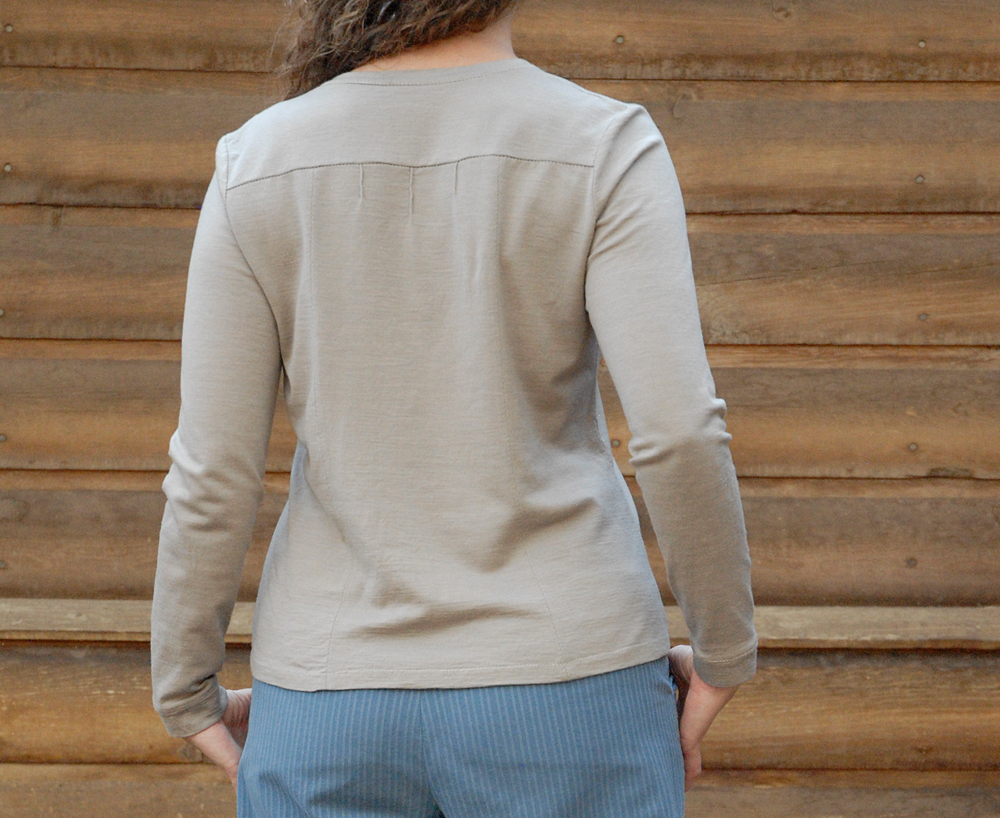
The second shirt I made just a little more complex, using another pattern that I copied from one of those lucky thrift store finds with fit and style I love.  In an ongoing experiment to see if I can get knit shirts to more closely follow, and still flatter, my shape, I tried dividing the pattern into princess lines in back, so that I would have two extra seams to add width over the hips.  If I do this again, I’ll curve the lines more so that they come in at the waist, and then out again, yes?


blue stripe trous and wool knits 6


And I have fabric leftover!  Somehow, despite an earlier failure to squeeze one uninterrupted long-sleeve knit top out of one yard, by careful placement and a somewhat generous cut, it looks like I will get 3 tops out of 3 yards of this.  I was debating maybe dyeing the last top’s worth, until Bryan mentioned that he liked the way this color looks with my skin.  That settles that—I’m looking forward to making another style, same color, this coming fall.

I wore this exact outfit, new top and pants, on both our way out to Texas AND my flight back.  It’s just really versatile, comfortable, and perfect for the varying temperatures of spring.  More about the pants coming soon!


blue stripe trous and wool knits 4


Me-Made-May, My Wardrobe, and Drawing

Plus, I pledge to knit a sweater!


mmm14 logo drawing


So, you guys know I love Me-Made-May, right?  This challenge was a major motivator for me to start really building a handmade wardrobe, especially two years ago, the first year I had this blog and the first year I took part.  Last year, I upped my challenge to wearing two me-made garments every day through May, which was great and gave me a kick in the bum to make at least one thing I had been thinking about for quite a while, but it didn’t have quite the feeling of realizing new things about what I make and wear, and opening up new horizons, which the first year did.

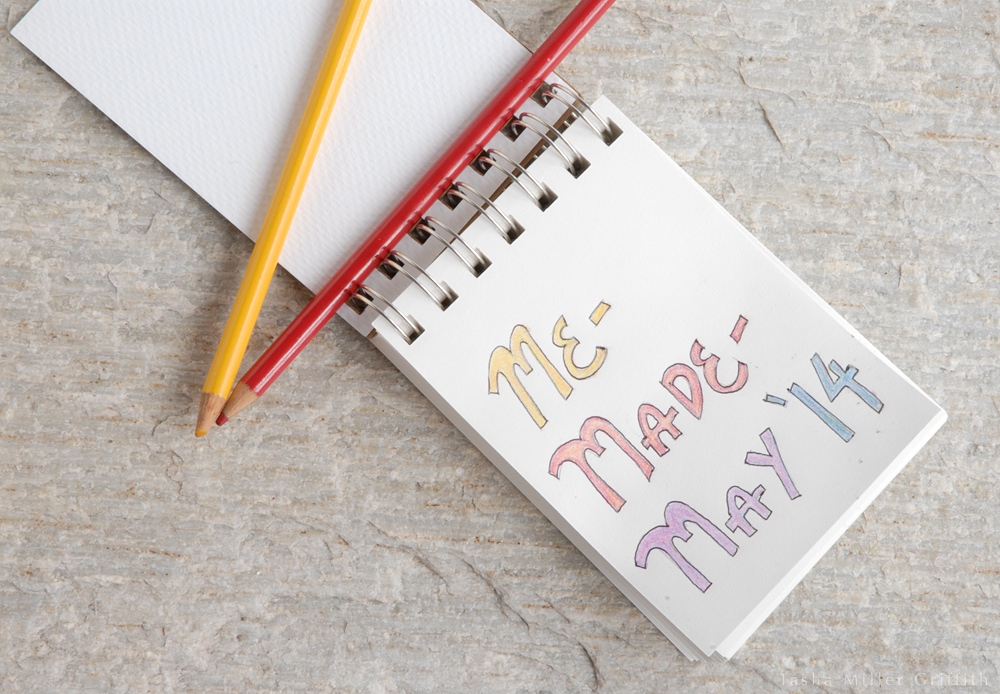
This time, I’d like to bring back a bit of the self-discovery element.  Also, documenting my MMM has been a challenge, we’re usually on the road during much of the month, and it can be hard to find a time when Bryan and I are both not busy to take a picture.  Plus, I am always looking for ways to bully myself into doing more drawing, just practicing drawing … so I’m going to keep a mini visual journal (pictured above) for May.  I’m leaving the exact format of what I’ll put in it purposefully vague, to see how it works out, but it will definitely include drawings of clothing, words about what I wore and thought, etc.  I’ll photograph and post at least some of what I put in it on Flickr and/or here.


mmm'13 day 11-1And, about the sweater.  I’ve had this particular soft blue silk and cashmere cardigan since I started traveling with Bryan.  I got it at a clothing exchange/naked lady party right before we left that first summer, so really, it’s held up amazingly well, that was 10 years ago (egad—really?) and it’s been an indispensable summer wardrobe item that whole time.  I’m wearing it at left, in a pic from MMM last year.  It doesn’t have another summer in it though, the fabric under the arms and around the cuffs is totally shot.

I do have some light blue yarn, which has been in my stash longer than I care to remember, and it occurred to me that, in the spirit of making my own, I could knit a replacement sweater.  It won’t be exactly the same, in fact I would like the style of it to be a little more interesting, but it must have the following characteristics, which I figure are key to indispensable-ness: soft, lightweight, cardigan (easy to layer), washable (at least by hand), go with most of my wardrobe.  I’m thinking of starting with the Talamh pattern (links to Ravelry).

Here is my official pledge for Me-Made-May ’14:

‘I, Tasha of Stale Bread into French Toast, sign up as a participant of Me-Made-May ’14. I endeavour to wear as many me-made and handmade items each day as possible, minimum of two, for the duration of May 2014.  In addition, I pledge to keep a wardrobe journal for May, and to share it via flickr/blog.  And finally, I will knit on, and attempt to finish, a much-needed sweater during this month!’

If you’re thinking about taking part, I definitely encourage you to do it!


Make Your Own Retro Pro-Style Camera Strap


dad's camera strap finished 2


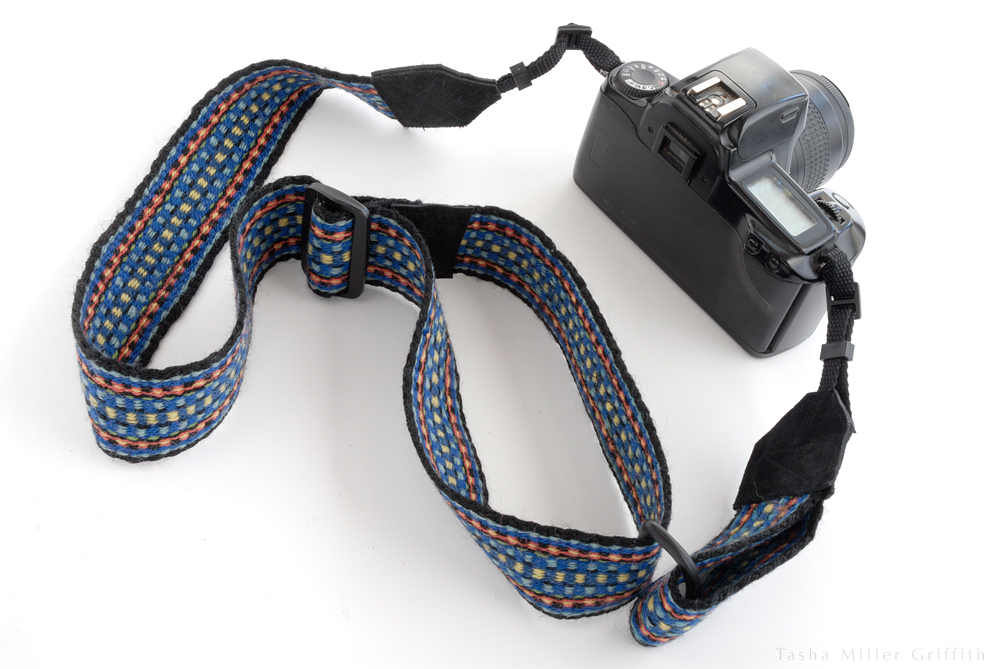
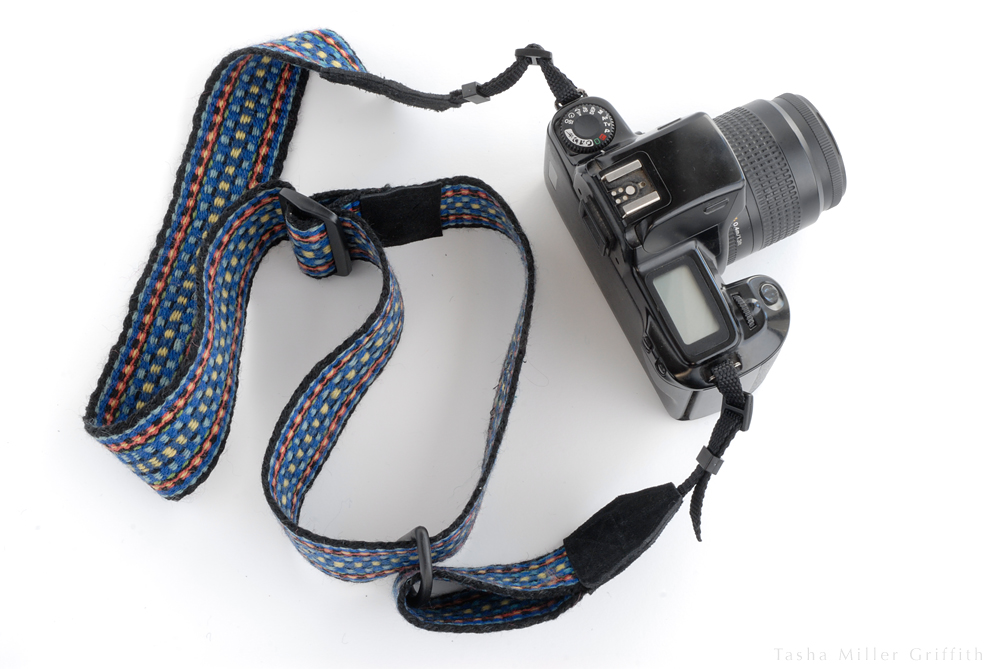
How to make your own camera strap, using the same hardware and webbing you’d find on one at the photography store, and practically anything you want for the strap!

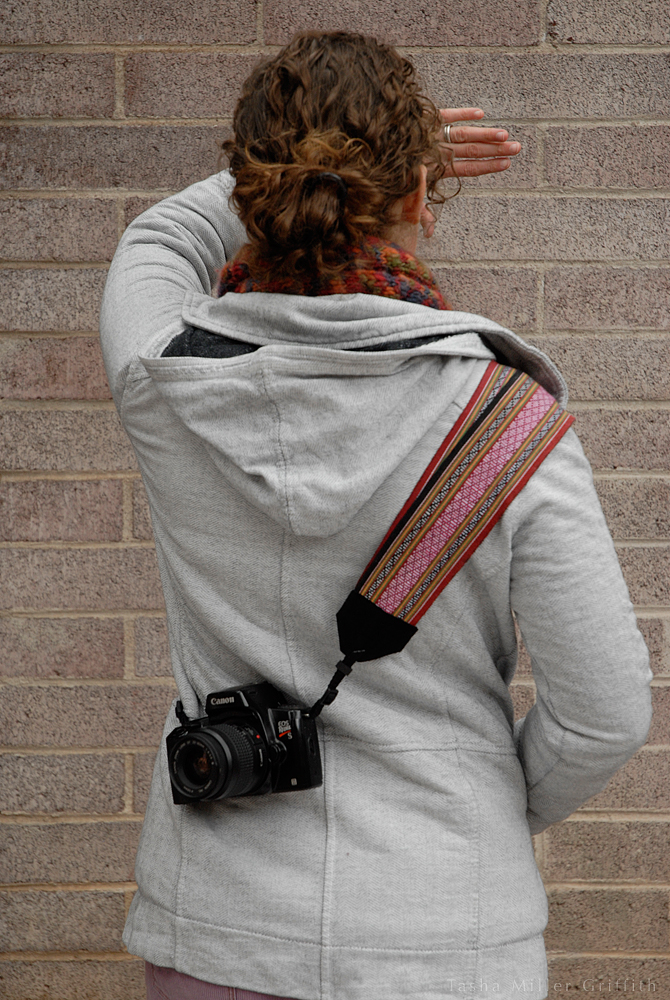
When I got my new (used) camera, I just carried it around in the crook of my arm for quite a while, because I knew exactly what I wanted for a strap, and I couldn’t find it in any camera shop we visited.   The new camera is heavy (by my standards anyway) and I did not want a thin strap that would dig that weight into my neck all the time, I wanted a wide soft strap that would cup around my shoulder and hold the weight there.  I got this idea from Cat Bordhi (have I mentioned that she’s a mad genius?) specifically from knitting one of her mobius sling bags (in A Second Treasury of Magical Knitting), and it stuck with me.


camera strap on


You will need

I got the 3/8″ webbing and hardware to go with it from SewingSupplies on Etsy.  She made me a package deal like this one, which includes enough supplies to make two straps (each end of a strap takes one piece of webbing, one slider and one keeper).  I’m assuming that your camera has a ring or loop which 3/8″ webbing will fit through (most do, but some small point-and-shoots don’t.  You might be able to substitute something lighter, I would take your camera to the fabric store and see what you can find).

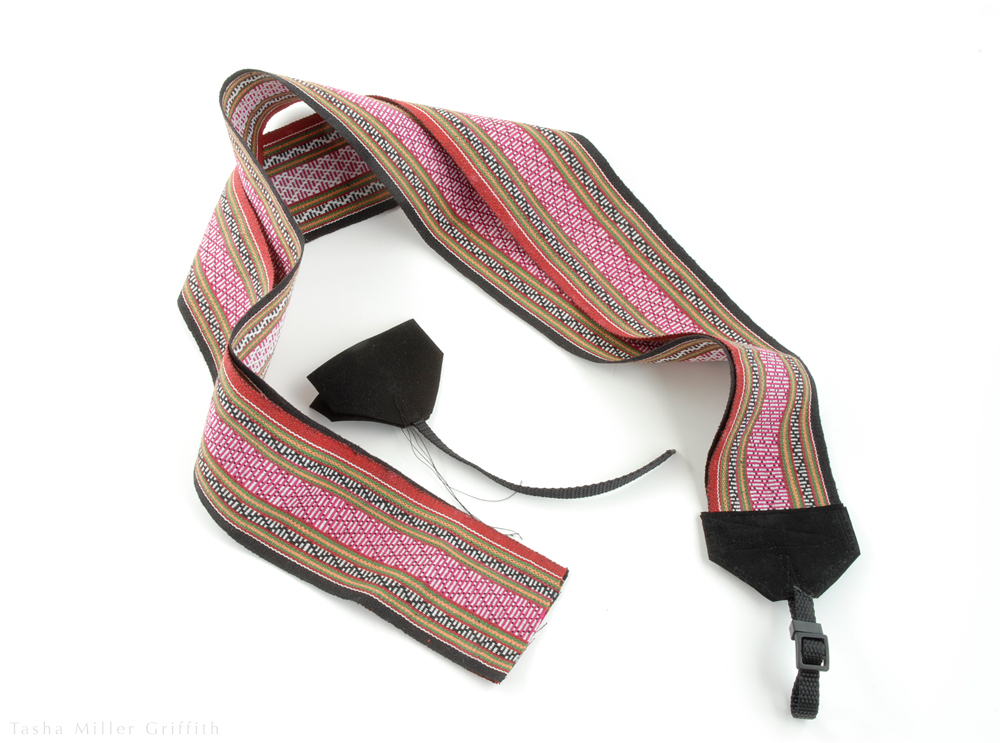
You will also need sturdy material for ends of the strap, where the strap meets the webbing.  I used Ultrasuede (faux suede leather) for my strap (above), and some scraps of real leather on a strap for my dad (the one at the top of the post).

If you want your strap to be adjustable, you’ll also need one slider and one loop of hardware, in a size that works with your strap material.

My strap is cut from a length of soft cotton textile woven about 2  3/4″ wide, which was in my mom’s stash.  I suspect that my parents brought it back from somewhere in their travels in the 1970’s, but neither of them remembered where, and they both said I could use it, so I did.  Dad’s strap is one his mom (my grandmother the weaver) made, which I put new ends and a slider on.  I found some similar straps by searching for “handwoven band” or “handwoven strap” on Etsy.  You could also start with a belt, or a guitar strap or anything else you like, as long as it’s sturdy enough to hold your camera and thin enough to sew through (which leather belts aren’t.  You might be able to use rivets though …).


Prepping the pieces

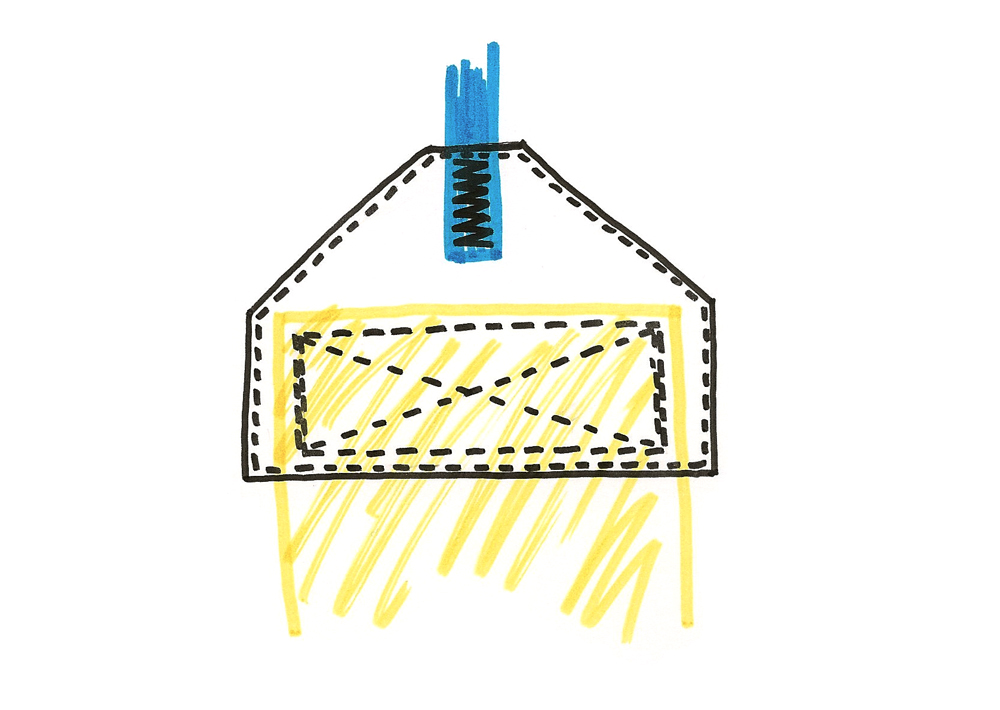
Cut pieces for the ends from faux leather or leather, a bit wider than your strap (allow extra width if your material is thick, so that it can come together and cover the edges of the strap), continuing that width for about an inch, and then tapering to an end to cover the webbing.  See below to visualize how the ends cover the strap and the webbing.  You will need two leather end pieces for each end of the strap (four total).


camera strap transparent


Cut a piece of the 3/8″ webbing about 7  1/2″ long for each end of the strap.  If you cut the ends of the webbing on a slant, it will make it easier to thread them through the slots on your camera.  I like to sear the cut edges of the webbing (to keep them from fraying) by passing them quickly through the blue part of a candle flame.

Either figure out where you would like your camera to rest on your body and cut the strap to that length (accounting for the ends and webbing) or plan to make your strap adjustable.  I knew exactly how long I wanted my strap to be (so that the camera would rest on the top of my hip), but I made Dad’s so he could adjust it (keep reading for how to do that).

If your strap fabric is prone to fraying/spreading out all over the place, you may want to stitch over the ends before putting everything together.  You can even use that stitching to gather in the end of the strap a bit, which I did for Dad’s strap.

Heavy duty stitching

Sewing the strap is actually pretty simple, it’s all about how to join two things which you really don’t want to come apart.  My camera is the second-most expensive and precious piece of equipment I own (sewing machine being #1 ) and as I said it’s kind of heavy, so I definitely want some heavy duty stitching here!  Basically you’ll do this by adding extra stitches to reinforce the critical areas.

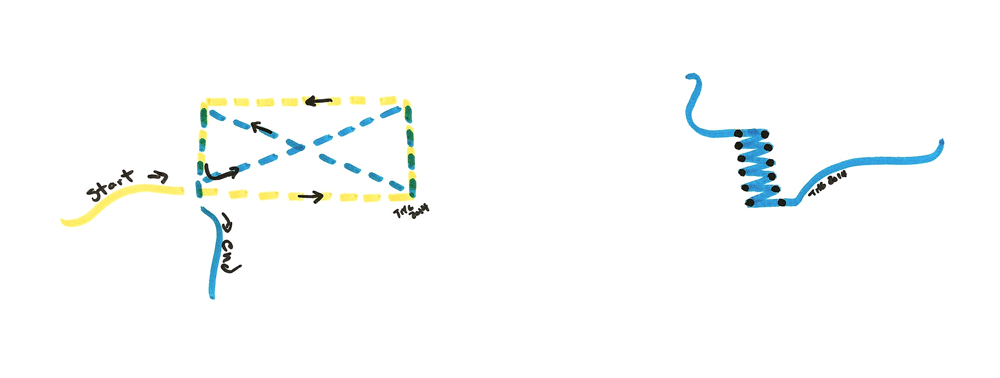
A good way to attach straps for extra strength is to sew a rectangle-and-X pattern (I just realized I have no idea if there’s an official name for this … but here’s how to do it anyway).  Sew a rectangle just inside the edges of the strap, basically as big as you can inside the area where the strap and end overlap while catching all the layers (illustrated above).  When you get to the point where you started (this is the point with the curved arrow, where the illustrated stitches change from yellow to blue below), sew to the opposite corner.  Keep going, overlapping the stitches on one side, then diagonally back to the other side.  Overlap one side’s stitches again, to come back to where you started.


camera strap square and bar tack

Another way you can add stitches to an area that will get stress is to make a bar tack (that is the real name for this one) by using a wide stitch and a short stitch length.  Just keep in mind that every time you make a stitch it also makes a hole in the material, so don’t make the stitches so close together that the holes touch and make a weak place where the material could tear.

I used a mini version of the rectangle-and-X to attach the webbing to the ends.  A bar tack would work well too.  As usual, it’s a good idea to try out your planned techniques on some scraps to see what works.

Once you’ve attached the strap and webbing to the ends, I like to sew around the edge of the ends to keep everything neat.  Bury the thread ends wherever you can, and you’re done.


camera strap in progress


Leather 

I’m not a leather sewing expert, but I can give you a couple of tips if you decide to use real leather for the ends.  Although it’s more difficult to sew than the faux stuff, it’s wonderfully strong and malleable.  First, you will definitely need a leather needle.  The main difficulty is getting the machine to punch through the leather, and everything that would normally make your machine want to skip stitches (sewing over different thicknesses of materials, etc.) does so even more.  Go slowly, go over skipped stitches again or pick up the foot and go back.  Use the hand wheel if necessary, get the weight of the machine on your side.  Try switching between a regular foot and a zipper foot to sew around the edges of the ends.  I still ended up with some skipped stitches and broken/restarted threads to hide, but I was overall pleased with how my machine handled the leather and all the layers.


Adjustable straps

It’s not much harder to make an adjustable strap, you just have to wrap your head around how it works.

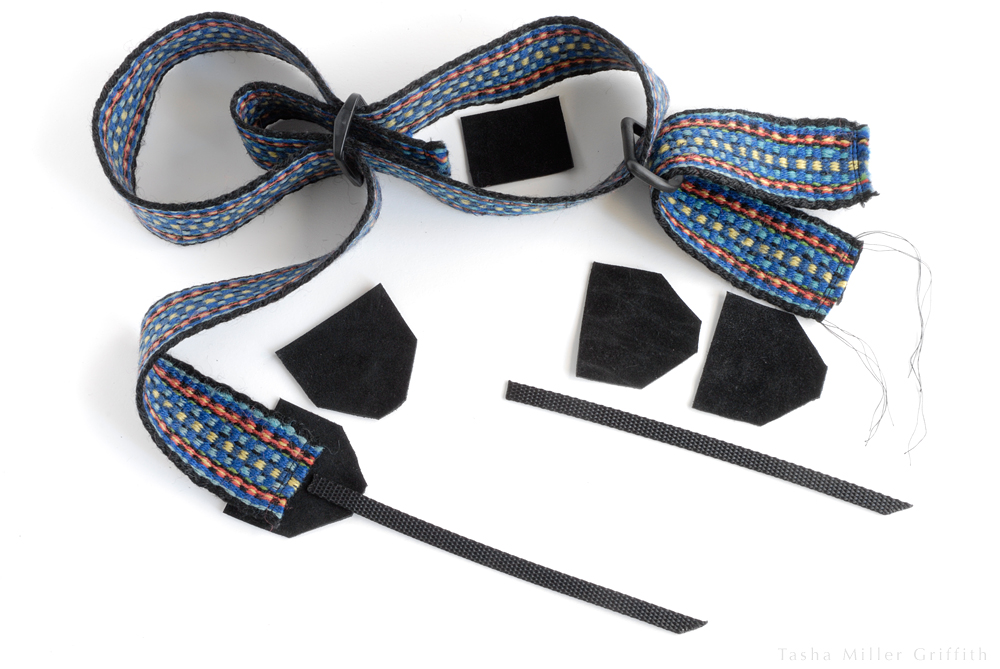
I’m such a visual learner, I need to draw it or better yet, lay out all the pieces to see how they’ll go together, as below.  One side is a simple length of strap that goes through the loop and back to the end.  The other side goes from the end, through the slider, through the loop, and back through the slider (inside the first pass).

Sew the strap end down so that there’s a short loop of strap inside the slider, covering the raw edge with the extra suede piece.  You can use the rectangle-and-X method again.


dad's camera strap layout


dad's camera strap finished 1

Special thanks to Bryan’s first 35mm camera for modeling.

A note if you’d like the strap to hug your shoulder like mine: I used two lengths of the strap fabric so that I could separate them to either side of my shoulder.  It turns out that it works even if I don’t separate them—I think as long as your strap is fairly wide and soft it will work to wear it on your shoulder.

Make any strap you want!  Nice, right?


How to Mend a Small Hole: Sewing a Patch by Hand


small hand sewn patch 5


Here’s another way to fix a small hole in a shirt or a sweater—especially a hole that’s a little too big to simply sew back together without causing puckers.  No sewing machine required though, it’s more invisible to sew a little patch like this by hand.  These examples are in woven fabric, but this technique also works on knits.  I sewed a patch like this on the front of this sweater, which because of the fuzzy knit fabric is too invisible for pictures!

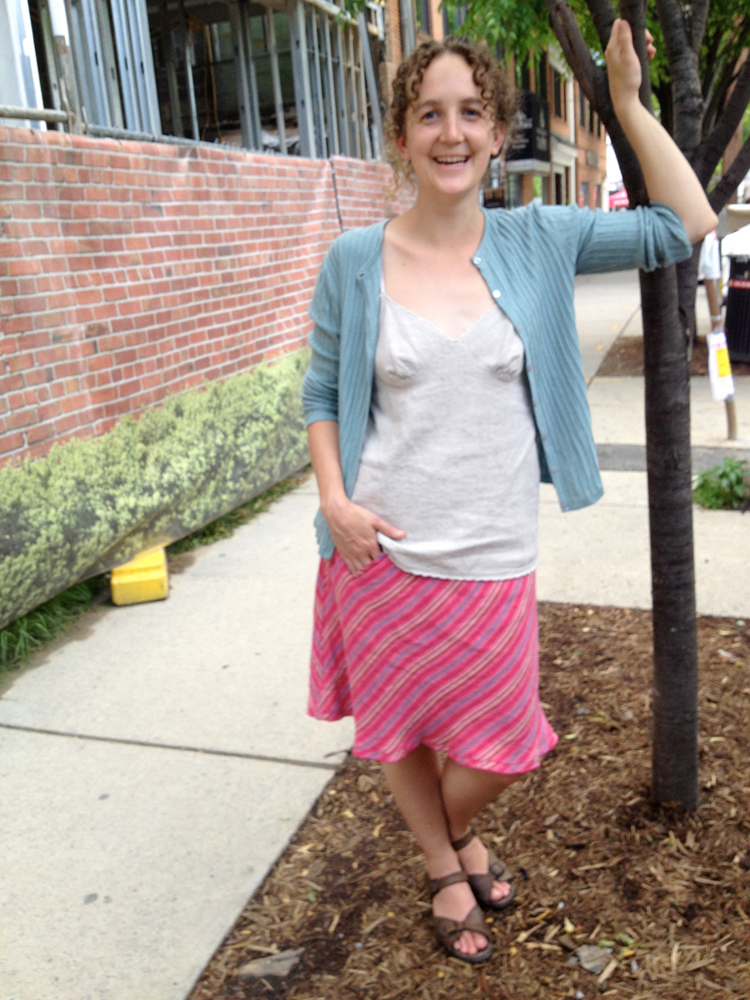
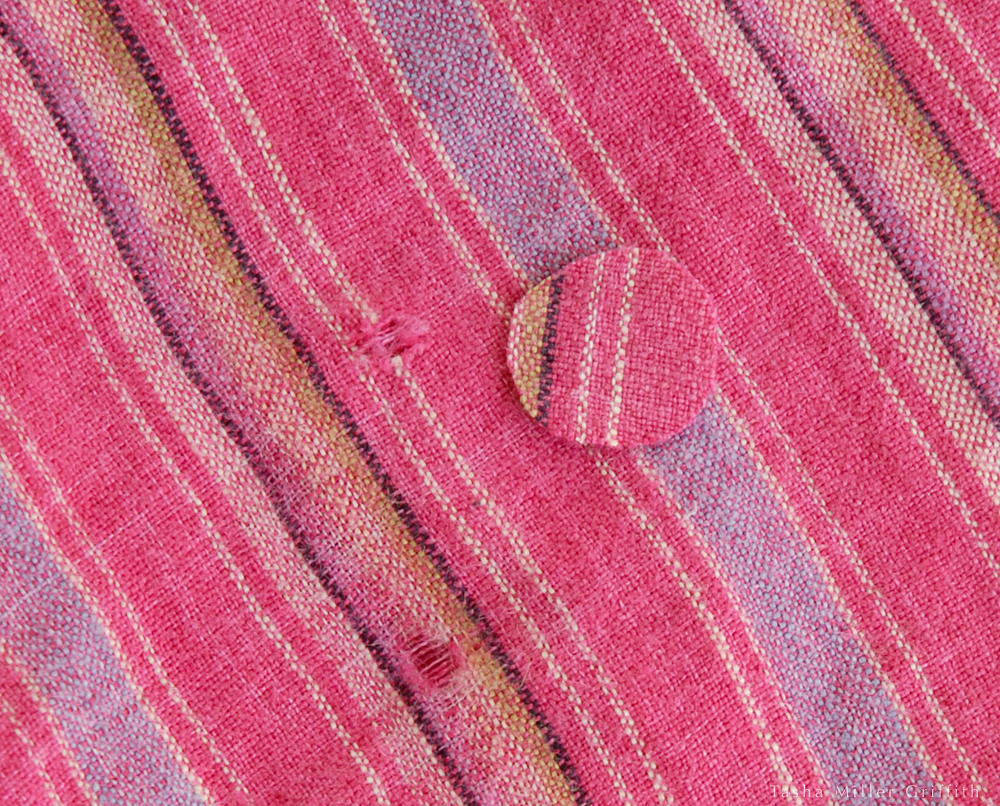
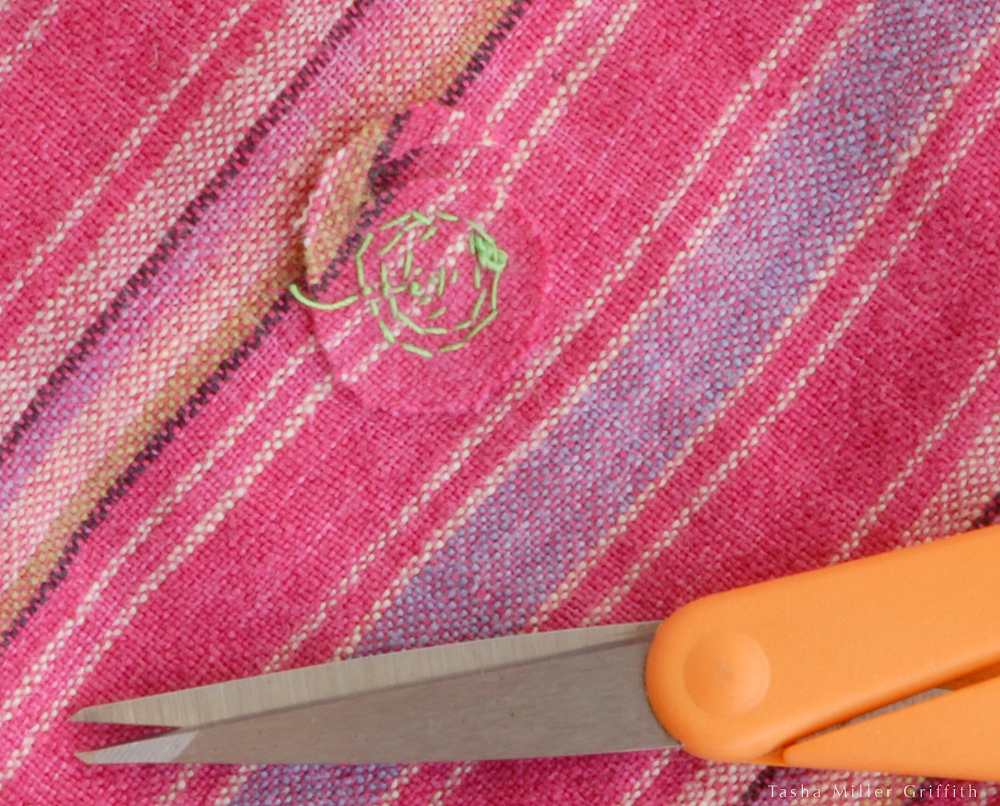
I’m going to demonstrate on two skirts, which happen to both be made of linen, cut on the bias, and have small holes.  The difference is, the blue one at the top I fixed for keeps—it had a little tear, but the rest of the fabric is still in good shape.  I bought the pink stripey one for a dollar on the sale rack at St. Vinnie’s, and it followed me around the country on our summer travels for years.  I even tried out two different ideas for adding pockets to bias skirts on it.  By now it’s on its way out, the fabric across the back has a few tears, and is super thin and ready to tear in a lot more places.  It’s ready to retire, but I can get one more use out if it by fixing one of the holes with bright green thread so you can see what’s going on.

To start, cut a circular patch, about three times as big across as your hole.  Making it a little bigger will make the sewing easier, and you can trim it later.  If you have a piece of the garment fabric, cut the patch from a section that matches up with where the hole is, in terms of color, pattern, or wear.  If not, just try to find something that matches as well as possible.  Hold the scrap behind the hole to see how it looks.  If your fabric is very loosely woven, you may want to sew around the edges of the patch to keep it from unraveling.  Otherwise, a circular patch should be ok as it is through normal wear and washing.

Click on any of the pictures to enlarge, you can see more detail here than I could while sewing the patches!


small hand sewn patch 1


Carefully center the patch behind the hole.  Match the grain (the direction of the grid of threads) of the garment and the patch.  This is especially important if the garment is cut on the bias (with the grain at 45°) like this one, because I want to avoid changing the drape of the bias cut.

Pin the patch in place through the front of the garment, sticking each pin in and out of the fabric twice.  Check to see that the patch is centered over the hole, and re-pin if necessary.  If the fabric is slippery, it may be easier to sew a few temporary basting stitches, and pull them out when you’re done, than to get the pins to hold it.


small hand sewn patch 2


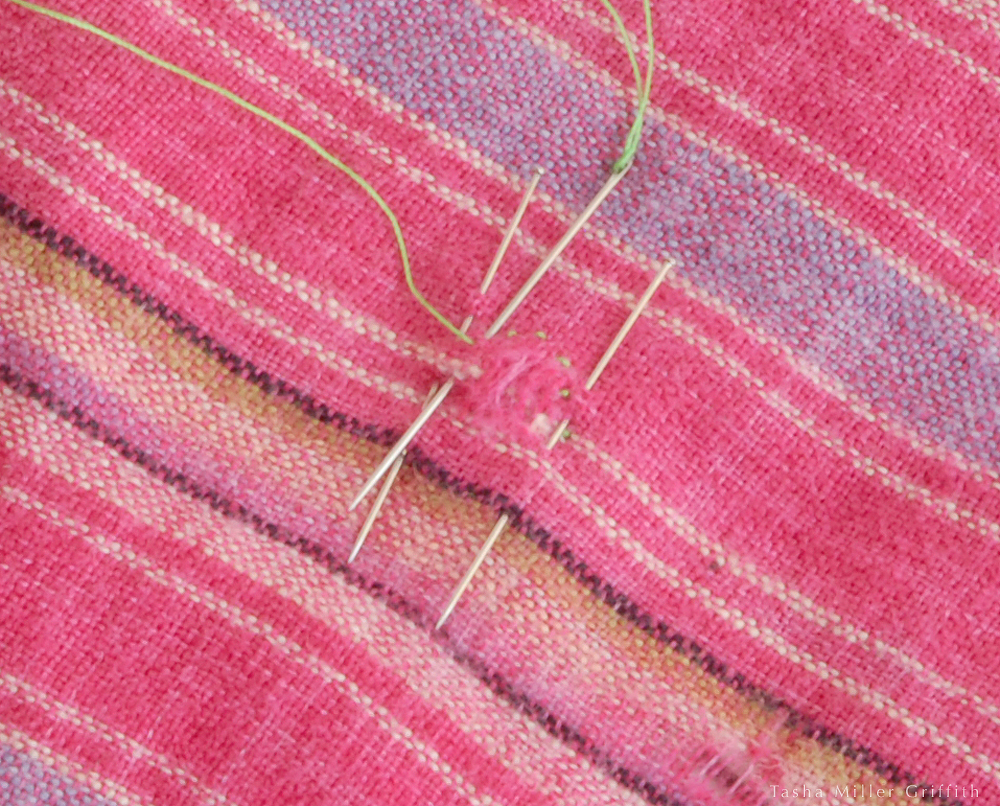
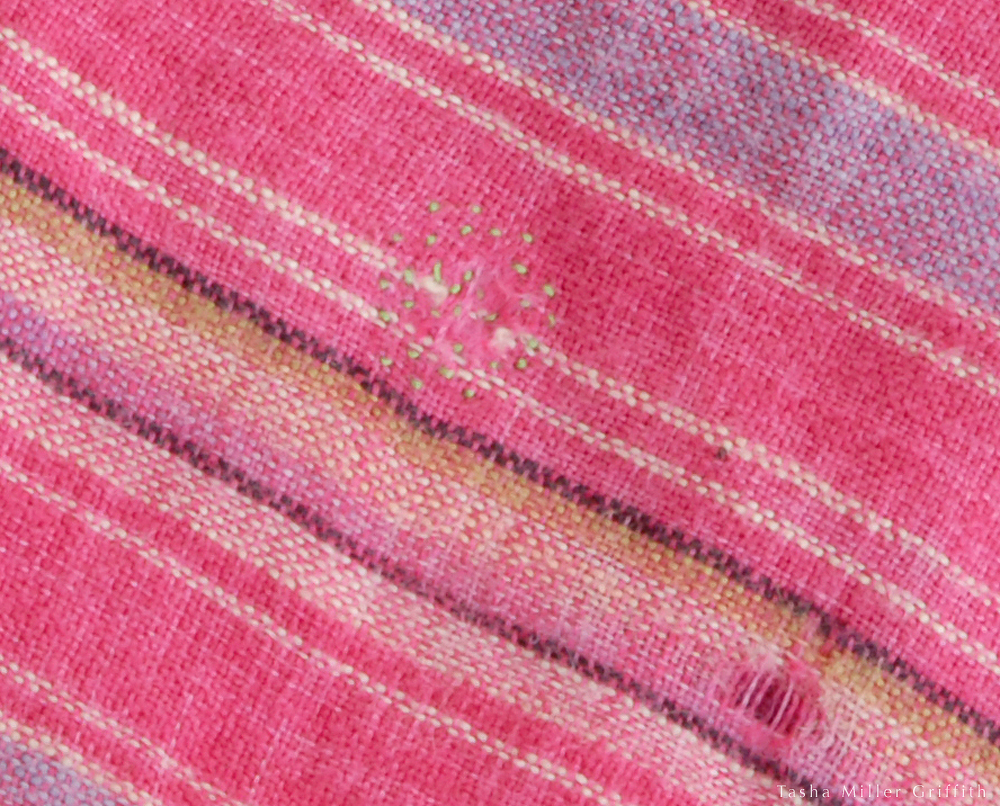
Knot your thread, and bring it up from the back.  Sew around the hole a couple of times, sewing through both layers using small backstitches.  Don’t pull the stitches too tight, or the fabric will pucker up.  Try to catch each thread that is cut by the hole on one pass or the other.  If there are intact threads in the center of the hole, tack them down to the patch too.

The goal is to keep the hole from unraveling any further, without adding so many stitches that it makes the patch stand out.

When it’s done, secure the thread with another knot or a couple of backstitches just through the patch on the back.

Here’s the finished patch on the front:


small hand sewn patch 4


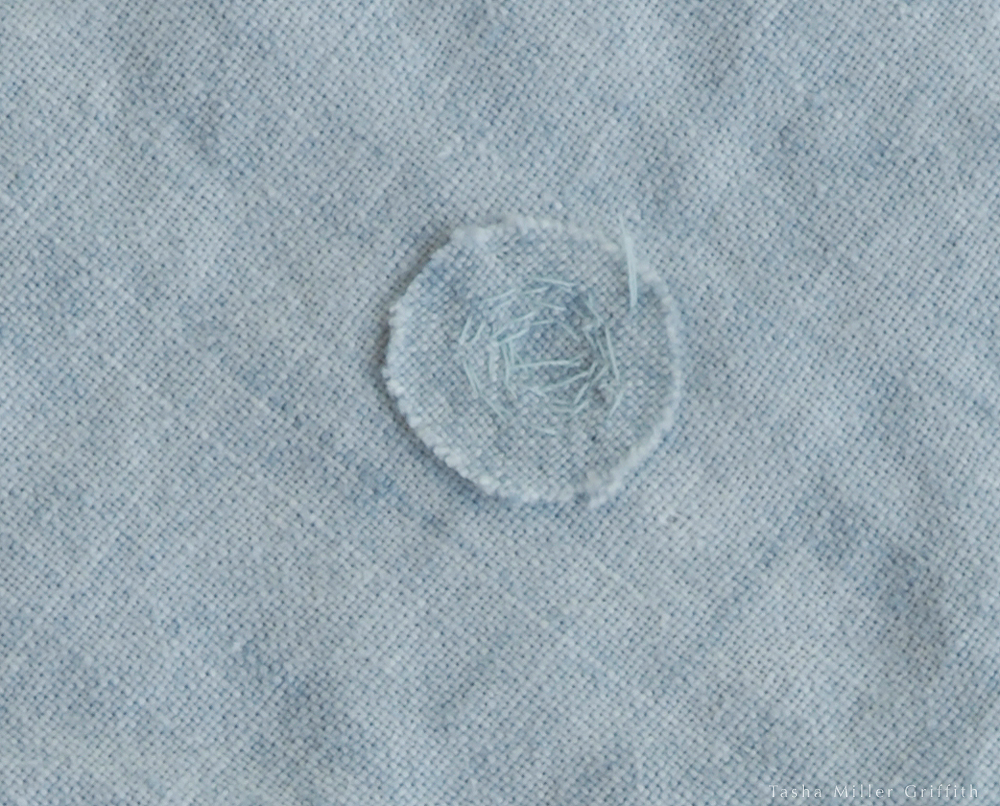
And from the back.  You can trim the patch, but leave some around the edges so that if it unravels slightly, there will still be enough fabric to hold it in place.


small hand sewn patch 3


Here’s the back of the blue one:


small hand sewn patch 6


Hopefully this adds another option to your mending toolkit!

Recycled, Naturally Dyed Silk Camisoles

Plus My Favorite Method for Sewing Knit Fabric Straps, and Self-Fabric Binding with Elastic


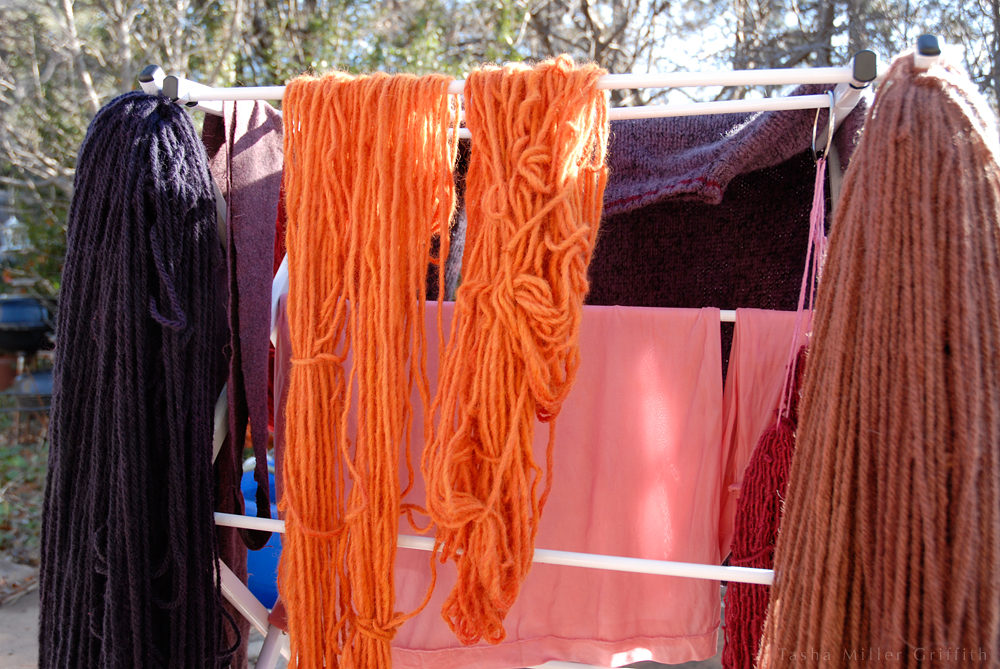
pink silk cami dyed hangingThe pink top before re-purposing, hanging with other materials dyed the same day.


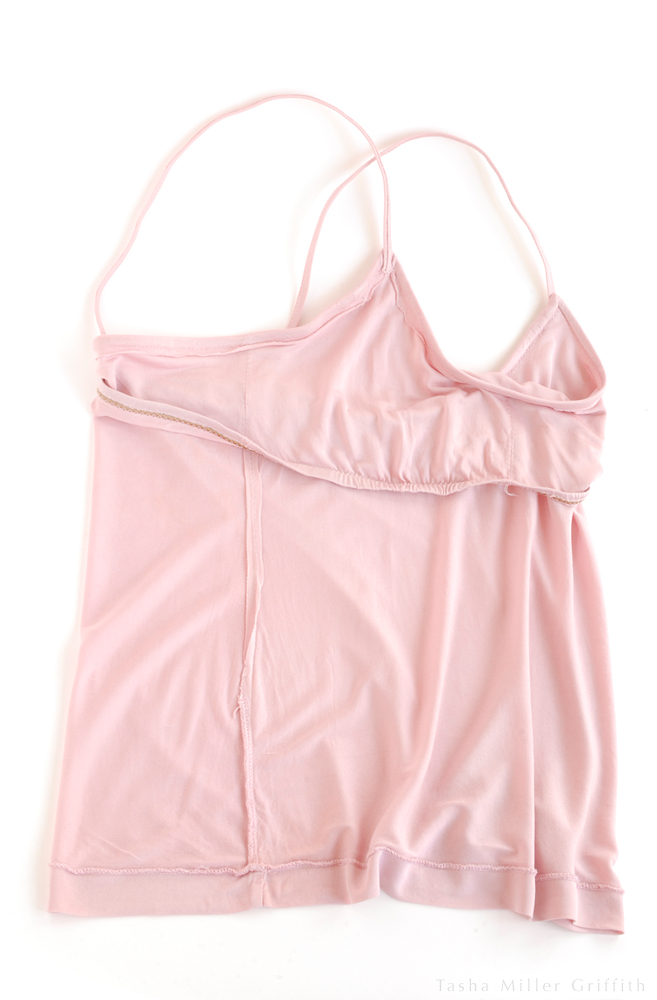
Last fall, my friend Zuni invited me over for a day of dyeing with natural materials at her house.  I have an informal craft exchange going with some of my fiber friends, and it’s fantastic to have Zuni as part of this group.  All the mess and calculations for dyeing stay at her house, and we just bring home the colorful finished products.  The day in question, one of the dye materials was indigo.  Most of the craft exchange members tend to dye yarn.  I’m pretty militant about not letting my yarn stash exceed the capacity of one big plastic bin (after, ahem, seeing what happened to my fabric stash), plus I sew more than I knit, and I’ve sewn for longer, so I tend to be the one who shows up with odds and ends of fabric or garments to re-purpose.  This time it was a silk long underwear top.  I inherited two of these from my grandma’s stash.  The fabric is really lovely, but I hardly ever wore the tops, they were kind of baggy for layering, and looked awkwardly like underwear when visible—picture your classic long undies, but maybe a bit looser.

I think I had a class that morning, because I came to the indigo day partway through, at which point we literally just dropped the top into the dye bath.  Indigo doesn’t need a mordant, but I learned something important: dyeing something without soaking it in water first leads to splotchy fabric!  Funnily enough, a slightly mottled fabric was what I pictured when I envisioned how this would come out … although maybe not quite that spotty!   I also think not wetting first may have led to some of the color not being bonded with the fibers, and then rubbing off.  This was all an experiment though, and I was just happy to have a dyed piece to work with.

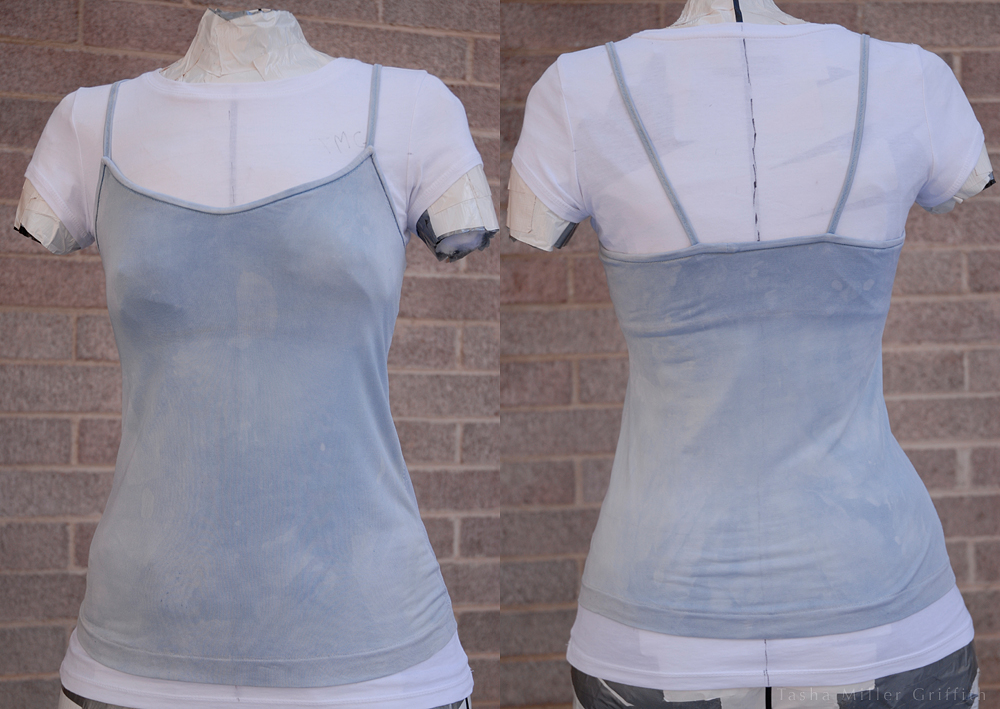
My plan was to cut the top up and make something I would definitely wear: a lovely silk camisole (tank top, vest, whatever you want to call it) for a winter-time first layer.  I used the same pattern as for my summer tanks, which after many alterations, bears almost no resemblance to the starting point: Kwik Sew 3524.

Click on any of the pictures for more detail.


blue silk cami on form


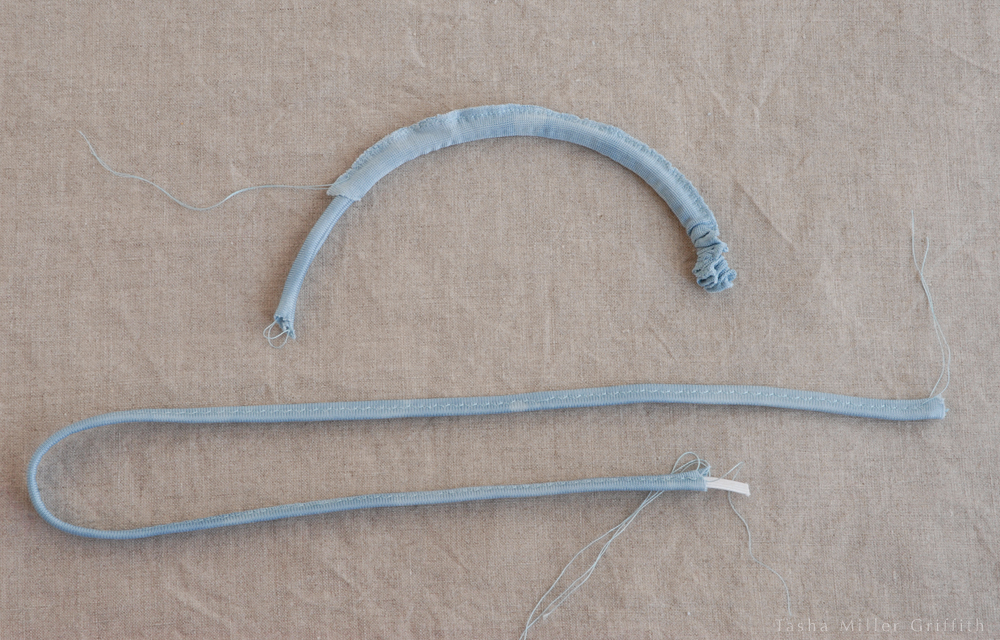
A couple of things that came out really well: the straps and the elastic binding at the top.  I’ve used this method for straps on a couple of (not blogged) other tanks, and really like it.  Basically I just sew a tube of fabric, using a narrow zigzag stitch since it’s knit fabric.  I turn the tube with a wire, and then slide a piece of elastic through it, using a bodkin or a safety pin.  Then I stitch through all the layers.  The added elastic gives the straps more stretch, recovery, and sturdiness than they would have if they were just made from the fabric.  This seemed essential when working with practically transparent silk!


blue silk cami straps


For these straps, I used 1/4″ elastic, and cut the fabric strips for the straps 1″ wide.  You need a little more than the elastic measurement for the fabric tube to fit around it, especially once the seam allowances are also tucked inside, and a bit for the seam allowances themselves.  Sewing through the fabric and the elastic holds everything smoothly in place.  I roll all of the seam line to one side of the elastic before sewing, which becomes the bottom of the strap, and the top looks clean.

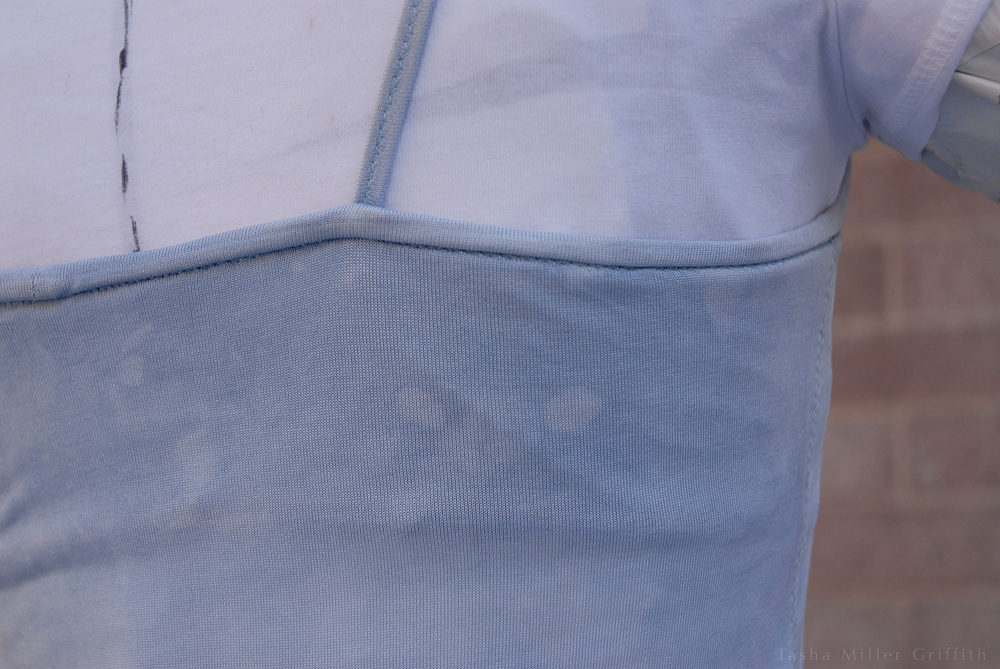
My favorite thing about these camis (other than the feel of the silk on my skin, or maybe the color) is the way the edging fits at the top.  I used another fabric strip, and plain 1/8″ elastic.  I didn’t stretch the elastic at all when pinning and sewing it on, and the slight negative ease in the pattern (I checked—it’s about 88% of my body measurement at the upper chest) turns out to make just exactly the amount of stretch I want at the top.  It just hugs against my skin, without gaping or digging in.


blue silk cami binding closeupThis dress form is a copy of my body in duct tape, and the binding fits just as nicely on me.


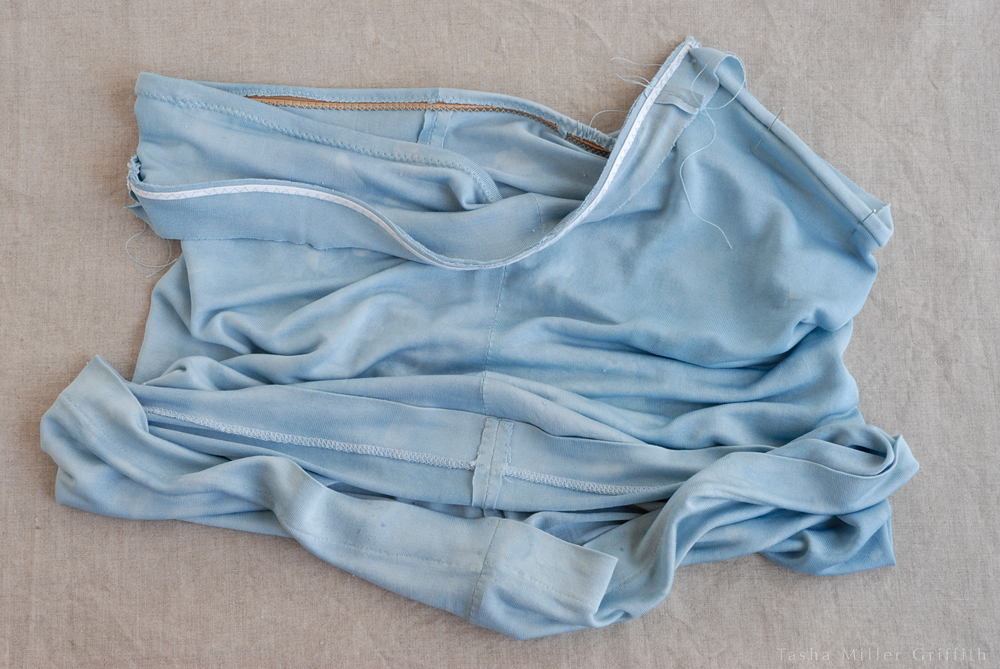
Below you can see in more detail how the pieces of the binding went together.  After sewing through all the layers, I rolled the binding strips to the inside, and sewed again just outside of the first seam.  The part at the top with the bronze colored elastic is the built-in shelf bra, which I attached at the same time, in the first seam of the elastic and binding.


blue silk cami inside


For the blue one, I cut the original top completely apart, and used as much of the width of the original hem as possible.  I didn’t want the seams to show at the bottom, so I tacked them down by hand.

Not long after I finished the blue cami, Zuni invited as over again, this time to dye cochineal and purple.  I’m not that huge a fan of pink, unless it’s cochineal, and then I’m all over it.  The particular shades that come from those little bugs really float my boat.  So, excited by my first success, and learning from mistakes, I thoroughly soaked the second top in water and brought it over.  I was also careful to stir while it was dyeing, and the result was an even, beautiful coat of color!

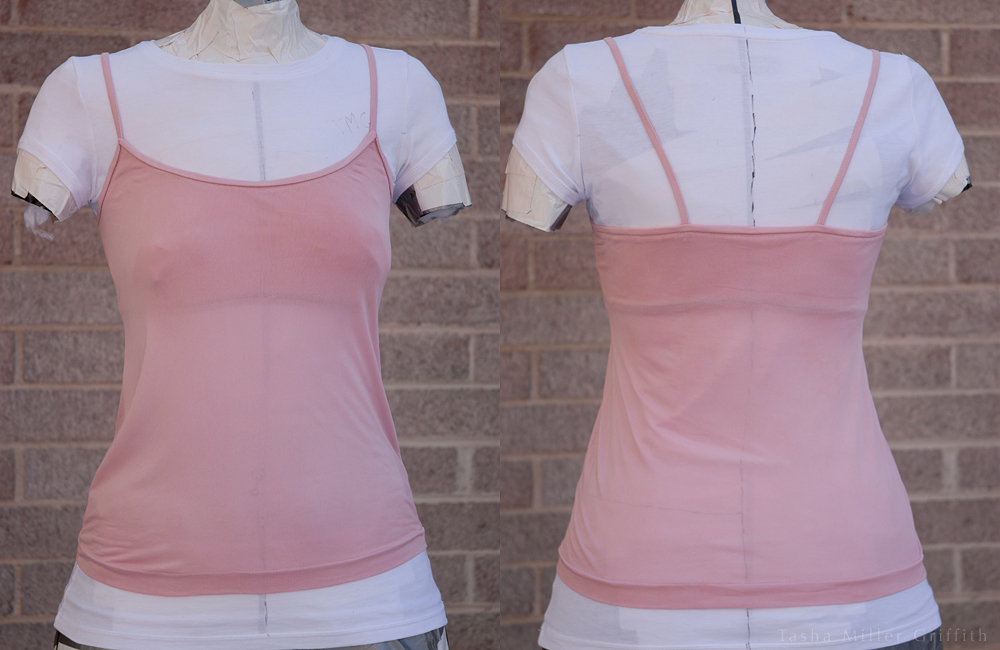
If I could have, I would have cut both tops wider at the bottom.  You can see a little pulling, and stretching in the fabric around the hips.  For the pink top, I decided for maximum width, to keep the hem and bottom of the original side seams intact, and taper my new seam in.  Below you can see this, as well as the construction of the shelf bra and what the binding looks like from the inside.

With this method of binding, I like sewing the straps in at the end by hand, catching just the inner layers.  That way I can try on and adjust them exactly, plus I think it’s more secure and less likely to distort the fabric than trying to catch them in the seam under the binding.


pink silk cami inside


I got some good practice sewing with delicate petals of silk making these, and it seems less intimidating now.

The other fantastic thing about this project is that, when those long undies were just sitting in my drawer, I thought that maybe someday I would dye them and make them into something useful.  In the same way that maybe someday I’ll spin enough yarn to knit with, maybe someday my studio will be completely clean and neat … things that I dream about, but may never happen.  But this one did!  I’m trying to acknowledge and appreciate this as a victory, rather than just rushing right on to the next project, as I am apt to do.


pink silk cami on form


Plus, I just love having these in my closet!  In fact, combined with two silk camis I already had (one is an earlier take on the recycled silk shirt idea, and one is the original I used to copy my woven tank pattern), I have just enough to wear one almost every day.  That inspired me to pack away most of my summer tanks, shirts and dresses for the first time ever.  I always carefully clean and store my winter woolens over the summer (mainly to protect them from the scourge of moths) but putting away the summer clothes never seemed that important, especially when I still used my cotton tanks as winter layers.  The silk ones are noticeably warmer though, even as thin as they are.  And I love that my summer clothes are getting a break from being on the hanger, and how much more space there is in my winter closet.

Take time to celebrate your victories, people!


How to Felt Basics, and Felting FAQ Part 2:

Fulling, Felting Your Knitting, Felted Fabric, and More Questions Answered


If you read Part 1, you already know what felt is and how to get started making it by hand.  For Part 2, we’ll start with how to finish your handmade felt, or felt something you’ve knitted first.
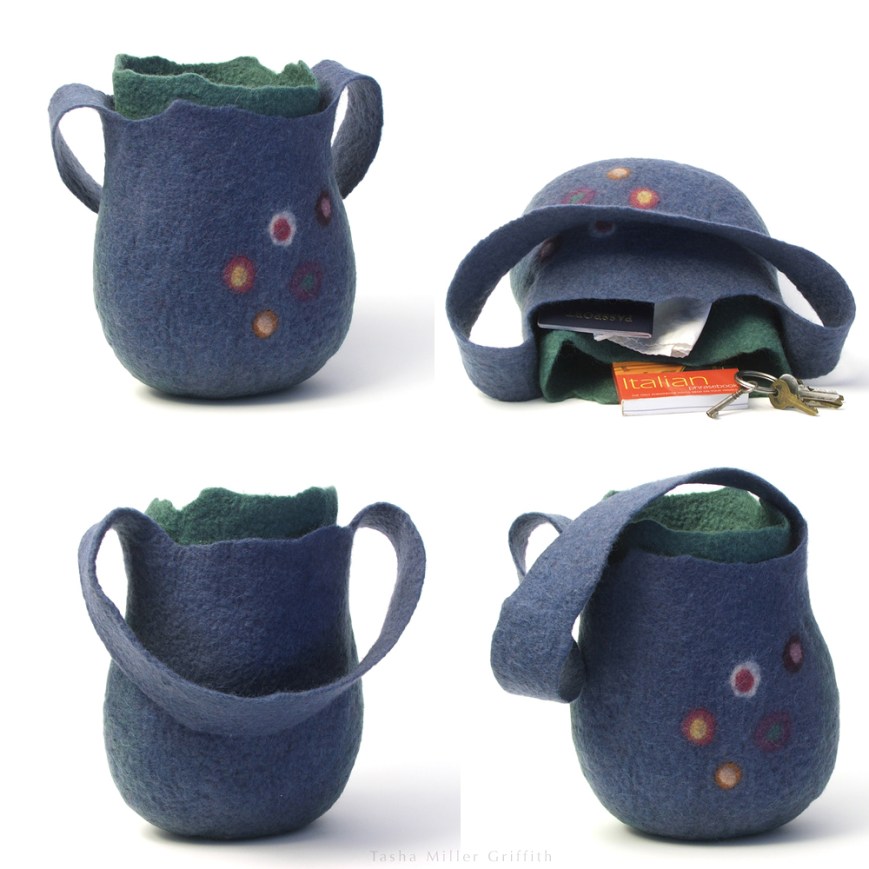
wet felt bag exampleAn example of the bags I made.  These are made entirely by wet felting; they start out as fluffy wool like the example in Part 1.  As you can see, it’s possible to make complex sculptural shapes without any stitching or even yarn!  I formed the pockets by using resists to keep the two layers from felting together where I didn’t want them to.


What is fulling?  Or, how do I felt knitting or fabric or old sweaters?

Fulling is a term used for the second stage of felting, and for felting fabrics which are already knit or woven.  This makes sense because in either case, the fibers are stable enough to take some more vigorous agitation.  Although, when you’re felting something like your knitting by hand, it’s still a good idea to gently encourage the fibers to cling together at first, rather than rubbing them around as hard as possible.  Keep in mind that at any stage, gentle agitation can actually work better.  Try it and see.

There are lots of ways to full, or harden, your felt.  This is where the majority of the agitation takes place.  In Mongolia (where there’s an amazing heritage of felting, think yurts), the tradition is to roll a new rug up inside an old one, and drag the bundle behind a horse!

By Hand

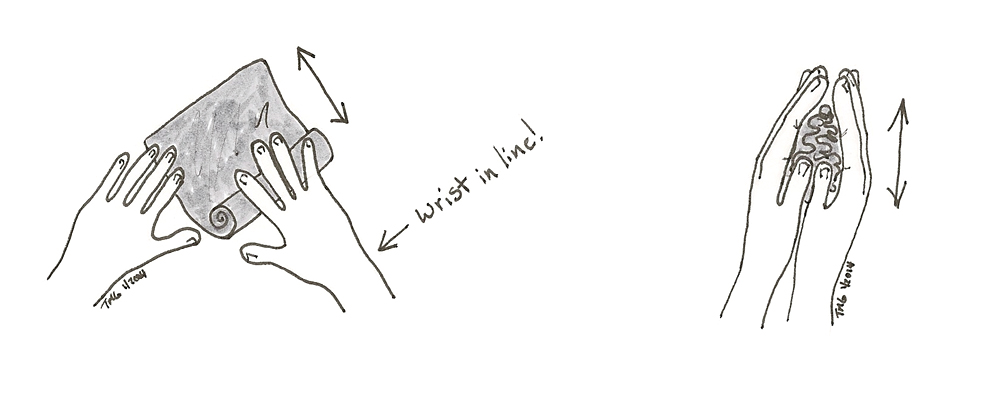
When I’m felting knitting by hand, or fulling a felt piece like the one illustrated in Part 1, I have a bowl of water about as hot as my hands can stand.  I dip the piece into the water, squeeze some of the water out, and rub it.  Two effective motions are rolling, and scrunching the felt between your two hands.  You can also scrub it around on the bubble wrap, or even throw it against a hard surface to get the shrinking going.  Whatever you try, remember to keep your hands in alignment with your arms and wrists in good alignment.
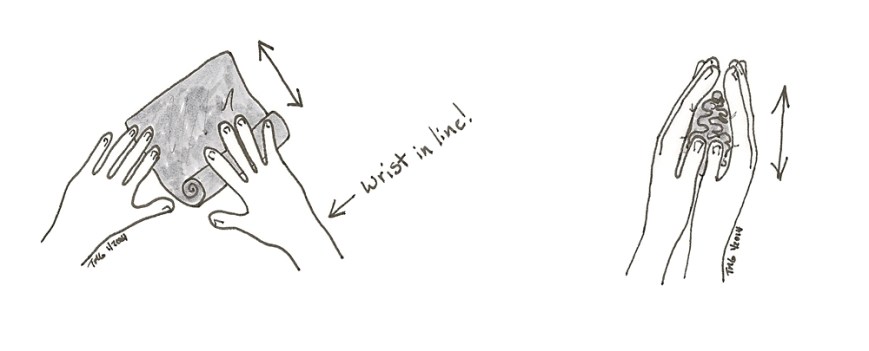
 

felting motions drawing

The advantage of felting and fulling by hand is how much control you have.  The exact parts of your felt you rub are the ones that shrink, and they shrink dramatically more in the specific direction you are agitating them!  Try it by rubbing a corner in towards the middle of the felt, and you’ll see what I mean.  For even fulling, make sure to rotate the direction in which you’re rolling and rubbing.

Stop and stretch your felt (and your hands & arms!) from time to time, stretching out your work will actually help it shrink down further.

For felting my gloves/mittens, I put them on, dunked them in the water, and rubbed them all over and around each other, concentrating on areas that I wanted to shrink more, and alternating taking them off for stretching and rolling with more rubbing while on my hands.
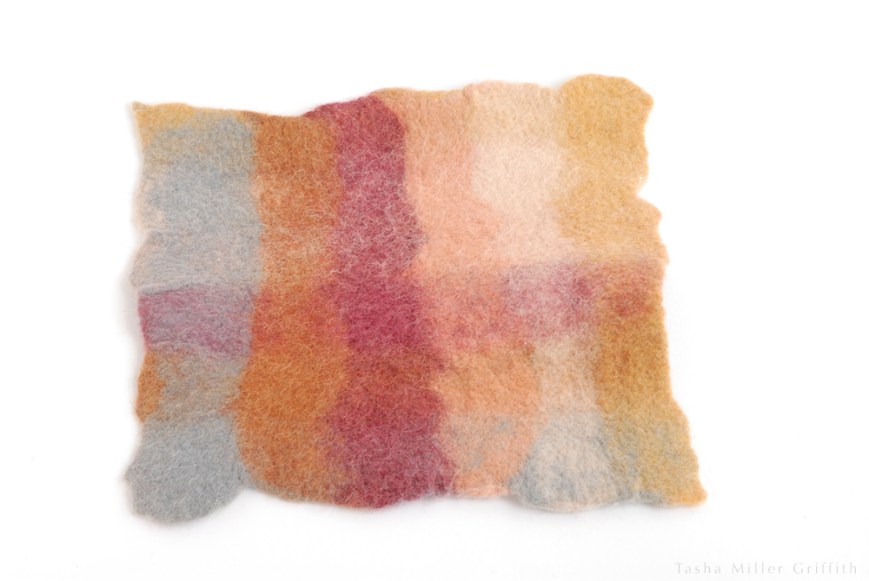
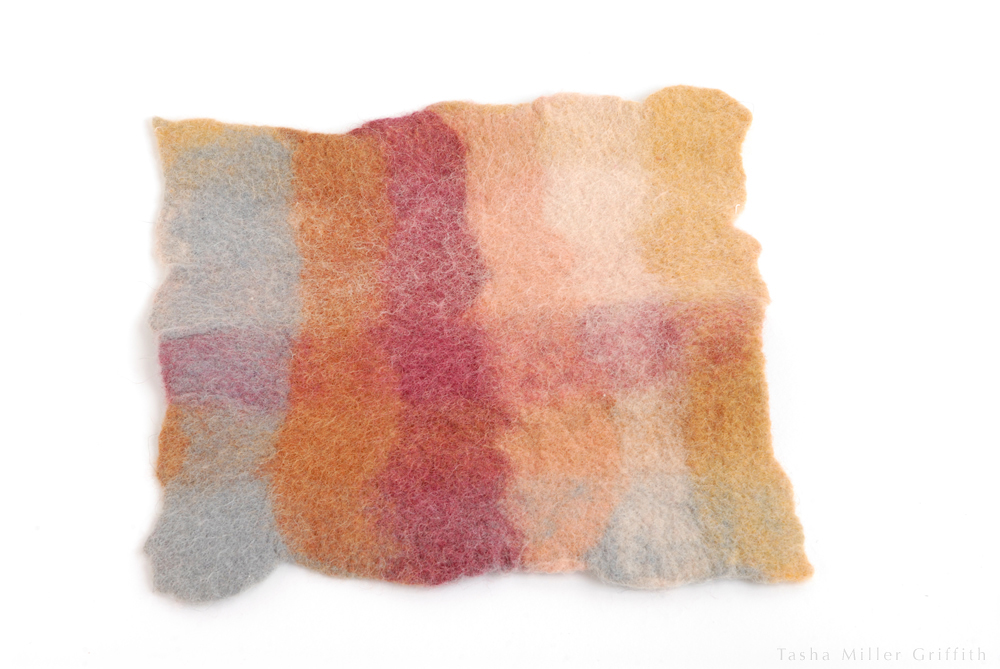
natural dye felt color sampleIn this wet-felted color sample, you can see how fibers from each side of the piece worked their way to the other side with thorough felting.


In the washing machine

You can also shrink knitting, fabric, and even hand made felt that’s getting good and sturdy, in the washing machine.  Proving that agitation trumps any and all other factors, even though the fibers are swimming in water and the water may not be that hot, you can quickly get dramatic results.  The downside is that you don’t have much control over what happens.  I usually use the washer to help with fulling when I’m felting something big, but I check on it every few minutes, getting the felt out of the water and stretching or rubbing certain parts to help it take on the shape I want.  Top-loading washers produce the most agitation, and are the easiest to use for checking the felt frequently. Front-loading washers also work, especially if you are trying to felt something as much as possible, so you’re planning to leave it in for the whole cycle.

Set the water level for lowest amount that will cover whatever you’re trying to felt, and the most soil/most agitation setting, with hot water.  Put your piece in a zippered pillowcase, to prevent the wooly lint which some pieces shed a lot of from clogging the washer pump (ask me how I know about that!).  If your washer has a removable lint filter, you don’t need the pillowcase, just be sure to clean the filter when you’re done.

I don’t recommend felting large pieces of fabric in the washing machine, the agitation is just too uneven over such a large piece, and it will probably come out with some areas much more felted than others.  If you want to felt fabric for a sewing project, try cutting it into smaller pieces first (be sure to account for shrinkage when planning the size of the pieces, see below).  Even then, you’ll get the most even results if you can alternate being in the washer with stretching and rolling the pieces.

Some people use the dryer to felt as well.  If you’re trying to shrink your felt as much as possible, throwing it the dryer certainly won’t hurt.  Also feel free to experiment with putting damp felt in the dryer, and checking on it frequently the same way you would for felting in the washer.
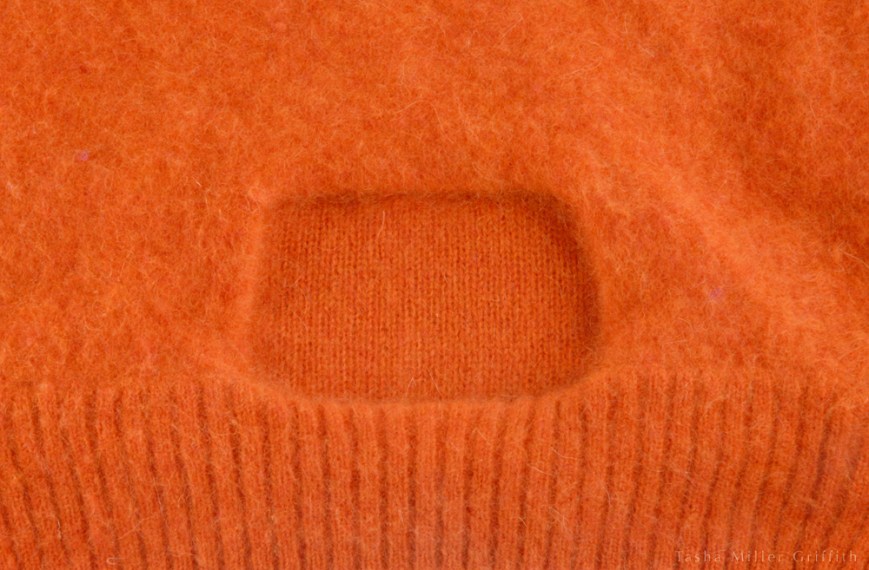


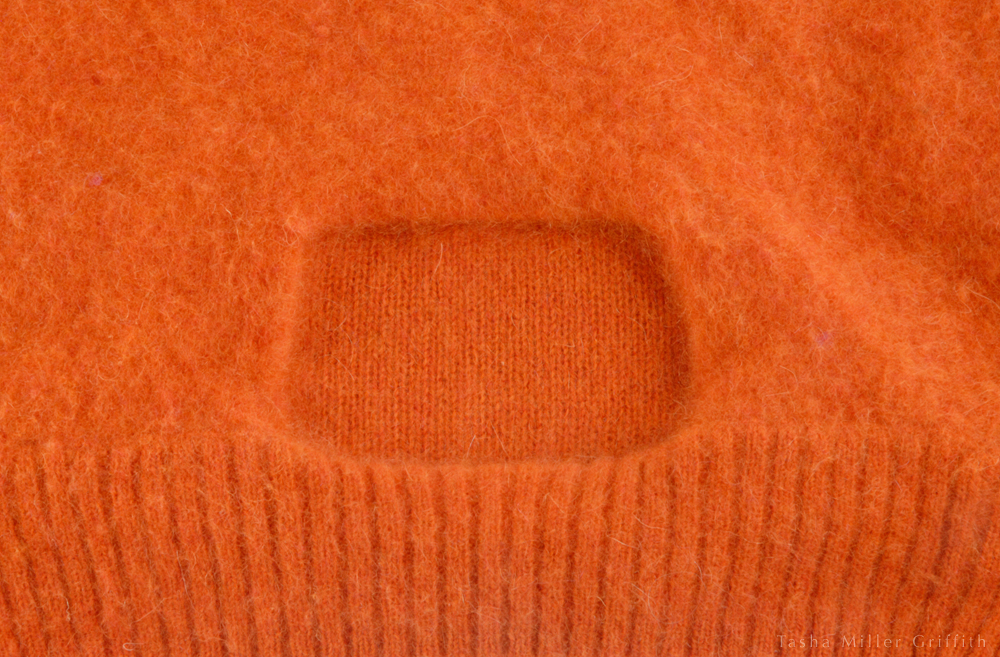
orange felt with unfelted labelThe body of this sweater felted well, except where the stitches were held in place by the sewn-in tag.  Since those fibers weren’t free to rub against each other and felt, they still look the same as they did before going through a few hot washes!


Will felt keep shrinking forever?

No.  At some point, the fibers have locked down as much as they are ever going to, and you really can’t get your piece any smaller, even if you want to.


Can I decide that my felt is done even if it hasn’t shrunk/hardened as much as it could?

Absolutely.  As long as it’s sturdy enough for its intended use, you can stop whenever it’s the size and thickness you want.  Sometimes the maximum that your felt could shrink would be much too thick and stiff for what you intend, or just too small, especially for felting knitting and fabric.  On the other hand, if you are making hand-felted boots or handbags, you’ll probably want to plan on the maximum amount of felting you can get, so that as many fibers as possible will be locked in, and the finished item will be as long-wearing as possible.


How much will my felt shrink?

It depends on a dizzying number of factors, but there is one sure way to find out: test it, by making a sample and measuring it before and after, as I illustrated in my post about the magic purple mittens.  This method works for wet felting too, just measure the dimensions of the wool you lay out before you felt it. If you’re trying to get a sense of how much fiber you used, any dry felt weighs the same as the fiber used to make it.

Wool from different breeds of sheep felts dramatically differently, some from sheep raised for meat may not felt at all!  Even different individual sheep can produce wool which felts differently from the next sheep over.  The hat at the beginning of Part 1 is Churro wool, which shrinks a lot, as you can see from the pattern!

If you’re buying yarn or fabric to felt, unless it’s from a local herd, you may not know what type of sheep it comes from, but most quality wool will felt to some degree.  The yarn or fabric should be at least 50% wool, alpaca, cashmere, or other feltable critter, and not be treated (“superwash” etc.) to prevent felting.  Bleaching can be hard on the fiber scales that make felt work, so lighter colors often take longer to felt.  Like I said, there are a lot of factors, so if it matters what size the final felt is, test first!
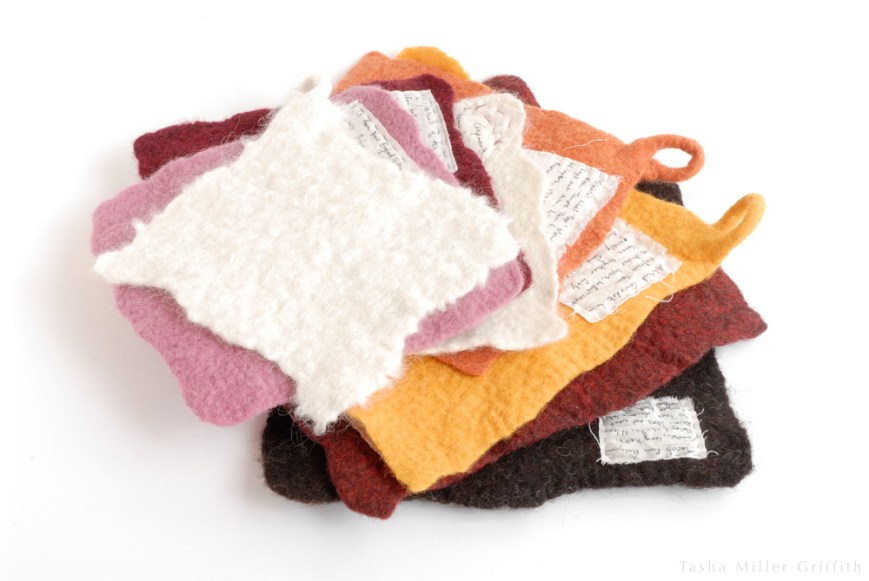
 

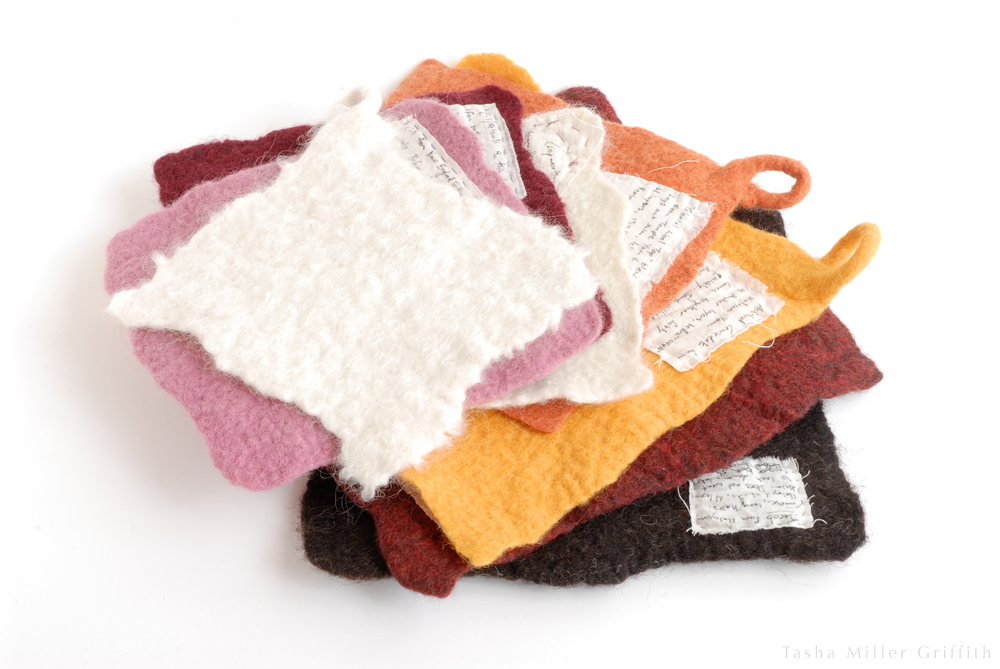
felt breed samplesWhen I was looking for a wool to make my wet felted bags from, I made a lot of samples!


Can felt happen by accident, or with wear?

Definitely.  As you’ve seen by now, the conditions for felt are readily available in your washing machine, which can be disastrous if your nice sweater accidentally gets in there.  And, as I found out the hard way, even if it seems like a garment made from wool fabric is not felting, over many many washes, it eventually will (illustrations and happy ending here).

I also know from experience that a garment can felt as you wear it.  I have a pair of alpaca and wool blend fingerless mitts that, as they are exposed to warmth and moisture from my skin, and agitation as I wear them while I grab my keys, the steering wheel, etc., are slowly becoming more solid.  We shall see what the end result is.  This is something I’m really interested in at the moment, so stay tuned for more findings.  For now, my best advice is: don’t make an article that will be exposed to felting conditions out of a material that felts easily, or plan for shrinkage and felt it first.


What should I do with my felt when it’s done?

Let it go through the spin cycle, or roll it up in an old towel and squash it, to get out as much extra water as you can.  In this damp state, the felt is super malleable, so plan on doing some final shaping.  You can rub, tug, scrunch, stretch, and otherwise push the felt around into exactly the shape you’d like.  If you’re felting something like a hat, it helps to have an object to “block” (shape) it on, try a bowl a little bigger around than your head.  When you get you new felt shaped just as you would like, leave it alone to dry.  If the felt is thick, this can take  a couple of days.

Once the felt is dry, you still have another chance to shape and smooth it, with steam from your iron.  All wool responds especially well to steam (think about tailoring), but on felted wool steam is a minor miracle.  It can straighten out lumpy areas and smooth the whole texture of your felt.  Placing the iron right on the felt will also smooth and flatten the surface fibers, so if you don’t want that, hold the iron above the surface to fill the felt with steam, then put the iron down, and shape with your hands.


Don’t I need soap to felt?

My current experience says not necessarily, except under special circumstances.  Historically, all kinds of harsh chemicals were used in felting, to roughen up the fibers’ scales and speed up the process.  These were also highly toxic.  Most felters now just use a mild soap.  Olive oil soap and liquid soap are popular choices.  This soap doesn’t do much beyond decreasing the surface tension of the water.  Lately I have been felting mostly without soap, and I haven’t noticed a difference between using it and not using it in my studio.  You may find soap more helpful than I do, depending on your wool and your water.  Don’t add too much though, if the fibers are too slippery they won’t want to grab on to each other.

When you are hand felting, if your hands are sticking to the fibers rather than sliding over them, a little soap on your hands should help.  A mixture of solid soap and water can be a very effective “glue” if you are hand felting two things that don’t want to stick together.

If you are felting in the washing machine, you definitely do not need to add soap.  There will be enough left from the last load to make plenty of foam.

If you do use a soap that’s alkaline (most are), make sure to rinse it out thoroughly when you are done felting.  Animal fibers, like your own hair and skin, are slightly acidic, and being left in an alkaline environment for long periods can damage them.  Include a splash of vinegar or lemon juice in the last rinse, and let the felt soak in it for a few minutes to neutralize any remaining alkalinity.
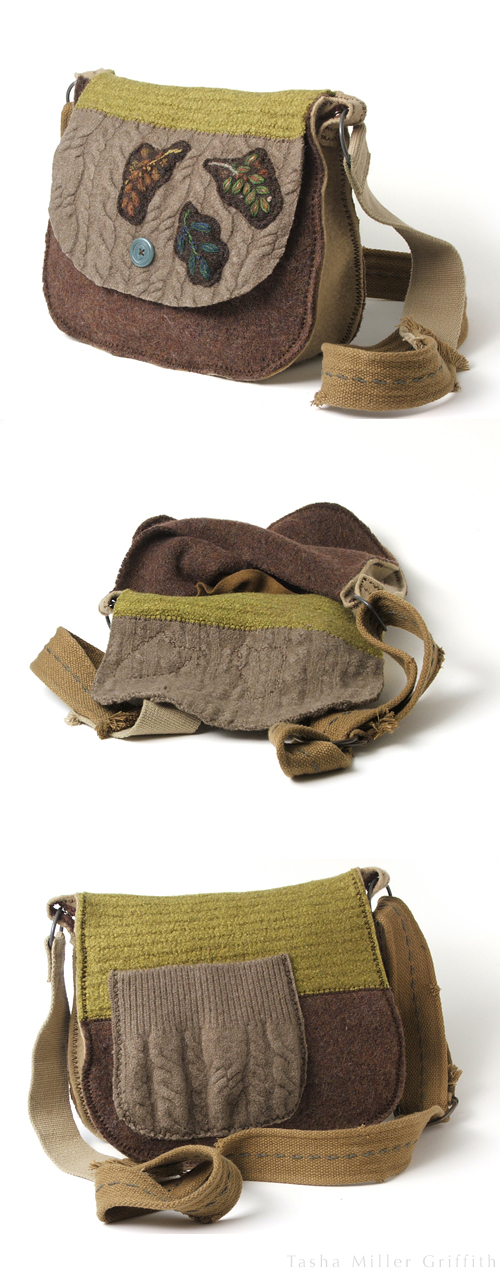
 

sewn felt bag exampleI made this bag from felted wool sweaters.


Why would I want some felt anyway?

Felt is fabulous!  It’s a dream to work with.  As you sew it, you can ease in what seems like an impossibly large piece onto a small one, just using your fingers.   It doesn’t ravel when you cut it.  It wears like iron (assuming it’s tightly fulled).  It’s so insulating that I can iron the outside of one of the wet-felted bags, with lots of steam, with my hand inside, and feel nothing for minutes.  It’s breathable and odor-resistant and has all the other lovely properties of natural fibers.  Plus it’s beautiful, natural, and fascinating.  It can be sculpture with fiber.  It’s the perfect next stage for a sweater that’s been attacked by moths or pets, or just has cuffs too worn out to repair—felt it and make it into something else.


Finally, how not to felt

To care for precious article you’d rather not felt, basically do the opposite of what you would to felt it.  Hand wash it very gently: place it in water with a little bit of pH neutral soap.  Let it soak clean, press down gently to move the water through it, and drain the water off without agitating.  Keep the rinse water the same temperature as the wash (lukewarm is fine) and avoid letting the water run directly on the article.  Spin it out (spin only) in the washer, or roll in a towel and mash on the roll.  Reshape, and leave to dry flat.


Further reading

My favorite felting book is Uniquely Felt by Christine White.  It covers, in detail, methods for just about every type of wet felting you could think of.  Pat Spark, who I mentioned in Part 1, has been at the forefront of bring felting to the internet since the very beginning, and she has a ton of useful info on her site.


I packed as much as I could in here without going into exhaustive detail, so I hope it’s helpful and not too overwhelming.  If you have more felt questions, send them my way!

 

DIY Crib Rail Covers for Teethers — A Tutorial


So apparently, small teething children will chomp down on wooden crib rails like beavers.  I really had no idea until, visiting our dear friends at the end of the summer, I saw the evidence first hand, little teeth marks right through the wood finish.  My friend the mama was thinking about ordering some covers for the crib rails, but I knew we, ok I, could easily make some, and I would get to sew!  In August, after months away from my sewing machine, this seemed like a gift from the universe, plus it would be so useful and cute for friend mama and her little one!  I’m going to share my notes and method, which should work for any crib, below.  This is a fairly quick project, so if you are still looking for a gift for a young family, it could be a good one.
 

crib rail protectors onTo make up for only having quick snapshots of this project (did I mention there was a baby involved?) I’m making it my illustrated post for this month.


First things first, I measured the crib.  I wanted the covers to go around the whole rail easily, so I added a little extra ease to my measurements.  The back rail is against the wall, apparently too awkward an angle for little one’s head to chew, so I didn’t worry about that one.

crib rail protector mathI know that the quilt batting (which I want here for padding) will shrink a little bit, probably not enough to affect the width, but for the length I’ll include a bit extra.  I usually use 1/2″ seam allowances, which I did for the width.  I decided to use 1″ seam allowance on each end for the length, since that is where I am likely to want more wiggle room.  To figure out how much fabric I need, I made another diagram, since I’m really a visual thinker.

crib rail protector fabricSo here are the supplies I got, including a little extra fabric for shrinkage, since it’s 100% cotton:

Two yards fabric (Modern Bliss design #13662 by Robert Kaufman)

One yard super wide cotton quilt batting, for two layers of batting in each cover

Eight yards of totally beautiful soft cotton ribbon for ties

All of this came from Stitchin’ Post in Sisters, OR.


When getting ready to sew, don’t forget to preshrink your fabric!  Wash the fabric and dry it the same way you (or the recipient) plan on treating the finished project.  I also put the ribbon through wash and dry, in a lingerie bag, just in case it was going to bleed any dye, etc., since a baby might be chewing on it.  I didn’t pre-shrink the batting.  The package it came with says it will shrink 3%, which will give the covers a bit of that puffy quilted look once they are washed.  After washing, I ironed the fabric and ribbon to get rid of wrinkles and make it easier to measure and work with.

Cut or rip the fabric and batting into strips 10″ wide (or the width you picked for your crib), and then divide them for the length of the covers, as in the diagram above.  Take one fabric section with its corresponding batting to the crib, make sure the size seems close, and decide where you want to put the ties and how long they should be.  We decided on 7″ for each tie, which divided fairly neatly into 8 yards, 20 ties with two sides each.  I just cut the ends of the ties at a diagonal to keep them from fraying, and left the other end, which will be sewn inside the cover, squared off.

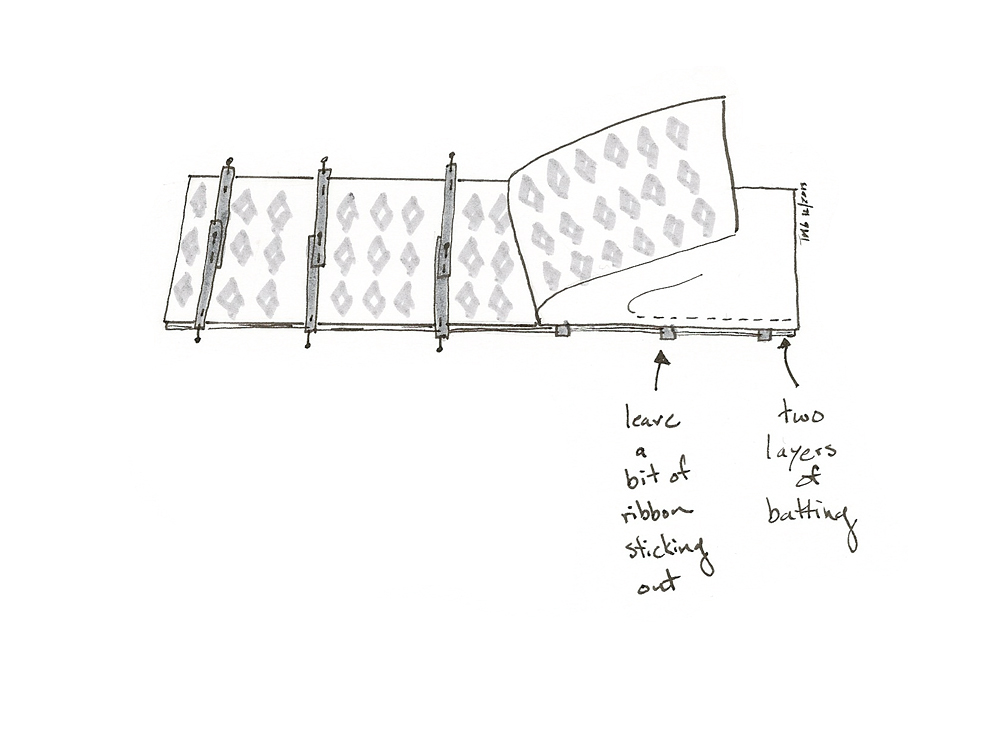
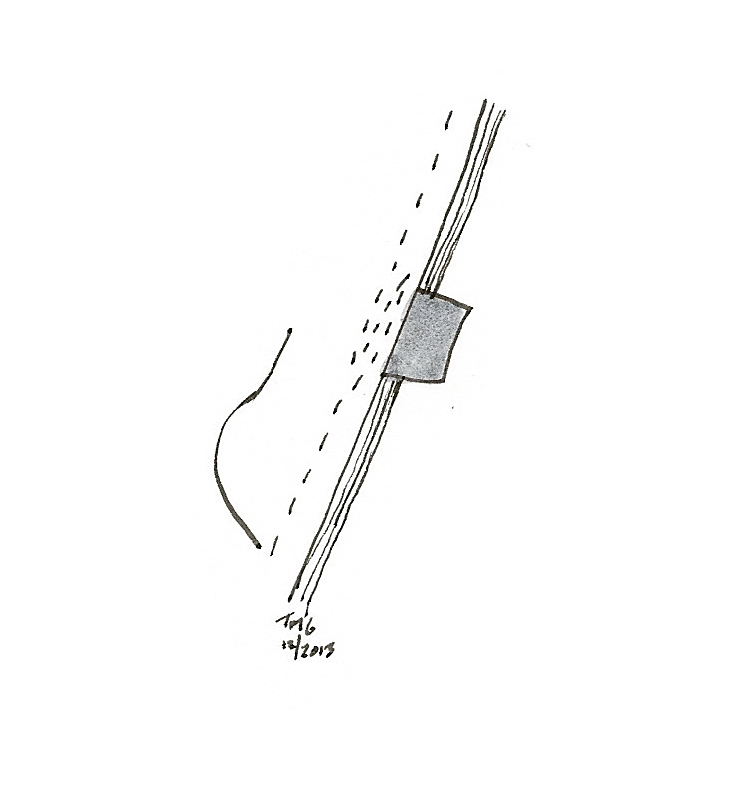
I pinned the ties to one side where I wanted them to go, and then with the fabric off the crib, folded it in half to match and pin the matching tie. It’s helpful to leave just a bit of each tie sticking out beyond the fabric, so you’ll be able to see where they are when you’re sewing.

Make a fabric stack for each cover, with two layers of batting on the bottom, then one layer of fabric (right side/public side up) with the ties pinned in place (I pinned them in the middle too, so that they wouldn’t shift around and get caught while sewing).  Then top with the other side of the fabric, right side down towards the ties.

crib rail protector sandwichHold the whole sandwich together with a few pins, and sew down each long side with a straight stitch, 1/2″ from the edge—our planned seam allowance.

Each time you come to one of the ribbon ties (which you’ll know because the ends are sticking out) sew over it, then back up and sew forward again, so that there are three lines of stitching holding each tie in place.  Blend back to your seam allowance line, and keep sewing to the next tie.

crib rail protector sewing ribbonOnce you have sewn down both sides, turn the whole thing inside out and tada!  The batting is on the inside and the ties are on the outside.  I had thought I would trim the batting from the seam allowances, but when I got to this stage it didn’t seem necessary.  I just pressed everything in its new orientation, smoothing things out and using the iron with steam.

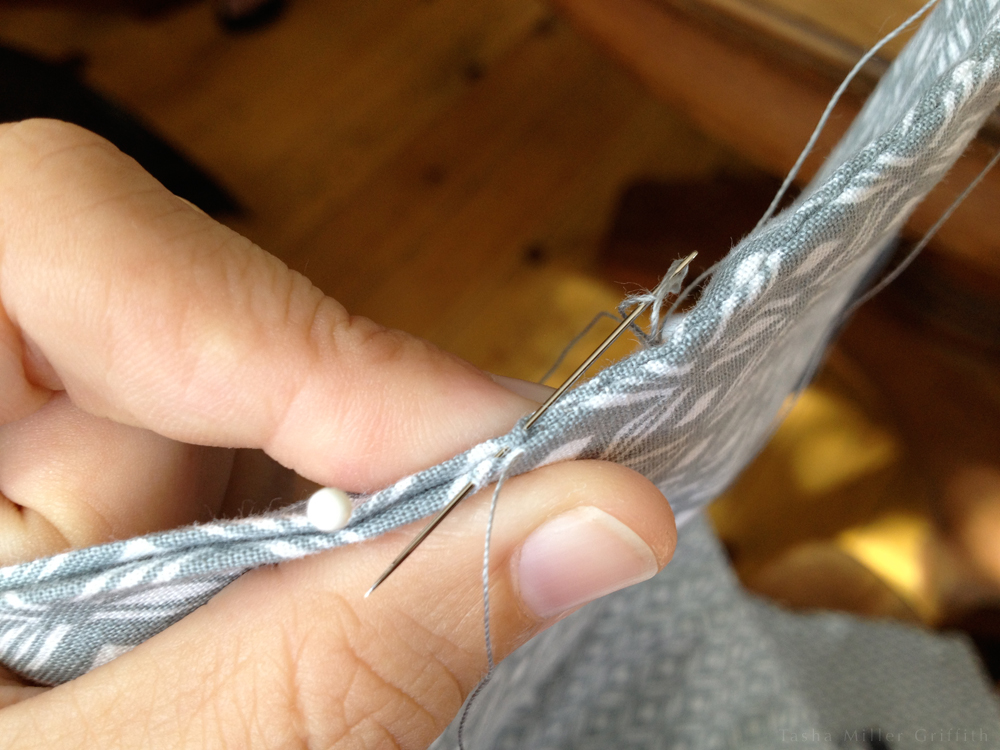
Check the size of the cover on the crib, the fold the ends to the inside to get the length you like.  I decided to stitch them closed by hand, using a ladder stitch which picks up a little fabric from each side.  It just looks better, and I can also add a line of stitching near the ends when quilting so that the hand stitches won’t take much strain.  The white UFO near my fingers in the photo is the head of a pin . . .


crib rail protector sewing ends


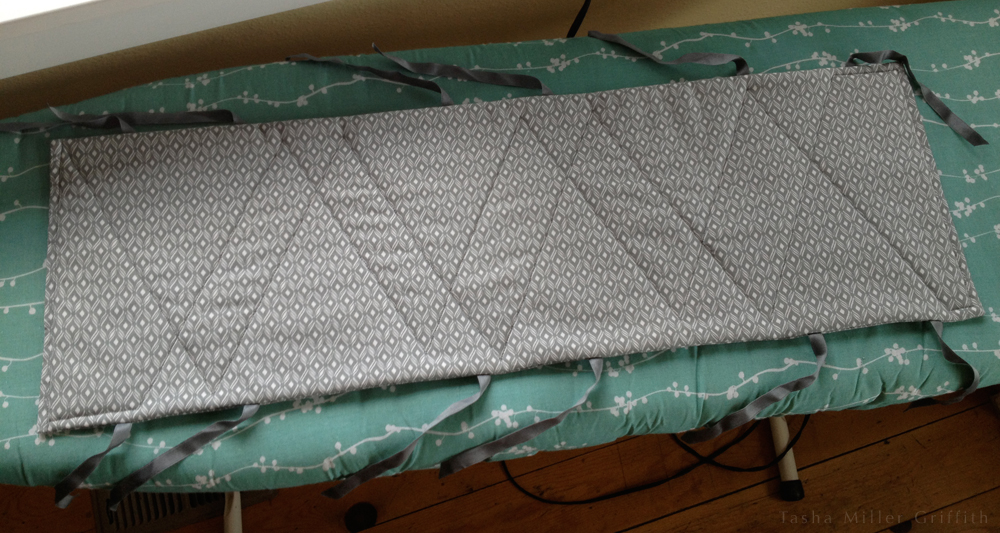
All that’s left is the quilting!  I don’t usually quilt; I’m too obsessed with the properties of different fabrics, their drape as a 2-D material wraps a 3-D body, and the possibility of walking around all day protected and flattered by garments I made.  I do see how quilting is perfect for something like this though, and I don’t mind the quilted look, but it does bug me when the stitching totally contrasts with the fabric, especially when I like the fabric as it is.  I decided to use the diagonals in the print as guides for my quilting stitching, and not to worry about them being exactly all the same.  It gave the covers more of a modern look, which the mama and I loved.  I did check the batting instructions, which said to quilt no more than 8″ apart, and make sure the maximum distance between my lines was not more than that.  I quilted to one end, checked the measurements and then did a second round.  I didn’t have access to a walking foot, so I spread the fabric and batting sandwich outward from the foot with my hands as I went, and it worked just fine.


crib rail protector finished


I just loved making these, mostly because at the time I was thrilled for the chance to take a project from idea in my head to finished object in my hand!  I’m sure I could have looked up someone else’s directions, but I didn’t want or need to, and I love how my version came out.  I played with the balance between making something as good as I can, because it’s for my best friend’s baby, and going with the flow, letting it be a bit inexact and show its handmade-ness, because it’s the real world, and because I always think handmade things are the most beautiful.

If you try this project, I hope you’ll agree, and have as good a time as I did!  Happy week everybody!