Turning a Lotion Bar into Handmade Salve


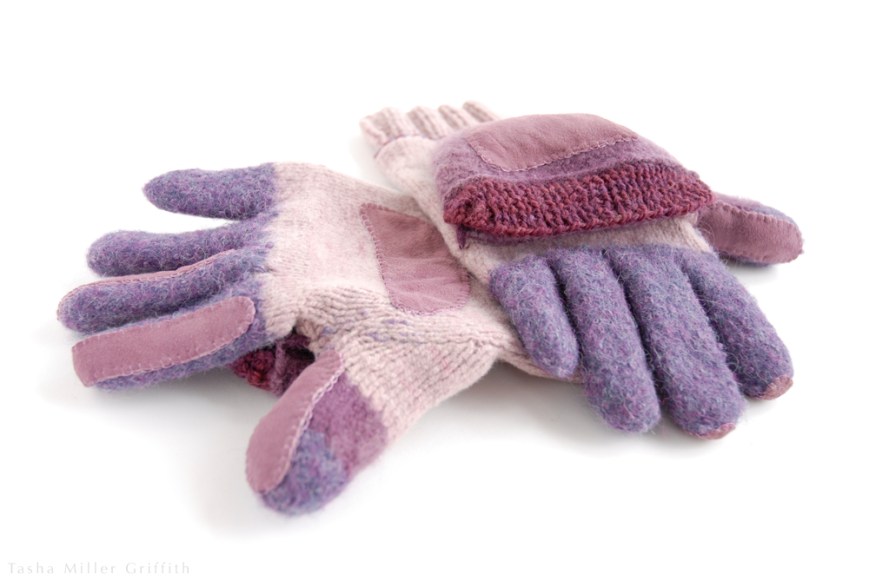
For some reason, people give me these lotion bars.  It’s true that I have super dry skin, but the consistency of the bars doesn’t really work for me, it leaves a sticky film on my fingers.  However, I just love homemade salve.  I use it for lip balm, minor burns, on my dry fingertips before bed, etc.  The ingredients of the bars and the salve are about the same (a combination of oils and beeswax, and sometimes a few other ingredients like shea butter), except the salve has a higher proportion of oil.  So …

Basically all you have to do is heat the lotion bar until it melts, add more oil, and cool it again.  I’ve tried this a few times and the mixture has always stayed emulsified.

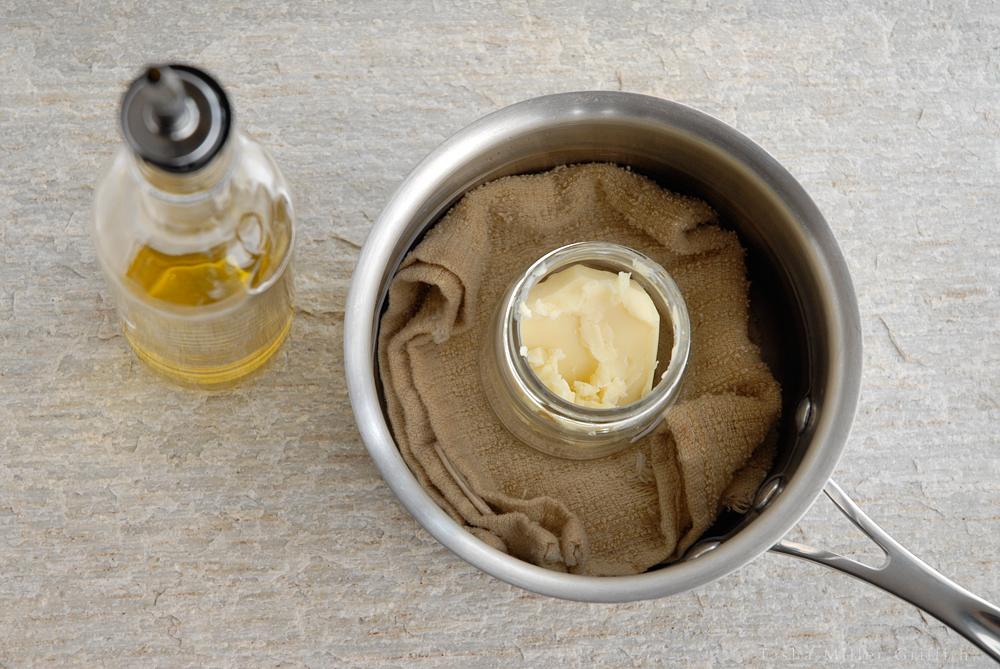
A re-used glass jar is a good vessel for heating. The ideal container would have a pouring lip (which this one doesn’t). It only took a little brute force to get my lotion bar inside.


lotion bar to salve 1


I melt it gently, in a pot with water over low heat.  It might not be necessary, but to insulate the jar from the direct heat, I put an old dishrag in the bottom of the pot. The bar will take a while to melt, but you don’t have to watch it the entire time, just remember to come back and check every so often, until it’s completely melted.

To figure out how much oil to add, you really just have to let the mixture cool and try it out, as it depends on how much is in the bar to begin with, and the finished consistency you like.  Err on the side of a little less than you think to start with, you can always add more.

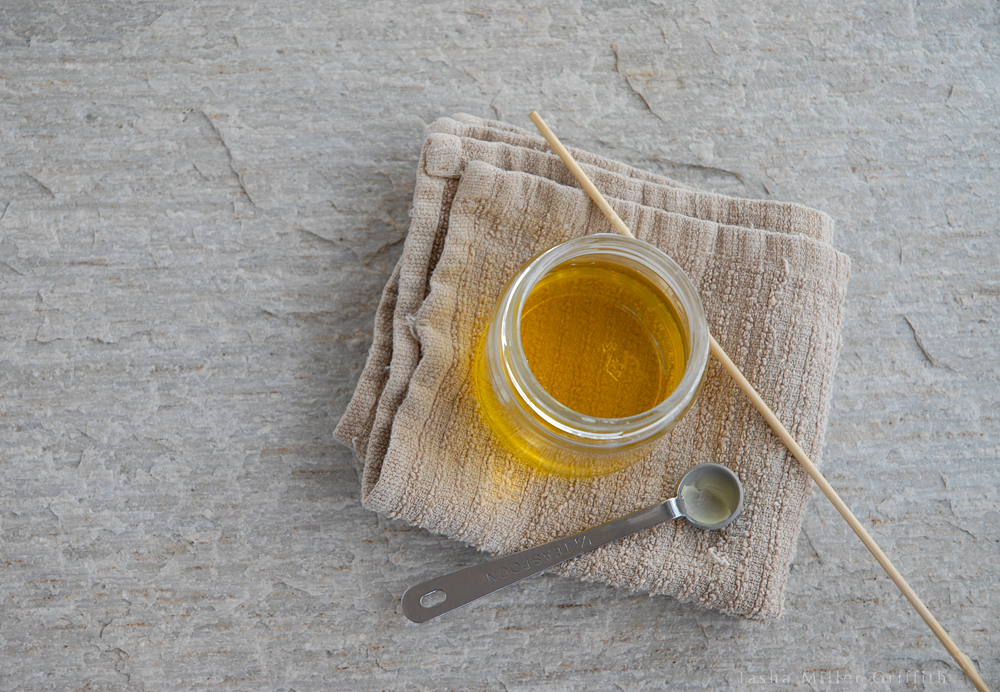
You can add olive oil, almond oil, or any other oil you like that’s good for your skin.  I’ve used jojoba oil for the last few batches, since I had some from another project.  Stir the oil into the mixture, so that it’s distributed throughout (I used a wooden skewer).

The first time I did this, I let the jar cool down all the way to test it.  Then it occurred to me that it would be much faster to cool a small amount in a little measuring spoon.  Wait until it’s completely cool to test, and keep in mind that a hard skin forms on the surface, so break through it and smear the salve between your fingers, on your lips etc. to test the texture and absorbency.


lotion bar to salve 2


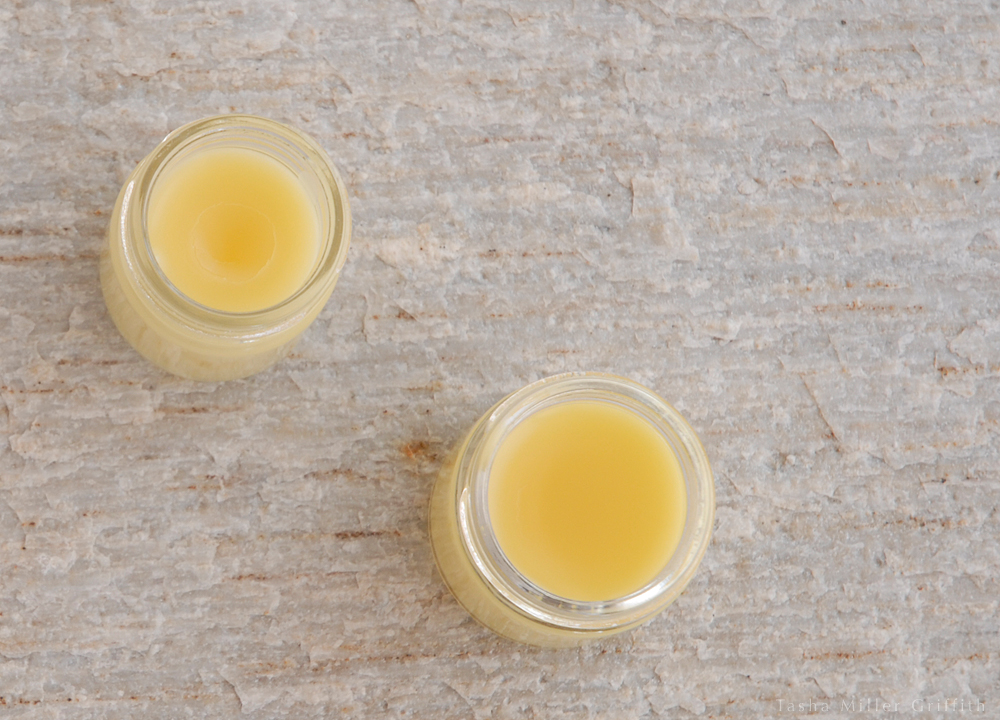
As soon as you get in as much oil as you want, the salve is done!  If you’d like, you can pour it into smaller containers for storage and use while the salve is still liquid (using a funnel or very carefully).

Every time I do this, I’m pretty excited about the almost effortless batch of lovely new jars of salve around the house.  If you want to, you can even make fun labels for them, like we did for the salve we made at my craft retreat two years ago.


lotion bar to salve 3


I find the best way to get the salve off the teaspoon, or out of a jar I’d like to use again, is to just keep rubbing it off with one dry fingertip after another.

Here’s to upcycling!


Recycled, Naturally Dyed Silk Camisoles

Plus My Favorite Method for Sewing Knit Fabric Straps, and Self-Fabric Binding with Elastic


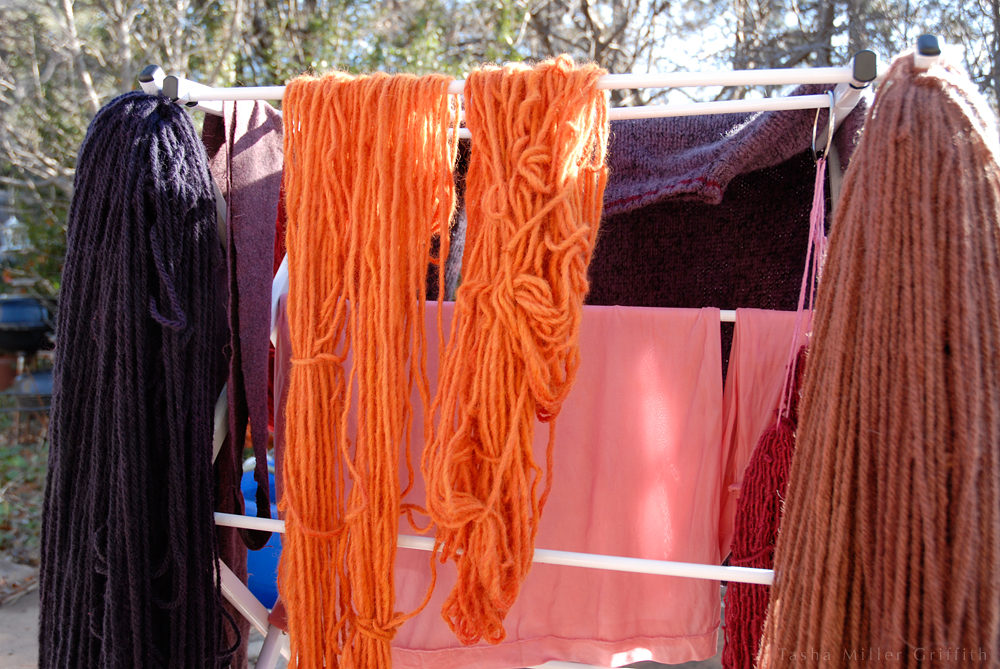
pink silk cami dyed hangingThe pink top before re-purposing, hanging with other materials dyed the same day.


Last fall, my friend Zuni invited me over for a day of dyeing with natural materials at her house.  I have an informal craft exchange going with some of my fiber friends, and it’s fantastic to have Zuni as part of this group.  All the mess and calculations for dyeing stay at her house, and we just bring home the colorful finished products.  The day in question, one of the dye materials was indigo.  Most of the craft exchange members tend to dye yarn.  I’m pretty militant about not letting my yarn stash exceed the capacity of one big plastic bin (after, ahem, seeing what happened to my fabric stash), plus I sew more than I knit, and I’ve sewn for longer, so I tend to be the one who shows up with odds and ends of fabric or garments to re-purpose.  This time it was a silk long underwear top.  I inherited two of these from my grandma’s stash.  The fabric is really lovely, but I hardly ever wore the tops, they were kind of baggy for layering, and looked awkwardly like underwear when visible—picture your classic long undies, but maybe a bit looser.

I think I had a class that morning, because I came to the indigo day partway through, at which point we literally just dropped the top into the dye bath.  Indigo doesn’t need a mordant, but I learned something important: dyeing something without soaking it in water first leads to splotchy fabric!  Funnily enough, a slightly mottled fabric was what I pictured when I envisioned how this would come out … although maybe not quite that spotty!   I also think not wetting first may have led to some of the color not being bonded with the fibers, and then rubbing off.  This was all an experiment though, and I was just happy to have a dyed piece to work with.

My plan was to cut the top up and make something I would definitely wear: a lovely silk camisole (tank top, vest, whatever you want to call it) for a winter-time first layer.  I used the same pattern as for my summer tanks, which after many alterations, bears almost no resemblance to the starting point: Kwik Sew 3524.

Click on any of the pictures for more detail.


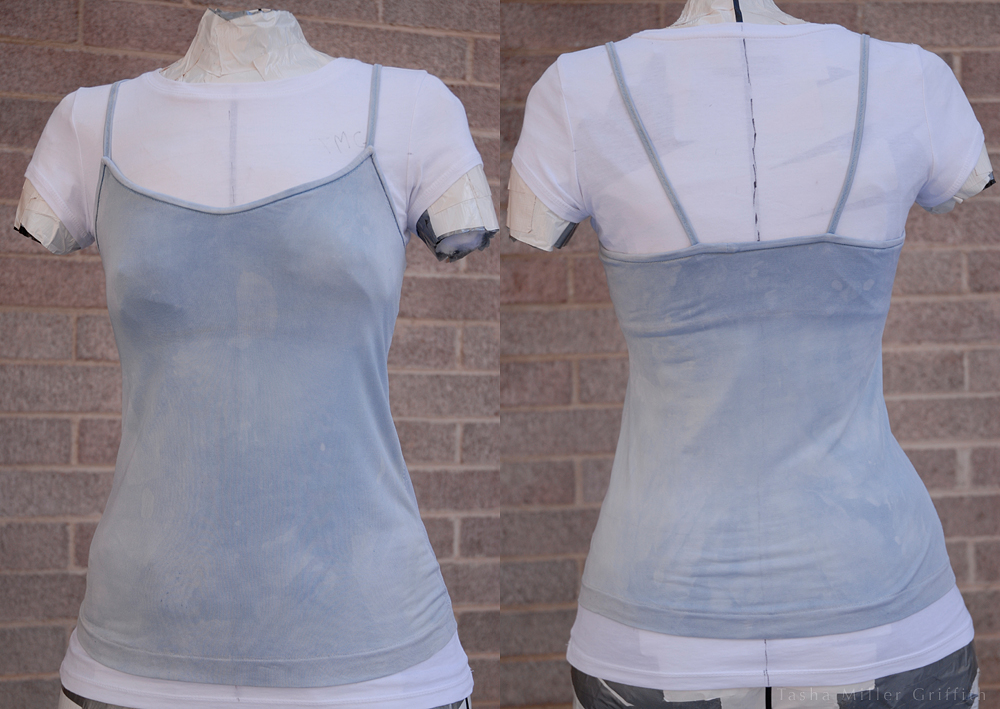
blue silk cami on form


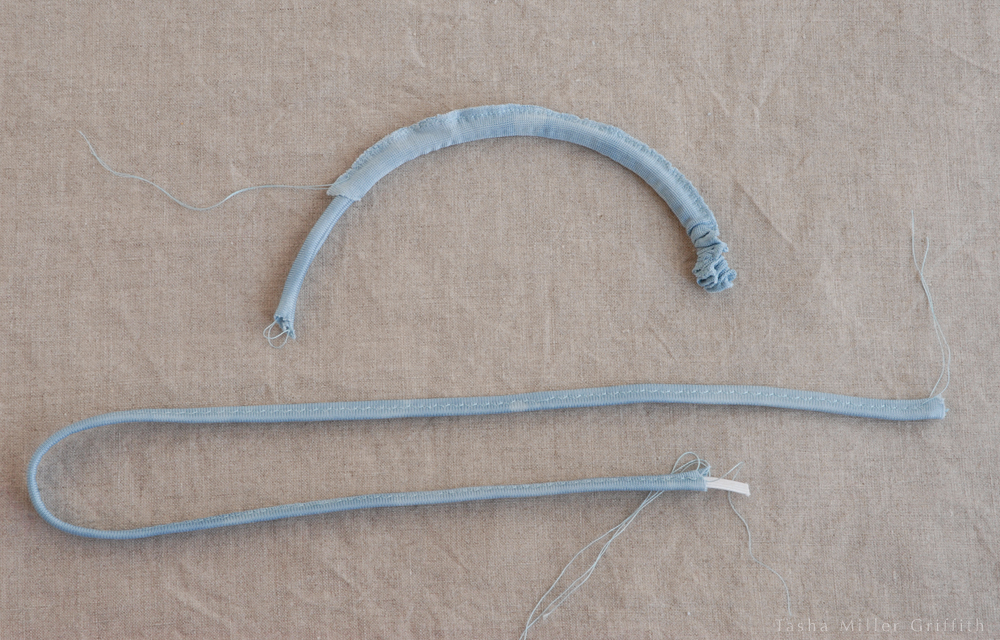
A couple of things that came out really well: the straps and the elastic binding at the top.  I’ve used this method for straps on a couple of (not blogged) other tanks, and really like it.  Basically I just sew a tube of fabric, using a narrow zigzag stitch since it’s knit fabric.  I turn the tube with a wire, and then slide a piece of elastic through it, using a bodkin or a safety pin.  Then I stitch through all the layers.  The added elastic gives the straps more stretch, recovery, and sturdiness than they would have if they were just made from the fabric.  This seemed essential when working with practically transparent silk!


blue silk cami straps


For these straps, I used 1/4″ elastic, and cut the fabric strips for the straps 1″ wide.  You need a little more than the elastic measurement for the fabric tube to fit around it, especially once the seam allowances are also tucked inside, and a bit for the seam allowances themselves.  Sewing through the fabric and the elastic holds everything smoothly in place.  I roll all of the seam line to one side of the elastic before sewing, which becomes the bottom of the strap, and the top looks clean.

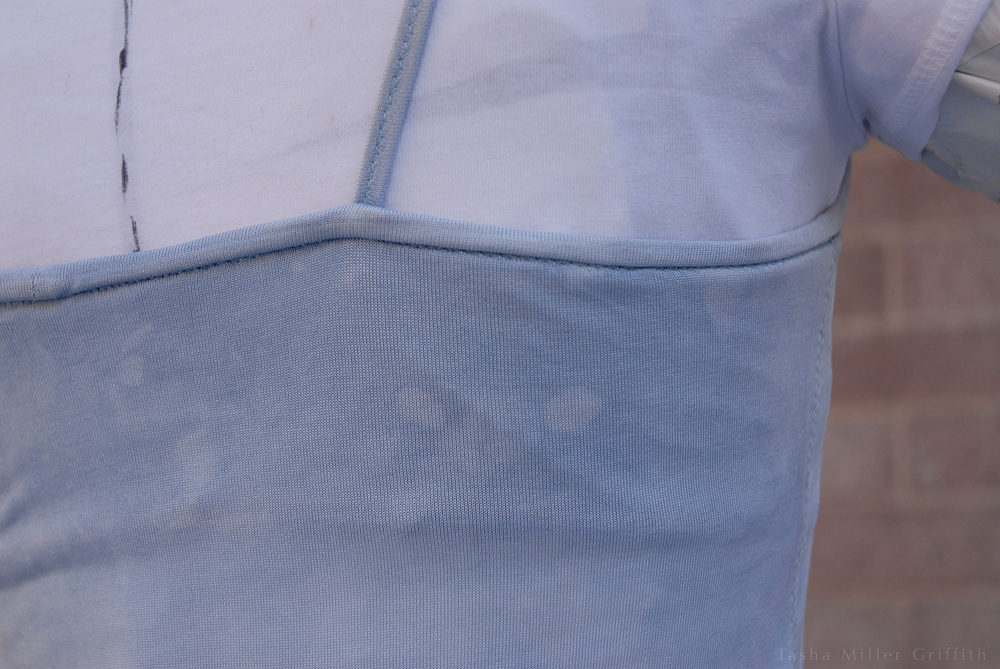
My favorite thing about these camis (other than the feel of the silk on my skin, or maybe the color) is the way the edging fits at the top.  I used another fabric strip, and plain 1/8″ elastic.  I didn’t stretch the elastic at all when pinning and sewing it on, and the slight negative ease in the pattern (I checked—it’s about 88% of my body measurement at the upper chest) turns out to make just exactly the amount of stretch I want at the top.  It just hugs against my skin, without gaping or digging in.


blue silk cami binding closeupThis dress form is a copy of my body in duct tape, and the binding fits just as nicely on me.


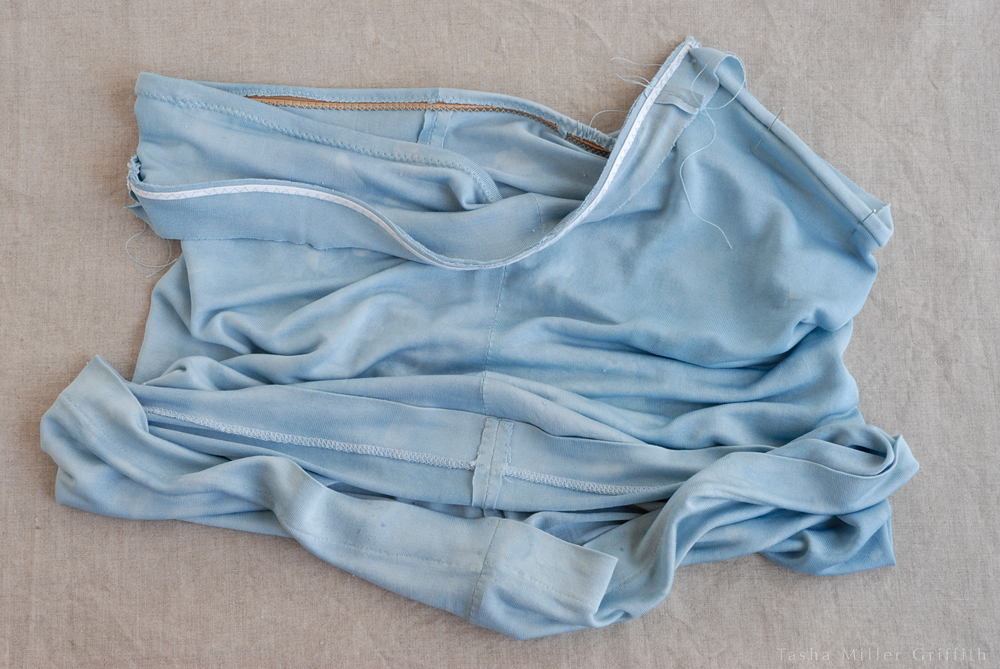
Below you can see in more detail how the pieces of the binding went together.  After sewing through all the layers, I rolled the binding strips to the inside, and sewed again just outside of the first seam.  The part at the top with the bronze colored elastic is the built-in shelf bra, which I attached at the same time, in the first seam of the elastic and binding.


blue silk cami inside


For the blue one, I cut the original top completely apart, and used as much of the width of the original hem as possible.  I didn’t want the seams to show at the bottom, so I tacked them down by hand.

Not long after I finished the blue cami, Zuni invited as over again, this time to dye cochineal and purple.  I’m not that huge a fan of pink, unless it’s cochineal, and then I’m all over it.  The particular shades that come from those little bugs really float my boat.  So, excited by my first success, and learning from mistakes, I thoroughly soaked the second top in water and brought it over.  I was also careful to stir while it was dyeing, and the result was an even, beautiful coat of color!

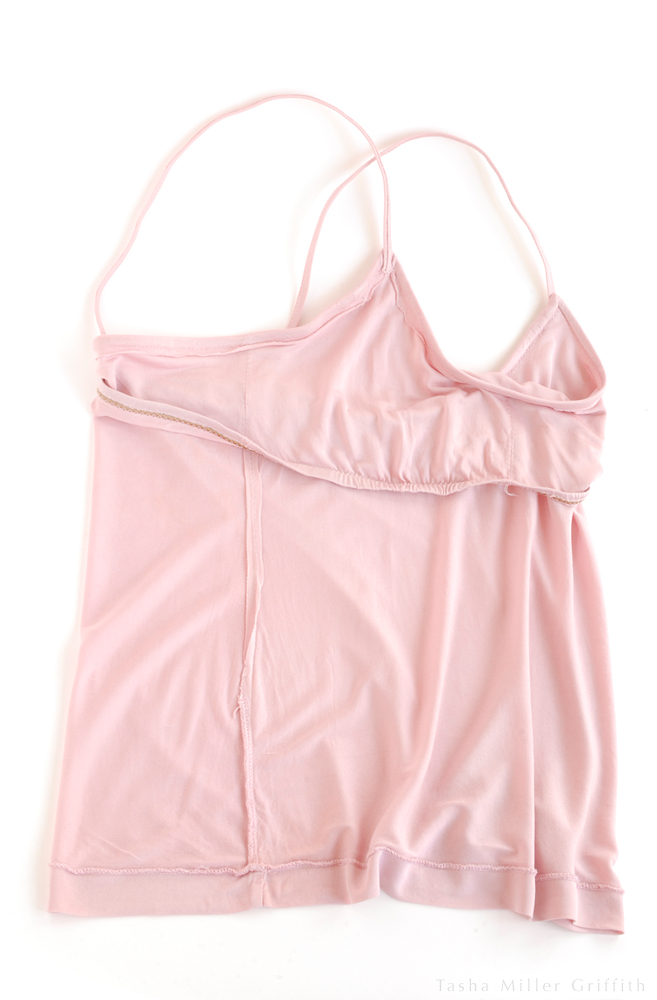
If I could have, I would have cut both tops wider at the bottom.  You can see a little pulling, and stretching in the fabric around the hips.  For the pink top, I decided for maximum width, to keep the hem and bottom of the original side seams intact, and taper my new seam in.  Below you can see this, as well as the construction of the shelf bra and what the binding looks like from the inside.

With this method of binding, I like sewing the straps in at the end by hand, catching just the inner layers.  That way I can try on and adjust them exactly, plus I think it’s more secure and less likely to distort the fabric than trying to catch them in the seam under the binding.


pink silk cami inside


I got some good practice sewing with delicate petals of silk making these, and it seems less intimidating now.

The other fantastic thing about this project is that, when those long undies were just sitting in my drawer, I thought that maybe someday I would dye them and make them into something useful.  In the same way that maybe someday I’ll spin enough yarn to knit with, maybe someday my studio will be completely clean and neat … things that I dream about, but may never happen.  But this one did!  I’m trying to acknowledge and appreciate this as a victory, rather than just rushing right on to the next project, as I am apt to do.


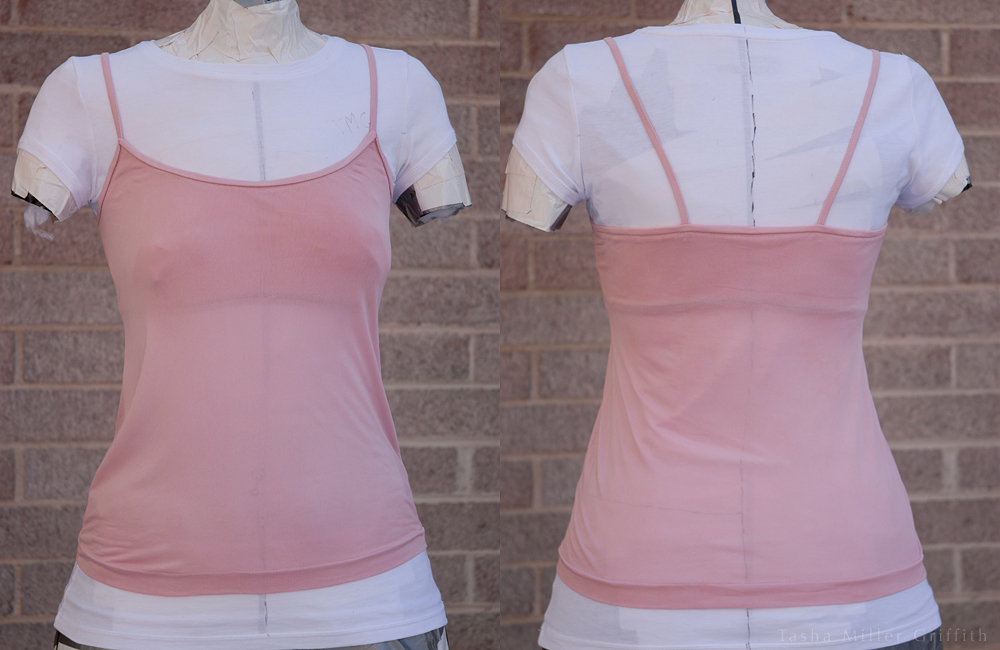
pink silk cami on form


Plus, I just love having these in my closet!  In fact, combined with two silk camis I already had (one is an earlier take on the recycled silk shirt idea, and one is the original I used to copy my woven tank pattern), I have just enough to wear one almost every day.  That inspired me to pack away most of my summer tanks, shirts and dresses for the first time ever.  I always carefully clean and store my winter woolens over the summer (mainly to protect them from the scourge of moths) but putting away the summer clothes never seemed that important, especially when I still used my cotton tanks as winter layers.  The silk ones are noticeably warmer though, even as thin as they are.  And I love that my summer clothes are getting a break from being on the hanger, and how much more space there is in my winter closet.

Take time to celebrate your victories, people!


How To Felt Basics, and Felting FAQ Part 1:

What is Felt, and How Do I Get Started Making it?


felted hats with patternA hat I made early in my felting experiments (top) and a commercially felted hat.  The hats are sitting on the pattern I used to lay out the wool . . .


As I mentioned in the post about my magic purple mittens, felting is probably the fiber technique I have the most claim to be an “expert” on, and, until now, I haven’t posted much about it here at all.  Most of my deep explorations into felt happened before I started this blog, and as I’ve been digging into my research and photo archives, compiling what I want to say as an intro to felting, it’s clear there’s enough material here for a least two posts.

I’ve organized this roughly as a list of felt FAQ.  I could go on at length from any one of these starting points, but I’ll try to keep it concise.  The photos and illustrations here are necessarily going to be a little mishmashy, as they represent work over a big swath of time.  Click on the photos to enlarge for an better view of the felt texture.  Ok, let’s get started, shall we?


What is felt anyway?

The short answer: Fibers (for real felt these must grow on an animal: a sheep, an alpaca, a cashmere goat etc.) which have matted together into a permanent fabric.  It’s the scales on the fibers (like the ones on your hair, visualize the close-up from a shampoo commercial) that open up and cling together.  It doesn’t sound permanent, but if you’ve ever tried to pull apart a piece of felt, or un-shrink a sweater that accidentally went through the wash, you know it is.

There are lots of types of felt.  It can be made from combed fibers alone, or from fibers that have already been spun into yarn and woven or knitted into fabric.  In either case, as long as there are at least 50% feltable fibers in the mix, the fabric should be able to felt.  It’s easy to make felt at home (even by accident) and there are factories that make felt on a commercial scale.  I’d love to visit one sometime.

Wet Felt

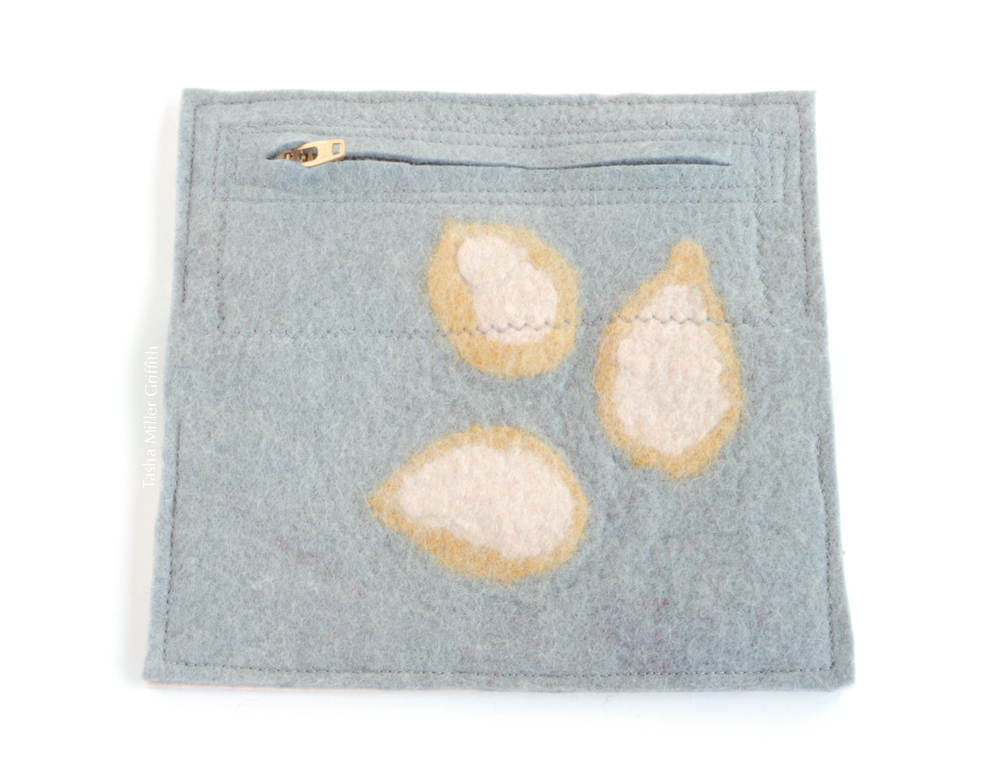
When someone says their work is “wet-felted”, they’re probably talking about the seamless, stitch-less felt made from only fluffy brushed wool fibers (read on for how to make your own).  Below is a piece of my hand made wet felt, which I cut and sewed after it was done, to make the wallet.  The decoration was made at the same time as the fabric.

Most commercially made felt, whether starting from fibers or fabric, uses some kind of wet or steam process.  When you felt your knitting, recycled sweaters, or fabric, you’ll also use water and heat.


blue petal wallet 2


A couple of special types of felt that I won’t cover in depth, but wanted to mention, in case you’re curious:

Nuno felt

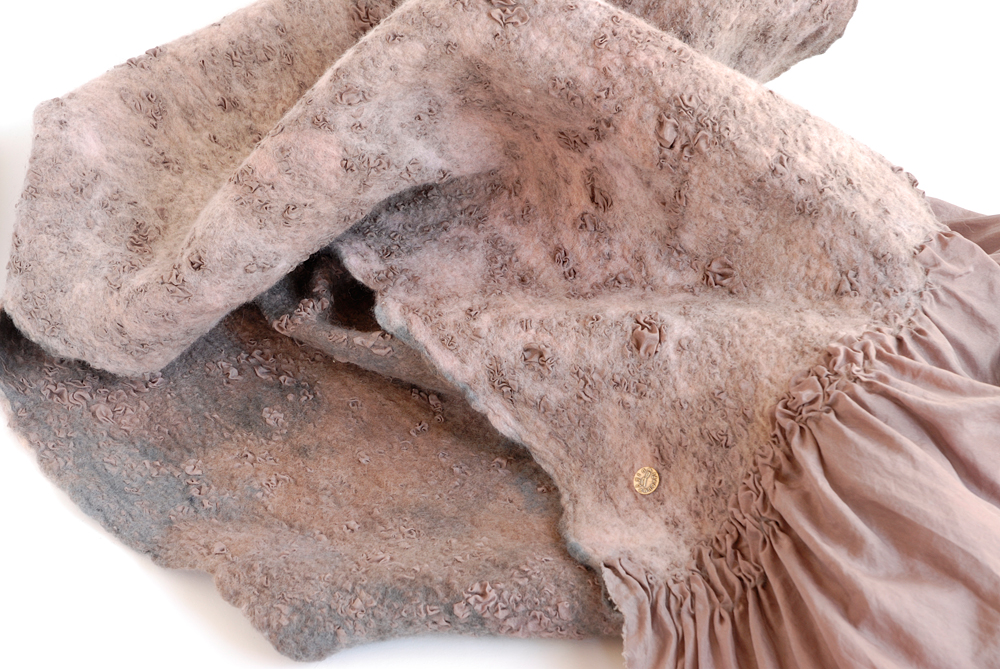
Nuno felt is made with thin layers of wool on either either side of a piece of fine fabric, usually silk.  We traded Bryan’s work for the totally gorgeous example below by Gina Pannorfi at one of our art shows this past summer.  (Lucky me, it’s just the loveliest thing.)  Because the silk provides some of the structure, nuno felt can be quite thin and drapey while holding together.


Gina nuno scarf


Needle felt

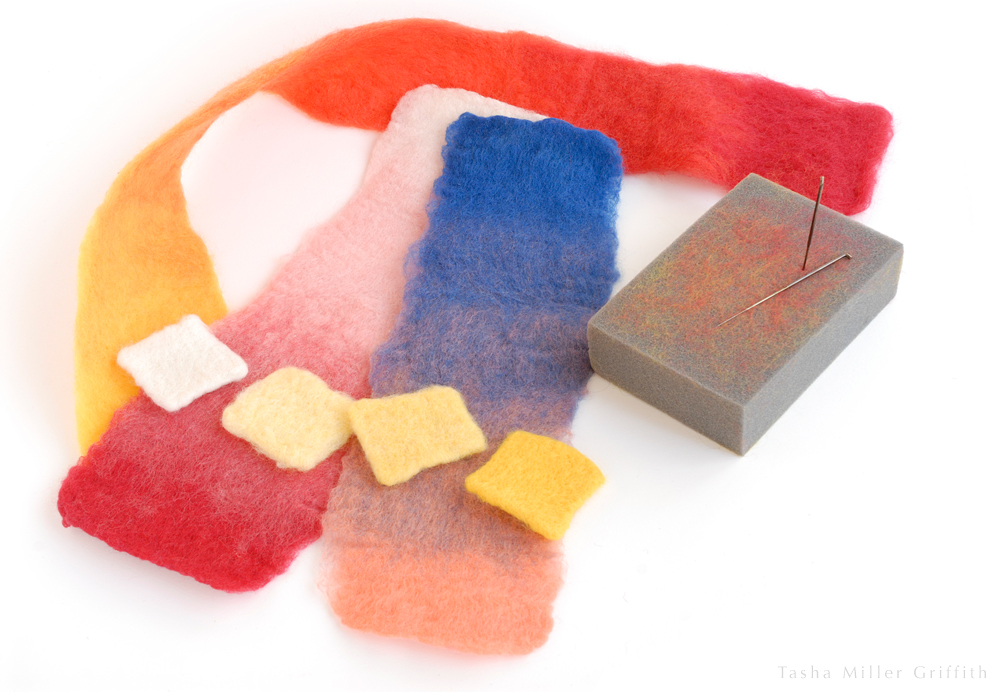
Needle felt is what it sounds like, made by pushing fibers together with a special barbed needle, or a collection of them.  Although it doesn’t make a sturdy, hard-wearing fabric the way that wet felting does, amazing detail is possible with needle felt.  Do a search for “needle felt” with your favorite animal name on Etsy, and you’ll see what I mean.  I made the examples below in a class on color theory for felters—with Pat Spark!  She has a whole bunch of good felting information and tutorials on her site if you’re looking for more felt info.


needle felt color studies


Fake felt

That slightly sticky, slightly glittery “craft felt” at the hobby store is usually made from polyester.  The fibers are punched together with needles and/or held together with glue.  It really has none of the lovely properties of real felt.  Commercial wool and wool-blend felt is more readily available than it used to be (at least in the US), so you may be able to find it at your craft store as well.


How do I make felt?

The short answer: Most importantly agitation, combined with at least a little moisture, and optionally heat, on wool, alpaca etc. makes felt.  There are about a million ways to apply these, depending on what you’re working on and what equipment you have.

I’ll start with a quick intro to making felt from just combed wool.  I think that way, the rest of the felting process will make more sense, and it’s interesting to know, even if you only plan to felt from knitting or fabric.

If you’re looking for to buy wool for felting, it’s usually sold as roving (a loose roll that spinners use) or batts (which are more convenient for felting, since you can pull off big thin layers).

These photos are from my felt flower tutorial, which will walk you through the whole process if you’re interested.

Step 1

Lay out thin layers of wool, with the fibers alternating directions.  Keep in mind that your finished project will shrink in as the fibers pull in toward each other, so make it bigger than you want (I’ll go into how much bigger in the next post).  The wool is very fluffy and will seem thick, but it will compress to almost nothing once it’s wet.  Use several layers for a cohesive piece of felt.  Squish it down with your hand to get an idea of how much fiber is really there.


dry wool layers


Step 2

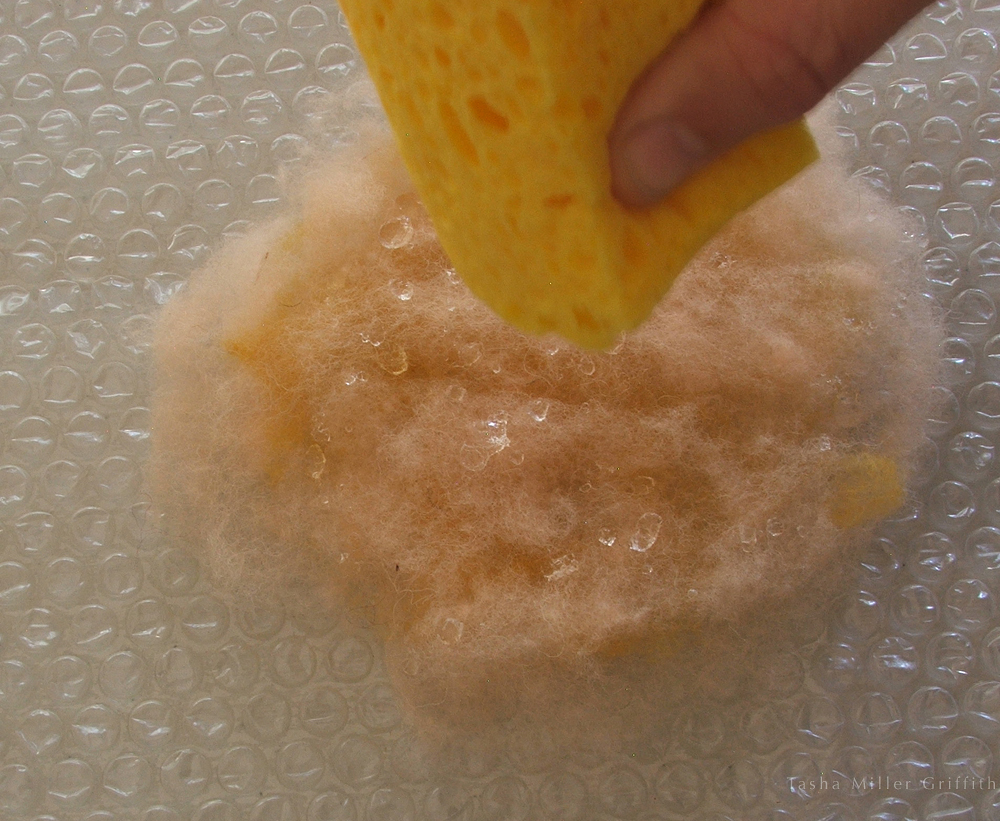
Add a little water.  Dripping it from a sponge is a good way.  You want the wool to be all wet but not swimming in water.  You can squash on the wool gently with the sponge to get it all wet.


water from sponge


Step 3

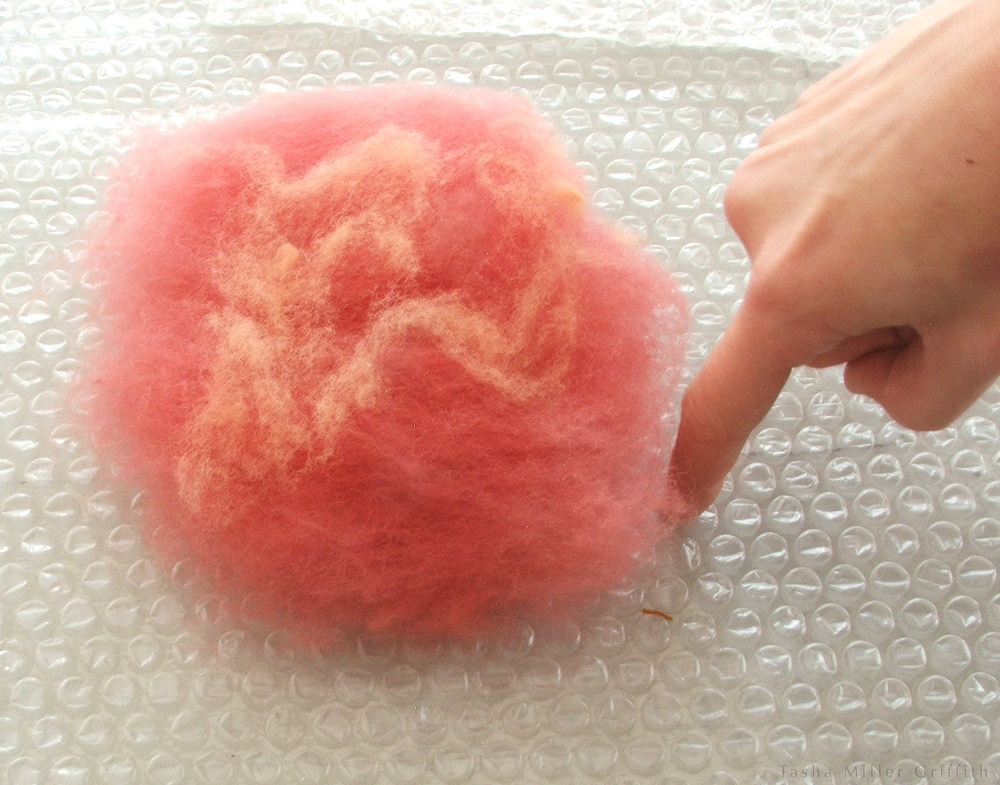
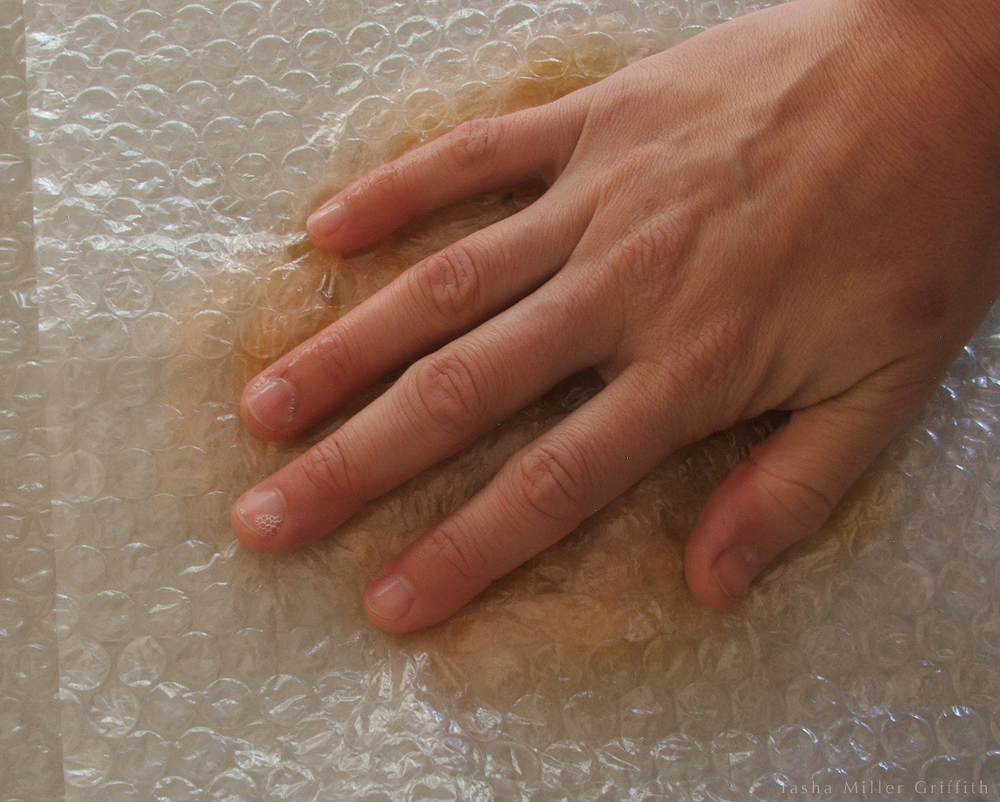
Agitation.  Arguably this is the last step, but there are a few stages to it.  At first, you’ll need to rub the felt very gently.  You want the fibers to cling together, which they won’t do if they’re being shifted all over the place.  For wet felting small pieces like this, I like to use two layers of bubble wrap (the ordinary, small-bubble kind), one underneath the fiber and one on top.  The bubble helps spread and soften the motions of your hands.  Think about getting the bubbles to massage the wool, not about moving your hands on the bubble.

Important!: Felting by hand involves a lot of repetitive motion.  As you work, make sure your wrists are in line with your arms and not bent at a strange angle, to avoid injury.


bubble wrap rub


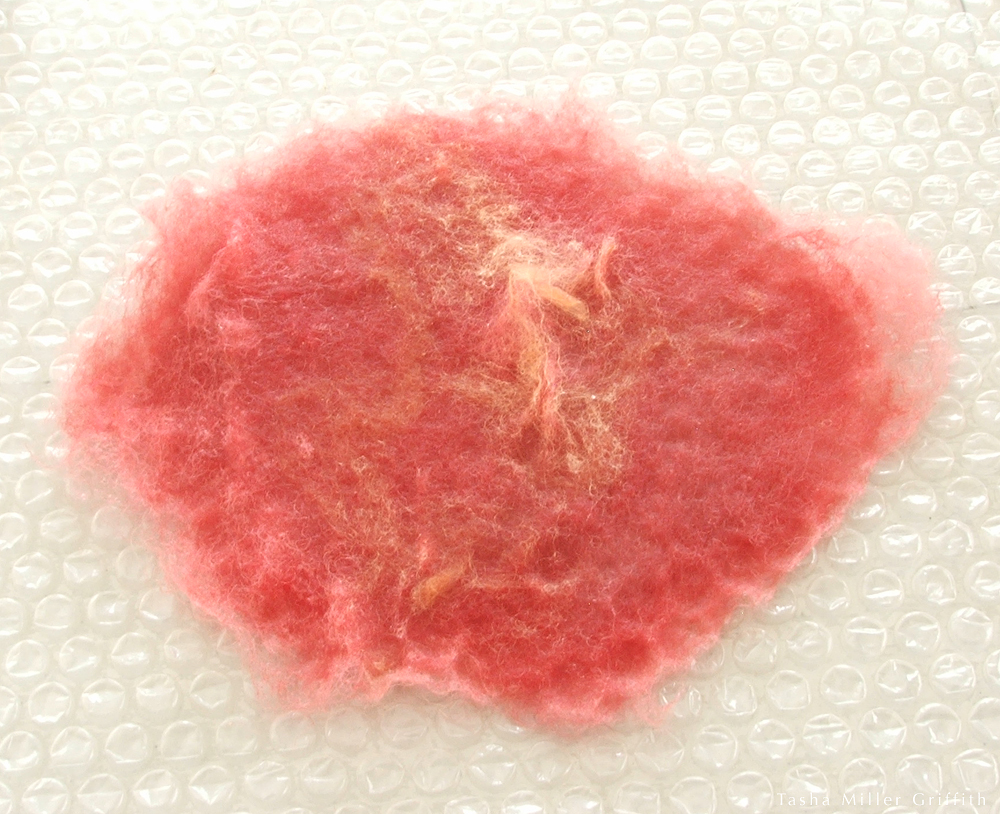
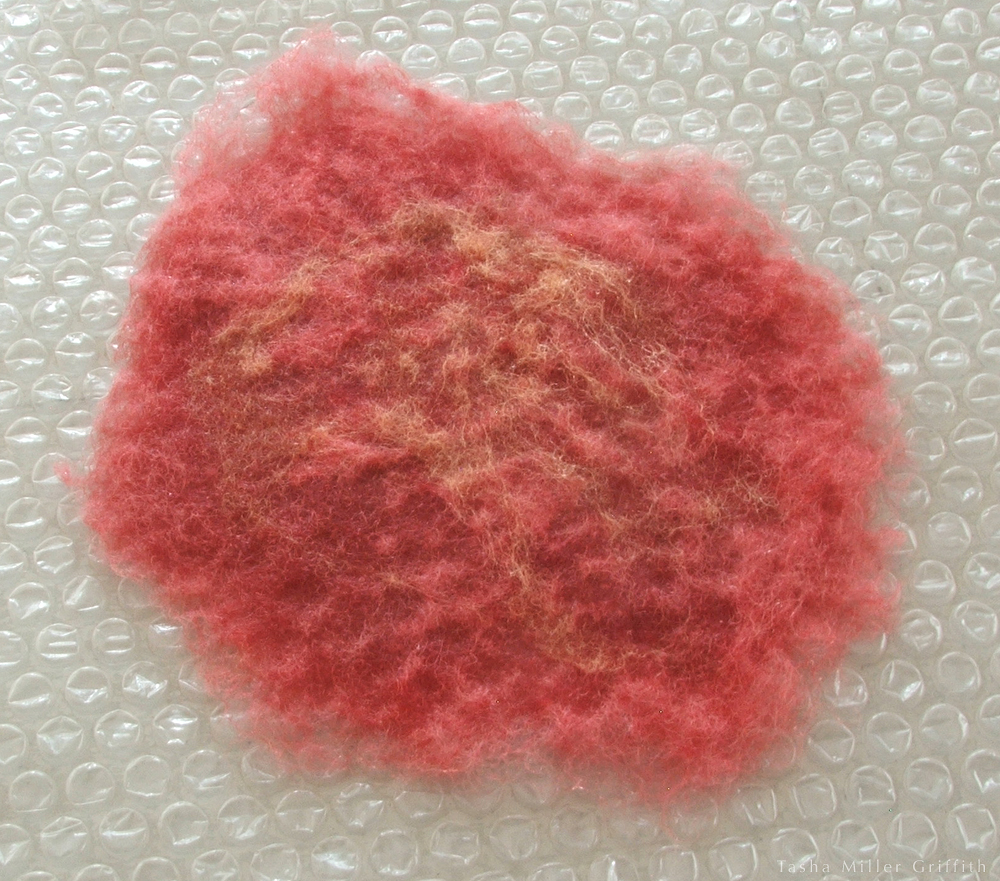
Rub for a couple of minutes, then lift the bubble and check on how things are coming.  You’ll probably need to rub some more.  As you practice felting, you’ll start to notice subtle changes in the texture of the piece that show how it’s coming along:


wet wool layersWet wool layers.


slightly rubbed wool layersThe wool is starting to cling together, but there are still a lot of loose fibers.


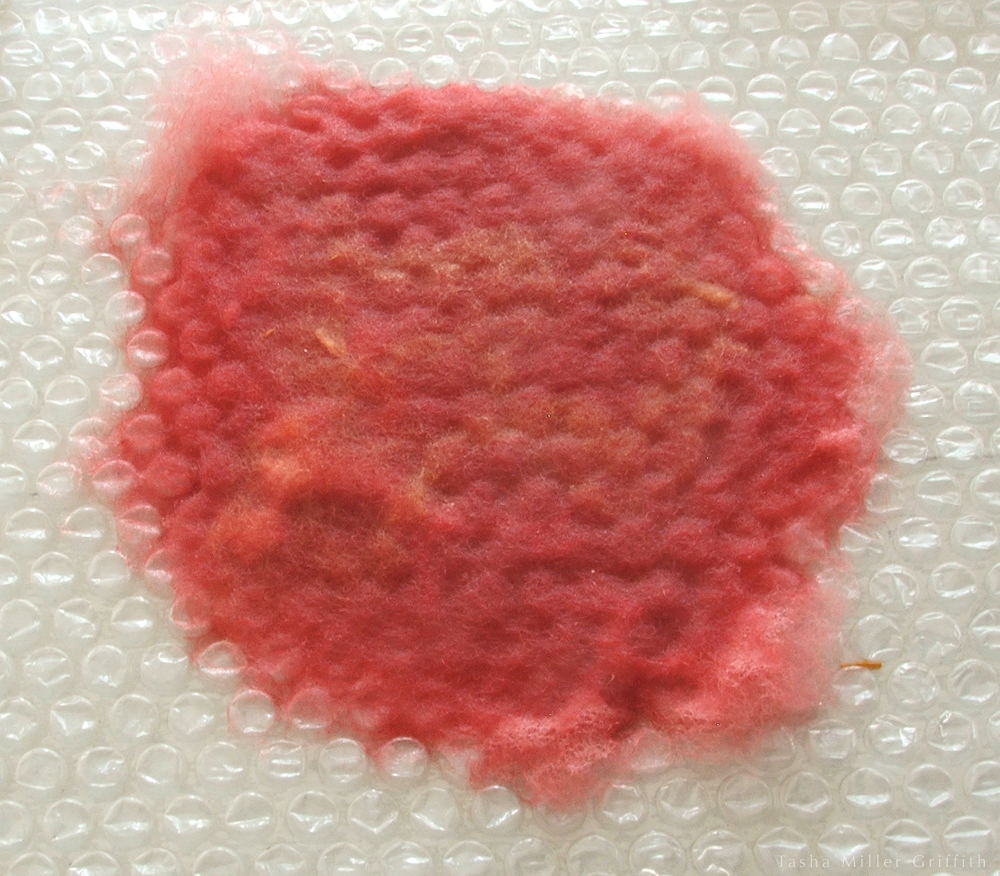
more rubbed wool layersAlthough still soft, this prefelt is now a cohesive unit.


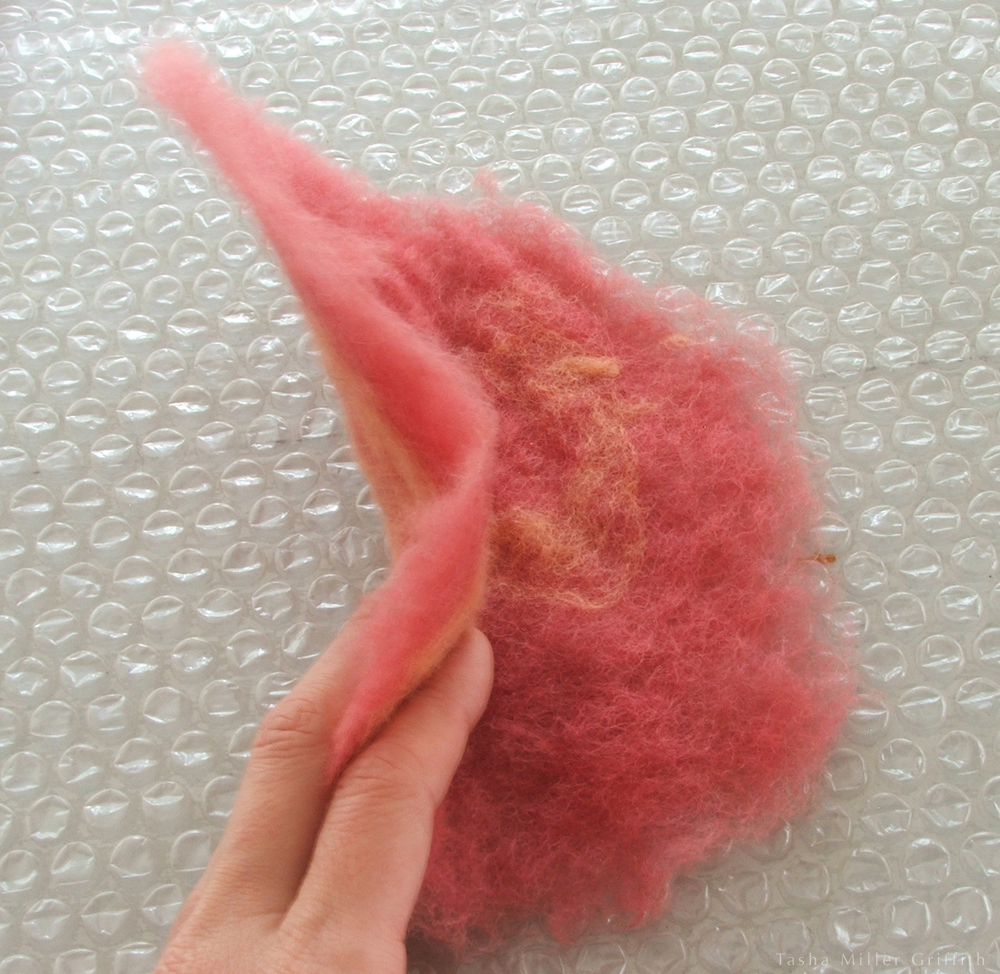
Once your wool is holding together enough that you can pick the whole thing up and it stays together, it’s what felters call a prefelt.  A prefelt isn’t strong enough to be a finished object, and it has lots of fibers that are still ready to cling to each other or to other parts of your project.  You can check by pinching up a few of the top fibers to see if they’re attached to the ones below.  At this point, the felt is ready for whatever you have in mind for its next stage.  It can be easier to work with if you dry it off, by squashing it between two layers of an old towel.


prefelt


So, my wool is holding together, now what?  Read on to Part 2 for how to finish felt like the piece above, how to felt your knitting, more questions answered, and even how not to felt . . .


How to Make French Toast—and Happy New Year

With variations, tips and tricks to customize your own perfect French toast recipe.


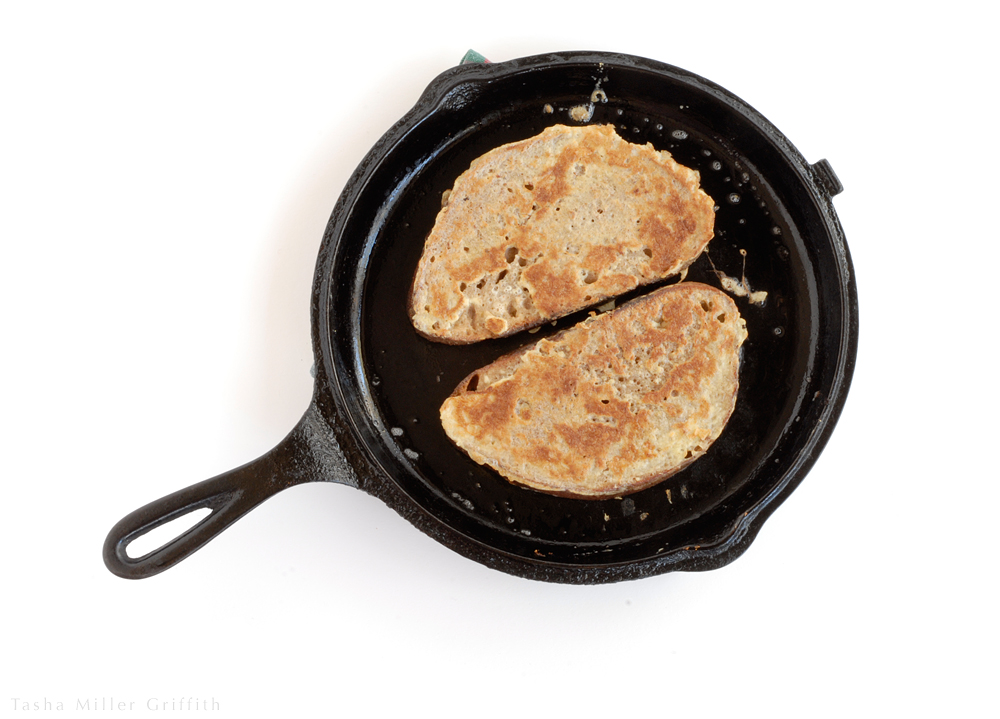
french toast in skillet


It took me long enough, right?  (Can you believe it’s been almost two years?  Yeah, me neither.)  For a blog with this name, which features recipes, the lack of actual directions for making French toast was getting a little ridiculous.  Here’s the thing, I didn’t want to post just a recipe for French toast, that seemed silly, everyone already knows how to make French toast, right?  Instead I would put together some marvelous, unheard-of combination of toppings and put that in a post, with the actual French toast just included almost as a by-the-way, here’s how I make it.

I started off yesterday morning with just such a plan, to make a seasonal orange-based sauce.  I wasn’t going to tell you this next part, but it now seems important: it did not go well.  In fact, it reminded me specifically of the part of the year just passed that I would very much NOT like to repeat in the year to come: me trying very hard for a goal which I (perhaps) have somehow misjudged in one or more ways, expending a lot of time and energy but not quite getting where I’d like to go.

I like to think I’m not superstitious, but at first, this seemed like the most inauspicious possible sign for January 1.  Then, as it rolled around in my brain a little more, I started to think that maybe the failed orange sauce (it came out ok after all) was a cautionary tale, and if I took it the right way, I could use it to steer away from the process I don’t want, and towards the one I do.


french toast on plate


I started thinking; maybe just French toast is enough.  Of course not everyone already knows how to make it.  Especially since I have some tips and ideas to get you started with your own never-before-seen, awesome variations.  After all, this space is supposed to be about empowering you to make things, and not about me showing off, even though I love sharing the things I make here.

In 2014, I’d like to be more grounded, less hectic.  I still have a million dreams of every kind, so many things that I’d love to do.  But my journey towards them might not be about reaching as far as I possibly can in one grasp, or frantically trying to fit as much as I possibly can into every single day.  Maybe it will be more about doing one little bit at a time, and even about recognizing and sharing the good bits I already have right in front of me.

Happy New Year, friends!  May it be a good one for all.


How to Make French Toast


First, and most importantly, you need bread.  You can use any kind, and it’s not just a metaphor, or part of the 6 words I chose to describe my life, it really is the best possible use for bread that’s staler than you’d like to eat it.  Brioche, or banana bread, or any other thing that’s called a “bread” and maybe borders on dessert, will make amazing, Ann-Sather-worthy French toast.  I’ve used my homemade bread for our most recent versions.  As always, a quality bread (or any ingredient) will lend even more layers of subtle delicious flavor to the toast (or any finished dish), but it also may be a tastier use for a less-than-stellar bread than eating it alone.  How much batter the bread will soak up varies wildly depending on the type of bread and how dry it is, etc.

Next, you need some egg and stuff to soak the toast in.  I like it to be mainly egg, because I do not like the inside of the bread to be soggy when it’s done.  I like to whisk up the egg etc. in a glass dish with a flat bottom rather than in a bowl, so I can put a few pieces of bread in to soak at a time, and not be left with a little well of liquid at the bottom that the bread can’t reach.  For about 6 pieces of bread (again, this varies a LOT depending on your bread, but you can always add a little more to the pan) I use:

3 eggs, whisked up well with:

1/4 cup milk (it’s Ok to substitute non-dairy milk here)

A pinch of salt

A larger pinch of sugar

Next, add some flavorings to the egg mixture—whatever your heart desires.  A generous sprinkle of cinnamon, a pinch of ginger and a pinch of cloves is a good way to start, especially in winter.  A splash of liqueur is good—for an especially luxurious version, substitute a generous splash of cream for the milk, and add the lost liquid back in by way of brandy or rum etc.  Vanilla extract is good (but probably choose it or liqueur), or try another extract, maybe paired with a spice or two, for a unique flavor.  I especially like to compliment whatever I’m planning to put on top with a bit of something in the batter, but keep it fairly subtle.

french toast soakingSoak the toast in the batter for a few minutes, then flip the slices over, and let them soak for another couple minutes.

To cook the toast, heat up a heavy skillet over medium heat and melt some butter in it, maybe 1/2 Tablespoon butter for four slices (in my little skillet I used less).  The toast should sizzle when it hits the pan, and the egg batter should start to set up right away.  It only takes a few minutes to get lovely brown spots on the bottom side, at which point flip the toast over.  You may need to add a little more butter between batches.

If not all of the toast is done at once, you can keep it warm on plates in the oven at 200° F, until you’re ready to serve it.

For toppings, really, the sky is the limit.  It’s—ahem—delicious with just real maple syrup and homemade crème fraîche.  A little orange zest (or even iffy orange sauce) is really good with this basic setup.  Practically any fresh seasonal fruit is amazing on French toast, strawberries in spring are particularly wonderful.  Any jam you have is good.  Coarsely chopped toasted nuts are great (bread with nuts in it would also be great as base).  Melted butter, fruit syrup, whipped cream . . .

Some of my favorite flavor combinations may yet appear as time goes on.  Please share yours as well!


Convertible Knitted and Felted Mittens

In which I remodel my mittens to make them better than ever, and show you how to calculate shrinkage when felting your knitting.
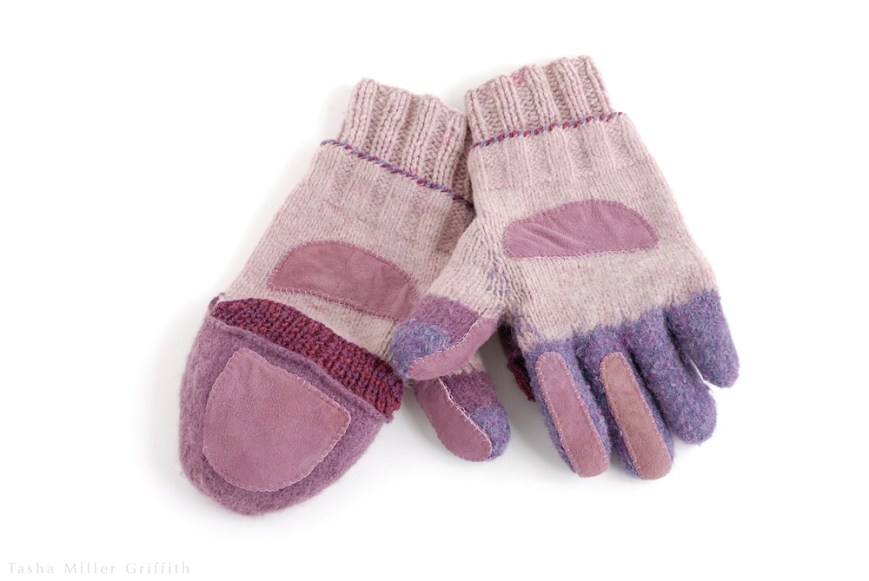
 

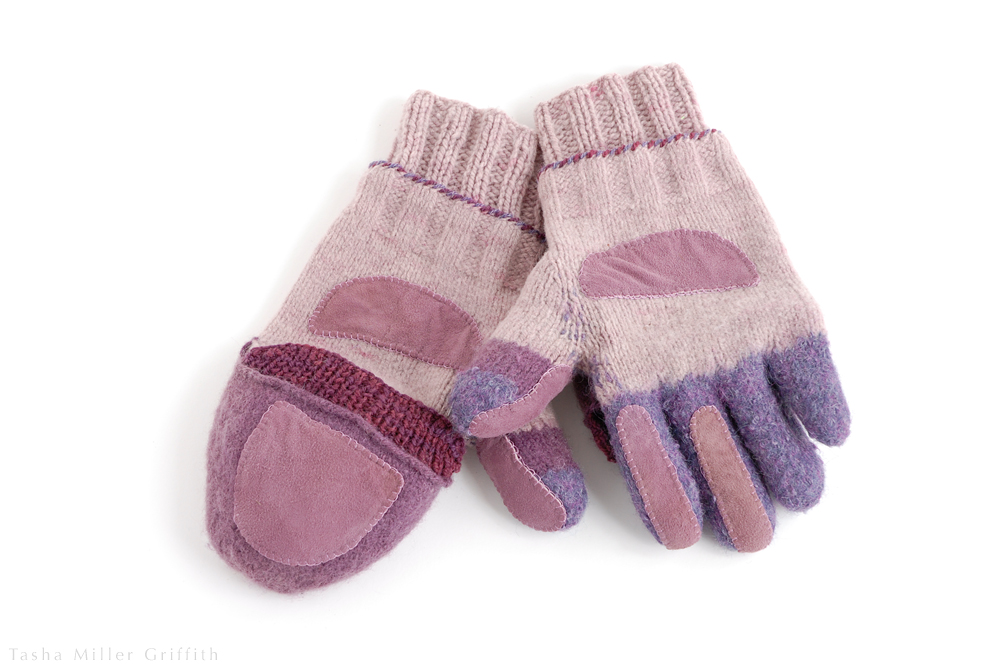
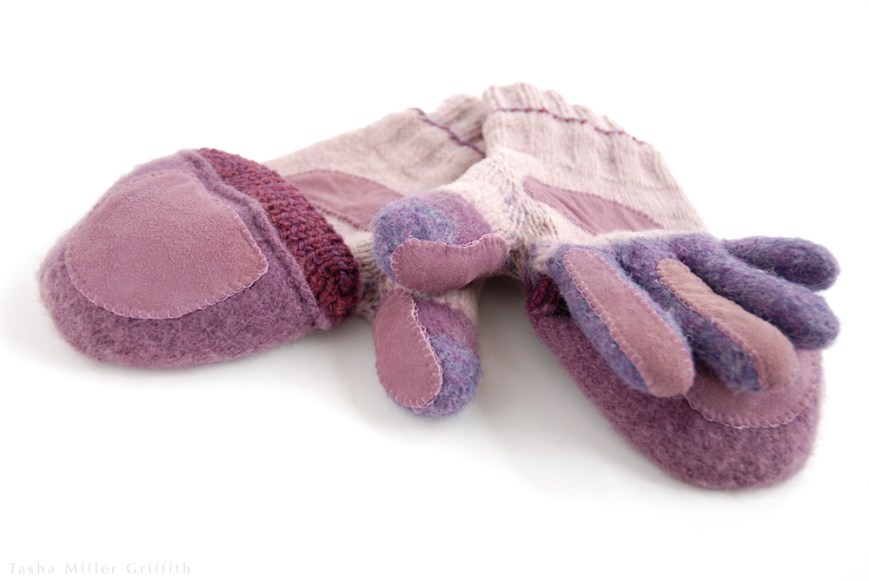
purple mittens finished 2


My friend Tom once commented that many of my clothes have stories behind them, and these mittens are no exception!  In fact, I’m going to tone it down here, story-wise, and stick to only the most interesting and relevant of the many angles I could go for.


A Very Short History of the Original Mittens

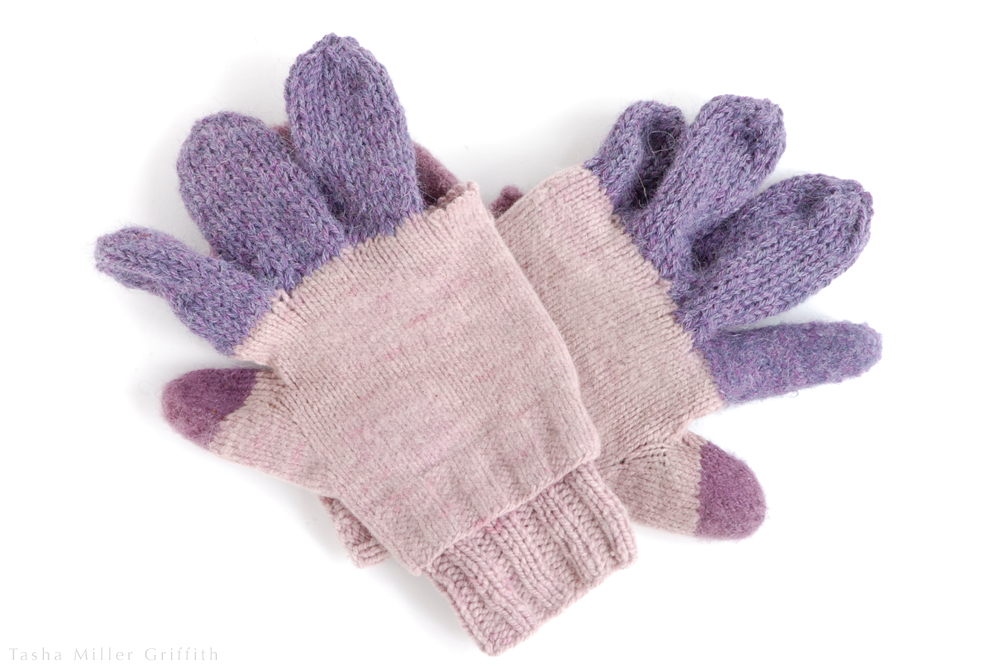
I started knitting these as my take-along project on our trip to Italy in February of 2010.  I knitted the main parts from yarns that we dyed the first time I ever did natural dyeing, with my grandmother and a bunch of dear family members in 2008.  (I’m telling you, I’m skipping  a lot of stories here).  My goal was glove fingers for finer dexterity, that could also be covered by a mitten flip-top for extra warmth.  Typically for me, I consulted a few patterns, but didn’t end up really using any of them.  I didn’t have enough purple for the fingers and the flap, and because I love purple and green together (one of my favorite color combos for the hats) I decided to get green yarn.  No one else was impressed with this decision, and I can now admit that one of my students at the time probably put it best when she said they looked like “dead fingers.”  So, moving on, when I discovered that they were too slippery to drive in, I sewed on a bunch of patches from faux suede samples in different colors.  Ignoring whether or not this made the green fingers look any better, and also the fact that all the fingers had come out too short after felting, I wore them all the time, all over the place, skiing, shoveling snow, etc., through last winter.  By the end of that season, one of the fingers had developed a rather large (and cold) hole in the end.
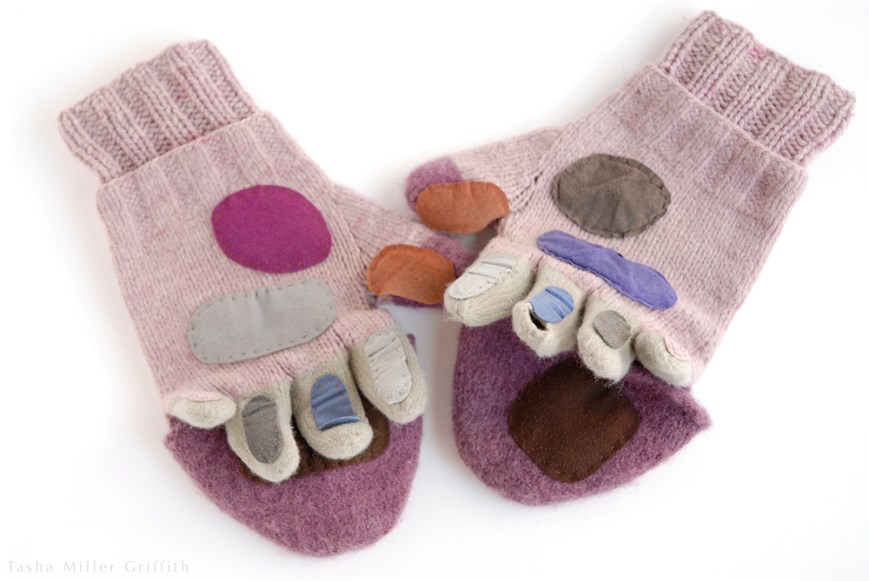
 

purple mittens before


A Plan for New and Improved Mittens

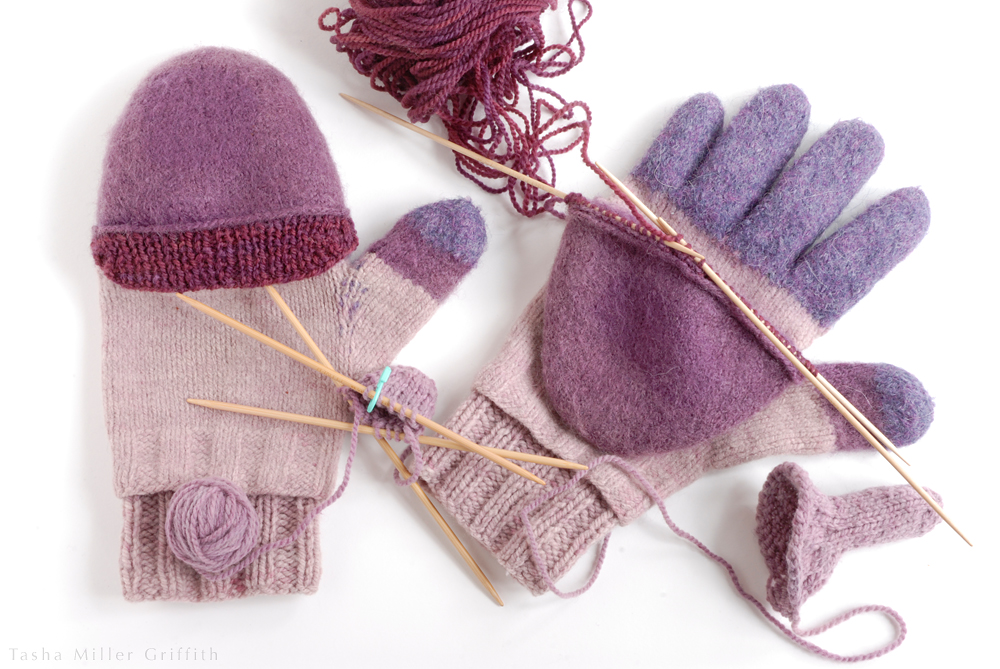
When I got them out this fall for the season, the more I thought about it, the more I wanted to do more than just fix the hole.  You see, if I was going to fix the hole, it made way more sense to knit on a little more finger, so that it would be actually the right length.  And, it would be ridiculous to do that for only one finger.  And, if I did it for the rest of the fingers, I would either have more green fingers or an even more ridiculous color mash-up than before.  I decided to start over on the fingers, and this time, do the math.

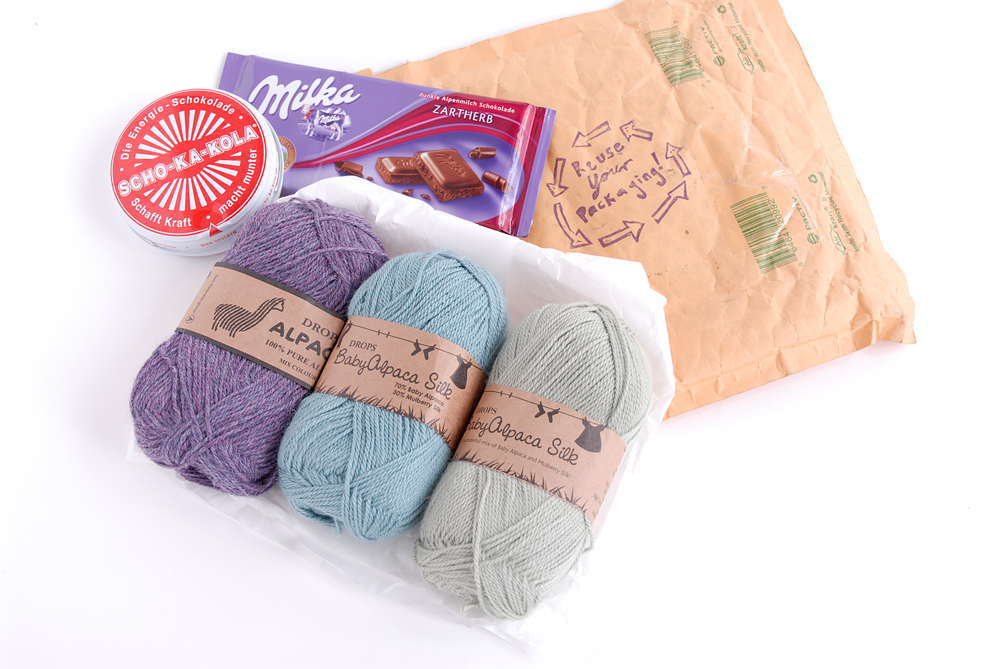
As fate would have it, last winter I sent my blog friend Alessa some American patterns, and she sent me some yarn and other lovely stuff from Germany (these mittens really are more full of stories than average, even for me).  Thanks Alessa!  One skein of the yarn (on the left below) was a lovely variegated purple in 100% alpaca.  Alpaca felts like a dream, and is just as soft felted as not.  I saw it in my yarn bin and knew it would be perfect for new fingers.
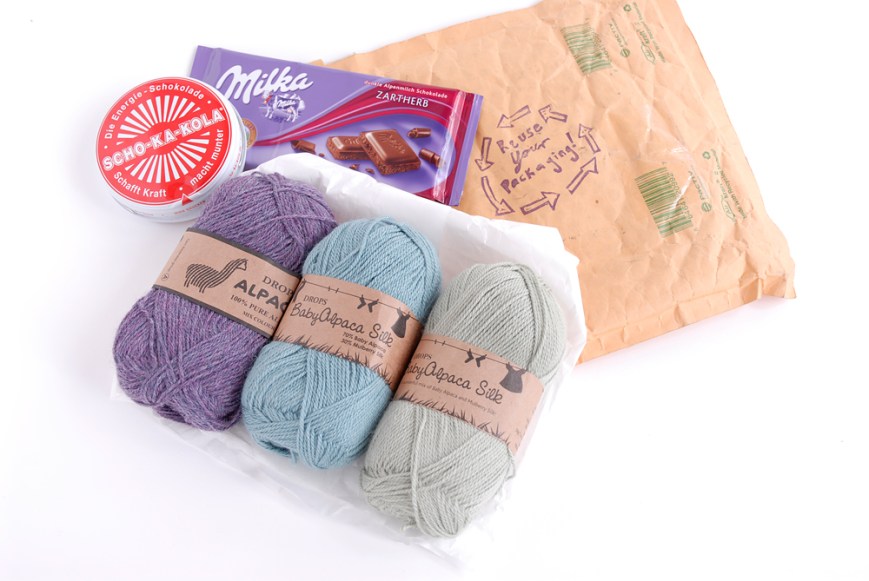
 

package from AlessaIs that not the most-awesome-looking tin of chocolate?


How to Calculate Shrinkage for Felting Knitting

Lots of times I tell my students that knitting can either be all math; full of charts, calculations, and exact numbers of stitches, or no math at all; flowing along and decreasing when it looks right to you.  In my mind, the happiest mix is somewhere in the middle.  When you’re felting, it really helps to have a least a little math, which comes from making a sample in your intended yarn and measuring how much it shrinks, especially if you need it to come out a certain size.  (I neglected to do this for the first fingers, and you saw how that went.)

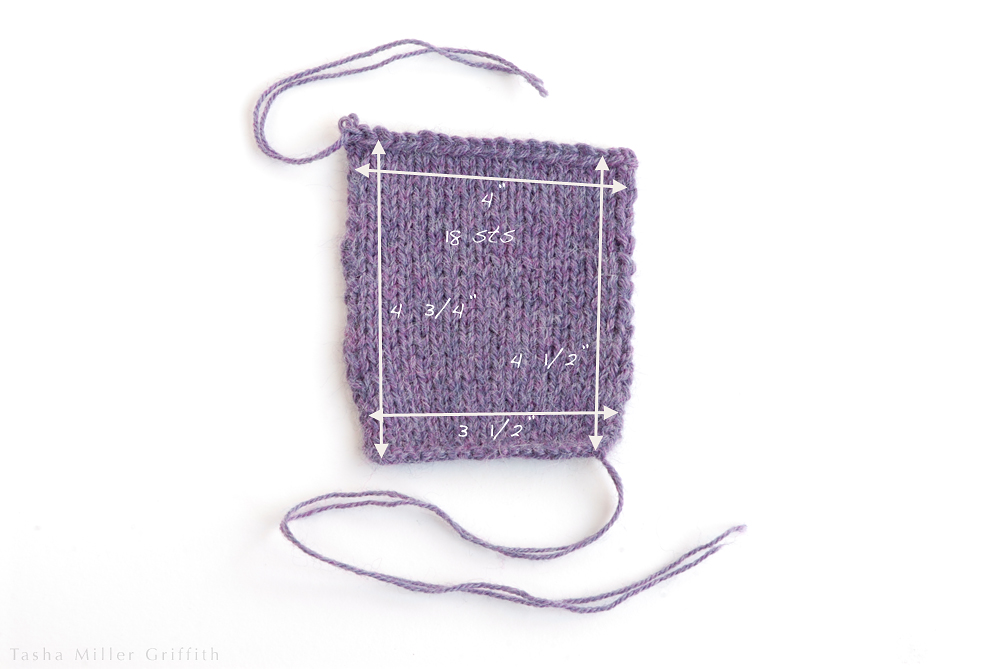
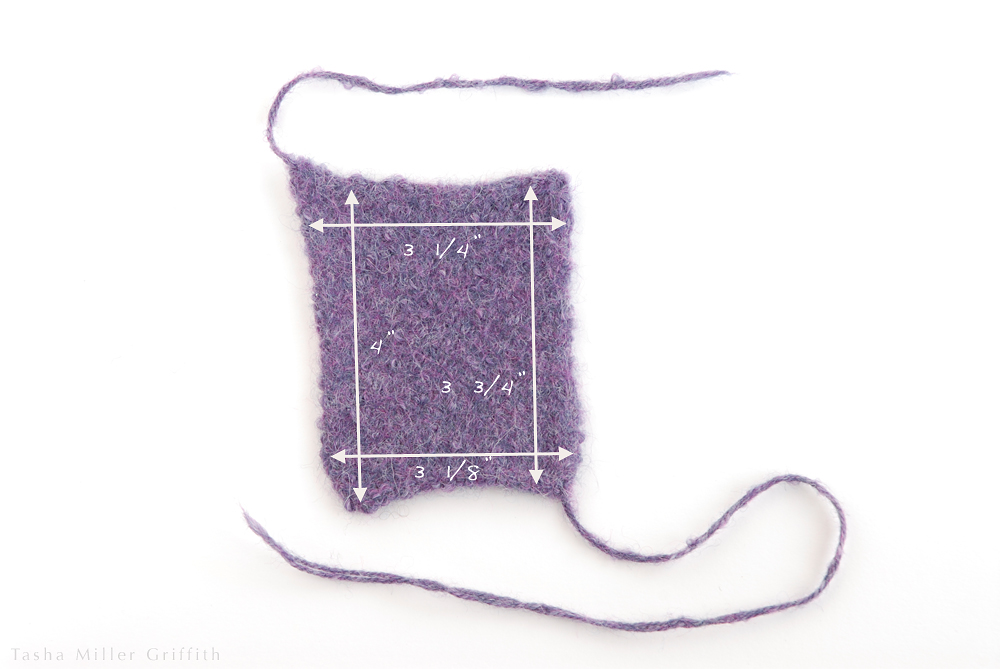
I started out with a tighter gauge, then decided to increase my needle size, because looser knitting will felt faster (you can see from the before and after that it also affects the percentage of shrinkage).  I’m using two strands of the yarn since it was fairly fine, and I wanted the fingers to be nice and thick and warm when finished.  You don’t have to take a photo, but do measure and draw around your sample.  Also make a note of how many stitches are in your sample, they will disappear into the felted texture and you won’t be able to tell later.  (This is about the smallest sample that will give you an accurate idea.)

Before felting:
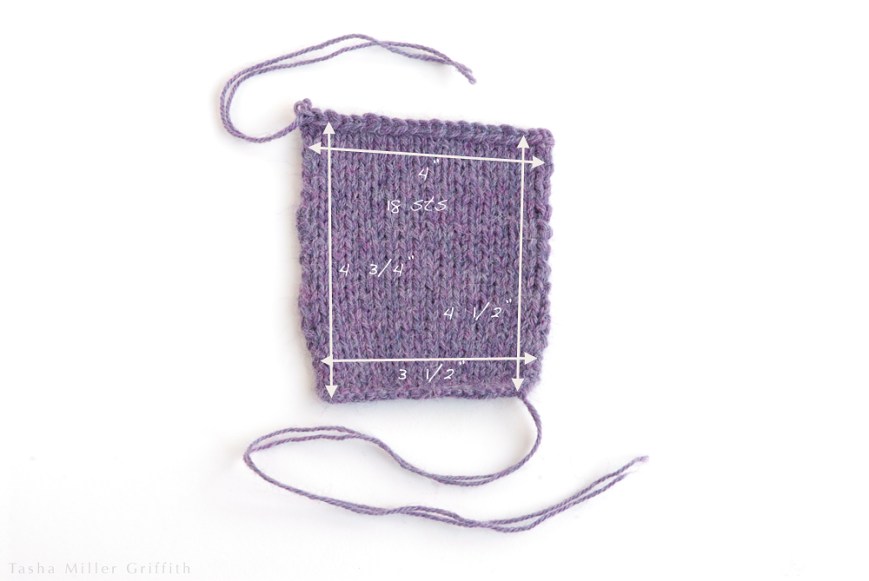
purple mittens sample before

After felting:  (As usual, click on the pictures to enlarge if you wish.)
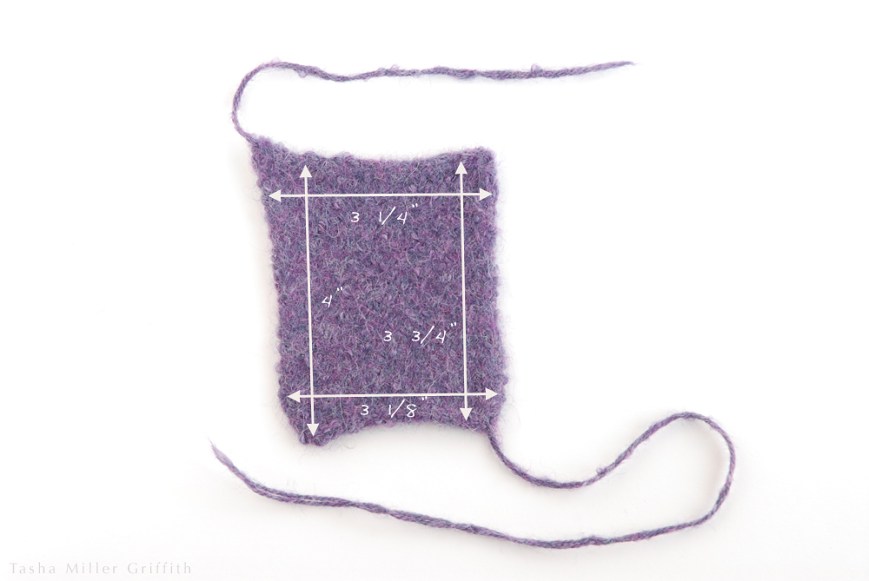
purple mittens sample after


Here’s the math part, it’s not too scary: divide the felted measurement by the unfelted measurement, to get the percent of the original measurement after shrinking.  F/U = %  I did this across my various measurements and got an average of 79% for the width, 84% for the height.  I wanted both, because I had noticed when felting the fingers the first time that they wanted to shrink more in height than in width, no matter how I stretched them out, which meant that I had not added enough extra knitting in that dimension.

Now that you have your percentage, apply it like this (there was algebra involved but I did it for you): the unfelted measurement (the one you want so that you know how much to knit before it shrinks) equals the felted measurement (how big you want it to end up) divided by your percentage of shrinkage (.79 or .84 in my example).  U = F/%  Clear as mud?  Try it, you’ll see what I mean.  You end up with a number a bit bigger than the felted/finished number you put in.  You can check it by putting it back in the first formula and see if you get the right percentage.

For my finished/felted measurements, I used the width of the previous fingers (by now chopped off), which I liked, and measured the height of my fingers sticking out of the mittens, adding a little extra for the thick knitted fabric to go over the top.  I calculated the unfelted measurements, then used the gauge from my sample to figure out how many stitches to use for each finger.  You can’t have a fraction of a stitch, so round up or down, whichever is closer or you want to err on the side of.  I knit until each finger was about the calculated unfelted height, erring on the side of a bit extra at the top, which turned out to be a good idea!

Just in case, I made one finger as test (the index finger on the right below) and felted it before knitting the others.  It came out great.
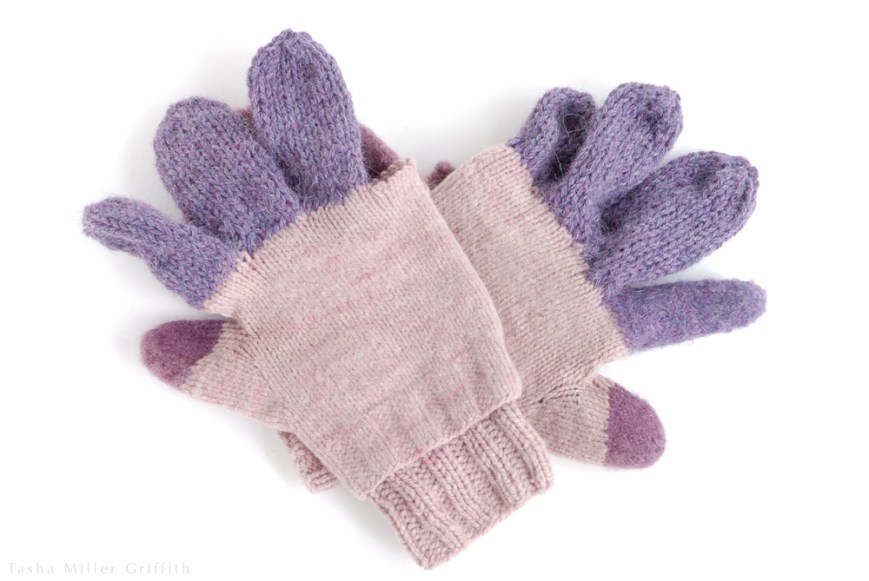
purple mittens unfelted fingersEven though the old fingers were felted on, I was able to snip the green stitches and pull them out, leaving the purple ones which I could pick up and knit from.  It helped that the palms never got totally felted.

Other Improvements

The thumbs were too short as well, plus worn mostly through in one spot from gripping.  And having only one layer of knitting (the part between the thumb and palm where the stitches tend to stretch open no less) meant that my thumbs were sometimes cold.  I fixed all that.  At this point, there was no stopping.  Since the thumbs were somewhat loose, I decided to knit inner layers for them.  I thought that I might need to slash the top of the mitten flap and extend it too, but after felting the fingers, it fit snugly over them, which would be warm, and I could add a bit of ribbing on the palm side for a little more length and to help hold the flap down.  Neither of these new additions would be felted, and both were small, so this was the no-math part.  I made adjustments visually, pulling something out if it didn’t seem right, and tried on the thumbs a lot to fit the shape to my hand.
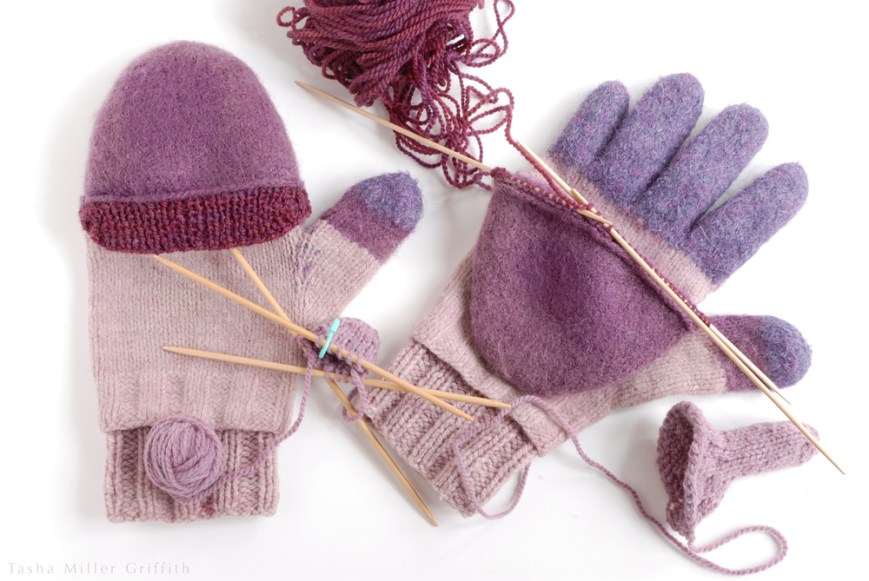
 

purple mittens knitting extras  This may be hard to believe, but according to my notes, the wool I used for the new ribbing is the same as the original flap and thumb!  So it has definitely faded with sun and wear and washing.  Fortunately I like both colors.


A Minor Miracle of Purple Suede

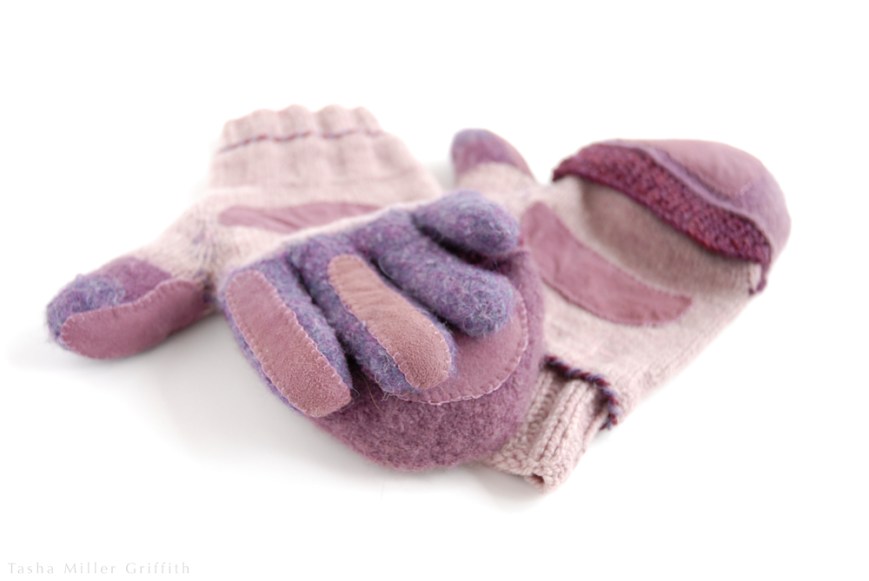
Finally, I needed something for grip on the fingers and palms.  (I’m telling this story whole, it’s a good one.)  I want to be able to drive and grab ski poles and my keys, etc., and I didn’t want to go back to the multicolored bits of Ultrasuede.  I briefly considered using some light green suede elbow patches I got along with a sweater for recycling . . . and was fortunately dissuaded by friends.  What I ideally wanted was something that would match the mittens.

Almost on a whim, I dropped into a rather old-school shop downtown, which sells saddles and leather and a few seemingly random bolts of blanket wool and skeins of rug yarn.  I remembered that the last time I was there, over a decade ago, they had a bin of leather and suede scraps, and I thought if they still did, I might be able to find something close.  I was the only one in the little shop, not too long before closing, and the woman working said that no, they didn’t have any scraps.  I had the mittens with me, I showed her what I wanted to do.  Suede and leather started at half a hide for $24, there were black and green and red . . . and at the end of the rack, four smaller, scrappier pieces, all in dusky, slightly mottled shades of purple.  Not just purple, four distinct purples that each were so exactly what I needed that they looked like they were dyed to coordinate with the mittens, and left on the end of the rack by magic.  “Oh,” she said, “You could use those!  They’re $9 each.  We sold all the red, all the black . . .”  Hardly believing my good fortune, I picked the color I liked best out of the thicker two (two were quite thin), paid for it, and practically skipped down the street towards my car.  A few times, when I’ve been intensely searching for a supply I cannot find, probably which doesn’t exist, I’ve dreamt that I went into a shop and found exactly that thing, only to wake up disappointed.  This is the only time, so far, it’s ever happened in my waking life.  I have a rather large piece of somewhat smelly purple suede left in my studio to prove it!
 

purple mittens finished 5

purple mittens finished 3


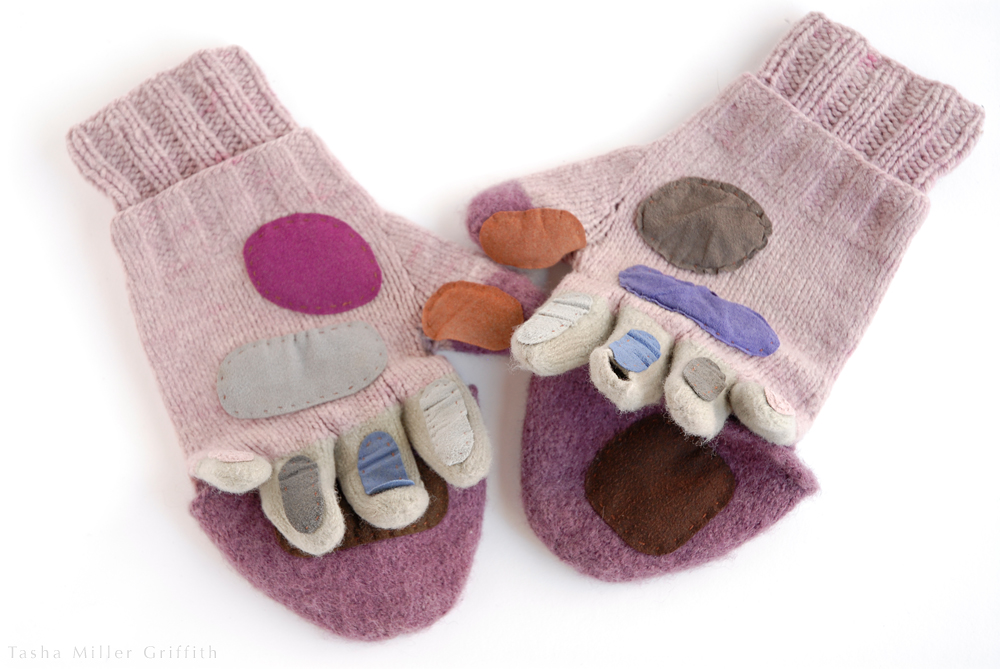
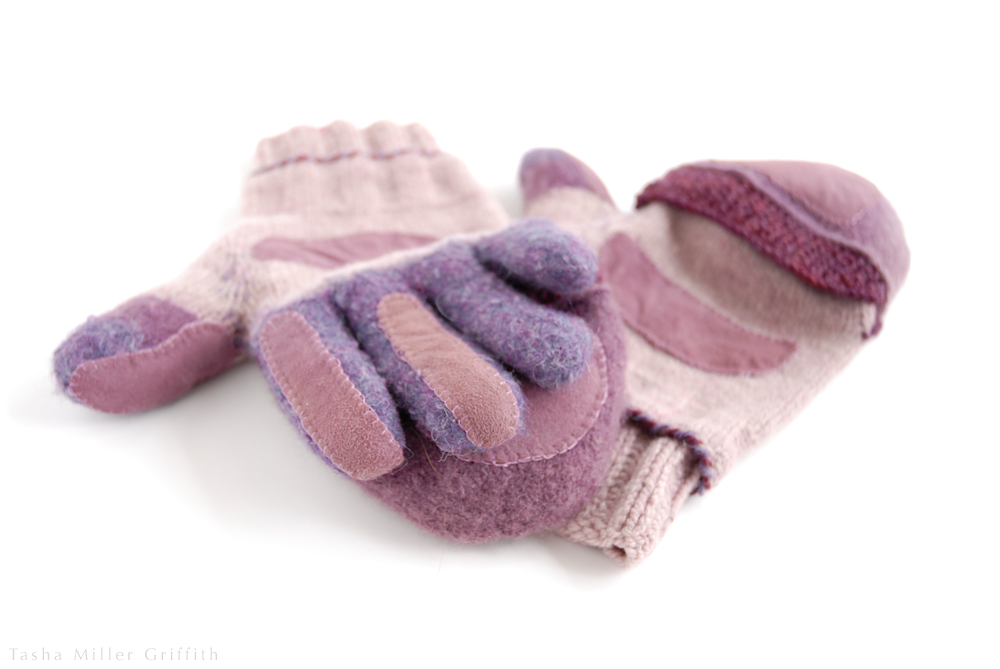
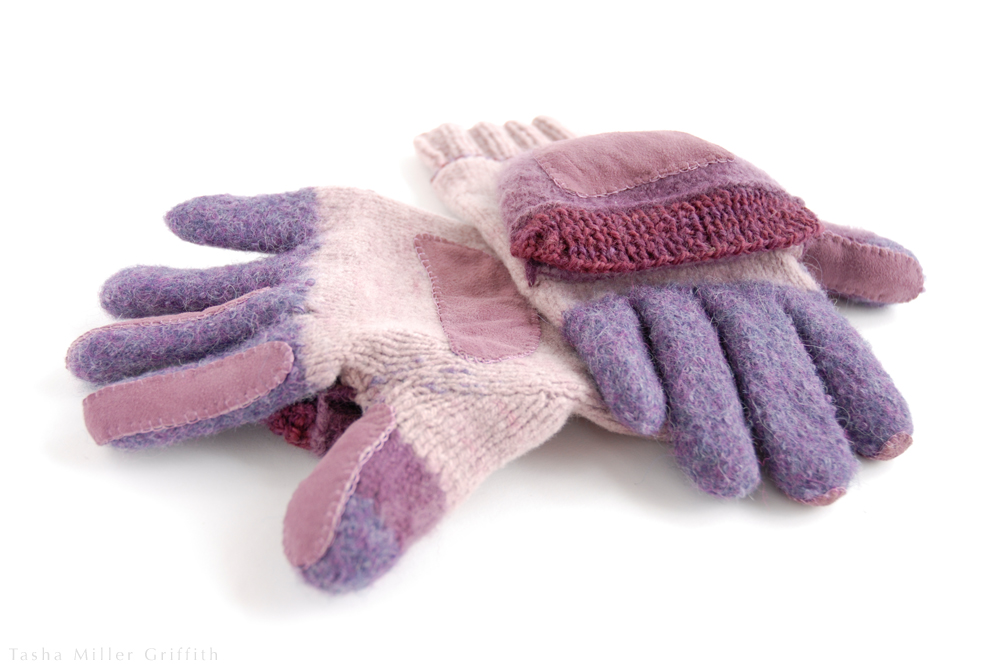
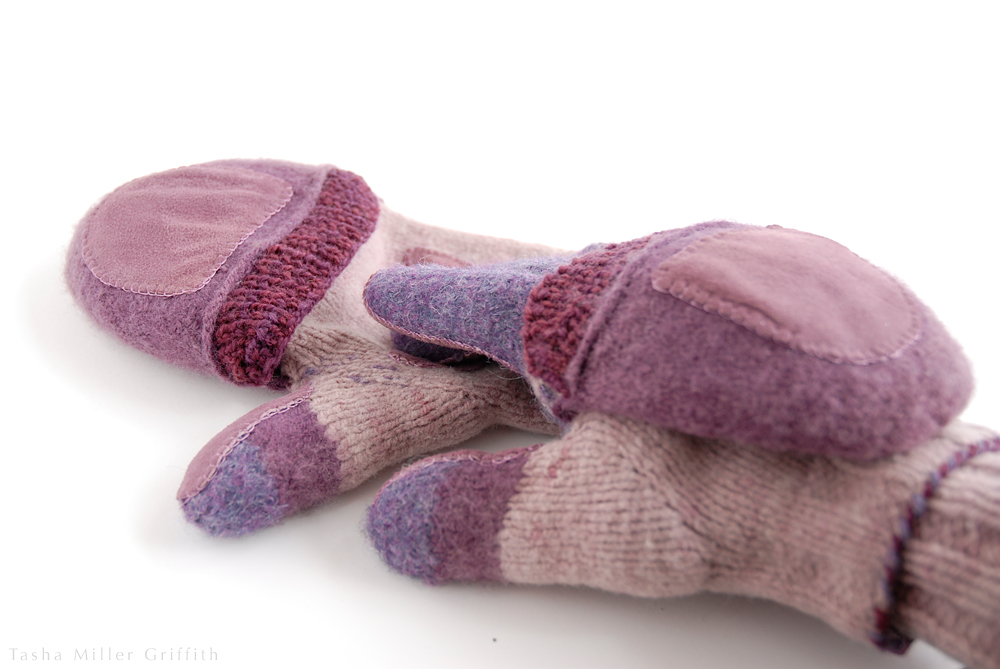
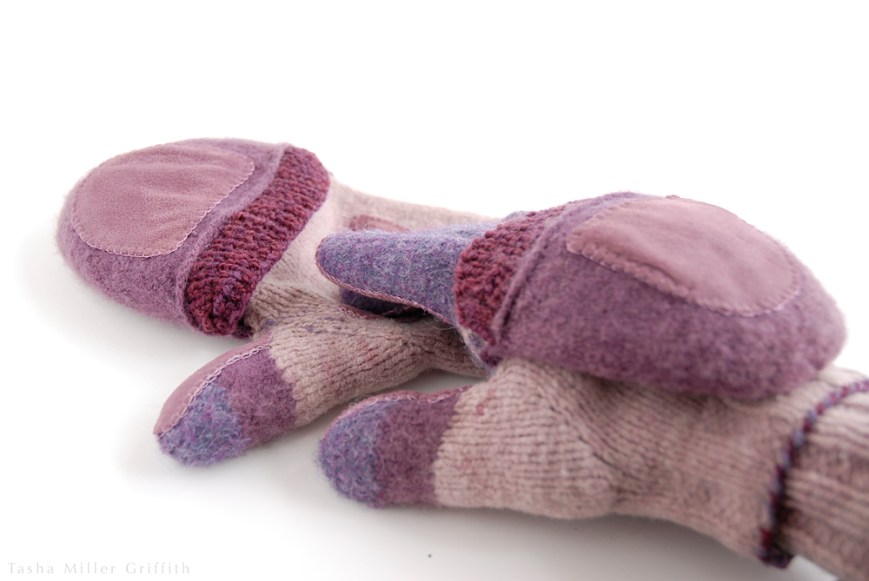
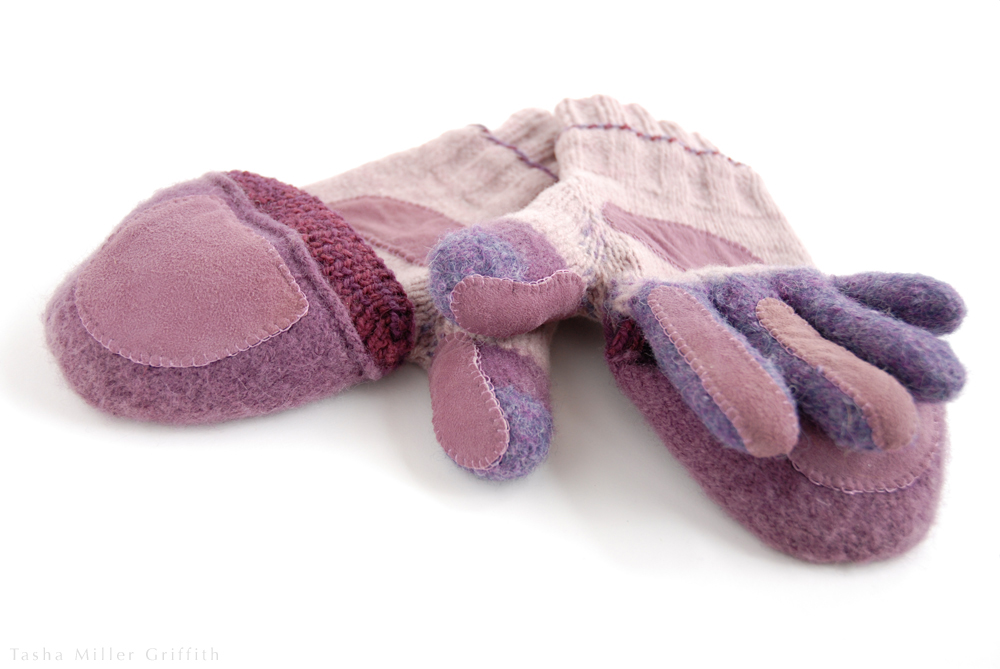
I love love love these mittens.  I finished sewing on the suede over our family Thanksgiving trip, and just in time too, when we got back our town had a major cold snap, not getting above freezing at any time for over a week, unlike our usual mountain cold nights but mild days.  I’ve worn these cross-country skiing, I wore them to art walk downtown at night (during the below-freezing week), shoveling snow, driving, and never one cold finger have I had!  Felted alpaca is like little down blankets for your fingers.  I can easily wriggle my fingers out of the mitten top for fine tasks without using the other hand.   Having placed the suede patches where the wear was on the old fingers, plus the part of my palm that I use when I grip things—surprise!—they are in the perfect spots.  I recommend the inside of the thumb especially.
 

purple mittens finished 4


If you want to make your own version, I’d start with a glove pattern you like.  Either refer to a flip-top mitten pattern, or make up the flap as you go (Basically:  I picked up sts across the back of the hand, cast on across the front and did a few rounds of short rows for a curved shape, joined everything into a round and knit, decreasing following the shape of the fingers underneath).

I realize that I haven’t talked about the actual felting, in fact that felting is probably the thing I know the most about that appears the least on this blog.  Maybe I’ll do something about that in 2014.

In the meantime, if you have any questions about making mittens or felting in general, feel free to let me know!

Happy Solstice, everyone!
 

purple mittens finished 1


A Fall Harvest Without Much of a Garden


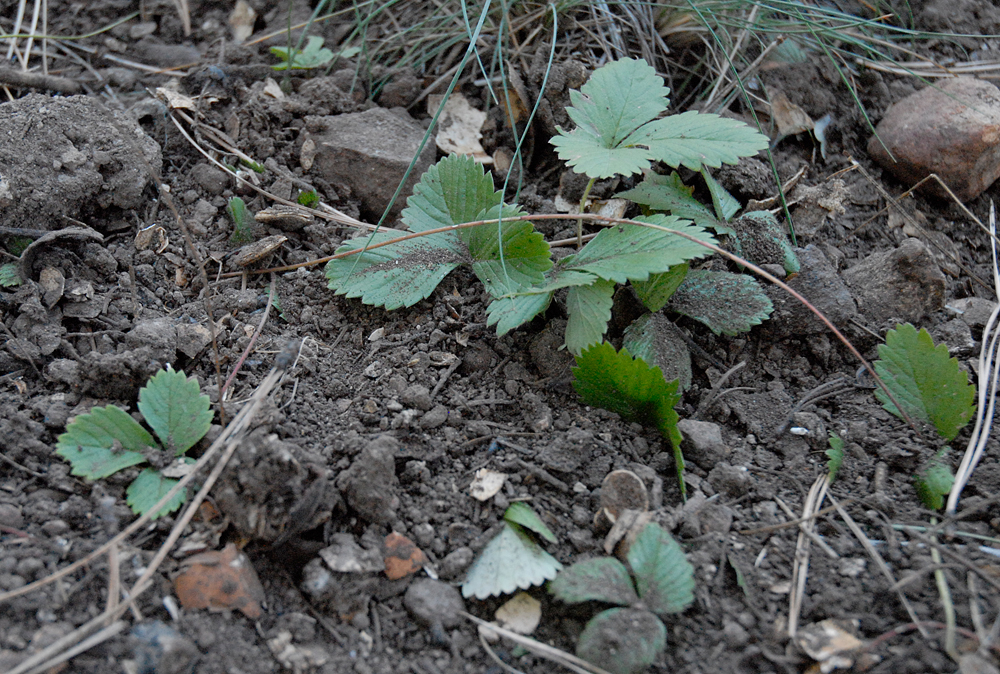
strawberries in compost


Over the past few weeks I’ve done a couple of things that I’ve been meaning to do since, oh, last year . . . one was to dig out the compost.  I mention this because for any of you who think you don’t know enough or have enough time to compost; I don’t either, and mine still works.  I practice a kind of benign compost neglect which goes like this: I dump all of our vegetable scraps into a big black plastic cone-shaped thing outside with a screw-on lid, which I got from the city of Flagstaff.  I continue to do this all winter, when everything is frozen.  I did some research when I first got the bin, and theoretically I know that I’m supposed to add stuff that contains lots of carbon, as well as the food scraps which are mostly nitrogen.  So, every three months or so (when It’s not too cold out and I’m feeling ambitious) I dump in a shovel of fireplace ashes which the previous owners of our house left in a large metal trash can outside.  Depending on the season, I scoop out the bottom of the little compost container from the house with either pine needles or snow, and that goes in the bin too.  The one thing I do actually add with some regularity is a bucket of water, since it’s so dry here.  If there is snow on top of the lid, I dump it inside the container too.  I turn my compost once every never.

Then I leave for the pretty much the whole summer and abandon the bin completely.  Only once have I coerced any friends and/or house-sitters to do anything to it while we’re gone.   And when we come back, a minor miracle has occurred.  The mound of frozen stuff that was nearing the top third of the container is now a much smaller, browner pile of—dirt!  Tada!

I asked my dad which of our motley collection of plants would most like some extra nutrients, and he suggested the strawberries growing out by the front fence, which he planted there . . . they are just like the strawberry plants we had at our house when I was little, producing a handful of the tiniest and most intensely flavored strawberries you’ve ever tasted every year.  Maybe a few more next year?

After digging it out this time, I have a few compost rules which I am trying to stick to: 1. All eggshells must be crushed (otherwise they take forever to break down).  2. No stacking/nesting of things like avocado skins (ditto.  Surface area is a good thing).  3. No stickers of any kind.  They do not break down (in my haphazard compost anyway) ever.


farmer roasting chile


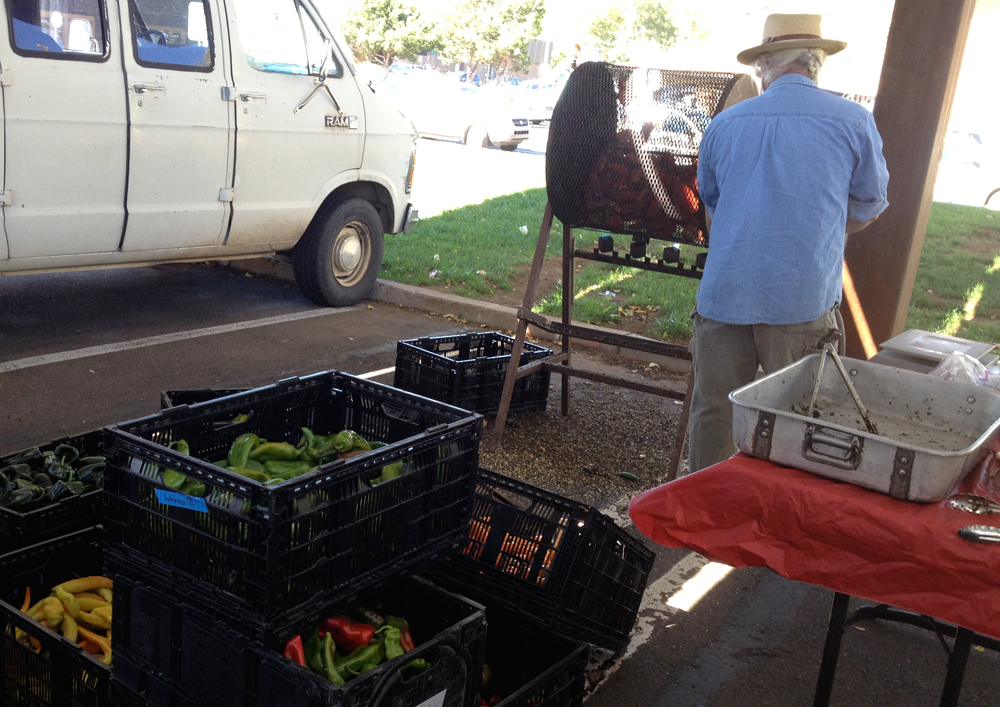
The second thing I did was to freeze chiles for the winter.  And this year in a new twist, we asked Cory, the super nice farmer from Whipstone Farm, to roast us some sweet red bell peppers as well (on the spot at the farmers’ market) and he did!  I froze them using the exact same method I do for chiles.  I’m pretty excited about this development, which should mean a steady supply of relatively cheap, local, sustainably grown roasted red peppers all winter long—yes!  I mention this in case someone is growing peppers near you as well.  You could roast them at home if you don’t happen to know an accommodating farmer with a giant gas-powered chile roaster . . . I usually use the broiler in my oven.

Anyway, I’m pretty pleased with myself, especially for someone who doesn’t have anything approaching a real garden.  Any time I do manage to put a little bit of my work into my bit of soil, or into saving food for the winter, it feels pretty great.


Making Drawstring Bags—Another Option for the Top


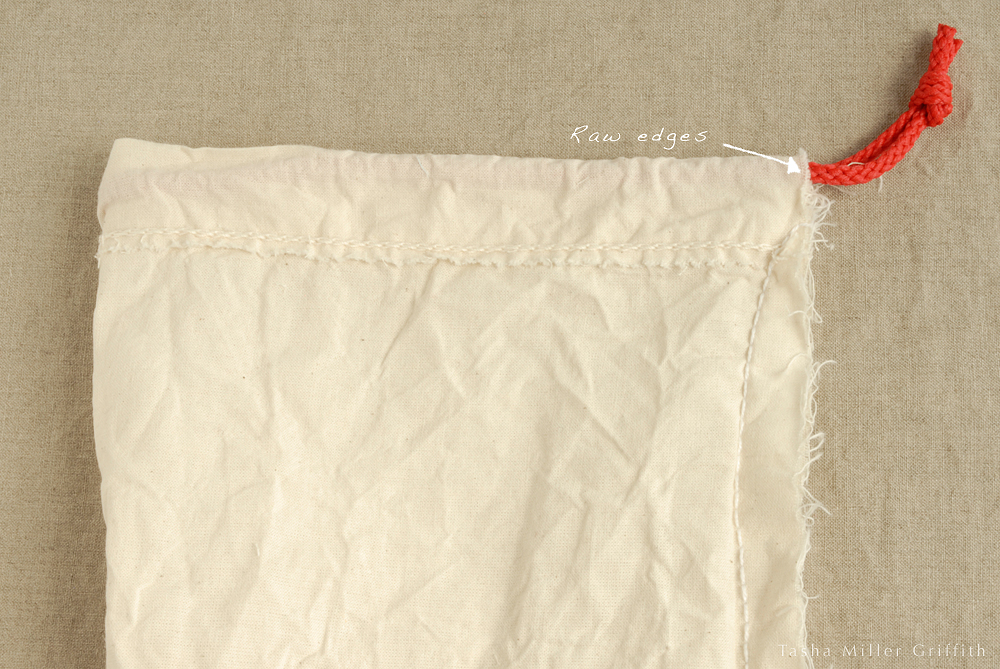
Hello!  There’s been just a little more radio silence around here lately than normal, but hey, that’s what retreats are for, right?  Today let’s jump back in with some thoughts about drawstring casings on bags.  In the second part of Hello Sewing Machine, I guide you though making a drawstring bag and leaving a “buttonhole”—a gap in the side seam for the drawstring to pull through.  That’s probably my favorite way to finish the casing, and one that helps you think about how a piece of fabric becomes a finished project, which is why I chose it for my beginner e-book.  There are lots of other options though, basically any method that encloses the raw edges and leaves a place for the drawstring will work.  One of my proofreaders asked about making a little hem on the sides of the bag instead, and I wanted to present that option here.  In my example, I’m altering a commercially made bag which doesn’t have much in the way of seam finishing, and is not going to stand the test of time.  You can also easily use this technique on DIY bags.  Click on any of the pictures to enlarge for a closer look.


drawstring bag 1


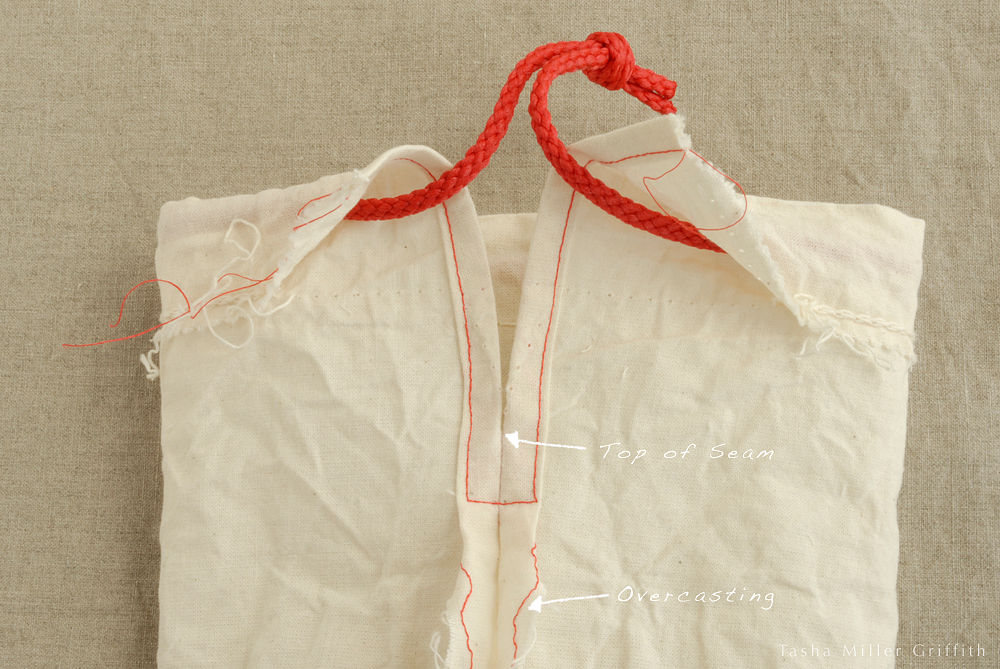
On this bag, there’s nothing to keep the raw edges from unraveling.  I’m especially concerned about the area where the drawstring emerges from the bag, because it’s likely to get a lot of wear and tear, which will cause the fabric to unravel faster.

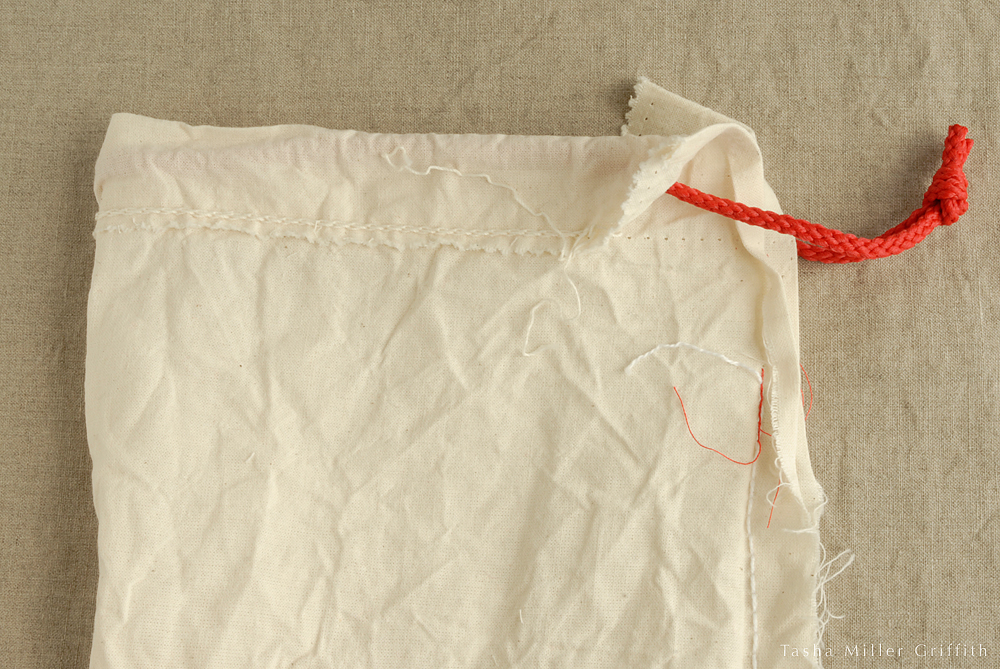
My first step was to take apart the seam stitching, down to where I wanted the seam to stop for the new finish.  I stitched up to that point and back down (with red thread) to hold all the stitching in place.  Then I took apart enough of the seam holding the casing down to let me make a narrow hem on the edges.


drawstring bag 3


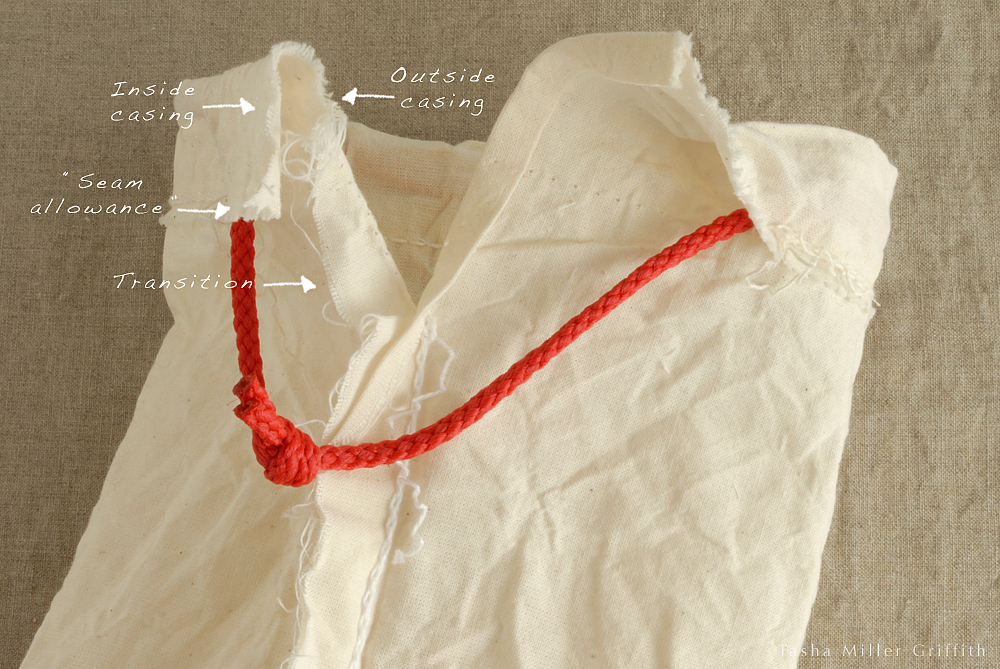
If you are making your own bag, just stop sewing the side seam a little ways from the top, and back tack over the seam end.  To figure out where to stop, think about the parts of the casing you need to leave room for at the top of the bag.


drawstring bag 2


At the very top is a little extra fabric, usually turned under (or stitched over) so that it won’t unravel.  It serves the same purpose as a seam allowance.  Then you have the inside and outside of the casing (keep in mind we are looking at the bag from the inside), and you will also need a little more room (about 1-2″ or 3-5 cm) for the transition between the hemmed edges and the seam.   Once you figure out where the end of your seam will be, go ahead and overcast the seam edges, continuing a little bit past the point where your seam stops.  Then on each edge above the seam, fold over and press down 1/4″ (or .5 cm) with your iron, towards the inside of the casing.  Fold over the edge again in same direction, using your first fold as a guide, and press in place again.  Then stitch down your hemmed edges, sewing close to the edge with a straight stitch.   Sew across the seam as well, below the top where you stopped stitching, so that all the stress from opening the bag is not on just one point.


drawstring bag 4


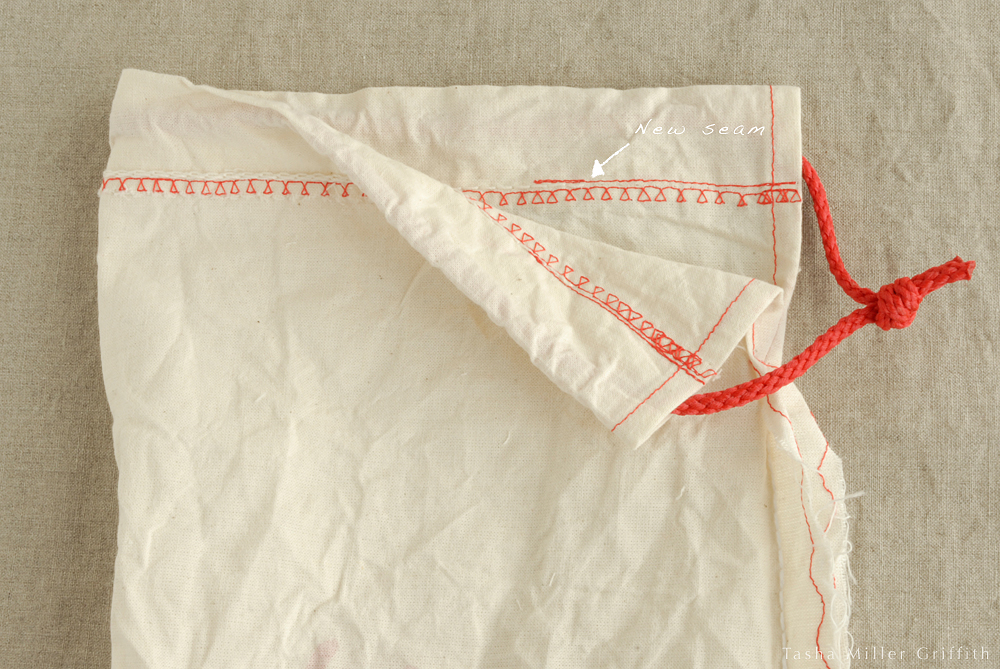
Next, sew your drawstring casing in place.  Normally I would press a small fold at the top edge towards the inside, and then fold and press down the width of the casing.  Since the casing here is already sewn in place around the rest of the bag,  I opted to replace the original stitching, overlapping it with the red thread.  Make a small back tack at each edge, since those ends won’t be held down by any other stitching later.  Then I used a mock-serger stitch to go over the small raw edge below the casing, since I don’t want it to unravel and lead to my casing pulling loose.


drawstring bag 6


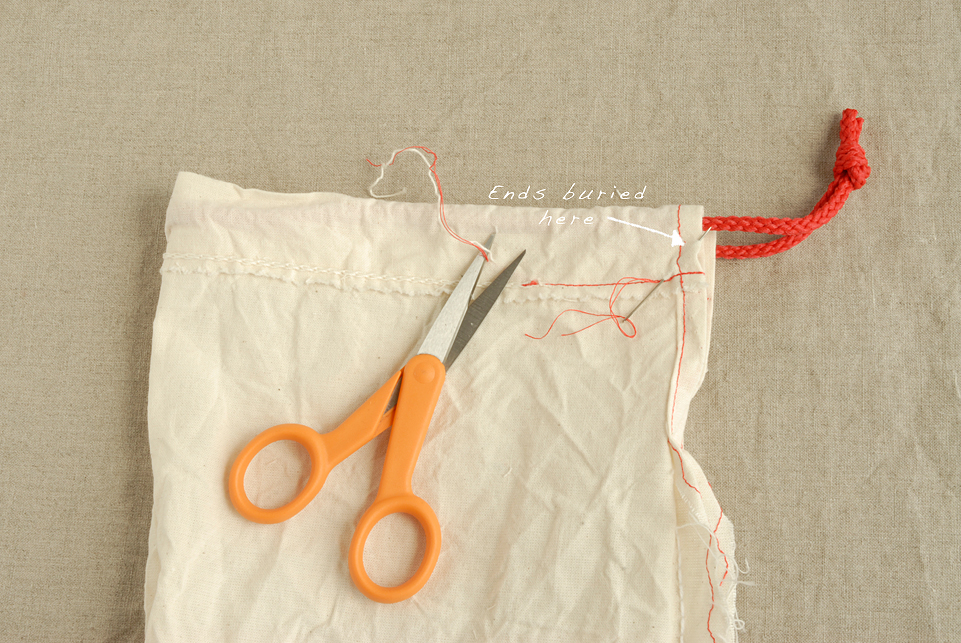
A quick note about ends: I like to bury them inside the casing or hem, or wherever there’s a double layer of fabric, so that enough thread remains to keep the stitching from pulling out, but it’s hidden.  I thread the ends on a hand-sewing needle, pull them between the fabric layers for one long stitch, and snip them off where they come out.


drawstring bag 5


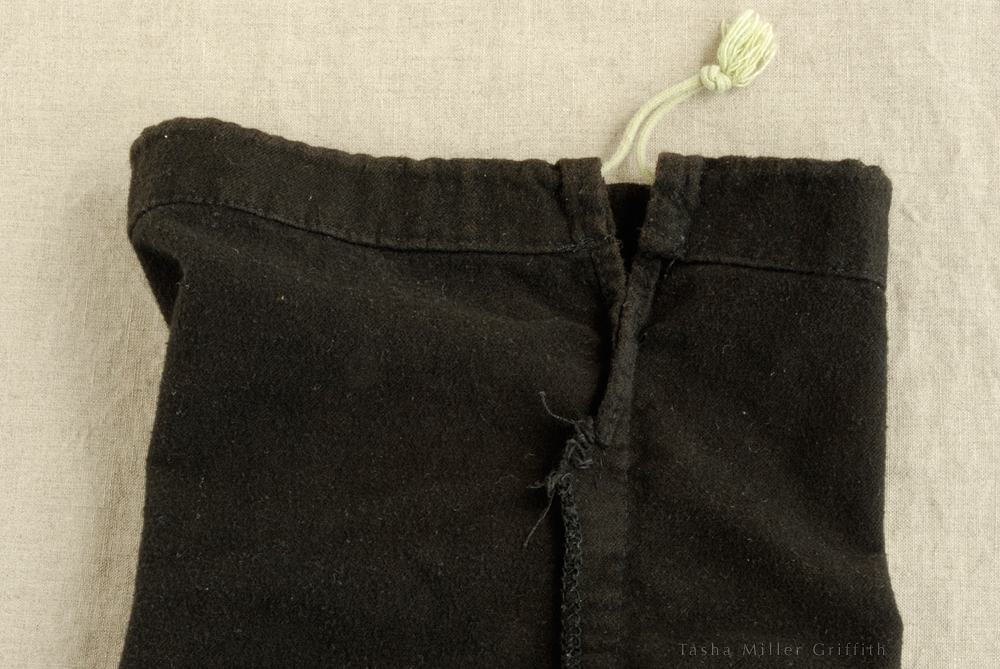
Here’s an another example of a commercially-made drawstring bag using the same concept.  I think they hemmed the sides of the drawstring first, and then caught them in the side seam, and finished the seam allowances with a serger.  As I said, you have a lot of options!


drawstring bag 13


There’s lots more thorough and friendly beginner-oriented directions for sewing seams, overcasting, using your iron to make a casing, and everything else you need to know to plan and sew a drawstring bag in my e-book, Hello Sewing Machine!
If you have other beginning questions, feel free to let me know, I’m always curious about what’s on your mind.   You can also read my answers to others’ questions in this post on Sew,Mama,Sew!
 

Hemming Jeans Part II, with Catch Stitch Tutorial


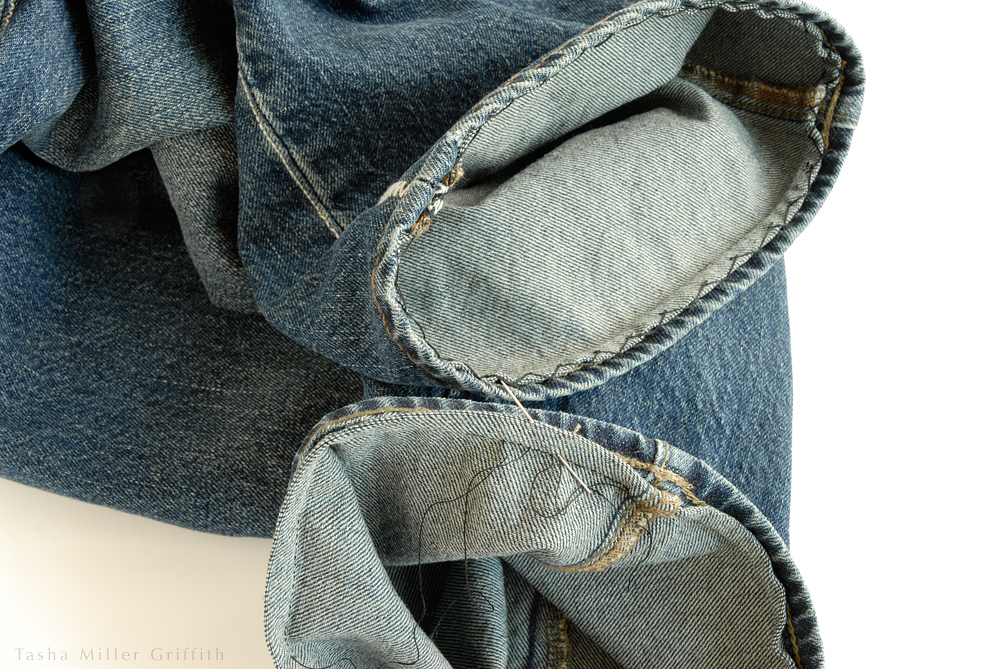
In my last post, we went over how to shorten your jeans, or other pants, keeping the original hem intact.  We left off with the jeans the length you want them, and a little fold of fabric on the inside.  That fold may have cut and overcast edges, or not, depending on how much you needed to shorten the legs.

First, let’s neaten up the thread ends left from sewing the hem by hiding them, and then trimming.  Get out your hand-sewing needle and thimble.  (Any time that the fabric I’m sewing is thick or tough, I use a thimble to protect the finger I’m pushing the needle with.)  Thread your leftover tails onto the needle, and take a stitch between the layers of the fold.  If the ends are short, you may need to put the needle into the fabric, and then thread the tails onto it.  Pull the needle through, and clip the tails where they emerge.  This keeps your stitches from pulling out later, and also keeps the thread tails from showing.


Jeans hem ends


This next thing I’m going to tell you to do is not exactly industry standard.  It’s better!  If you’ve ever had your jeans hemmed at the store where you bought them, they probably sewed them in a similar way to what I showed you in the last post.  At the store, for some reason, they usually turn the fold of extra fabric up and stitch it in place.  I think that looks weird, and like the jeans have obviously been hemmed after the fact, since the bulky fold of fabric is not where you would expect it to be for the hem.  It looks much more natural if you fold the extra fabric down, where the original hem is.  Try folding it both ways and see what I mean.

So, if we turn the fabric fold down, how to keep it there?  You could stitch beside the original hem stitches by machine, either with thread that blends into the jeans fabric, or a contrasting thread you like.  However, that’s a lot of layers of denim to sew through, and it’s likely to be difficult for your machine, and cause some skipped stitches and broken thread.  There are some times when using a hand stitch really is quicker and easier, and I think this is one of them.

Then hand-sewing stitch I like for this is called a catch stitch.  It’s designed to do just what we want here, to keep two layers of fabric in place against each other.


Jeans hem catchstitch 1


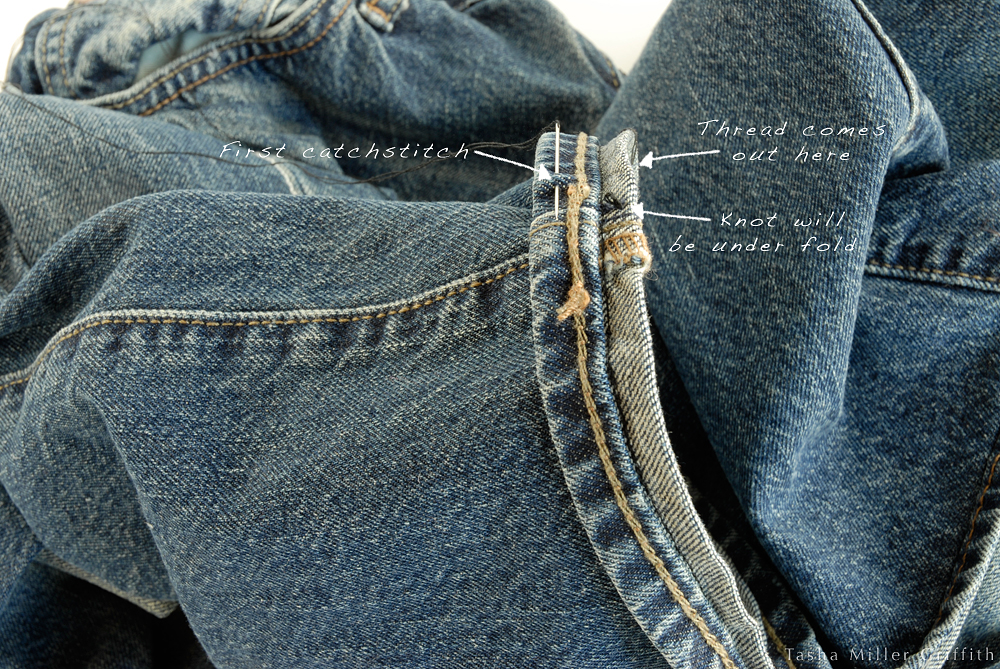
I used a doubled thread, to make the stitches a little more resistant to abrasion.  Get a piece of thread no longer than twice the length of your arm.  Thread it onto a sturdy hand sewing needle (choose one with a little more metal around the eye if you can, it will be less likely to break in the thick fabric) and knot the two thread ends together.

You want the knot to be on the inside of the fold, so stick the needle in there, and bring it out a little way away, on the outside edge of the fold.

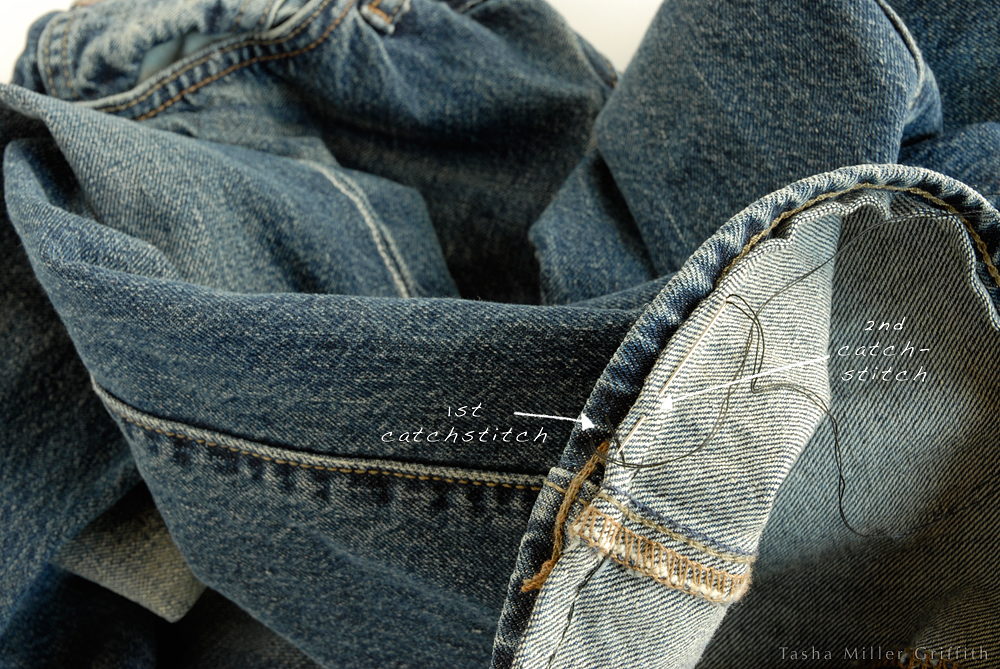
Catch stitch crosses back on itself as you sew it.  To do that, you’ll make each new stitch further along in the direction you are sewing (away from you or to your right in the pictures) but bring the needle in and out going the opposite way (towards you or to your left in the pictures).  Hopefully this will make sense as you read through the next few steps.

Make the first small stitch in the original hem.  Go through only the first layer of denim, to make it easier, and so that the stitches won’t show on the outside.


Jeans hem catchstitch 2


Make the second stitch in the fold, again taking a small stitch through just one layer.


Jeans hem catchstitch 3


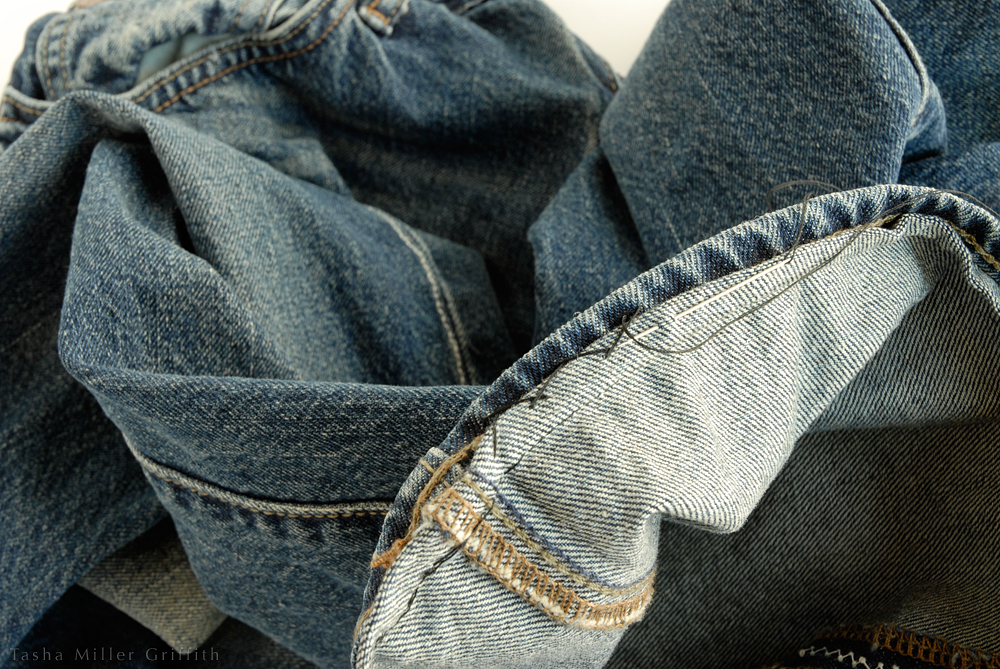
Continue alternating taking a stitch in the fabric fold and one in the original hem.  Make each stitch towards you/to the left, then move a little bit away from you/to the right, and to the opposite side to take the next stitch.

When you get to the seams, you may want to make the stitches smaller and/or closer together, since those areas are thicker and more likely to flip up.

What if you run out of thread?  No problem.


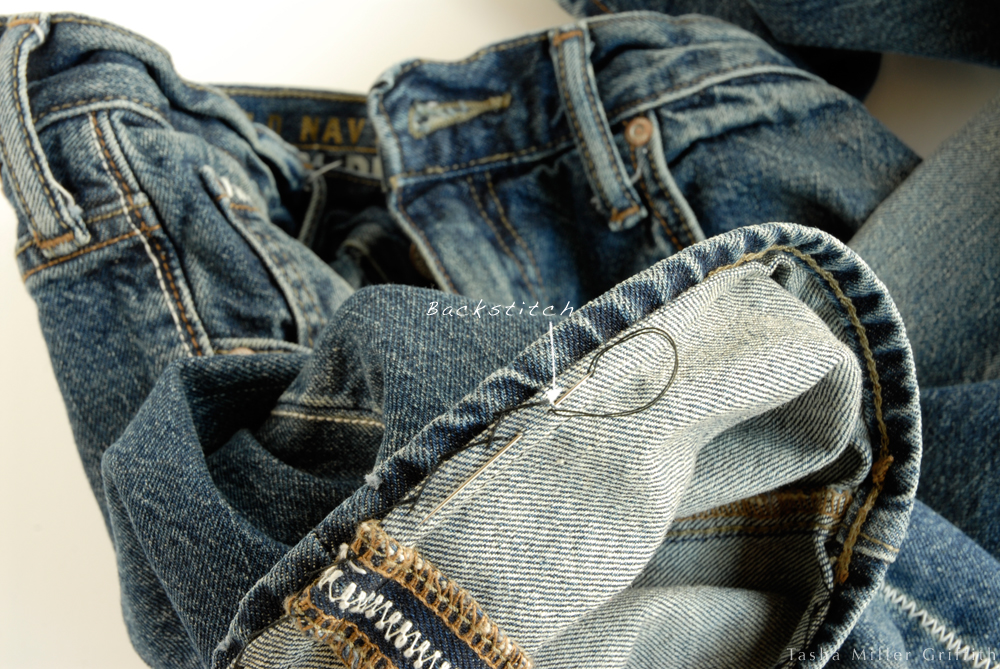
Jeans hem backstitch


When you get near the end of the thread, secure it by taking two small backstitches a little way apart.  It’s fine to only go through one layer of fabric, and the stitches can be tiny, as long as they loop back on themselves.

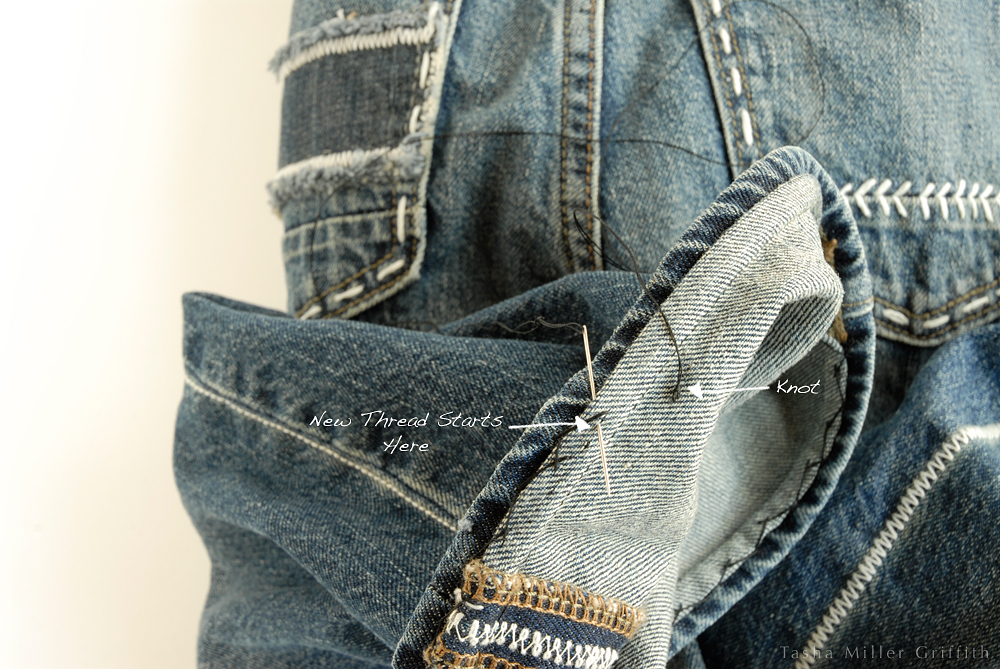
Bring the needle out a little way from the second backstitch, and snip off the thread where it emerges.  Get a new length of thread, and tie a knot in it.  Stick the needle inside the fold (to hide the knot again), and bring it out where you left off stitching.  Keep stitching around the hem until you reach the place where you started.


Jeans hem new thread


That’s about it!  Backstitch again when you get to the end, to secure the thread.  Bury the ends and clip them off.

Enjoy your new hemmed pants!

Get Your Sewing Questions Answered with Me and Sew,Mama,Sew!

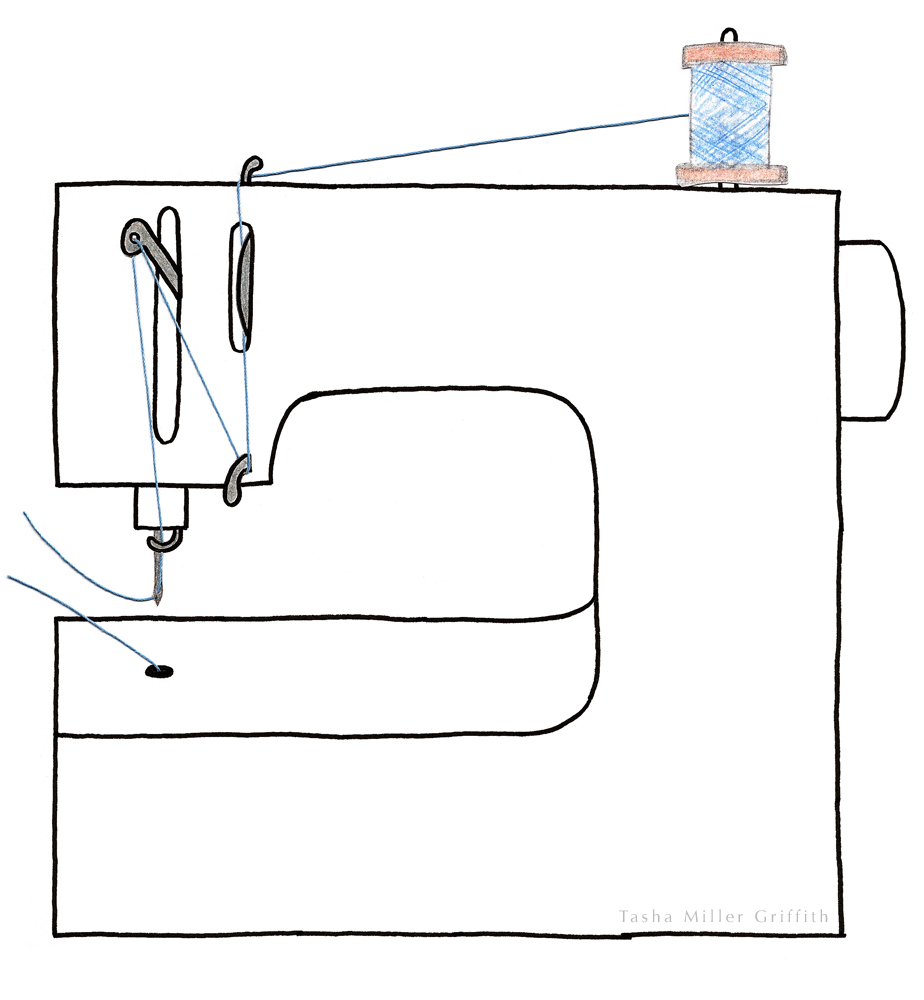
cartoon with both threaded small


Here is the first exciting event in celebration of the release of my new e-book Hello Sewing Machine – I’ve collaborated with the lovely ladies at Sew, Mama, Sew! to answer your sewing questions!  Head on over there and put in any basic questions you have, and I’ll answer some of them in a post coming up soon.  I’m curious to see what you want to know!


How to Hem Your Own Jeans, and Keep the Original Hem


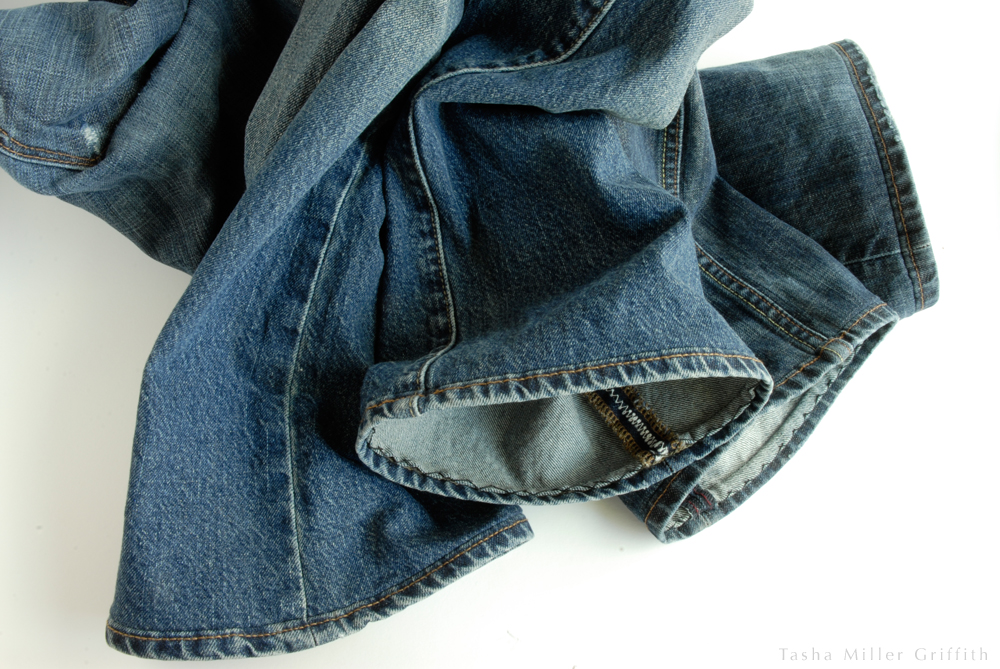
Jeans hem finished hems


Once you get started sewing, I’m guessing one thing you’ll want to tackle is to hem your jeans.  You can definitely do it yourself, and keep that distressed hem just as it is.  You’ll need just a few more pieces of equipment than for normal sewing.

(If you need to start with some basic instruction about how to use your sewing machine, check out my e-book for beginners!)


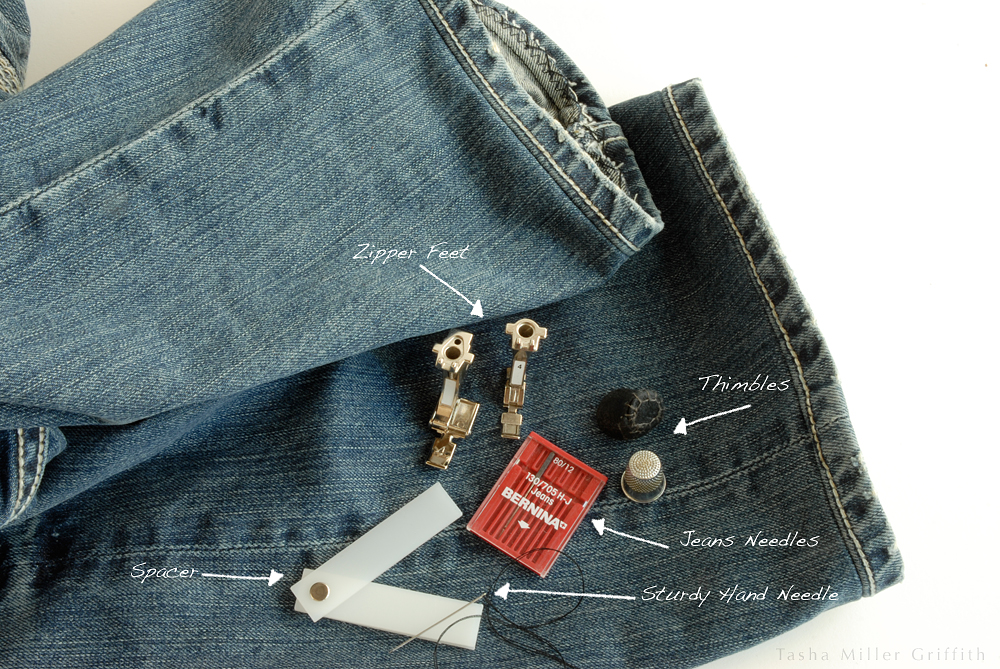
Jeans hem equipment


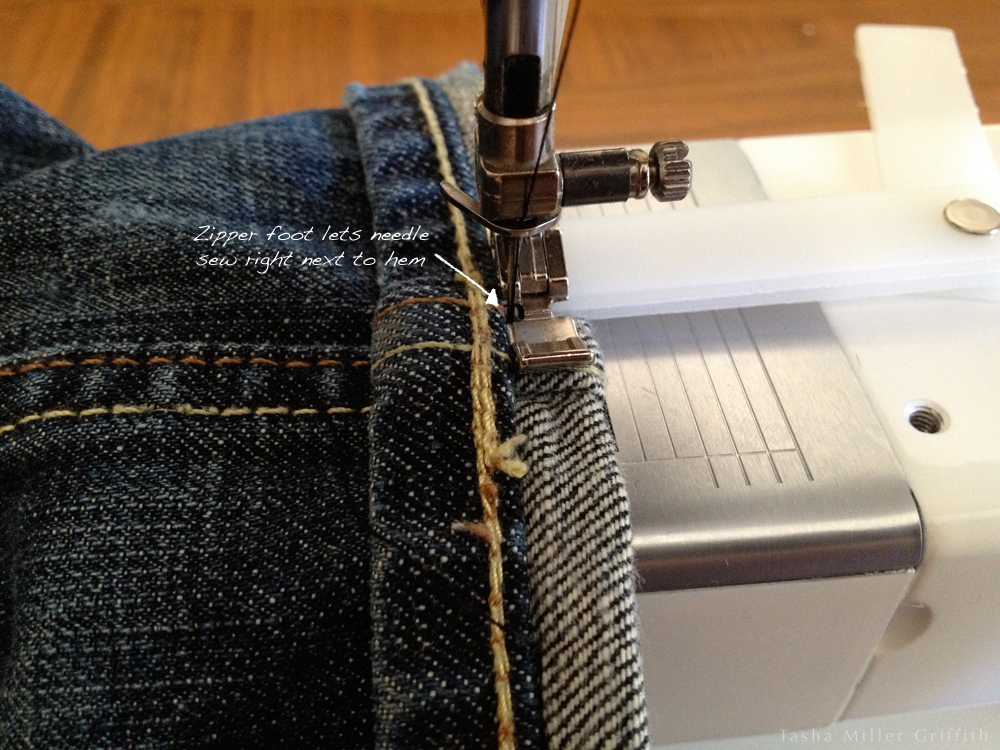
A zipper foot lets you stitch with the needle to one side of the foot, right next to the original hem.

Jeans needles for your sewing machine have a sharper point and a longer eye, for sewing through layers of denim.  For the most part, you won’t have to stitch through too many layers with this method, but it still helps.  If you don’t have jeans needles, use a sharp rather than a universal needle.

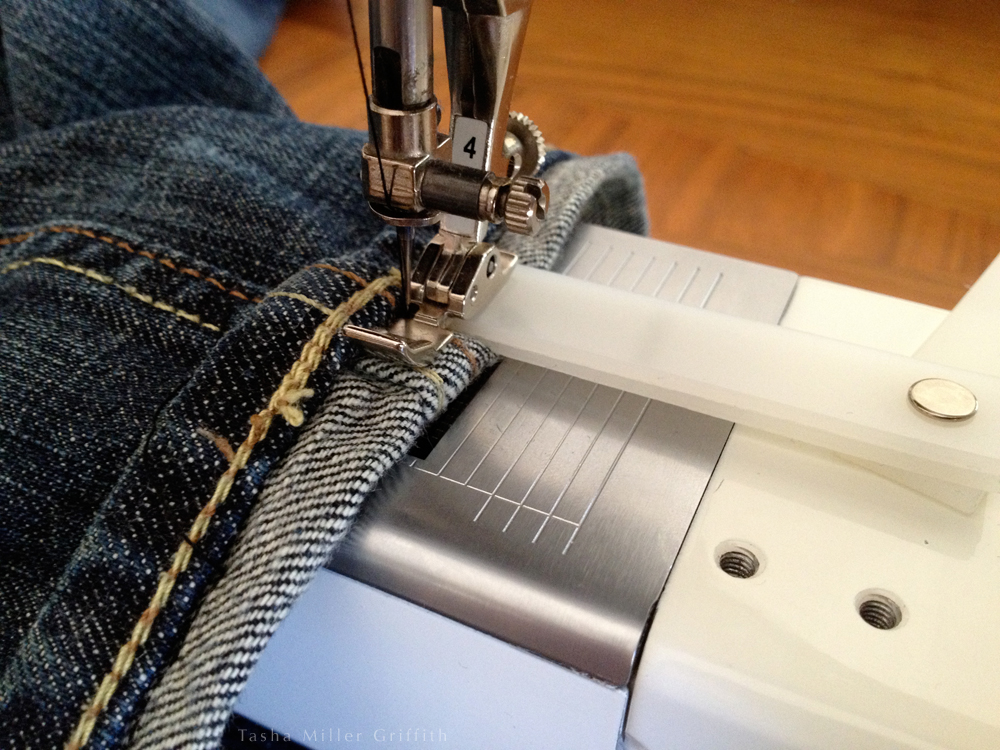
It really helps to have a spacer, something you can prop up part of the presser foot with as you sew over thick seams (you’ll see why below).  This one came with my sewing machine, but you could also use something not too wide and about 1/8 to 1/4” (3 to 6 mm) thick, like maybe a popsicle stick.

A sturdy hand-sewing needle, and a thimble to push it with, is essential for the finishing of this method (I’ll go over that in the next post).

You’ll also need pins and thread.  The ones you use for regular sewing are fine.  I didn’t happen to have matching thread, so I used black.  It doesn’t show at all on the finished jeans.  Darker thread colors usually blend in easier than lighter ones.

Once you gather your equipment, try on your jeans, and fold up the hem to figure out where you would like it to fall.


Jeans hem measuring


You can get someone to help measure how much you want to hem your jeans up, while you try them on.  Or pin, try them on, and adjust until you get the hem where you would like it.

Figure out how much in total you want to take out of the length.  Make a fold that measures half that much, starting at the inside edge of the original hem.  You’re going to stitch right next to that original hem, effectively removing the fold of fabric from the length of the jeans.  Whether you’re using cm or inches, the principle is the same, your fold should be half the amount you want to take out, since both sides of the fold are removed from the length.

Make sure your fold is on the inside of the jeans, so it won’t show when you’re done.

Pin the fold in place every couple of inches.  Put the pins in perpendicular to the fold, or at an angle as shown, to make them easy to pull out as you sew.

Pay special attention at the seams, making sure that the original seam lines and topstitching match on both sides of the fold.


Jeans hem zipper foot


Set up to sew right next to the original hem, using a straight stitch (width 0), length about 2.5 mm.  Use your zipper foot so that the foot can sit flat on just the fold of fabric.  Move the needle position all the way over to your left, towards the original hem, so that you can stitch right next to it (and not hit the foot with the needle).  Let the edge of the foot touch the edge of the hem as you sew.

When you get to the leg seams of the jeans, you’re suddenly sewing through a whole bunch of denim layers, instead of just two.  When this happens, the presser foot ends up at a steep angle, which makes it much more likely to skip stitches (resulting in a weak seam).  This is where the spacer comes in.  When the front of the foot reaches the seam, prop up the back of the foot with the spacer to make it level.  Then as you stitch over the seam, move the spacer to the front of the foot, to keep it level until you are past the bulky seam.  Be careful to keep the spacer in front of the needle, so that you don’t hit it as you sew!


Jeans hem spacer


If your machine still skips a few stitches, try sewing in reverse and then forward again over the part that’s giving you trouble.  Going slowly over the bulky parts will also help.  You can even use the hand wheel on your machine to make just one stitch at a time.  If it’s skipping a bunch of stitches in a row, check to see if the bobbin thread has broken.  If so, stop and cut the top thread too, then start again so that you overlap a few of the last stitches before the thread broke, to hold them in place.  If the leg seams are giving you a lot of trouble, you can also try flattening them as much as possible using a steam iron, or pounding them with a hammer.

When you get all the way around the leg, sew over the first few stitches that you made, to hold them in place.

Do not skip this step: once you sew around the hem, try on the jeans again to check that the length is where you want it.  If not, at this stage all you have to do is pull out this one line of stitching, and start again.  If the length looks good, you’re ready to finish off your hem.

If you took out more than about an inch in total, it’s likely that your folded out fabric is long enough to show below the hem if you turn it down.  If so, trim it to about 3/8″ (10 mm), or a bit smaller than the original hem (I repeat, try on the jeans and check the length of the new hem before you do this).  To keep these cut edges from unraveling, overcast them with a zigzag stitch.


Jeans hem overcasting


Use a regular sewing foot for this (zigzag and a zipper foot don’t mix).  Stitch close to the edge.

This whole process is pretty darn simple once you get the hang of it.  You can also use this method to hem other pants, when you want to keep the original hem intact.  It will be even easier if you don’t have think layers of denim to sew through.

In the next post I’ll go over my method for tacking down the extra fabric to make the hem look natural.  In the meantime, if you have any questions, just leave a comment!